
I told you I’d tell you a story about fishing in a snow squall. Well, here it is.
For 46 years, the Mungers, the Scotts, and the Nelsons have assembled at the Scott family cabin off Cabin Circle on the shores of Whiteface Lake, a Minnesota Power reservoir lake located between Duluth and the Mesabi Iron Range. The tradition began with six families: the Scotts, the Mungers, the Lundeens, the Listons, the Nelsons, and the Tessiers. Over time, and due to the aging of the six patriarchs of the event, only the Mungers, Scotts, and the Nelsons have continued the tradition. This year, the sole founder of this tradition was my dad, Harry, who, at 86 years old, was intent upon continuing his streak of having missed very few Openers at the Scotts. The other five dads are all gone, having battled old age and a variety of maladies until they could fight no more. But Harry is still with us, ready, willing and able to barbeque chicken Friday night. His buddies, Bob Scott, Leonard “Red” Lundeen, Jim Liston, Ed “Bun” Nelson, and Larry “Lunga” Tessier have all passed on to that great fishing hole in the sky. But they were with us in the stories, both real and imagined, about past Openers. And this year, a fourth generation became part of our ritual: Johnny Scott (named for his grandpa John, Bob and Pat Scott’s eldest son) ventured into the world of cussing, cheap beer, saunas, card games, and yelling at the Twins on the television for the first time. And young Johnny, being that he is, after all, a Scott, fit right in.
Now, I’ll be honest. I wasn’t looking forward to John Scott’s annual telephone call. I knew, because my sons Matt and Chris had bumped into John and Joe Scott (John’s son and Johnny’s dad) a few months back, that the invitation to the Opener, despite the loss of most of our mentors, was still “on”. And, in the ordinary course, since I am fan of tradition and personal history, I love keeping memories alive. But this year, I was swamped. I was teaching two night classes at UWS, trying to be a dad to Jack (my fifteen year old still at home), do my job for the folks of Minnesota as a district court judge, and every once in awhile, behave like the husband my wife wants me to be. Despite all the great times we’ve had over decades spent at the Scott place, I was just not in an “Opener” state-of-mind as the second weekend in May approached. Adding to my funk was the weather: It was May and it was still snowing, lakes of NE Minnesota were still ice covered, and the Minno-ette, our local convenience store and bait shop, had declared a “shiner” emergency: The very minnows we’d need for a successful Opener were nowhere to be found. We’d be reduced to fishing with chubs, crappie minnows, or worse, dew worms. Taking it all into account, I was leery of John’s call. I needn’t have worried: John never did call me. His youngest brother, Patrick, known affectionately to all as “Poncho” did.
“Mark,” Poncho said when he called,”we’re on. You need to call John and tell him how many Mungers are coming up for The Opener.”
By this point, the Monday before Opener, I’d done my homework. I’d chatted with a janitor at the courthouse who has a cabin on Whiteface. My worst fears were confirmed. Even if we could pull it all together: the food, the minnows, the boats, the logistics, Whiteface was iced over and there was no way, with dismal cold and continued snow in the forecast, the lake would be boatable by the weekend.
“How are we going to fish?”
“I’ve got a plan.”
“What’s your plan, Poncho?”
“I’ll tell you when you get to the lake. Call John.”
Truth be told, my concerns were more selfish, more about having to scramble to get my boat and motor ready (when Poncho called, it was still buried in a fold of crusted snow) than about whether we’d catch fish. I mean, in all the years we’ve plied the waters of the Whiteface, there have been only a handful of years where we collectively caught walleye in sufficient numbers to deem the weekend a fishing success. But as you can tell from this essay, fishing has little to do with our annual gathering. The Opener is about friendship, family, and memories. Whether we catch walleyes has very little to do with our motivation to gather at the Scott place. But in all our years of attempting to behave like fishermen, we’d never encountered, to my recollection, an ice covered lake on The Opener. I was interested to hear Poncho’s plan but, before I could press him, he was off the line and I was calling John.
From the photo above, you can see what Poncho’s plan was. Actually, to be fair, the plan was a joint effort between Poncho and his older brother, Tim. Tim is about to retire as the Activities Director of Hibbing High School after a long career of teaching and coaching so I’m guessing he has plenty of time, now that he’s contemplating his golden years, to figure out puzzles: Like how do you fish on a lake covered with ice?
Saturday morning. The Opener. That’s Tim, in the photo below, standing on an island, trying to stay warm as it snows. Four of us: Marc Mullen, Tim, Pete Nelson, and I were dropped off on the island. We had two boats in play: John’s 14′ Lund with a 9hp outboard was under Poncho’s dubious command (many stories, not enough space) and TJ Nelson’s big old tub with a 15hp Merc were in service. Problem was, TJ put the motor on his boat, loaded the gas can, but forgot the gas line. So there we were, a crew of a dozen or so, with one operating motor, two boats, and eight life jackets. Poncho’s plan had to be modified. He towed TJ’s inoperable boat to the island before heading up river, to the rapids, our ultimate fishing destination, to drop off three other fishermen. Big white flakes fell around us as Marc, Tim, Pete, and I clambered out of TJ’s boat and tossed chubs to invisible walleyes. Poncho motored away, with the understanding he’d head back to the landing to pick up my son Chris and, eventually when TJ got back from his adventure, haul TJ’s boat back to pick up TJ and the gas line. There were no guarantees TJ’s motor would work. But it was the best we could do. Complicated? You bet. And all that energy was being put into a very dubious proposition: That we’d actually catch fish on The Opener.
But guess what? We did catch fish. Nice fish. With Poncho and Marc anchored in the middle of the river in John’s Lund and the rest of us fishing from shore (except Dad who decided the weather sucked and stayed back to watch golf on TV), we caught and landed well over twenty of the nicest walleyes I’ve ever seen come out of the tannin stained waters of the Whiteface. For a while, I was personally stymied. I couldn’t feel the meager bites of the black backed fish nibbling at the minnows on the bare hook I’d tossed out into the river’s swirling current. But then Chris rigged me up with a slip bobber and my luck changed for the better.
For the rest of the day, I was part of the party. And for the first time, I caught nice fish on The Opener. Included in that experience was one beauty, the likes of which I’d never seen landed by anyone in our crew over four decades of disappointment.
Unlike some of the bigger walleyes I’ve caught in the past, this fish fought like a frenzied pike. When Chris finally dipped the net under it, we were all amazed: None of us knew that such fish existed in the Whiteface. John Scott took a quick measurement of my fish and then, with as much gentleness as I could muster, I stroked water over the walleye’s gills until it revived and vanished into the depths.
As we drank cold beer and ate bacon wrapped steaks on Saturday night (John, our quartermaster, outdid himself this year!), my fish continued to grow in size. I guessed the walleye I released was 24″, a nice five-six pound male. John insisted it was a 28″ legacy. It’s the first time I’ve ever had someone else embellish my fish story for me! But regardless of the fish’s actual dimensions, I can tell you this: as I fought the walleye, feeling its steady tug, bringing it up with each turn of the reel from the rocky bottom of the river, all my dread, all my angst about not being able to get my boat ready, about feeling rushed into The Opener evaporated. Catching that fish was indeed the therapy, the healing my soul sorely needed.
Sunday morning. The great debate raged. Should we go back to the river, which, given logistics, would be an hour and half excursion before we were able to fish, what with the need to ferry an additional three people (my sons Matt and Jack arrived Saturday in time for steaks and were anxious to catch fish and Dad, after hearing our tall tales, was motivated to rig up his 9′ Sage and have a go at it). In the end, we returned to the river only to find another boat sitting in the pool where we’d been catching fish. Understand: There’s no right of ownership to a good fishing spot. It’s first come, first serve. We were late and we paid the price. In the end, Poncho landed a red horse sucker and one walleye, the only fish we caught on Sunday. But I learned, once again, that the Opener is much more than catching fish. All you have to do is take one look at my 86 year old dad, sitting in his lawn chair, waiting for the tug at the end of his fly rod and know that, whatever the weather, come hell or high water (or, as happened this year, ice and snow) so long as the Scotts ask, I’ll be at Whiteface for The Opener.
Peace.
Mark
After spending considerable time working on my back listed titles, I am pleased to announce that my best selling historical novel, Suomalaiset: People of the Marsh, is being published in eBook format. At present, the book is loaded to Nook and Kindle platforms, with Smashbooks and Kobo to follow. This will allow you to download the book onto any mobile reading device and to take the story of Olli Kinkkonen, Elin Gustafson, Anders Alhomaki, and the rest with you where ever it is you’re headed to on summer vacation. Or, as the title to this blog suggests, download it for the upcoming rains that are about to sweep into the Northland. At $4.99, if you haven’t read this story of love, intrigue, the labor movement, and Minnesota’s rich immigrant history, well, you’ve missed the boat, plain and simple. I’d love all my fans of my other work to grab hold of a digital copy of Suomalaiset and come along for the ride. Better yet: If you have friends, relatives, neighbors, or kids who are eBookers but can’t turn a paper page, turn them on to my books through this latest publication effort of Cloquet River Press.
$4.99 is a heck of a sweet price for story this well written and big…
Peace.
Mark
PS Next up on the digital publication list, The Legacy, my first novel. And soon to follow, all the other back listed titles you have come to love, together with new editions. Let’s start a revolution in the way America reads and in the process, you’ll be helping keep one lonely little author pecking away at the keyboard!
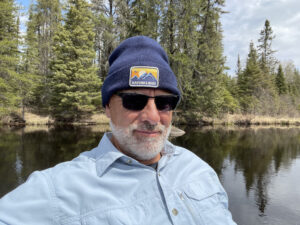
That’s me on the first day of Spring, 2013. The big smile was because after six months of winter, the snow had finally decided to recede and the sun had finally decided to shine.
Now we Minnesotans are a hearty lot. Mostly, I think, due to an infusion of Finnish sisu, Norwegian heltemot, and Swedish fasthet from the Scandinavians who collected here two or three generations ago. Not without coincidence, each of those ethnic groups also came from places of gray, cold, perpetual gloom, and frozen water. So they were right at home here, in northeastern Minnesota. But I digress. As I said, we are, even those of us from Slovenian, German, English, Irish, French, Dutch, Scotch, and Welsh ancestry, a non-complaining bunch. But this winter, I think, tested most Minnesotans beyond their native fortitude. Cabin fever? Ha! I don’t know about you, but I came down with a full blown, seasonal affective disorder-based depression.
How bad did did it get? Well, Jack, my youngest boy had his first outdoor soccer matches of the season on May 4th, the day before the above picture was snapped. Check out the two pictures from those games. Yes, that’s Griggs Field and Malosky Stadium at UMD. Looks like perfect weather for international football, right? Lord. Think of the poor young boys and girls sliding around in little shorts on snow-covered, still-frozen artificial turf a full month after the official onset of Spring. What gives? Is this a sign, a symptom of global warming? I have no idea. But I do know this: the past winter was a rare bird, harkening back to the days of my youth. True, the big snows I remember filling the streets of Duluth, blanketing Park Point, and clogging downtown with drifts the size of elephants usually came earlier in the season. One memorable March storm hit when I was a student at UMD. My buddy Larry was stuck at his parents’ house in West Duluth and I was stuck with Mom and Dad in Piedmont Heights. Borrowing some of that sisu from my pals Tynjala, Rikala, Sikio, and Peltoma, I bundled up, pulled on my downhill ski boots, threw my Rossignols over my shoulder, and trudged through thigh deep snow to the top of Piedmont Avenue. Cars were buried to their windshields. The neighborhood was as still as a tomb. I stepped into my bindings, slid the straps of my ski poles over my wrists, and proceeded to ski down 24th Avenue West to Grand, doing graceful turns around stalled Fords and Chevys until I hit the flats. Fueled only with the promise of beer, I slid one ski ahead of the other all the way out to 47th Avenue West and spent the next two days in Larry’s basement, drinking Buckhorn and listening to Crosby, Stills, Nash and Young.
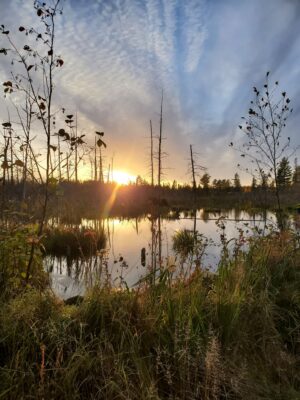
But an entire season of snow in the month of April? Unheard of, even for those of us who have lived all of our lives in this neck of the woods. Fortitude can only last so long, my friends. And with the advent of the snow that fell on May 4th, I was pretty much at the end of my endurance for wintery things. I’d sunk to the lowest of the lows, the bluest of the blues on the heels of the wet flakes that disrupted the Gitchi Gammi Soccer Jamboree. And then, redemption. The sun came out, the snow began to melt, and with the snap of God’s finger, spring arrived.
The photo above does indeed show the last trace of snow along the southern treeline bordering our pasture in Fredenberg Township. The last vestige of the storms that kept me from work, bogged our plow guy down in our driveway, and broke the back of my father’s wooden deck at the old family homestead in Piedmont is now but a hint of April’s plot line. It’s time for the Spring rains to fully and finally scour away recently unveiled dog crap, green things up, and make us forget the April of the forever snows.
Peace.
Mark
PS Stayed tuned for the next blog when I take you fishing in a blizzard!
OK. I Love snow as much as the next guy. I’ve been a downhill skier since I was ten. A cross-country skier since my early teens. I’ve owned and used snowshoes for much of my life as well. I’ve even owned and enjoyed a snowmobile or two over the past few decades my family and I have lived in the country.
Hell, I was born and raised in Minnesota and spent most of my life north of Hinckley, where real Minnesotans live. I look forward to November hoping that each predicted storm will birth big snows like we had back when we were kids. You guys remember those winters, right? Drifts so high in Piedmont Heights or on Park Point or at the base of the Sawtooths that you couldn’t walk, much less drive, for days on end. That’s real winter, the kind of winter that builds stout hearts and strong wills. We Minnesotans don’t panic at the first sight of snow: We crave it. We relish it. But this past month has sorely tested my snowy resolve. I bet it’s getting to you too. Am I right? I mean, come on. Fifty plus inches of snow in April? That’s not evidence of global warming-it’s the makings of a new ice age!
Take a look at the photo below, on the left. That’s our back stairs, a few days ago: a few weeks before Minnesota’s most celebrated outdoor event, the fishing Opener. You can’t see it in the photo, but out beyond that snowy maple in the center of the picture is my 16′ fishing boat, motor, and trailer mired in a snowdrift.
If you look at the photo to the right, you’ll see what I mean. Yes, that’s my 1992 Northwoods and 35 hp Force waiting for spring and the chance to fool a walleye or two up on Whiteface. I don’t see that happening until sometime in June, do you?
You ask: What the hell good is there in grousing? You can’t change the weather any more than you can change the sun or the moon. It is what it is. I understand. But if faith can move mountains, maybe a prayer or two to the Almighty might start things a thawin’. Gradually, Lord. I don’t want a repeat of the great flood of 2012. Canoeing to work for a week long stretch made for some great blog posts but let’s not overdo it. Let’s have the sun peek out and work slow, methodical magic on the snow pack.
I’ve complained enough. The sun is finally shining. The snowbanks are beginning to shrink. Now, if only the ice on Whiteface would begin to melt, maybe, just maybe, the Opener won’t have to be moved. I’ll say a prayer and I hope you will too!
Peace.
Mark
PS If you look real close, you’ll see the sun shining on open water in St. Louis Bay and on the Big Lake in the above photo. I took that yesterday on my lunch break at work. Hope springs eternal…
The Shield: The Complete Series Collection (2009. Sony Pictures Home Entertainment.)

I wasn’t able to watch more than a handful of the episodes of this groundbreaking series on FX because my wife is not a fan of violence. Neither am I. I see little value in the Quentin Tarantino version of life: sex, grit, hatred, and methodical killing, as depicted in Pulp Fiction. I wish I had been able to convince my wife Rene’ that The Shield was a different sort of “bad cop” show, a Shakespearean enterprise of high art and great acting. I was never able to do that so, as I said, the few episodes I was able to watch were cherished moments spent with Vic, Lem, Ronny, and Shane, the four members of the Strike Force, a unit of anti-gang cops housed in the fictional LA precinct of Farmington.
My fortunes changed when my son Dylan surprised me this past Christmas with the entire series. 4,100 minutes of blood, guts, sweat, tears, sex, drugs, and rock n’ roll featuring probably one of the greatest ensemble casts ever assembled for a television series. Not convinced? Michael Chiklis as Vic Mackey gives a consistently believable, tough yet nuanced performance as the titular head of the Strike Team which inhabits “The Barn”, an old evangelical church in Farmington turned police headquarters. Walton Goggins hits every note as the troubled, sociopathic Shane Vendrell. They are joined by series regular C.C. Pounder playing a mid-career African American woman put in charge of The Barn while battling lupus, Michael Jace, as Julian, a homosexual African American line officer trying to play it straight on the force and in his marriage, Jay Karnes as the troubled intellectual detective Holland Wagenbach who has a penchant for discovering serial killers, Cathy Cahlin Ryan, who portrays Vic’s long suffering wife and the mother of three kids, two of whom are afflicted with autism, and Catherine Dent, as Vic’s one-time love interest and tough as nails female beat cop. If that’s not enough, add to these fine actors and actresses, Academy Award winner Forrest Whittaker as the IAD cop trying to take down Mackey and crew, six-time Oscar nominee Glenn Close, who lasted a season as C.C. Pounder’s predecessor, and Anthony Anderson who portrays street thug turned man of peace (oh yeah, I buy that!) and you have the makings of a cast, as I’ve stated, unequaled in television history.

I watched this series from beginning to end as I recovered from shoulder surgery and started working out on the treadmill in the master bedroom of our house. My wife was happy with this arrangement, though, as I’ve stated, I think she would have come around to being mesmerized by the storyline and acting of this fine cop show as I did. This is the show that, with Homicide Life on the Streets actor-turned-director Clark Johnson at the helm, and a great team of writers, took the production and story values of Homicide and NYPD Blue, mixed in the tragedy of good cops corrupted by power, a heavy dose of human nature, and created one of the strongest series in television history over its seven years of existence. Truly, there isn’t a weak episode or season in this package. And to be clear, no other actor could have portrayed Vic Mackey. Forget Michael Chiklis on the tepid new series Vegas ( alas, I had high hopes but my sons are right: it’s a dog), or in his comic book spin as The Thing, or his first series work in the uninspired The Commish. Chiklis is Vic Mackey and no matter what else he does in his acting career, that should be enough.
5 stars out of 5. A must see from beginning to end.
I’ve only had the one day this winter. What with shoulder surgery keeping me off my skis until just before President’s Day and the winter rains that fell in January, I didn’t get out on our family trail until we came back from Montana. By then it was March. March, mind you, when I finally put on my cross country boots, waxed up my skis, and headed out the door. I could tell from the energy of our three dogs: Daisy, a stocky black lab/sled dog mix rescued by our eldest son Matt from a group home; Kramer, a chocolate lab of thin withers and bad hips, rescued by our third son, Chris from certain euthanasia at a vet’s office in River Falls; and Jimi, my wife’s obnoxiously colored and tempered dachshund; that the four of us were overdue for a ski. It was sunny spring day a few weeks back when we set out on a quick hour jaunt on the trails that loop through our 135 acres of God’s country, Daisy in the lead, Jimi here and there and everywhere in search of rabbits, and Kramer content to saunter behind me over fresh snow.
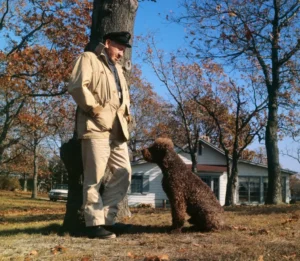
That’s Kramer, looking into the lens of my iPhone. You can tell from the narrowness of his hind end that he’s got some issues in the joint department. He’s also pretty shy, except when our pair of resident brush wolves deign to confront him out in the open country surrounding our house. Then Kramer is all bark and growl and bluster. Like I said, he never breaks trail, he always follows behind me when I ski. I don’t mind. At least he doesn’t walk on my skis like Copper, our long departed yellow Labrador, used to. I’d be skiing along just fine and wham, I’d stop dead in my tracks because an eighty pound juvenile delinquent retriever thought it was smart to step on the backs of my skis. Maybe Copper was the smart one, eh? After all, standing on my skis kept him out of the deep stuff…
The day of our first (and so far, only) ski of the winter, my dogs and I pushed off from the garage, coasted down the snowy driveway, clambered over the snowbank created by our plow guy Barney (every Minnesotan needs a Barney to plow their road), and began to find a pace, a rhythm in the quiet woods. The first trail we took brought us through some nice Norways onto an old pasture that was once owned by Minnesota Power. Our former neighbor, Dave Holte, used to hay the field way back when we first moved out to Fredenberg and it was MP property. Then Rene’ and I bought the old pasture and stopped haying it. During a downpour in July of 1999, while our new house was in the process of being built, I wandered out from the apartment we were renting in Hermantown to plant sixty white pine seedlings in the old field. The trees, handed out at the funeral of my uncle, legendary Minnesota State Representative Willard Munger, are now taller than my head, having survived a decade of attempts by deer to grind the seedlings to nubs. As I skied across the snowy field, I marveled that one day, when I am gone, when my sons are old, the trees I planted in my uncle’s memory will be dropping cones of their own, reforesting the land in pine. There are a few 100-year-old whites on the property, survivors of the 1918 fire, along with clusters of Norways of equal age. But much of the land I skied through with the dogs is second growth timber: mature aspen, birch, and maple. Don’t get me wrong. I love a good birch or maple. Aspen? Not so much. But what I wouldn’t give to be able to turn back the calendar and witness this land before the white man tore it apart, when woodland caribou, cougar, black bear, wolves, and moose ruled the forests and marshes, and white tailed deer stayed south of Hinckley.
Jimi let out his bunny yelp. A snowshoe hare, all white fuzz and coated in white snow from hiding, bolted across the trail. Daisy, always interested in tearing into a rabbit, followed the dachshund into alder. The dogs emerged empty mouthed from the thicket.
I poled hard, and regained my pace. Three to four inches of fresh, untracked snow dusted the trail. I was lucky to be the first to ski our trails. Normally, our neighbors, the Kaas’s, beat me to the punch. Jim is retired and Barb works odd nursing shifts so they’re usually the first ones into the woods after a snowstorm. But there’s a positive to the Kaas’s energy: with Jim’s chain saw, 4-wheeler, and snowmobile, he keeps the trails free of deadfall for all of us to use, so I don’t complain when they track the trails ahead of me.
Daisy and Jimi were out ahead of me as I broke from the maple studded floodplain onto the banks of the Cloquet River. I scanned the dark water for our resident flock of Goldeneyes, ducks that fly in from Manitoba every November and stay through early April. There were no ducks to be seen. Just a big ol’ goofy black dog and her partner in rabbit mayhem standing on the trail, waiting for an old man. I pushed harder, trying to work up a sweat. The dogs turned and trotted ahead. Kramer looked interested in joining the other dogs but stayed behind me, acting as the rearguard as our little contingent meandered towards the house. I avoided the easy route, the old logging road that deadends at a couple of little used cabins on the river. I skied a spur I cut years ago, when I was younger, my back was stronger, and my chain saw was sharper. The dogs and I passed through a cathedral of new white pines, all taller than the ones I’d planted in the field, all natural offspring of the ten or so big whites that still stand above the land. I stopped to give thanks to the oldest and biggest of the trees and I noted that it seemed to be shedding branches at an alarming rate. It would be a shame to lose such a giant, such a link to the old days of lumbering and robber barons. But if it dies, I’ll have someone come out, take it down, and saw it up into white pine boards. There’s a house of lumber tied up in that old tree, lumber that will simply turn to dust if I don’t take advantage of the tree’s grace in dieing on my land. Plus taking the tree will open up more space for little whites to sprout, open up the canopy for light and rain to nurture the fallen emperor’s children. Some might argue against cutting down the magnificent old tree even if it dies. They would assert that the dead tree could be a platform for an eagle’s nest, a haven for squirrels, a legacy to time. They might be right. But they don’t own the land: I do. I’ll decide what happens to the tree if and when it’s time comes.
The dogs skittled ahead, sniffing home. I increased my stride, trying to keep up. Kramer loped behind, wheezing and coughing as if he was about to croak. But we made it back, my three dogs and I, from our first, and perhaps, only ski of the year. The shoulder held up fine. The legs didn’t seem any worse for the time off. And my heart, which pounded in my chest as we climbed the hill to the house, seemed perfectly content.
Peace.
Mark
Sometimes you find the strangest things when you Google your name or your work. Vain? Of course. What writer isn’t? I mean, come on. If you’re honest about your work, whether you’re a hairdresser, carpenter, writer, or farrier, you want folks to stand up and take notice of the quality of your work and the effort you put into whatever vocation or avocation you’ve chosen to spend your time on. Most of you know that this writing gig is just a hobby for me. A passionate hobby. An all-consuming hobby. An uplifting hobby. A depressing hobby. Pick one. On any given day, you might find me as high as Mount Everest because a reader emailed me or posted a nice review of one of my books on the web, or as low as the Marianas Trench because of some perceived slight or insult that’s been slung at my prose. So when I come across something as unexpected and positive as I did this morning when I unabashedly Googled myself (don’t smirk!), well I just gotta share.
It seems that a student or a professor in the English Studies Department at the University of Vaasa in Vaasa, Finland, Mr. Roman Kushnir, has studied my novel of Finnish diaspora, Suomalaiset: People of the Marsh, with an eye towards critically analyzing the dialogue and language of the characters. He apparently spent considerable time with Anders Alhomaki and Elin Gustafson and the crew because his paper on this topic, accessible on the web, is 11 pages in length and thoroughly supported by citations and research (including a citation to my book, of course!). You can find it at the following link:
http://www.vakki.net/publications/2012/VAKKI2012_Kushnir.pdf
It’s not often that a regional novel, a story of invented lives, is chosen for scholarly study. Thanks, Mr. Kushnir for noticing. And by the way, I need a Finnish publisher to pick up Suomalaiset and its forthcoming sequel, Sukulaiset: The Kindred. Maybe you could put in a good word for the books?
Kiitos.
Mark
Shelter by Sarah Stonich (2011. Borealis Books. ISBN 978-0-87351-775-1)
A fine novelist can make a fine nonfiction storyteller. That’s the thing one learns if one has read and appreciated Minnesota native Sarah Stonich’s works of literary fiction (These Granite Islands and The Ice Chorus) as well as her most recent book, Shelter.
Categorized by the publisher as a memoir, the flow of Stonich’s latest is more akin to spending time with a close friend, male or female, and talking about the general nature and nuances of modern existence rather than a strictly linear story of one girl’s northeastern Minnesota roots and her unexpected diaspora upon relocating to the Twin Cities.
Ostensibly the tale of a single mom (who just happens to write for a living) searching for a place “up north” where she can build a rustic cabin to share with her growing son, Shelter is, over its slim 208 pages, so much more. Internet dating. Conservation versus preservation. Minneapolitans versus locals. Mining history. Logging history. Family legends. Family secrets. Ethnicity and roots. These themes are all touched upon as Ms. Stonich chronicles her search to find sanctuary in the piney forest her ancestors once inhabited.
Throughout the book’s serious passages of love and loss and divorce and anguish, Stonich maintains a clever and bawdy sense of humor, as the following passages depict:
If isolation fosters extremism, northern Minnesota is a potential incubator for nutcases on either end. A fanatic, as my father defined one, is anybody with his head so far up his own ass he can’t smell anyone else’s…On the road north, you’re welcomed to the region by an array of signs planted next to Highway 53 near Cotton, where for decades the landowner has been posting hand-painted billboards that change as his beefs do. Sometimes the signs are illustrated with primitive drawings, as if painted by a sort of Curmudgeon Moses. At the height of the anti-French sentiment that swept Real America a number of years ago, curmudgeon painted the UN flag urinated on by a poodle…(H)is compound is surrounded by ten-foot fencing that warns “No Trespassing, Injury very Likely”, which should dissuade most anyone from approaching his bunker, or his spaceship in progress, or whatever he does behind the scary fence.
Or this gem from her first Internet dating experience after her divorce:
Bachelor Number One was handsome and interesting., definitely showing promise right up until the bill came. We both had the same meal…and we each had a beer. When it was time to split the tab, he tallied the price difference of my bottled beer to his draft beer, making my share 79 cents more. I paid the extra and then covered for his miserly 10 percent tip. Date over.
My only disappointment in reading Shelter was the ending. I would have preferred that the story end with the scene depicting Ms. Stonich’s father unable to cry at the funeral of a friend until…I won’t give it away here. But that scene, to me, should have been the tale’s final act, or, as they say in Ely, “the end of the road”. To me, the concluding paragraphs that follow the funeral scene exude artifice in an otherwise very sincere, funny, and compelling work.
4 and 1/2 stars out of 5.
Wednesday evening. I’m teaching Paralegalism and Ethics at the University of Wisconsin-Superior later tonight. I could drive home after my “real” work day is over at the courthouse. But it’s a half-hour jaunt each way. And then there’s the fuel factor. I also teach Environmental Law at the college on Tuesday nights, so if I want to set a good example for my students, the less wasteful driving I do, the less gasoline my blue Pacifica consumes, the better.
Besides, writers are all about ritual, right? I mean, you’ve read my essays describing my 5:00am obsession. About how I get up every morning, put on the coffee, fire up the iMac, and try to spin yarns. Oh. Don’t forget rubbing the belly of the little synthetic jade Buddha my sister bought me for good luck before beginning to tap away at my keyboard. There’s nothing that says an old writer can’t adopt a new ritual, which is why Wednesday evenings between 5:00pm and 6:30pm, you’ll now find me slurping soup and drinking hot chocolate at the Red Mug Coffee House in Superior.
To be honest, I hadn’t been a frequent visitor to the Mug until recently. My coffee house of choice is located on my side of St. Louis Bay. I’ve been a loyal patron of the Amazing Grace Bakery in Canal Park ever since I first heard folk great Lucy Kaplansky sing there over twenty years ago. Along the way, I became casual friends with the owner, Chip,and a host of the characters that frequent the funky little Greenwich Village-inspired venue. Sadly, Chip’s gone, a victim of the Big “C”. But the place he founded and nurtured still serves great soup and sandwiches alongside some of the finest live music in the Twin Ports.
But back to Wednesday evenings at the Red Mug.
Deciding where to park my keester and write between jobs on Wednesday evenings wasn’t all that difficult. I mean, it’s Superior, right? That is to say, the choices for a clean, quiet, humble, and quaint place to write are pretty limited in a town better known for its cheap ass tap beer than its literature. But I’d been in the Mug a couple of times, so I knew the layout. It’s also right on the way to the campus from the courthouse, making it the perfect location for an OCD afflicted author who craves consistency and order. About a month ago, I started hauling my new Mac Air along with my books, notes, and supplies for my class to my day job every Wednesday. Before class, I find an empty table at the Mug, fire up my notebook, and order dinner. The soup’s very good. The Paninis are filling. And the Mug’s hot chocolate, after too many cups of coffee to start my 5:00am writing obsession, seems a calming elixir.
This is only the third or fourth week I’ve been hiding out at the Superior coffee house, which means I haven’t made any new friends or got to know the staff. But that will come. Superior, despite its lack of big hills and scenery, is a friendly place, filled with hard working, gregarious folks. Over time, I’m sure I’ll feel as comfortable at the Mug, tapping away at my prose, as say, William Kent Krueger is at the St. Croix Broiler. I don’t know if Minnesota’s mystery icon still hovers around that venerable St. Paul eatery. But that was once his haunt, the place where he sat for hours, spinning tall tales into his word processor, sipping hot coffee, and trying to remain nondescript. I, of course, don’t have similar worries here at the Mug. No one in the coffee house knows who the hell I am.
After three solid years to researching, writing, editing, feedback, and more editing, my novel-in-progress about the Finns and Estonians during World War II, Sukulaiset: The Kindred, is nearly finished. Oh, there will be a final edit sometime later this summer when I send the manuscript to Scribendi, the Internet editing service I’ve used for my last five books, receive the comments and changes suggested by Scribendi’s editor back in the form of Track Changes to my Word document, and make adjustments as need be. But if I’ve done my homework and put together a story that flows, the final edit’s not an arduous task. It’s all of the sweat, blood, tears, frustrations, and swearing that come before the final edit that causes a writer’s gray hair. Or, at my age, more gray hair.
I used to worry about which version of a manuscript floating around on my computer was the most current. Then there was the disaster of waking up and discovering that my Windows computer had experienced a hard drive crash. That’s serious business, as I learned working on Mr. Environment: The Willard Munger Story when a year of work vanished in the ether. I know, I know, I should have been backing up my work on an external hard drive or on the Internet. Or both. Attempts to recover that year of work were unsuccessful but I learned a valuable lesson. I bought an external drive and also began saving my work on the Cloud. Redundancy is apparently a good thing when it comes to data. My eldest son Matt then cured all my ills by a) convincing me to switch to a Mac, a machine much less prone to disintegration; and b)Using Dropbox to secure my work on the Web.
The hour runs late. I save the changes to my manuscript not only on the flash drive of my Air, but also on Dropbox. At home, when I’m using my iMac, security is even more rigid. My documents are saved to the hard drive, to an external hard drive, to Dropbox, and also Carbonite. OCD folks learn lessons well. I shuttle my dirty bowl, plate, and cup to the bin, pack up my computer, and wander outside on this beautiful spring evening, ready to talk to kids about ethics, my manuscript secure in numerous disclosed locations and ready for a final edit. And then? Stay tuned…
You’ll find information about the Red Mug at:
Peace.
Mark
Island Beneath the Sea by Isabel Allende (2010. HarperAudio. ISBN 978-0-06-199362-6)
Yes, that’s my title of this review of author Isabel Allende’s latest effort. I took a lot of heat from my buddy Mark Rubin, who was one of the pre-readers of my novel-in-progress, Sukulaiset: The Kindred because Mark thought I referred way too often to mammary glands in my story. So, in deference to my good friend, I conducted a literary mastectomy. Many scenes involving naked breasts, nipples, sex, and the like were removed to protect the innocent. Oh, if only Isobel had a Mark Rubin!
I’m no prude as the introduction to this review makes clear. And if you have any doubts about my being able to abide sexual innuendo, read some of my other novels. But I have to say: for a woman, Isobel is certainly fixated on breasts.
The problem with an audio book where boobs and sex pop up (pun intended) every few pages is that such descriptions are disturbing to the 15 and 25 year old young men sitting in the back seats of the Pacifica on the long haul from Duluth to Bozeman. It’s clear that sex sells. And maybe, with the success of soft porn lit such as Fifty Shades of Gray, Ms. Allende needs to “up her game” by spicing up her fiction. But I don’t think so. She’s a great writer who can get along with a few less breasts being exposed. There. I’ve said my peace. On to the book.
Allende takes an interesting and under appreciated facet of history, the slave rebellions on Haiti, and weaves a believable and thoroughly entertaining fictional tale from that legacy of murder, torture, rape, and instability. TeTe, the daughter of a slave woman and an unknown white father, is purchased as a young teen by a French plantation owner, Valmorain. The story of the pair, their families, their friends, and the times, sprawls from Haiti to Cuba to Boston to France to New Orleans. Along the way, the listener (or reader) is a guest on an amazingly accurate journey back in time.
A story of this length is bound to have incongruities and inconsistencies and implausibilities. And Island Beneath the Sea has a little of each. More troubling to me as an author who respects Allende’s skills as a writer,Valmorain isn’t a fully realized, living, breathing character. He seems, to my ear anyway, to be more of a caricature of a cruel plantation owner than a plausible rendition of humanity. On the positive side of the ledger, Allende’s portrayal of TeTe rings true, as do the author’s renditions of the other major protagonists and supporting cast.
In addition, the historical scenes, the use of geography as character, and the weaving the actual events of Toussaint L’ Overture’s revolution into the plot all ring true. This is not a great historical novel but it is, in the end, despite the cleavage, a very good one.
4 stars out of 5.