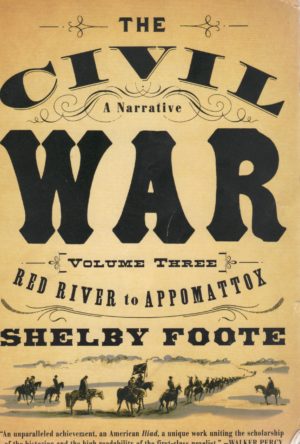
The Civil War by Shelby Foote (1986. Vintage. ISBN 978-394-74622-7)
When my pal Dave Michelson handed me Foote’s ginormous three volume study of America’s War Between the States, I was daunted by the task of reading 2,846 pages of history. History that at least, in part, I was aware of. But, as in all things that Dave has suggested over the fifty years of our friendship, I acquiesced and dug in. That was last summer, before Dave, his wife Lail, and six other couples joined René and I for a two-week cruise in the Mediterranean. Well, here we are in May and I finally finished the read! To the review.
Throughout the three volumes of this study, Foote makes his southern upbringing and outlook clear despite his attempts to conceal it. He reveals, though he tries not too, a personal affinity for the Confederacy and the right of secession. No that he applauds slavery and all of its ills. He acknowledges the institution’s evils and makes it clear that slavery, upon which the entirety of the Southern agrarian economy was based, had to go. But he spends much time inside the politics of Jeff Davis and his confederates (pun intended) trying to explain how the South didn’t begin the conflict in a vacuum, how Lincoln’s election triggered secession. That, of course, is indeed true. But Lincoln’s fairly modest anti-slavery stances before Ft. Sumter were, in my humble opinion, an excuse used by the radicals in the South to attempt the unthinkable; the dismemberment of the American experiment. And though Foote paints a fairly accurate and sympathetic portrait of Lincoln as a man and leader, his dissection of Davis’s and the South’s political motivations for firing the first shot ring hollow against the one and fundamental truth: Slavery, the mass bondage of an entire population of Africans brought here against their will, was and is a sin. A sin against man. A sin against God. Many times, as the author digressed into long-winded dissertations about the politics of the Confederacy, I simply skimmed over sections to get to the action.
That’s where Foote really shines. His depiction of the military leaders on both sides of the conflict, the details of their personalities and attributes and upbringings, when placed in the context of Bull Run and Shilo and Vicksburg and Gettysburg and the fall of Atlanta and all the rest is the reason to read this series. Foote is a master of describing skirmishes and battles, including much about Texas and the Wester Front left out in slimmer versions of the war’s history, and making it clear to the reader what transpired. The horrors. The casualties. The losses of loved ones. The genius of Lee and the steadfastness of Grant when finally, Lincoln makes him the overall commander of the Union forces. The dogged determination so men like Sherman and Sheridan and Forrest and Johnston to see their missions through. It’s all here in concise and precise detail.
His portrait of Lincoln’s last months as president, Lincoln’s travels to Richmond after the Army of Northern Virginia (Lee’s army) is dispatched, and the greatest president’s final days is all supremely wrought. His depiction of Jeff Davis’s attempted escape, incarceration, and ultimate release is equally well done. The last two hundred pages of the series was worth the slog that sometimes accompanied the earlier political digressions and personal stories, all of which added color to the page but didn’t necessarily move the narrative forward.
Foote’s work here is laudatory despite the Southern winds whistling through its pages. It’s one of those rare histories written, not by the winners, but by a descendent of the losing side. It is worthy, despite its attitude and somewhat biased bent, of reading by anyone interested in the possible disintegration of our Republic.
Thanks, Dave, for getting me to read this!
Volume 3 is the best of the lot: 5 stars. As an overall review, I’d give the three-book set a rating of 4 and 1/2 stars.
I’ve been delinquent in writing this story. Grief does that to a guy; makes things tough to wrap your thoughts around. It’s now been two months since our best girl died. It’s time I try to make sense of it all. Here goes.
She came to us on a whim. I’ve been a Lab guy since age four, when my parents bought me a black Labrador, a pup from famed Duluth dog trainer, kennel operator, and all around Lab whisperer, Joe DeLoia. Deuce I was a loving, unneutered male who never calmed down and never received any serious obedience or field training. I found him dead at age ten in his kennel. His replacement was a slightly less hyper black Labrador who died a tragic death I won’t relate here. Suffice it to say, that was the first time I experienced the loss of a pet at the behest of a vet’s needle.
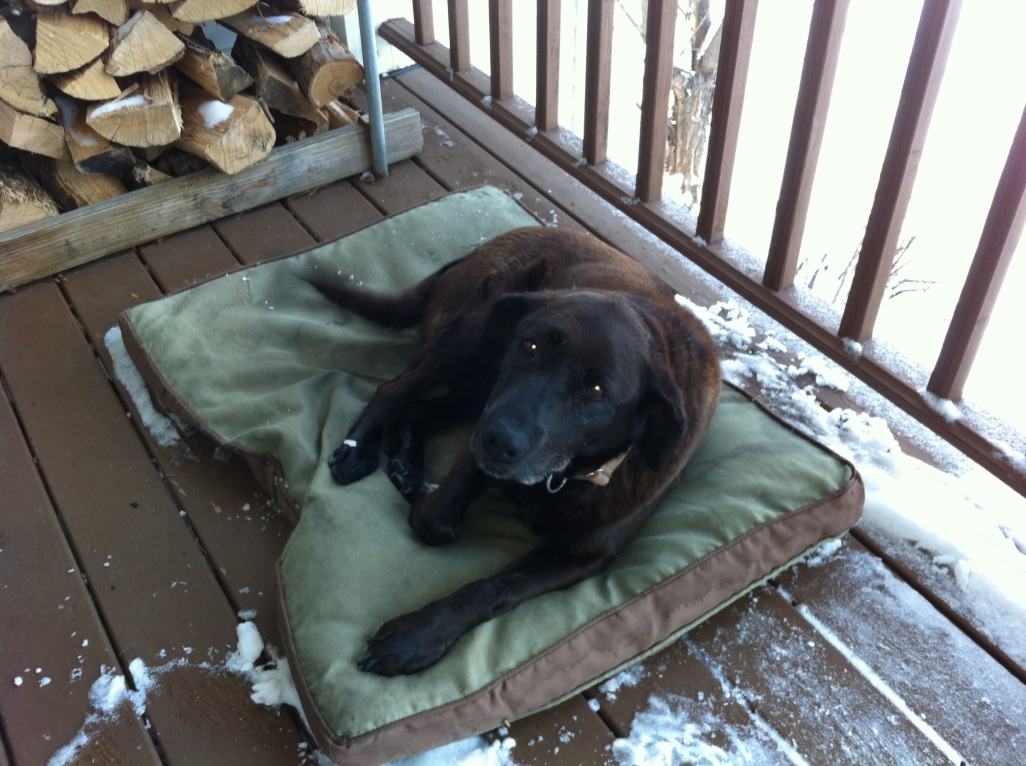
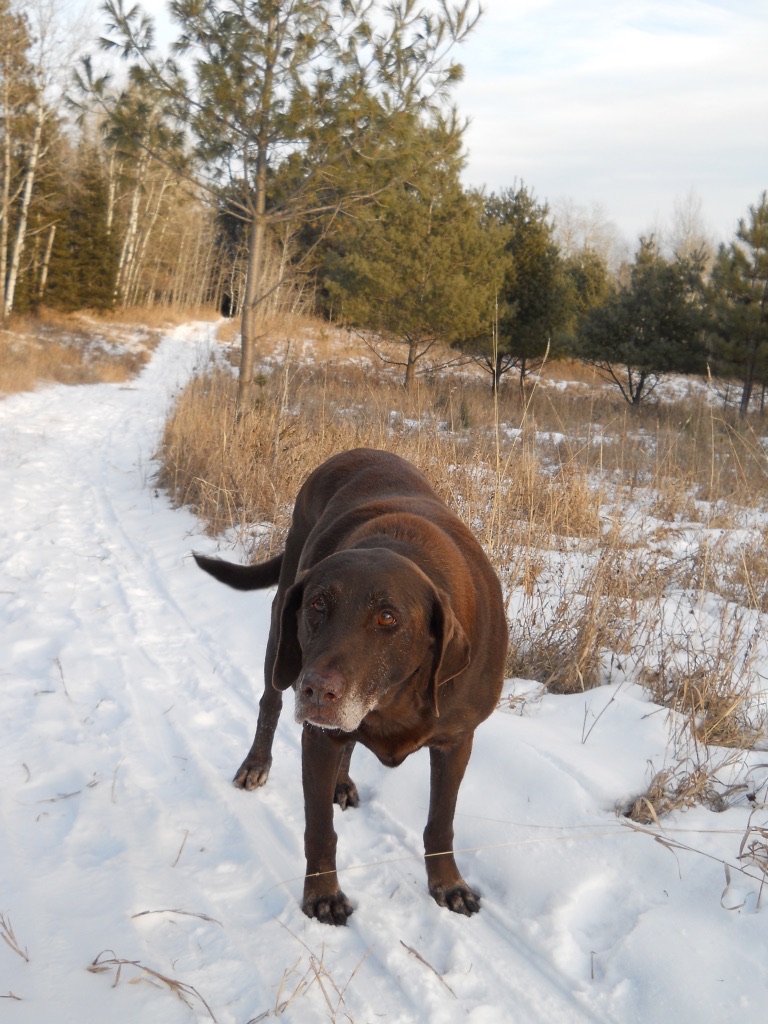
After Deuce II, I had a plethora of other Labs; black and yellow and chocolate; some of whom were exemplary companions and extraordinary hunting dogs. A couple females were intentionally bred and gave our boys litters of pups to consider and love. Other Labs we owned were gun shy or bit kids or didn’t survive country traffic long enough to get acquainted with the family. There were circumstances of loss attached to many of those dogs; some perished in the night in their beds at the Munger Farm. Others needed to visit the vet to be mercifully sent off to the next world. Grief came and went, generally lasting a few months’ until a new Lab came to the farm and a new bonding experiment commenced. Truth be told, I wasn’t very good about training our dogs. It wasn’t until I bought our youngest son Jack his own black Labrador bitch, Kena (“Greatest Champion” in Celtic) that, fairly late in the game and life, I grew serious about training. Turns out, I’d matured over the six decades of living sufficient to be patient with a dog. Kena is an intelligent, kind-hearted, bear of a girl who takes to our grandchildren like the mother she wasn’t allowed to be.
In between all the pure-bred, AKC Labs we had at the house, our sons dropped off a couple of rescue dogs. Daisy, a Lab-sled dog mix who looked like a purebred black Lab but had no instincts for hunting animals with feathers came to us from a group home where Matt worked. She was the best rescue dog a family could ask for. Chris, when he was going to school in River Falls, brought home Kramer, a supposedly purebred chocolate Lab. He too was utterly useless as a hunting dog but a sweetheart who once got mauled by a bear and refused to enter the house.
But dogs age and they pass on, leaving holes in a family. René had to take Daisy in to the vet because I was out of town when the dog finally hit a marker in her life requiring mercy. Three of our four sons met my wife at the vet and said their goodbyes through adult tears. Kramer passed not too long thereafter, dying in his sleep on his bed in the garage. Kena was still with us but was showing signs of knee issues making it problematic whether she could make our family’s annual hunting trip to Ashley, ND to chase pheasants.
“You’re looking for another dog, right?” Matt asked one Friday night, the two of us talking on the phone.
“Yup.”
“Have you thought of a Brittany?”
I was raised on Labradors. I was unfamiliar with pointers, which Brittanys are. Plus, I had this image of crazed, wild, untrainable Springer Spaniels I’d encountered over the years. Once upon a time, Brittanys were called “spaniels” and sort of remind one of Springers, But that’s in error. They are really pointers, not flushing dogs.
“Not really.”
“Well, there’s a litter in the paper. Just outside of Superior.” Matt paused. “Wanna take a look?”
Understand: René was not part of this discussion. She had no idea I was looking to begin anew with another puppy. I thought a moment: “Sure, but only if they have some females.” I didn’t want to have to deal with a male puppy marking every vertical space in the house.
Matt called. “They have one female left.”
I wasn’t put off by looking at the runt of the litter. Kena was the last female in a litter of ten and turned out to be one hell of a family and hunting dog. “OK. But you’re driving. Pick me up at ten tomorrow.”
We drove and drove and drove and drove.
“I thought you said this was right outside Superior.”
“It’s by Shell Lake.”
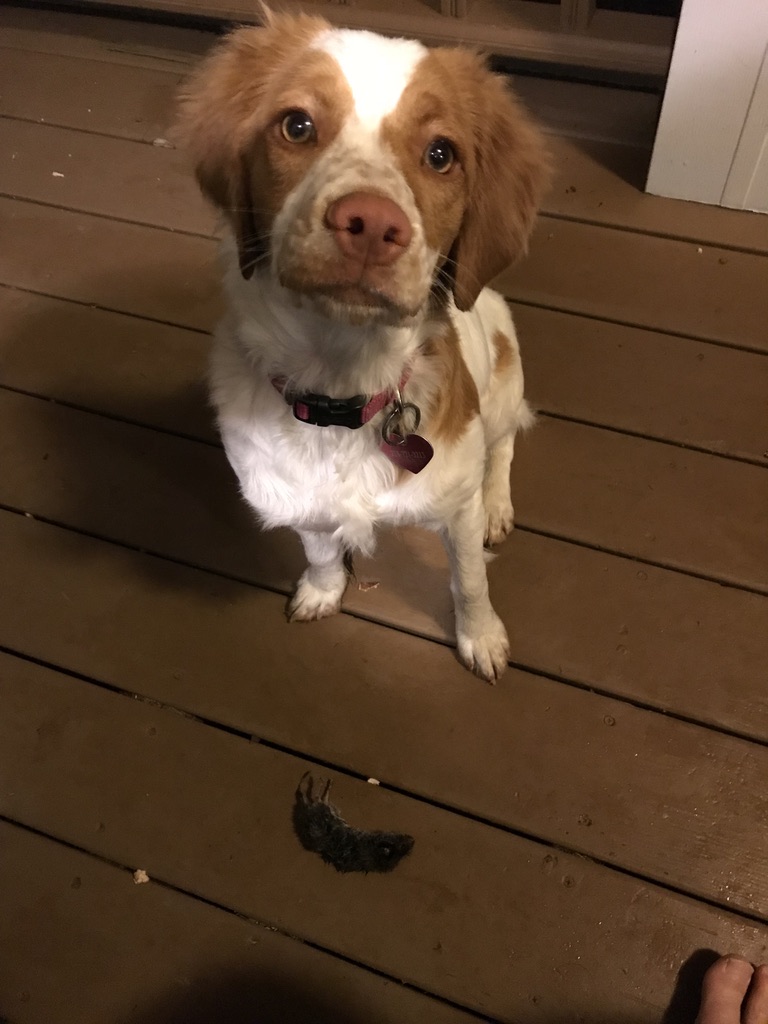
Since my four-year-old grandson was in the back seat with Kena, I held my tongue. An hour later, we were at the farm. I had a check in my wallet. One look at Leala (“Faithful” in French) and I was history. (Text photo sent to René from Matt’s truck).
Kena approved as well.
I learned very quickly that the stern tone one needs to train thick-headed Labradors doesn’t work with Britts. Brittanys are sensitive, loving, and energetic dogs who need constant reassurance and outdoor time. But that pink nose and those yellow and cinnamon eyes! No Lab I’ve ever had measures up to the emotional attachment I formed with that little pup. She became Jack’s buddy as well, replacing Kena in his bed. I’m not too sure what the Labrador thought of that.
I struggled to train Leala in terms of pointing. I went on the internet, watched all the YouTube videos of how to train a Britt to point, to “hold” and all that other stuff. Thing is, the damn pup was pointing chickadees in the bird feeder and holding her point long before I figured out she was self-taught. The dog was smarter than I was.
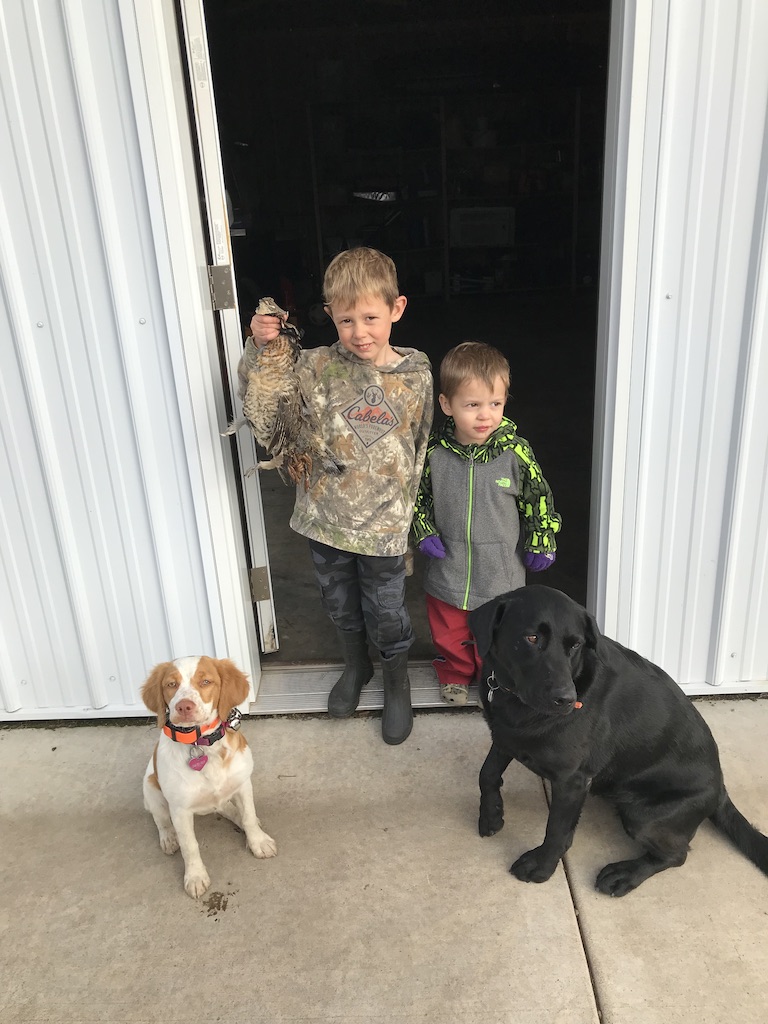
Of course, this meant she’d bring any manner of prey to the front porch. Mice. Song birds. Dead cottontails and snowshoe hares. She brought them all and proudly dropped them at the door for her master to see. A couple of
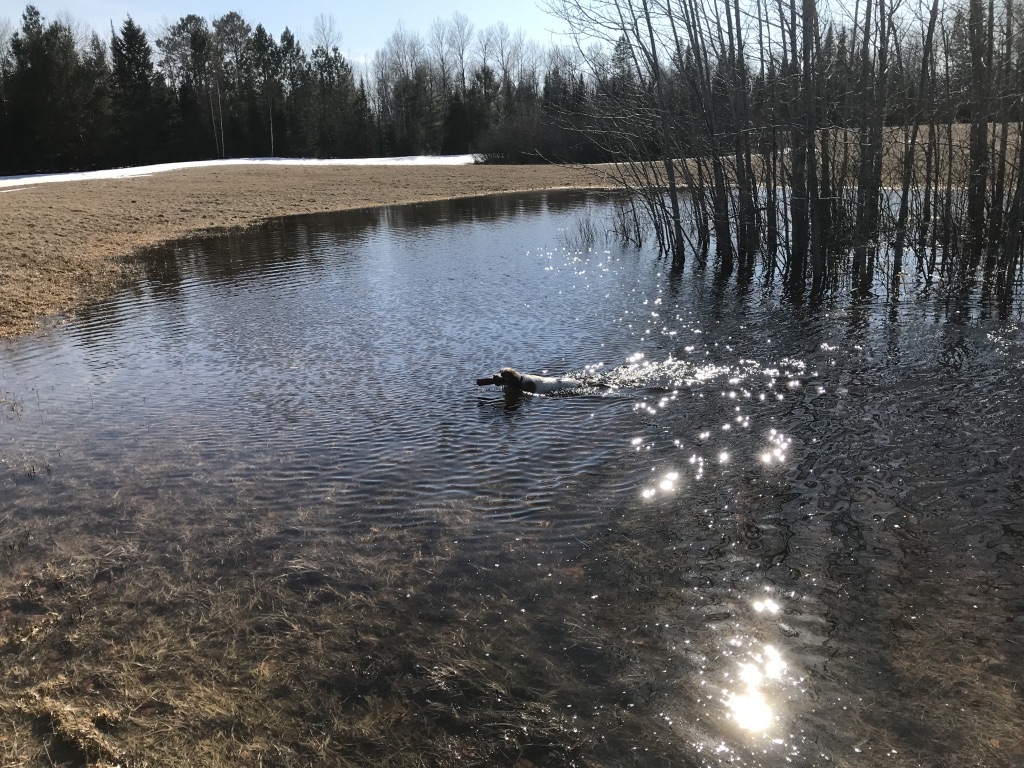
times she managed to sneak in the house hauling a dead bunny nearly as large as she was into the kitchen. One of the proudest moments in training, where she and I worked with the eCollar and learned sit, stay, come, and hold commands, was teaching her to water retrieve. I bought a small retrieving dummy for her and tossed it a few feet ahead into snow melt in a low spot in our pasture.
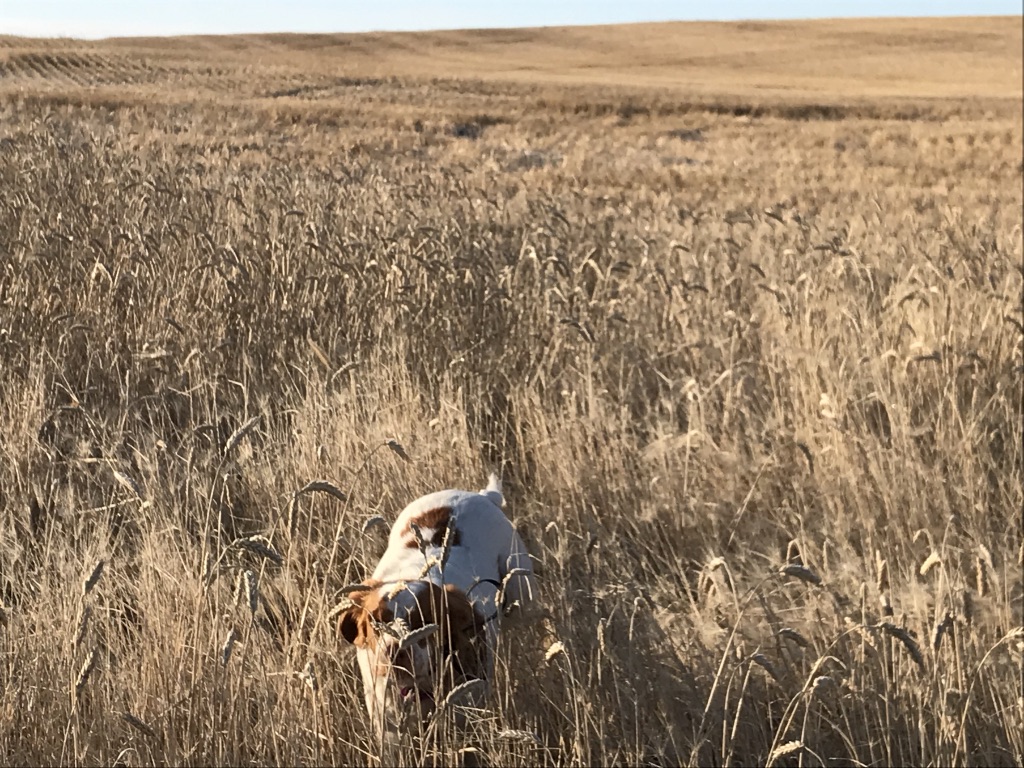
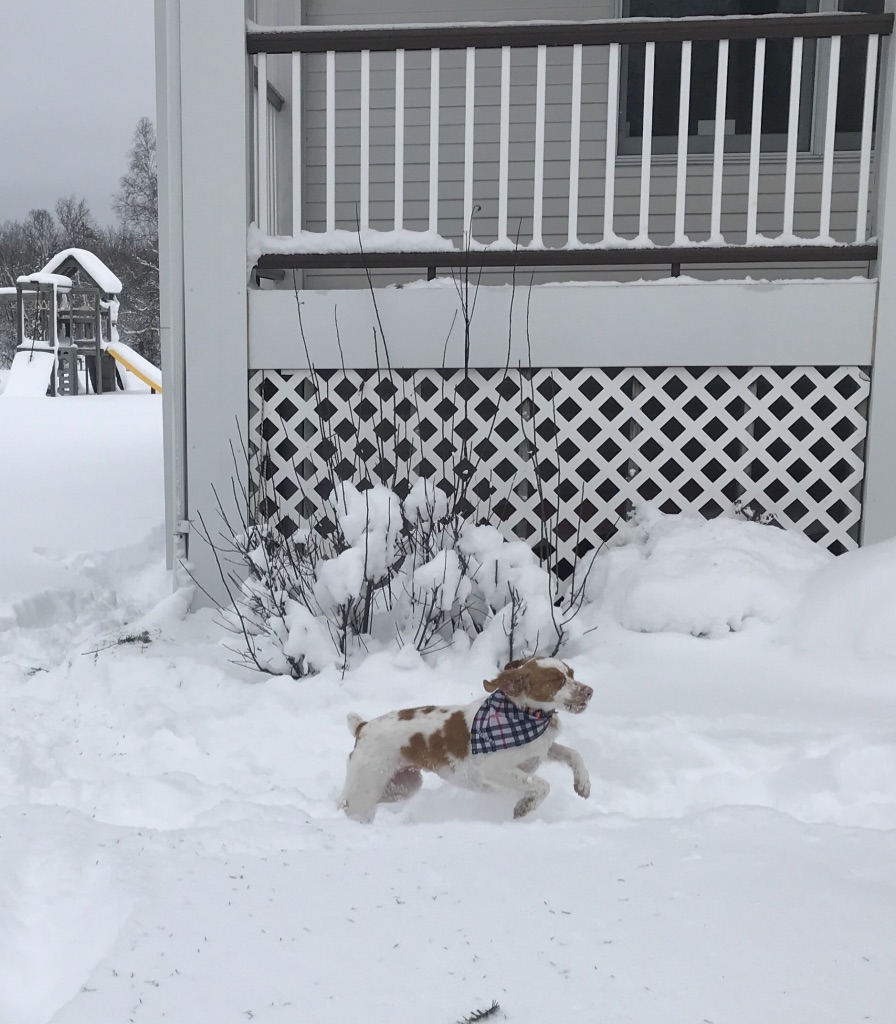
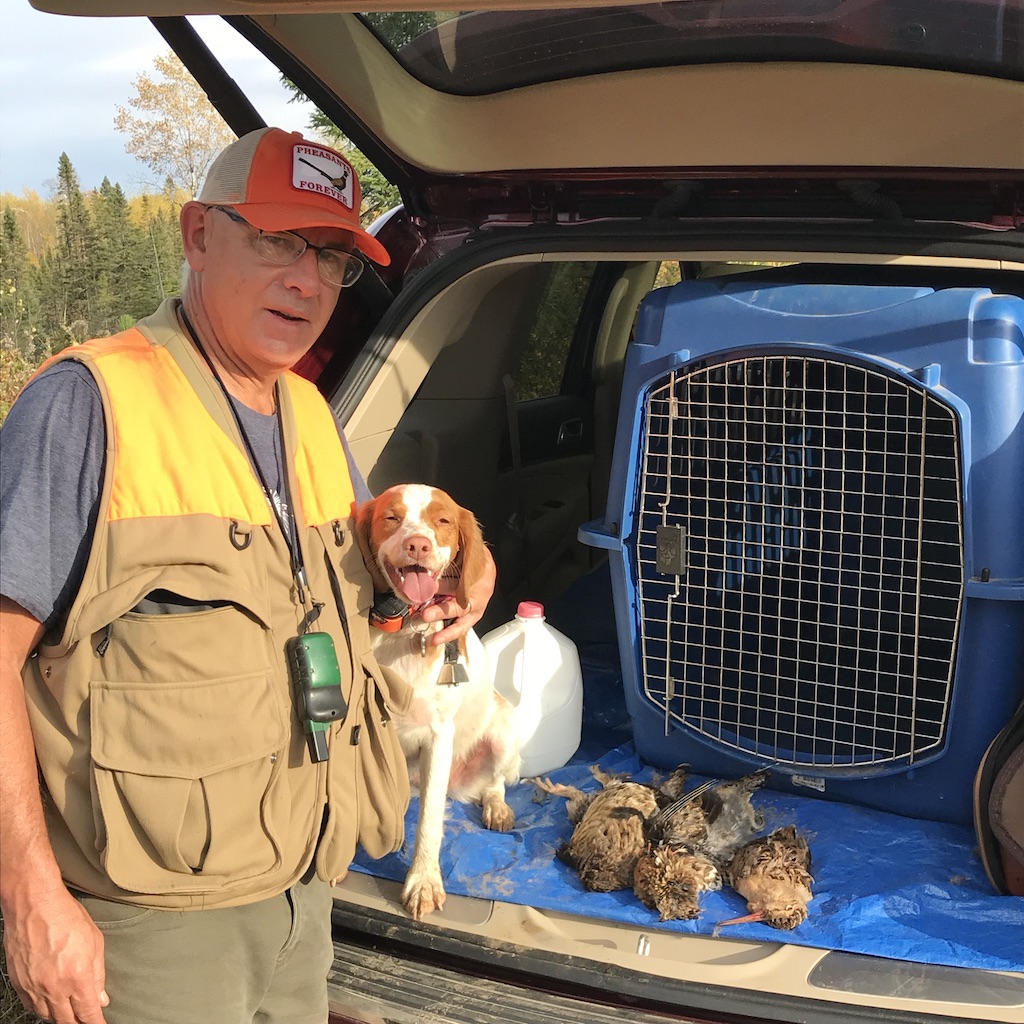
Once she got the hang of retrieving in that small puddle, she was ready for the Cloquet River, which she took to like a champ. She wasn’t quite as solid on grouse as Kena but in the wide open spaces of North Dakota, watching her work a field and lock up on point, man, that was some of the greatest hunting with a dog I’ve been privileged to enjoy over my long life.
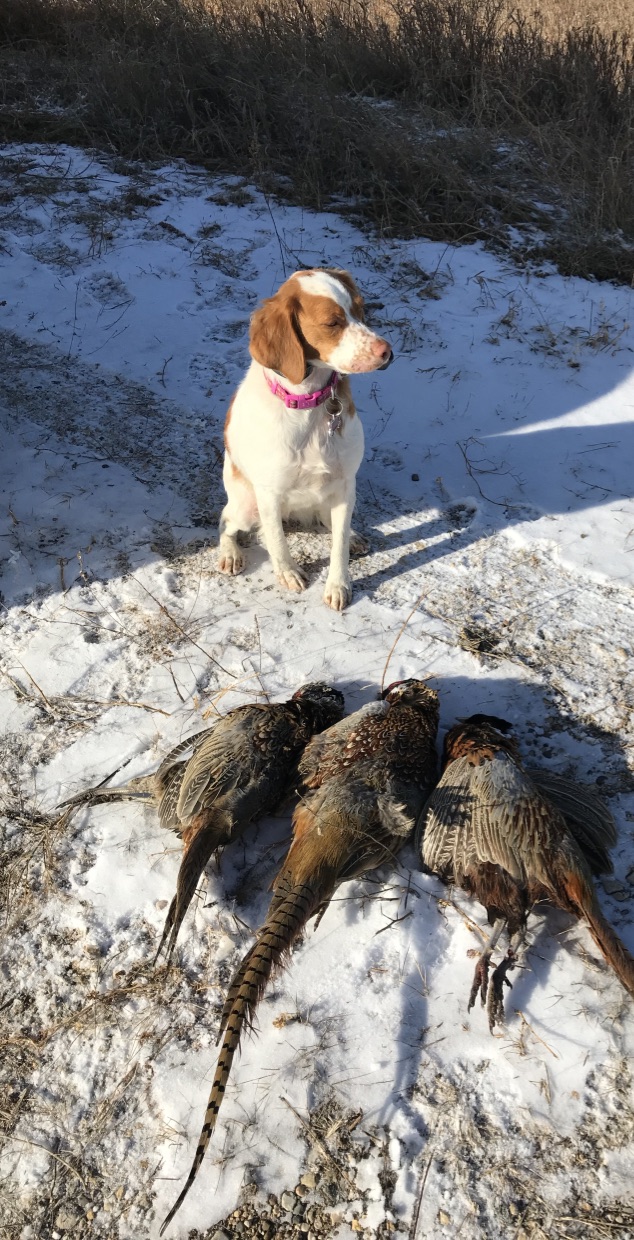
You look at her compared to Kena, who goes about seventy pounds and is built like a brick, and you wonder, “How can that little dog retrieve a rooster pheasant?” I’m here to tell you that it’s not the size of the dog, it’s the size of the heart. Leala had no problem running down a winged male pheasant, tracking it, retrieving it, and looking at me as if to say, “What’s next?”
Upland hunters understand the spiritual bond between man and dog in the field. It’s a connection that I was reminded of last fall, when I made a solo trip to Williston, ND to see my son Dylan and his family. A few weeks earlier, our annual trip to Ashley had ended in bitter disappointment. One bird for five guys and four dogs over four days. Oh, I should add here that, given the uncertainty over Kena’s knees (she’s on Ibuprofen and supplements to ward off surgery and it seems to be working) I convinced René into bringing another Labrador to the Munger Farm. Violet came to live with us in July and by hunting season, was in the field with Kena and Leala. Violet formed sisterly bonds with both her canine roommates. But whereas Kena tends to be somewhat aloof and her “own girl”, Leala, despite the constant nibbling on her neck by the puppy took to Violet. The two pooches spent much time nuzzling and cuddling. When four Mungers and an Amborn hunted Ashley last fall, we had our three dogs plus Matt’s new Labrador pup, Greta. But with torrential rains, wet and muddy fields, standing crop, and Leala being sprayed in the face by a skunk (after being encouraged to flush what Jack and I were sure was a rooster pheasant), our trip to the southern edge of the state was dismal. Which is why I decided to use my second week of hunting in the northwestern corner of the state where my son Dlyan, his wife Shelly, and their kids live.
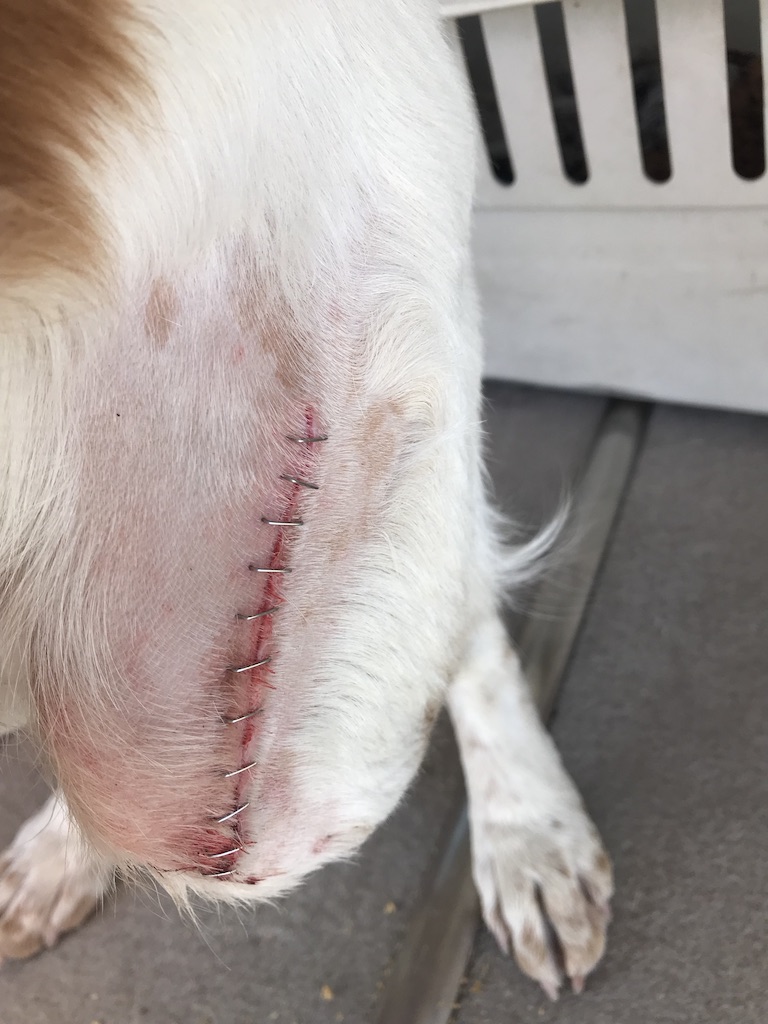
Leala came with. The two of us hunted two and a half days and had us a time. The crops were down. We found plenty of public and non-posted private land to hunt. Plenty of birds took wing. Some I was able to hit and Leala dutifully retrieved. Many more remained free unscathed. We worked our butts off, that little girl and I, averaging eight miles a day. Until. I’d never had it happen before but Leala found a barbed wire fence and tore her leg up something fierce. Thing is, she didn’t even slow down after it happened. I caught a glimpse of blood on her white fur from across the field, called her over, and knew immediately she needed a vet. I called Shelly. She gave me the directions to the clinic. Twelve staples later Leala was on the mend. But she was done hunting. Matt was coming out with René and our eldest grandson, Adrien. He was supposed to bring Greta with. He didn’t. I learned, over the next two days of dogless hunting, how much a good dog means to the whole upland experience.
I was pretty sure that the ordeal Leala endured in Williston would be the worst of what she’d experience. I was wrong.
A few months later I got up to let our dogs out to pee in the wee hours of the morning. When I went outside to call the dogs in, the scene that greeted me is one that I will never forget. My best girl was stuck, her collar wedged between Violet’s lower canines, being dragged along by the Lab. It was pretty clear to me what had happened: Violet had been chewing on Leala’s neck and got her teeth stuck between Leala’s fur and the collar. I imagine that both dogs panicked: Leala, because her airway was compromised; Violet because she had a thrashing, choking thirty pound dog hanging from her jaw. I called Violet over. She came, dragging Leala with. (This is not easy to write but there’s a point to be made about what I witnessed and what both dogs endured.) I could not disengage the dogs. I screamed for René. She heard me and came outside. I screamed for her to get me a scissors. She did. Jack, hearing the commotion, rushed to help. Though I cut the collar off Leala and spent the next ten minutes trying to breathe her back to life, it was too late.
All it took was five minutes. It wasn’t Violet’s fault. It was mine. Ignorance is no defense. But in my sixty years of owning dogs, I’d never seen anything close to what I was confronted with that morning on the banks of the Cloquet River. Never had I suspected a collar around a dog’s neck could be the instrument by which a beloved pet died. Every dog we’ve ever owned has worn a collar with his or her rabies tag and ID. No more. I learned my lesson. If I can save one dog owner from the pain and agony and hysteria I went through that morning, if someone else’s best girl lives because a collar has been removed due to my revelation, I will have done something in Leala’s memory. Something positive can come out of the most negative of episodes in a long, long history of loving and raising puppies into companions.
Peace, little girl. Violet didn’t mean it. And neither did I.
Maus II: And Here My Troubles Began by Ar. Spiegleman (1991. Pantheon. ISBN 978-0-679-72977-8)
I read Spiegelman’s first installment of his graphic novel about the Holocaust a month or so ago on the plane back from Key West. I immediately ordered the second part of the story. I am glad I did.
The artwork is tremendously moving despite this story being told through cartoons. Maybe that’s too simplistic: the entirety of this story is truly one of the first bestselling graphic novels of all time so labeling the work “cartoons” doesn’t capture the breadth and depth of the story or the depictions of Spiegelman’s struggles with his Jewish heritage, his parents’ captivity at Auschwitz, his mother’s suicide, his ghost brother’s murder in the camps, and the complex relationship the author had with his father.
Read together, the two volumes constituting Maus bring us into the most intimate of discussions between the author and his father and other members of his family with respect to his father’s zany, near stereotypical Jewish fetishism regarding plenty, money, saving, scarcity, and the like. When the last chapter is behind them, readers seventy to eighty years removed from the events depicted in this work will undoubtedly understand and appreciate the ugliness and horror of Nazi Germany conveyed through graphic artwork depicting the murdering of mice by cats in a manner that transcends time.
Stunning. Something every middle school and high school civics class should be required to dive into, analyze, and appreciate.
Women Talking by Miriam Toews (2018. Bloomsbury. ISBN 978-1-63557-434-0)
This is a book I picked up in Key West, mostly because it was written by Ms. Toews, a Canadian writer of Mennonite heritage I have read before. Her novel, A Complicated Kindness, is very good. In an act of personal kindness (pun intended) she actually took a look at the early stages of my novel, Pigs, a Trial Lawyer’s Story when she was the writer in residence at the Winnipeg Public Library and I was a member of the Manitoba Writers Guild. She made some helpful suggestions, which made the book better, and for that, I have always been grateful. Now to the headline.
No. This is not a masterpiece, nor a feminist manifesto, nor anything close. I admire the author’s attempt to use a new, or at least, fresh for her writing style, approach to telling a story. But while the premise of the story (based upon true events where Mennonite men drugged their wives, sisters, cousins, and children to have sex with them) could have been the basis for a big, bold, blockbuster tale of feminine strength, courage, and perseverance, the structure of Ms. Toew’s storytelling, casting it as reportage from the pen of a male sympathizer and being nearly entirely dialogue-driven, simply failed to grab hold and maintain my interest. This is a slender book, less than 220 pages, the sort of thing I’d hoped to be a fast read. Instead, because of the book’s writing style and the plot composition, I spent the better part of a month struggling to finish the story.
Maybe it’s the fact I’m male. Maybe it’s the fact I have writerly envy. Maybe I am a dullard and don’t appreciate art. Those things may all be true. But all I can say is that this novel did not suit my tastes, did not compel my emotions to rise and fall, and really did very little to interest me in the characters, topic, or religion behind the reality of what happened.
2 stars out of 5. But you be the judge if you wish …
The Civl War (Vol. II) by Shelby Foote (1986. Vintage. ISBN 978-0-394-74621-0
My friend Dave gave me Foote’s trilogy about a year ago and told me I had to read it. I always do what Dave says and so, here I am, having finished the second mammoth tome in Foote’s epistle of the war that still, in many ways, defines America.
As with the first volume, this second offering in the set is chock full of memorable scenes, speeches, maps, observations, and details regarding the battles fought to preserve the Union. And as indicated in my first review of this series, Foote’s goal is an admirable one, much like my goal in writing Mr. Environment: The Willard Munger Story a biography of my conservationist uncle. Both works tend to be a bit long for the casual, recreational reader but with purpose: For in both works one can find essentially everything one needs to know about the topics!
Foote is a good writer who, from time to time, could have used a better editor in terms of run-on sentence structure and the reporting of minutiae that most readers, except for academics scrutinizing this trilogy, could live without and still get the gist of what the Civil War was and what it means for present day America. There are two major themes that emerge from this series. First, that the North had a series of inept commanders in the East, charged with facing off with Lee, who continually failed to seize the day and deal the Army of Virginia the death knell that may well have ended the war a year or perhaps two before Appomattox. Only when Grant takes Vicksburg, after slogging around in the swamps of Mississippi for the greater part of a year to find a way to conduct a siege, and then follows that victory up with the saving of Chattanooga, does President Lincoln finally find the man he needs to face Lee and bring the war to an end. The second theme Foote weaves into the story is the that resentment and defiance which caused the South to secede, if one listens to present day political discourse, remains omnipresent in our politics more than a century after Lee’s surrender. Nothing has really changed other than the replacing of a D besides the names of politicians with an R. Lincoln’s party in the Deep South is no longer his party: It is the antithesis of who and what he was at the end of his life in terms of unity and equality.
Like the trauma experienced by Native Americans due to genocide and removal policies, there can be no question that the devastation unleashed on the South when Grant turned over the Western theater of the war to Sherman, whose slash and burn tactics brought the breadbaskets of the South to their collective knees, still leaves a bitter taste in the mouths of some Southerners. The difference? The South attempted to sever the Union, thereby beginning the conflict. The native tribes? They were simply trying to exist in ancestral lands Europeans deemed “up for grabs”. There is no equivalency between the two and yet, in many ways, both strands of our past continue to haunt us as a nation.
4 stars out of 5.
Peace
Mark
Posted inBooks|Comments Off on Another Step Completed!
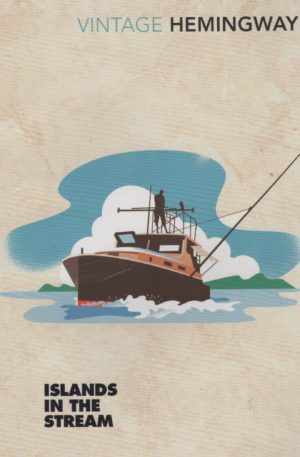
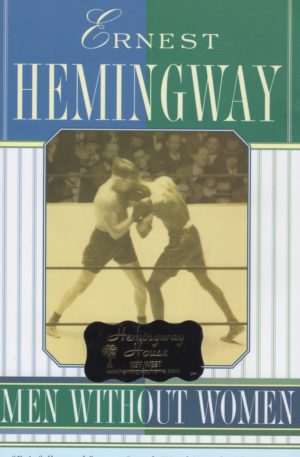
Islands in the Stream by Ernest Hemingway (2017. ISBN 9781784872045)Men Without Women by Ernest Hemingway (1927. Scribner. ISBN 9780684825861)Maus (I) by Art Spiegelman (1973. Pantheon. ISBN 9780394747231)
Three very different reads, for sure! Let’s start with Hemingway’s last novel, published for the first time in 1970 by the Hemingway Trust a decade after the master storyteller’s death.
Islands in the Stream
I’ve read all of Papa’s novels and this one, well, despite my appreciation for his other works, blew me away. Like much of Hemingway’s prose, this lyrical tale is chock full of scenes drawn from the author’s life. The underlying plot, whereby Thomas Hudson and his ragtag crew chase down U-boat survivors in Hudson’s personal fishing boat, is drawn from Hemingway’s own experiences in and around Cuba during WW II. Like any Hemingway novel, there is plenty of machismo: Hard drinking, chasing women, blue water fishing, and the rough and tumble of male ego are all on full display. But there is one crucial difference between this novel and say, Across the River and Into the Trees or The Garden of Eden and that is in Islands, much of Hemingway’s misogyny and disrespect towards women is replaced by a more adult, fully matured, kind appreciation for the opposite sex. Even though the protagonist and his two divorced wives have somewhat rocky histories, Hudson doesn’t trash talk Hudson’s prior partners nor belittle them to the extent that was done in some other Hemingway novels. And the women portrayed in the story also are not held to some idealistic pedestal of virtue, as in For Whom the Bell Tolls or A Farewell to Arms.
The plot, involving Hemingway and his crew chasing down survivors of a Nazi U-boat sunk in the Gulf of Mexico, is tightly drawn yet literary. The magic of the master’s voice, his ability to write a concise tale that moves swiftly and compels the reader to turn page after page is present despite the book being published well after the author’s death. A masterpiece even when shelved next to The Old Man and the Sea.
5 stars out of 5.
Men Without Women
Many of my favorite Hemingway short stories are his oldest. I’ve read some of the tales contained in this 1927-issued collection before, including the Nick Adams themed pieces “The Killers” and “Ten Indians.” And I’ve also read “The Undefeated” and “Fifty Grand” previously. Still, re-reading these stories reminded me, especially reconsidering Hemingway’s oblique look at abortion (“Hills Like Elephants”) and his marvelous rumination on age and athletics (“The Undefeated”), of just how unique and eye-opening Papa’s autobiographical and curt yet eloquent style remains. That’s especially true when reading Hem’s short fiction in sunny Key West on a lounge chair next to the sparkling Atlantic with a gentle sea breeze rustling the pages. Not every tale here is a gem; but there’s enough beauty and angst and turmoil and grit in this collection to keep the faith.
( Note: Both Hemingway reads were purchased at the bookshop in Papa’s Key West home, the titles having the apparent approval of the dead author’s cats.)
4 stars out of 4.
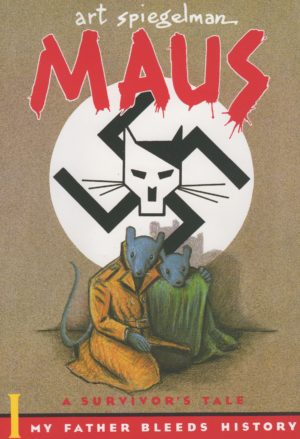
Maus (I)
I made a mistake. I bought my first-ever graphic novel thinking that this was the entire story of mice being rounded up by cats as an allegoric rendition of the Holocaust. Turns out, I only bought the first half of Spiegelman’s classic at Books & Books at the Studios in Key West. Oh well. Reading Maus on the plane coming home, I was glad I’d finally decided to break a fast from comics that has lasted since I stopped reading Mad Magazine in my late teens. Wait: That’s not entirely true. I read the comics in the Duluth News Tribune on a daily basis. But beyond that, I’ve been away from graphic stories for nearly fifty years.
Spiegelman’s book isn’t just a chronicle of mice and cats, good and evil. There’s that, for sure. But it’s also the revelation of the author’s relationship with his father and step-mother: That subplot is negotiated by readers alongside Spiegelman’s unveiling of Hitler’s evil. The drawings are stark and in many ways, prescient of the Final Solution through intimation rather than direct depiction.
This is a book (including Maus II) that needs to be read by every middle school child in America given the present undercurrent of demonizing immigrants and The Other. A nicely drawn and told tale that I am forced to give a lesser rating only because, well, the whole story isn’t in this one volume!
4 stars out of 4. Would be 5, I am certain, if the entire tale was in this book.
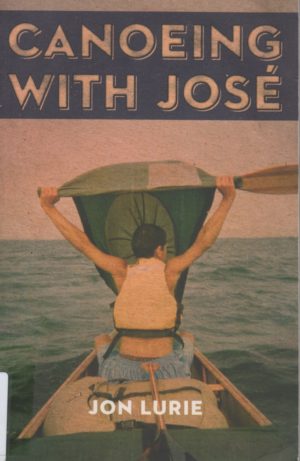
Canoeing with the Cree by Eric Sevareid (1968. Minnesota Historical Society. ISBN 0-87351-152-2)Canoeing with José by Jon Lurie (2017. Milkweed. ISBN 978-57131-321-8)
My friend, Kenny Hubert, finally got me intrigued enough in Sevareid’s meditation on youth, danger, and the far north for me to pick up a copy of Canoeing with the Cree last fall. Why was I inspired by my old friend to read an old book? Simply put, I was enthralled by Ken’s rendition of the trip that he and his brother-in-law Keith took replicating Sevareid’s epic northward paddle from Minnesota to Hudson Bay. I’d heard of Sevareid’s book, chronicling his journey from St. Paul to York Factory in a canvas and cedar strip canoe with a buddy (Sevareid was 17; his partner, Walter Port was 19), and had always wanted to read the narrative of that trip but never quite got around to it. When Ken related his version of his trip (which began in Keith’s hometown of Crookston and followed the Red Lake River south to its confluence with the Red River of the North-the river Sevareid and Port navigated to Winnipeg and beyond), it compelled me to locate a copy of Sevareid’s reportage. I found a used copy of the book but didn’t get around to reading Canoeing With the Cree until I was on vacation this winter. Here’s my take.
For anyone with wanderlust or a love of the out-of-doors or paddling, though it’s been said a million times, I’m certain, Canoeing with the Cree is a must read. Sure, as I’ll detail when reviewing the book’s anthesis, Canoeing with José, Sevareid’s journaling of a dangerous and arduous trek by water contains many pejorative references to Native American tribes, people, customs and the like. Modern commentators have criticized Sevareid-and rightly so-for his lack of cultural sensitivity when dealing with the scenes in the book involving his interactions with Native people; the very people who saved Sevareid and Port from injury, disaster, and death. But such objectionable references must be read in the context of Sevareid’s young age, his inexperience with indigenous people, and the times in which he lived. That said, the author does make it clear that he and Port would have never completed their journey, and likely would have perished, but for the kindness of strangers-white and non-white-met along the way. The criticisms of the book based upon today’s cultural sensitivity and knowledge of the travesties committed, both in the US and Canada, against the Sioux, Ojibwe, and Cree are spot on. But there remains, beneath that tarnish, a gem of a road story of two young men challenging themselves and nature.
As I relate below, when compared with a more recent reportage of a similar journey, Canoeing with the Cree loses a bit of its original luster. Sevareid’s prose is fairly simple and his themes and commentary seem dated. Still, this is an epic “buddy tale” that shouldn’t be missed just because some of its content isn’t politically correct.
4 stars out of 5.
Canoeing with José.
I bought Sevareid’s book at my favorite Bayfield, Wisconsin bookstore, Honest Dog Books (http://honestdogbooks.com/). Julie, one of the thoughtful owners, was the one who suggested, since I was going to read Canoeing with the Cree I should also pick up Canoeing with José. I followed her advice and I’m glad I did!
Jon Lurie, a Jewish guy with absolutely no wilderness canoeing credentials, befriends (maybe that’s too strong a term; theirs is a thorny and stormy relationship) José. The connection begins when Lurie is asked, because José is working as an intern on a a Native American newspaper, The Circle, to mentor the teenager whose ethnicity includes Puerto Rican and Lakota heritage. Things get off to a rocky start due to José’s reluctance to open up to Lurie about the trauma-both historic and personal-that has defined his young life. But, when Lurie suggests the two of them retrace Sevareid’s and Port’s journey as a means of spiritual cleansing and rejuvenation, José agrees.
It must be pointed out that the modern-day paddle up the Red River into Canada and beyond has several critical distinctions from the voyage Port and Sevareid embarked upon.
Lurie and José began their paddle on the Red River, choosing to begin their trip not in the Twin Cities as the original pair did but at Breckenridge, Minnesota, where the Otter Tail and Bois de Sioux Rivers converge to form the Red. This is significant, not in the literary sense but in the historic sense, because the first five chapters of Canoeing with the Cree detail Sevareid’s and Port’s miserable paddle up the Minnesota River and its connectors before arriving at Lurie’s point of departure. The original trip, as detailed in Sevareid’s book, took a full three weeks of work to complete; an additional three weeks of hardship that the modern-day team of canoeists avoided.
In addition, Sevareid and Port paddled, with minor exception, nearly the entire length of Lake Winnipeg, a distance of some 260 miles from north to south in a straight line. Of course, paddling a huge body of water in an eighteen-foot cedar and canvas canoe isn’t practicable; careful canoeists like Sevareid and Port meander from protected island to the shoreline, working their way gingerly northward, avoiding open water whenever possible. By way of contrast, Lurie and José transported their modern-day canoe by rental car to the north end of the lake, avoiding much of the consternation and danger that confronted and confounded the original journeymen.
Once the 21st century canoeists reached Norway House, they entered a series of rivers and lakes flowing north to Hudson Bay by way of the Hayes River system. According to both accounts, that’s the traditional route of the Cree and white trappers and adventurers seeking to paddle from Lake Winnipeg to York Factory. In 1930, when the boys made their trek, the Hayes was in the midst of drought. This required Sevareid and Port to change plans and head north by way of Gods River, a route rarely, if ever used, to reach Hudson Bay.
Canoeing with José is far less a story of wilderness survival and heroic exploits than Sevareid’s work.There is an element of that, to be sure, in Lurie’s account, especially given the relative lack of skills both he and José possess in regards to such an endeavor. But the guts of the newer tale is an introspection by Lurie and José juxtaposed against the history of white privilege and the shameful treatment of Native Americans and Indigenous Canadians. In many ways, this deep dive into history, a history that José feels in the every day stares of white folks he encounters in his hardscrabble life in the Twin Cities but has no real understanding of beyond intuition, is what makes Lurie’s work more compelling, more engaging, and ultimately, more compassionate than Sevareid’s. To be fair, Lurie was 34 and living in our contemporary world when he penned his book; Sevareid made his journey when he was 17 and published his story in 1935, when he was only 22 years old, writing at a time when there was little understanding amongst the majority white populations of the US and Canada of the cultural damage governmental policies had imposed upon the Indians of both nations. That having been said, Canoeing with José is the better written of the two in terms of overall style, language, story, and present day relevance.
One cannot discount the bravery, tenacity, and endurance exhibited by either pair but the later chronology is far more complex and detailed in its examination of what such journeys mean in the context of history and where we are today in terms of understanding that history. 5 stars out of 5. I’d suggest that book clubs and/or readers read both books, in sequence of publication.
Peace.
Mark
Posted inBooks|Comments Off on Two Epic River Tales
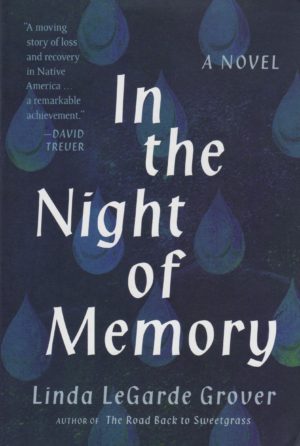
In the Night of Memory by Linda LeGarde Grover (2019, U of M Press. ISBN 978-5179-0650-4)
This newest effort by Duluth’s own Linda LeGarde Grover takes a bit of getting used to. What do I mean by that? Here’s my take.
In Memory, we follow the story of two Ojibwe sisters, Azure and Rain, from the moment their mother turns them over to the St. Louis County Social Services (welfare) Department to adulthood. Along the way, we meet caregivers kind and cruel, relatives from the Mozhay Point Reservation, strangers, and we find ourselves as observers moving with the girls on their journey from one foster home to another. The thing is; this is not a traditional linear narrative in a writing style most readers are familiar with. Having read Ms. Grover’s prior collections of short fiction (I’ll be honest and admit I haven’t read her poetry), I was expecting to find a replication of the storytelling used by Ms. Grover in her shorter pieces. It’s a style that is very reminiscent of Native American oral storytelling, a style I am familiar with having listened to many Ojibwe and Lakota and Cree parents, tribal social workers, and attorneys who appeared in front of me during my tenure as a district court judge. I’m happy to say that cadence and speech and tenor is honestly and authentically replicated in this novel.
There is, however, for the non-Native, some work needed to be done by the reader in following the twisting, turning, constantly changing narrative of the girls’ journey. But it’s an enjoyable task similar to that experienced by a white person diving into the diction and cadence of Hurston or other African American writers who remain loyal to their heritage in their writing. It’s work that some readers who prefer their storytelling more straightforward and easy to discern might shy away from after the first few chapters. That, in my view, would be ill-advised: Read the book to its conclusion and wonder about our nation’s treatment of Native Americans, the poverty of the reservation system, the hordes of young Native women gone missing, and the removals of whole tribes and children from the land and culture that nurtured their way of life.
In the end, this is a lyrical work, one chock full of lovely moments, dark sequences, and an awareness of heritage.
4 stars out of 5. A worthy, short read for any book club.
Peace.
Mark
Posted inBlog Archive|Comments Off on A Native Story Told In Native Style
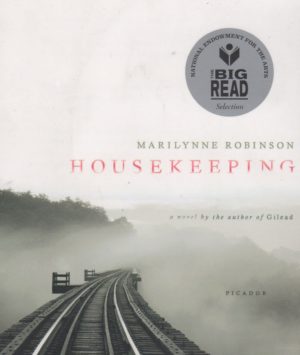
Housekeeping by Marilynne Robinson (1980. Picador. ISBN 978-0-312-42409-1)
The sticker on the cover makes it plain: Someone decided that this was a book worthy of a community read. Why else would it have been selected bu the NEA as a “Big Read”? But here’s the thing: After reading Robinson’s slender and beautifully phrased novel, I can’t figure out why the NEA found it so compelling.
Oh, I’ll grant you that the author knows how to write complex, intricately woven prose. In many ways, my reaction to the style used to flesh out this sparsely themed novella-seeking-novel-status never changed from the first chapter to the last: “Oh, she’s written an extended prose poem. How lovely.” But as I kept at it, reading snippets of the novel before bed and in the bathroom and finally, as I unwound after a long day at Heikenpäivä in Hancock, MI where I was appearing as the featured author, the same puzzlement intruded upon my enjoyment of the book: “Where’s the story?”
Set in the mythical, lakeside, western town of Fingerbone, there’s a little Russell Banks, a bit of Anne Lamott, and a smidgen of James Burke to the style and tone of Robinson’s work here. The plot, if that’s what one can call the backbone of this lengthy short story, is that all of the adults in the lives of sisters Ruth and Lucille, have either died or left, rendering the children orphans to be ultimately cared for by a maternal aunt, Sylvie. Sylvie is eccentric and unusual and well, a very hands-off sort of gal, leading to lapses in nutrition and care and schooling and the like for the girls, culminating in the expected: The local sheriff steps in to inquire as to the girls’ welfare. Maybe I’m too linear of a reader and a writer to get it. Maybe I’m just a dunderhead who needs to expand his mental capacity and enjoy a book, not as story or storytelling, but for its bones, for its well-crafted wordsmithery.
Perhaps these things are true, that it is a deficiency of the reader and not the writer that left me puzzled and unsatisfied at the end of Housekeeping. I’m open to that possibility. But for me, while the words all seemed elegant and orderly and keen, the end result of my time spent in Fingerbone was disappointing. 2 and 1/2 stars out of five.Pen/Hemingway? Maybe I’m missing something …
Peace.
Mark
Posted inBooks|Comments Off on A Long Journey to Nowhere
You can read the obituary in the Alexandria and Benson
newspapers or online. But words are an imprecise means of describing the life force that was Susanne. Let’s take a step
back and figure out who this tiny bundle of energy was, shall we?
First off,
she was the daughter of Jack, a Slovenian immigrant-miner-turned-coal-salesman
who quit school in the 8th grade, and Marie, a Normal-school-educated
teacher from Oak Park, Illinois who played piano at Zimmerman’s silent movie
theater in Aurora, Minnesota. Such different, disparate backgrounds and yet,
when Marie toured the mine where Jack worked at the time, it was love at first
sight.
Secondly,
Susanne was a sister to Barbara Jean who was four years older. The petty
snarking and disagreements that come from knowing your only sibling for over 80
years were never an impediment to Susanne’s love for Barb or Barb’s love for
Susanne.
Sukey was
also a wife. You won’t read this in her obituary but I feel it’s important for
you to know: Susanne was the survivor of domestic abuse. Now some might ask:
“Mark why bring that up at your aunt’s memorial service?” Here’s the
thing: You cannot understand, you cannot appreciate the toughness, the grit of
that little woman unless you know the truth. And the simple truth is Susanne is
a strong Christian woman who, with the help of her blessed Aunt Mary—Grandpa Jack’s younger sister—and
Barbara and other friends and family, healed and moved on. She made a
commitment: To not let one unhappy episode erode her faith in humanity. Which
is how she was able to say “yes” to Paul Pederson when, after years of
confirmed bachelorhood, the most eligible single man in tiny Benson, Minnesota
fell hard for the little, dark-haired woman with the college degree over coffee
in a small town café. In all ways that matter, Paul was Susanne’s first
husband, the love of her life, and, as you are likely aware, the father of
their two lovely daughters. One of my favorite people, Paul died far too young,
leaving Susanne, as both Julie and Heidi attest, the single parent of two
school-aged girls. Again, Sukey’s fiercely resilient heart led her to seek
happiness and companionship, albeit of a different sort, with her second
husband, Wayne Schuler. Together, Wayne and Susanne bought and renovated a home
in East Duluth and a farmhouse near Two Harbors. It wasn’t easy at the end with
Wayne living in an assisted living facility and Susanne tending to their rural
home. But my auntie was up to the task until her own health concerns started to
wear her down. It wasn’t long after Wayne passed that Susanne agreed (don’t get
me wrong: it took a bit of persuading!) to move closer to her family.
Of all the
roles that Sukey filled, however, none made her as proud as that of mother.
Julie and Heidi, know that, along with Susanne’s grandchildren and
great-grandchildren, you are the precious legacy of your mom’s love. I think
she knew it was her time, and, having seen her loved ones over the holidays,
and having fought heart and kidney maladies for so long, she decided “To heck
with this. It’s time to see Paul, have a screwdriver, and see if I can get Paul
and Harry to argue politics.” As an aside, your mom loved my old man. She never
had a bad word to say about Harry, not even after he and mom divorced. He
pitched in and helped Sukey solve some pretty thorny issues involving Paul’s
estate. Picture the three of them, sitting around playing gin rummy, having a
cocktail, your old man, the Republican from Swift County, having it out with my
dad, the Liberal from Duluth. I’m hoping that they’ve all learned their lesson
and aren’t smoking up there. But who knows? Anyway, it was in her role as mom,
even when she had to parent alone, where Susanne truly shined.
She was, of
course, also an auntie to me and my siblings, Anne and Dave, and a dear friend
to many people. There are so many stories I could tell but time is short and
maybe, the best way to make you understand our relationship is by explaining
how her beautiful little memoir, Back of Beyond, came to be.
For years,
Susanne talked about the manuscript she was working on; something to do with Buena
Vista, the resort her parents owned. Given I’m an author I’d ask her, “Hey, when
are you going to let me read your stories?” Year after year she’d put me off.
Until finally, she didn’t. She’d had the manuscript typed but left it to me to upload
her words into my computer and edit the work as best I could. When I handed her
the edited version of her words, she didn’t complain or balk or object or
argue. She cried. After we sat at her kitchen table, pouring over photos to
insert in the book, she cried again. When she saw the cover my wife René
created for Back of Beyond, still more tears. But she saved the biggest
cry of all for when she held the completed book, all 154 pages of her life, her
blood, her sweat, her family, in her hands fresh off the printing press. Being
the person she is, she thanked me and René and my son Chris for all our help
bringing her dream to fruition. But you wanna know the truth? Working with her
on that project, it was she who gifted us with her trust and her grace and her
steadfast belief in what we were trying to achieve.
Once she
had her stories in hand, she was, as in everything else, a whirlwind. She and
Wayne and my mom and friends and relatives drove hither and yon, that little
short Slovenian lady hiking up her skirt, grabbing a handful of books, and
charging into every bookstore and gift shop in NE Minnesota. She sold out two
printings, all by herself, her success resting upon an unrequited desire to
tell the world what a blessed childhood she’d been granted. Her story and the
story of Jack and Marie and Barbara Jean continues today. How so?
Aunt Sukey lived
long enough to see the Buena Vista Resort repurposed into a YMCA Family camp
that serves inner city folks. Last summer, even though she was feeling poorly,
Auntie made it to the dedication of the new camp and signed copies of her book
for adoring fans. Daughter Julie and son-in-law Brad, along with Grandson Caleb
and his husband, Nestor, made it happen. Despite her frailty, Susanne beamed at
the attention she and her words received that day. I felt so honored to attend
the dedication with my aunt, my mom, my son, my grandson, and my wife. It
wouldn’t have happened, the Kobe family being remembered in such fashion, had
Sukey not told her story.
Did you
know, Sukey was a television personality? It’s true. Her first job after
graduating from the Villa (now St. Scholastica) was as an extension agent,
which got her a gig on the locally produced, “Dottie Becker Show”, where she discussed
nutrition, recipes, and other home economics topics. She also worked as a
chemical dependency counselor at Project Turnabout in Granite Falls; was the
manager of her church’s traveling youth choir in Benson (even going to Japan on
tour!); worked hard for many charitable causes; was active in both ELCA and
Episcopal churches in Benson, Duluth, Hermantown, and Knife River; and was a
licensed lay preacher, giving sermons in the Episcopal church, many of which I
heard as a member of the congregation. I relished her take on faith, not only
because of her spirituality but because she valued brevity: Say what needs saying
and get on with the service! She was a tireless supporter of the Friends of the
Two Harbors Library and a lover of great books.
When it
became difficult for Wayne and Susan to make the long drives to spend holidays
with Julie and Heidi and their families, Wayne and Susan spent many
Thanksgivings and Christmases at my home in northern Minnesota. Again, it was
my family; me, René, and our children who were gifted by the presence of
Susanne at such gatherings. She was an intelligent, loving, kind, gal who
didn’t put up with shenanigans or nonsense and could spot both at the drop of a
pin. The hour is late. My time to talk has run its course. But before I go, let
me share some final words, words written by Susanne Kobe Pederson Schuler (Anna
Marie in the excerpt), with you:
Years
later, long after the resort was sold and her life had taken its course, Anna
Marie was sitting at her kitchen table sipping a cup of coffee. Her house was
silent. It was so quiet; you could hear the ticking of the grandfather clock in
another room. Outside the kitchen windows stately birches bowed with the wind
towards a stand of majestic pines. The woodsy setting in her own yard reminded
her of the resort.
Old photographs and one of Mother’s old journals lay on the table next to her empty coffee cup. One by one Anna Marie picked up the pictures and studied them. The photographs had been removed from old albums because Anna needed to add names and dates to the back of each one. Mother’s journal had a black leather binding. The pages had yellowed over time. Leafing through the journal, she found a short lovely poem written in her mother’s hand, author, unknown. She read the words aloud:
Life
Each life is like a changing flower
Like petals pale or colored free
The years slip by drop
Softly hour by hour
And leave rich seeds of memory.
Anna
Marie wondered, as she took up her pen to write her own words, her own story,
if the act of writing down what she remembered would mean that the journey was
finally completed.
Never, she thought. The journey will continue through the years, slowly, day by day. One
memory will recall another, each memory precious, bittersweet, funny. Memories
shared or kept private; memories of that special place, a place held close to
my heart, the Back of Beyond.
(Excerpted from Back of Beyond, by
Susanne Kobe Pederson Schuler)



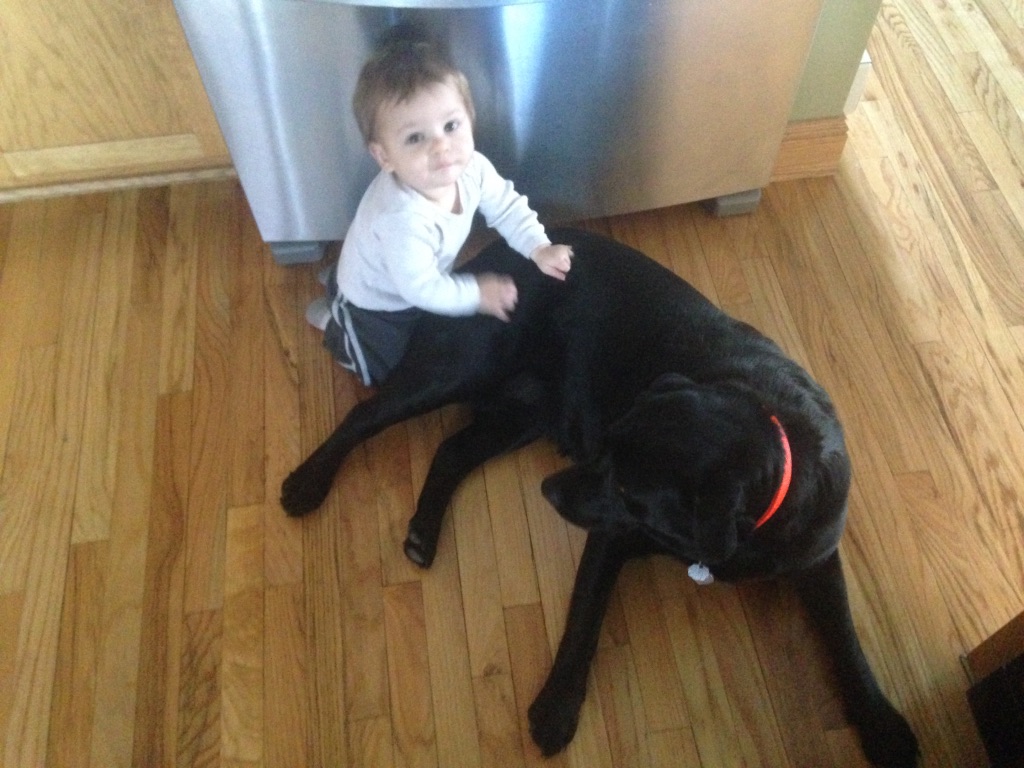
 (Text photo sent to René from Matt’s truck).
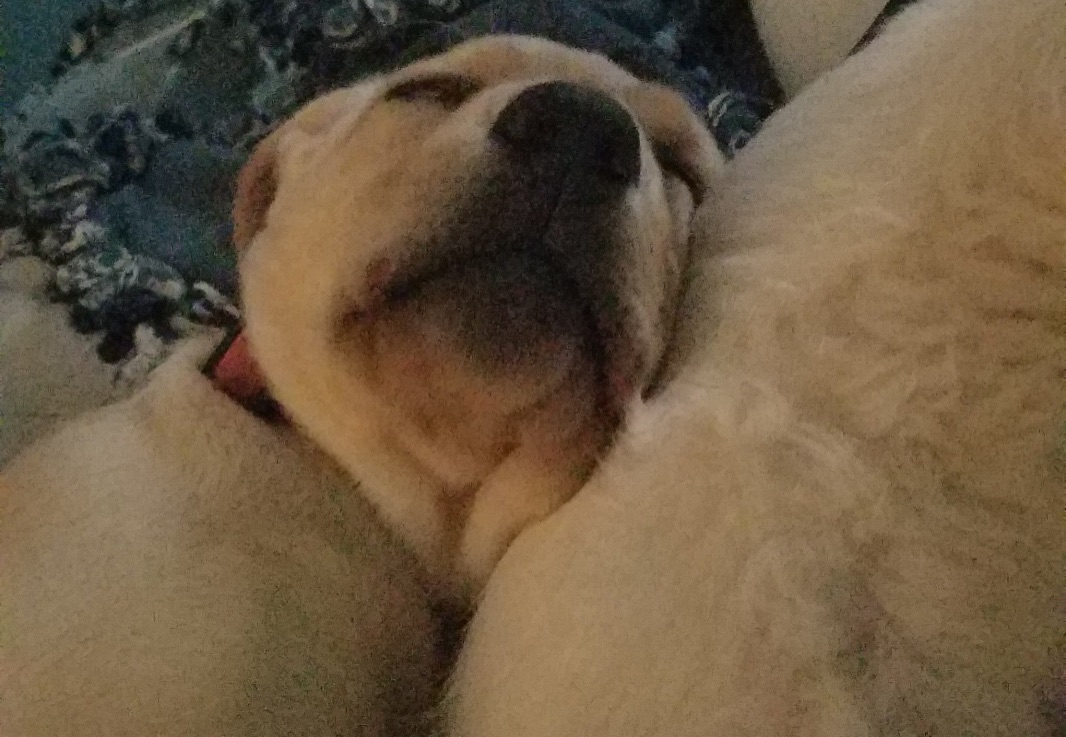
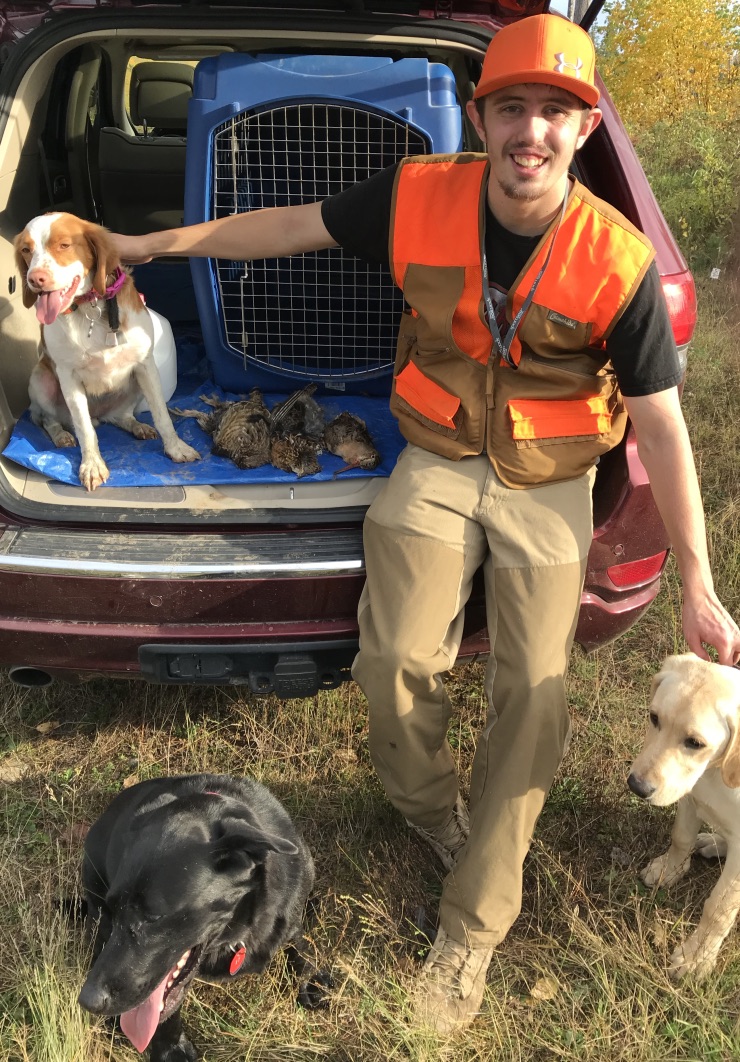
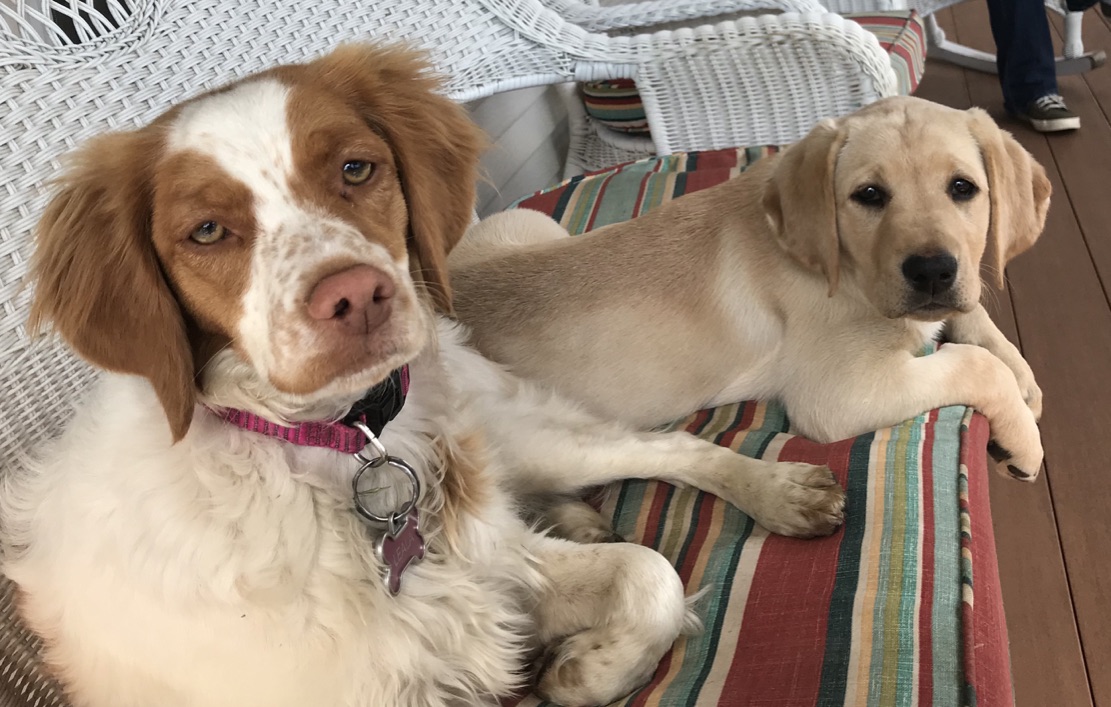 Leala. Violet formed sisterly bonds with both her canine roommates. But whereas Kena tends to be somewhat aloof and her “own girl”, Leala, despite the constant nibbling on her neck by the puppy took to Violet. The two pooches spent much time nuzzling and cuddling. When four Mungers and an Amborn hunted Ashley last fall, we had our three dogs plus Matt’s new Labrador pup, Greta. But with torrential rains, wet and muddy fields, standing crop, and Leala being sprayed in the face by a skunk (after being encouraged to flush what Jack and I were sure was a rooster pheasant), our trip to the southern edge of the state was dismal. Which is why I decided to use my second week of hunting in the northwestern corner of the state where my son Dlyan, his wife Shelly, and their kids live.