All Things Goodman

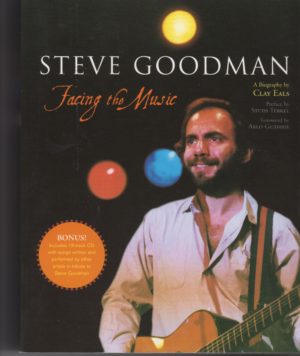
Facing the Music by Clay Eals (2006. ECW. ISBN 976-1-55022-732-1)

I want you to close your eyes. It’s 1977. You’re in a college ballroom on the campus of a medium-sized public university. The house lights are low. You are sitting on the floor cross-legged next to the girl you want to marry. There are maybe 100 other students and faculty sitting on the floor or in folding chairs arrayed in a circle around a microphone stand. A short, slightly rotund, long-haired Jewish boy from Chicago steps from shadow into light and confidently plants himself in front of the microphone. An acoustic guitar hanging from a strap will remain unplayed throughout the first song.  The singer, his brown eyes clear and bright, begins an a Capella lament:

Oh my name is Penny Evans and my age is twenty-one
A young widow in the war that’s being fought in Viet Nam
And I have two infant daughters and I do the best I can
Now they say the war is over, but I think it’s just begun.

If you can visualize the scene and hear Goodman’s voice, then you will understand how that concert remains, for me, along with seeing Bruce Springstreen perform live, on of the favorite musical moments of my life. “The Ballad of Penny Evans” was born of genius: a man singing in the voice of a war widow about the loss of her husband and what remains. And yet, unlike some other great songs written during the 1970s, it’s a song that very few folks know or appreciate. I’ve heard it performed publicly just twice in the thirty-three years since Goodman’s untimely death in 1984. Once in an Irish pub in St. Paul by a local dude simply making music and once, in my own voice, as I stood scared as a school girl in front of a live audience as the MC for Law Law Palooza at the Clyde Iron facility in Duluth raising money to provide free lawyers for the indigent. I’m pretty sure the dude in St. Paul hit the mark. Not so sure about me. But that’s the impact seeing Goodman one time, long ago, had on me. I bring all of this up as an introduction to my review of Clay Eals’s massive (778 page) biography of the singer/songwriter who wrote not only “Penny Evans” but some other very, very notable tunes, including “The City of New Orleans” (recorded by Arlo Guthrie, Johnny Cash, and Willie Nelson, to name a few), and “You Never Even Called Me by my Name” (a country hit for David Allen Coe). In between these well known songs, Steve Goodman penned such classics as “California Promises”, “The 20th Century is Almost Over”, and a host of others. But despite a great storyteller’s voice, mastery of the acoustic guitar, a wicked sense of humor, and a knack for creating memorable lyrics, Goodman never achieved universal acclaim. That’s the story Eals so painfully tells, along with Stevie’s 15 year-plus battle with leukemia, his roller-coaster marriage to Nancy, and his doting affection for his three young daughters. And, despite a misstep or two (sometimes bordering on redundancy) Eals manages to keep the life story of this beloved but obscure genius in focus throughout this massive read. The question I have to ask myself as I consider how to rate this book, how to fairly evaluate the over 1,000 interviews Eals conducted (with musical legends such as John Prine and Mary Stuart and Jackson Browne, and non-musical folks such as Hillary Clinton (who attended high school with Steve)) and mountains of newspaper and other written references that the author consulted to create a complete life of a man who died underappreciated by the general public, is this: Would anyone other than a devoted Steve Goodman fan or a Chicagoan want to read this tome? I think the answer is an unqualified “yes”. Here’s why.

First, Goodman was an Everyman, a Midwestern boy raised in a suburban, middle class neighborhood whose dad was a war veteran from the Greatest Generation, and whose Mom encouraged his career through its ups and downs, who, upon learning of his fatal cancer diagnosis just out of high school, was determined to “make it big”. He tried, like so many of us in the arts have, through sheer will of effort and personality and ability, to convince The Man (i.e., record company executives) and the public of his worth, wanting the brass ring so badly that, as Eals points out, he even moved his family to California in the misguided belief that being closer to the record producers would give him his “big break.” Instead, we learn that, as Steve’s studio career tanked (he was axed by both Buddah and Asylum), live audiences, from those who saw him on the “Austin City Limits” stage to fans attending over 200 Steve Martin concerts, loved him. Having only seen Goodman once, and having been enthralled with his story ever since, I can attest that, just like The Boss never leaves a stage without expending the last drop of sweat from his body, Steve Goodman was cut from the same cloth. When he performed live, he was “all in”. So it seems to me that anyone with any sort of unfulfilled aspiration, whether it be in music, writing, the arts, or some other endeavor,  will appreciate the painstaking narrative created by the author to depict Goodman’s slender successes and luminous failures.

And then there is this: I’ve read many other memoirs and biographies of musicians, from Woody Guthrie to Neil Young to Dave Crosby to Springsteen and Clapton. I’ve found them all fascinating looks at how musicians find success, hit the wall at some point in their careers, and then recover. But none of those books tear back the curtain so we are there, in the moment, both on stage and in the offices of the record company executives making deals, like this compilation does. In addition, Eals takes great care to memorialize the songwriting process, both Goodman as a solitary bard scribbling away on his own, or during the collaborative chaos Goodman engaged in while penning masterpieces with John Prine, Mike Smith, Jimmy Buffet, and a host of others. The depth and complexity the author ascribes to the process of songwriting is something to behold and, by itself, makes this biography a worthy read.

In the end, the book is long-winded but beautifully written. The language is direct, concise, and never flowery or cumbersome. And, I sort of get why Eals wanted to include everything in this book. I did the same thing in my biography of my late uncle, State Rep. Willard Munger (Mr. Environment: The Willard Munger Story). I knew, as Eals did, that no one else was going to pen a biography of his subject, at least not one that would conclusively document the life of someone so iconic yet so underappreciated. And so, Eals, left in anything that was revealing about Goodman’s life and creative process.   In the end, I think that’s a definite plus. The world can now understand the background, struggles, and brilliance of the man who wrote, what Johnny Cash once called, “The best damn train song ever written…”. 

Singing Penny Evans.

4 and 1/2 stars out of 5. 5 stars if you are a Steve Goodman fan. It is a must read for you if you’re in that category!

Peace.

Mark
 

Posted in Books | Comments Off on All Things Goodman

Finally Finished

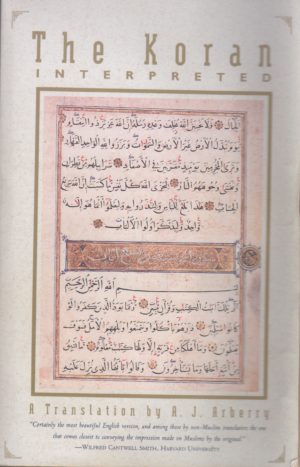
The Koran Interpreted (translated by A. J. Arberry) (1996. Touchstone. ISBN 9780684825076)

As with my reading of The Book of Mormon, this is a review of the literary merit of one of mankind’s most beloved scriptural texts, The Koran. It is not my attempt to critique or disassemble the theology of Islam: I will leave that to the scholars. I am just an average, ordinary American, raised Christian amongst other Christians and a smattering of Jews and nonbelievers, who is trying to understand the basic tenets of a faith that underpins many of the lives, cultures, and social orders of the latest immigrants to the United States. So take what I observe and write here in the spirit in which it is written: as a critic of the language, writing, and structure of The Koran, not as a criticism of The Book’s core beliefs.

First, the repetition. Gehenna, a Biblical valley that appears in Hebrew scripture, is referenced, by one account, more than 70 times in The Koran. I gave up counting how many times the terms “chastisement” (as in “the unbelievers will suffer a great chastisement”) and “punishment” appear within the suras (chapters) of the book. This constant refrain of salvation and damnation, the repetitiveness of the text, may well, when read aloud in a mosque or recited by heart at prayer, reinforce the central themes of the second largest religion in the world. (One source has Christianity as the largest at 33% with Islam second at 21% of the world’s population; USA Today predicts that by 2070, Islam will supplant Christianity as the world’s largest faith community.) But when read as a complete text, from beginning to end, this consistency becomes redundant. I found this repetitiveness reminiscent of the overly repeated refrains found in The Book of Mormon, though, to be fair, The Messenger’s collection of revelations and scripture precedes Joseph Smith’s discovery by 1,200 years, making The Koran a likely source of inspiration for the Mormon prophet’s revelations. One thing that sets The Koran apart from Smith’s retelling of the contents of the golden plates is the language. Whereas Smith, an uneducated and illiterate religious searcher, relied upon a tone and tenor that was pedestrian and ordinary in its prose, The Messenger’s presentation of the Eternal Book is, despite also coming from an oral tradition, far more polished and, in some suras, reaches the poetry of The Bible:

Hast thou seen him who lies to the Doom? That is he who repulses the orphan and urges not the feeding of the needy. So woe to those that pray and are heedless of their prayers, to those who make display and refuse charity.

(Sura CVII)

This is not an easy text to read. And I am certain that if I was privileged to hear the verses and suras recited in their original Arabic, there would be a flow, a magic to the words that transcends even the best English translation of this compilation of revelations from the Divine. But even in English, The Book displays moments of linguistic clarity and beauty; and, departing from my initial premise (that I would not delve into theology) much of what radical Islam is preaching and acting upon (jihad being raised against children, women, the old, and the infirm in the name of God) is nowhere to be found in this book. Certainly, just as with Judaism and Christianity, there are facets of a faith that come from customs and practices created over millennia of observance, some of which may support suicide bombings, kidnappings, beheadings, and the murder of noncombatants or captured combatants. But I did not, in my time with The Koran, find those practices ingrained in the spiritual message of this book. As a Christian, I may be troubled that The Messenger defines Christ not as God embodied on Earth, but as a mortal prophet akin to Moses and Noah. In addition, there is a theme of evangelism to the text; the need to convert unbelievers to The Book that mirrors Paul’s exhortations to conversion in the New Testament. But The Koran incorporates both Jews and Christians into a larger, monotheistic framework of faith, considering those religious bodies to also be People of the Book. Perhaps the world would be a better, calmer place if Jews and Christians extended the same courtesy to Muslims.

Reading The Koran was not easy but it was enlightening and, given the world we live in, essential for non-Muslims to at least attempt.

4 stars out of 5. The book is, as indicated, rated for literary merit, not its spiritual content.

Peace.

Mark 

Posted in Books | Comments Off on Finally Finished

Home Improvement

New microwave after the “easy” install.

“Rene’,” I called out across the kitchen, “I think the microwave is dead.”

The appliance was installed 17 years ago when we built our new house along the banks of the wild and scenic Cloquet River. Our contractor installed the under-the-counter, over-the-stove model that served us well for nearly two decades. But, after repeated attempts to resurrect the dawdling unit, I came to the unfortunate conclusion (unfortunate because who wants to spend extra money just before Christmas on an appliance?) that the life source of the microwave had indeed given up the ghost. After reaching this fatal conclusion, Rene’ and I trundled off to Home Depot to check out new microwaves.

Now, I won’t lie. Home Depot is my kind of store. Generally speaking, if I can’t buy it at Menard’s, Home Depot, Walmart, Dick’s, or a bookstore, I detest shopping.  So when my wife and I stood staring at the plethora of shiny, black and stainless steel compact ovens hanging from fake cabinetry at Home Depot, I wasn’t all that miffed about having to shop.

“Can I help you?”

The store was quiet and the clerk who stood behind us had plenty of time to tend to our needs. We talked wattage. We talked warranty. And then, because the new unit was going to have to fit above the range and below cabinetry, we talked size. Now, understand, I had, in my best “Tim the Tool Man” fashion, measured the dimensions of the space the new microwave would occupy. I hadn’t brought the ruler with me to check whether the GE would actually fit where we wanted it to fit but when I asked about the unit’s size, I heard nothing but reassurance.

“They’re all standard. Just take down the old unit, remove the wall bracket, install the new wall bracket, hang it, and you should be go to go!”

I was skeptical that my meager carpentry skills would allow me to get the thing mounted and operable but the clerk was very reassuring.

“Not a problem. We do offer installation but we’d have to charge shipping and delivery as well.”

“How much?”

“I’d guess around two-fifty.”

The price tag of the microwave was two-fifty. I was looking at either attempting the job myself or paying two kids in blue jeans with body art and piercings an amount equal to the cost of the new unit to drill a few holes, mount a bracket, and tighten down a half dozen bolts.

“Whatdathink?” I asked my wife. (I’m not sure I officially involved her in the discussion. But for sake of blameworthiness, I’ll include her response, real or imagined.)

“I think you can do it.”

“OK then.”

Later that afternoon, I called my son Matt to come over and help. He was occupied with the kids so I decided to begin the process of removing the old microwave without him. After pulling the range and oven away from the wall, I stood on a step stool, opened the upper cupboard, unplugged the dead microwave, and loosened the screws holding the unit. When the screws were mostly free, I asked Rene’ to hold the unit while I completed the task. Then, easy peasy, I tilted the microwave away from the wall and removed it from its wall bracket. I took a look at the existing bracket and the rear of the new unit. Just as the store clerk had warned, the new stove wouldn’t fit on the old bracket. I needed to remove the old bracket and install the new one so the bracket’s metal tabs lined up with slots in the back of the microwave. As I began to remove the existing bracket, I noticed the first major issue with my “do-it-yourself” approach.

“Shit.”

“What?”

“The contractor.”

“What about the contractor?”

“When his guys mounted the microwave, they stripped two of the lag bolts holding the bracket. I can’t use a wrench or a vise grips to get them out.”

I stared at the offending bolts, the heads stripped and useless. A solution made itself apparent. A half hour later, after cutting the bracket away from the ruined bolts with a tin snips, repeatedly bending and twisting the metal until it came free, the old bracket lay in a crumpled heap on new snow outside our back door. I measured the new bracket, found the studs in the wall, and had it mounted in a matter of minutes.

“Help me set the new microwave on the new bracket,” I asked Rene’. Matt still hadn’t shown but the GE wasn’t all that heavy. The two of us easily lifted it in place.

“Shit.”

“Now what?”

“The clerk…”

“What about the clerk?”

“One size fits all. Bullshit. The new microwave is too tall for the opening between the tile backsplash and the bottom of the cabinet.”

“Oh.”

“We’ll have to take the microwave down, remove the new bracket, and chip out at least two rows of tile.”

My wife’s eyes grew wide. She’s the craftsman in the house. She had, without a word of it to me, gone out and bought the tiles, the grout, and whatever else she needed, and installed a backsplash of small, metallic tiles around the kitchen cabinetry. It was a masterful job, one that I could never have replicated. And now, here I was, suggesting I was going to take a hammer and chisel to her masterpiece.

“Ah, maybe I should do that.”

I shook my head. We set the new microwave on the hardwood floor. “No, I’ve got this.”

After a half hour of steady diligence, I managed to remove two rows of tile without damage. Matt arrived as I was re-hanging the new bracket. “Help me set the microwave on this bracket,” I said. We did. The unit fit snugly between the cabinet and the backsplash. But there was another problem. In my OCD zeal to toss out the extraneous, I’d tossed the template needed to drill holes for the two bolts running from the cabinet into the top of the microwave. The old holes in the base of the cabinet didn’t line up with the holes in the new unit and without the template, I’d have to resort to guessing. I slid on my boots and wandered out to the garbage can. I dug and dug and dug but couldn’t come up with the template.

“Shit,” I muttered as I stomped snow off my boots, slid them off, and padded back into the kitchen.

“What’s wrong?” Matt asked.

“Nothing. Let’s see if we can line up the bolts with the microwave.”

After a couple of false starts, with Matt holding the microwave and the tabs of the new bracket holding the unit in place, I managed to get one lag bolt locked in place. “Damn it,” I yelped, my four year old grandson Adrien within earshot, “this second bolt just won’t line up.”

I’ll spare you the back and forth that took place over the next hour as I drilled the hole larger, as Matt raised the unit up, as the bolt refused to take, as more colorful words were expressed by Grandpa. At one point, Matt climbed the step stool and tried to adjust the unit so the bolt met up with the hole in the unit. No one noticed Matt was standing on the stove top while he worked. After additional moments of futility, I removed and inspected the second bolt. “This $#@! thing is stripped!” I said. We took the unit down off the bracket. I walked out of the house, into the garage, found a hacksaw, and cut off the last 1/4″ of the bolt. I was pretty darn upset by this point. But I was still, despite time wasted, money ahead.

Until.

“Goddamn it!”

I won’t sugar coat it. That’s what came out of my mouth when I mounted the step stool and Matt pushed the unit back on the bracket, holding it in place, and I placed my foot on the top of our stove for more leverage. My foot met the ceramic top of our range. Glass gave way under foot.

There’s more. Oh, much more. But I managed to pull it together enough to get the bolt in place. The microwave was solid, sturdy, and looked pretty damn good hanging beneath the cabinet. But the old stove? Home Depot was happy to sell me a new one.

The new microwave and new stove in place.

Peace.

Mark

Posted in Blog Archive | Comments Off on Home Improvement

A Solid Read

jolly1

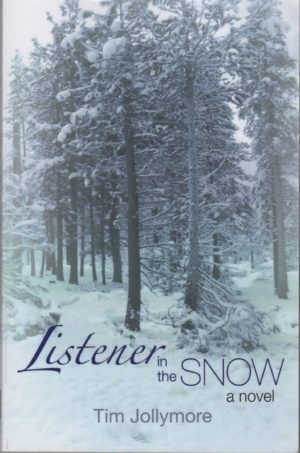
Listener in the Snow by Tim Jollymore (2013. Finns Way Books. 978-0-9914763-0-5)

Readers who enjoy Louise Erdich’s or Linda LeGarde Grover’s or Sherman Alexey’s brand of native mysticism wrapped within a fictional tale will enjoy this new novel by Cloquet, Minnesota native Tim Jollymore. Interwoven stories of the first-person narrator, Tatty, a mixed race Mi’Maq whose wife Mary is of Ojibwe lineage, and three legendary trips north from Tatty’s home in the States; first, for his father’s funeral; second, to bring his mother home to die in Canada; and third, to northern Minnesota to assist Mary in the birthing of her young cousin’s twin girls, all intersect in ways that are strange, enlightening, frightening, and legendary. Jollymore is a skilled storyteller and wordsmith, though, from time to time, the eloquence of his prose might, at least in this reader’s humble opinion, slow down the intensity of the action driving the plot. Still, there are so many well crafted passages and scenes throughout this flight of fancy intermixed with adventure and emotive recollection that one hardly notices the interruption of the storyline. Here’s an example one of Jollymore’s better pieces of narrative:

After the expansive, dazzling snow burning under the cloudless sky, the inside of the cabin was close and nearly black. The fireplace flame, whose smoke I had seen from above, was the first thing to reveal itself to my sun-glazed eyes. Then appeared the fainter glows of the windows, where drifts had been partially flung back by Danny’s shovel-work. As my eyes adjusted, I saw a white-draped bassinet standing away from the fireplace. Over this hovered a tiny silhouetted figure signing words I could not make out.

There are many memorable characters inhabiting Jollymore’s fictional story; from the enigmatically strong and defiant Mary, to the reclusive Tiny, to the aging, inherently wise Granny-the old woman who helps Tatty understand the visions he is plagued by. Each one is well crafted and unique. One criticism of the book would be that, for a work this polished, I found a few typos and/or missing words. These are rare occurrences, to be sure, and something my own work, also being self-published, has suffered from as well. There is also something unsettling about the climatic scene involving Roscoe and the ice flow. I won’t spoil the ending for you because this is a book that, if you have an interest in Native American fiction, you should read: Perhaps as a member of a book club to spawn discussion regarding the storytelling, the accuracy of the tale’s depiction of Native American life in the 21st century, and a host of other topics. Despite these minor flaws, I found the characters and the story memorable and well worth the time.

4 stars out of 5. A good novel for a book club to pick up, read, and discuss.

Peace.

Mark

Posted in Books | Comments Off on A Solid Read

Looking for an Answer

islam

Islam for Dummies  by Professor Malcolm Clark (2003. Wiley. ISBN 978-0-764-55503-9)

Though I’ve been a Christian my whole life, I like many modern men and women, still search and seek for answers. Answers to the questions: “Why are we here?” and “Is this all there is?” and other philosophical/religious queries. So, I’ve not only read the Bible multiple times trying to understand the roots and underpinnings of my own faith, but I’ve read The Book of Moron cover to cover (there’s a review in the Archives section of this blog) and last year, I began to study and read The Koran. With The Book of Mormon, I took up my quest to make it through the text not so much because I wished to understand the faith behind the faces of Mitt Romney, Glen Beck, and Marie Osmond, but more as research for my novel about polygamy, Laman’s River. On the other hand, my study of The Koran is fueled by a desire to understand why religious zealots across the world, but most predominantly in the birthplace of all three major monotheistic branches of faith-the Middle East-deign to blow themselves and innocent men, women, and children to oblivion, all in the name of Allah. I wasn’t finding the answer to my question reading the text of The Koran and so, I thought maybe Professor Clark’s tutorial could assist my research.

Like all “Dummies” texts, this book is very straight forward, well organized, and written at about the high school level, all of which I found refreshing. The one major drawback to my copy of the book (ordered through The Bookstore at Fitger’s) is that much has happened in the world regarding conflicts within and involving the Moslems since 2003, the year my copy was published. My edition of the book ends not long after the United States invaded Afghanistan and Iraq on the heels of 9/11/2000. So there is nothing in the book dealing with the Arab Spring, the rise of ISIS, and the more recent bombings, attacks, and conflicts within and without Islam. Still, Clark’s effort does give the reader a basic primer in the faith, people, culture, and history of Islam. I obtained, by spending my time with this book, a basic understanding of the religion and an appreciation, I think, that we, the West, have underestimated the import of Islam on the world. I am nearly through my reading of The Koran and, having now gained a better framework for reading the text through Professor Clark’s work, I may have to re-read Mohammad’s message to his people to gain a fuller understanding of how it is connected to today’s events.

What I came away with after racing through Islam for Dummies is an appreciation for the variety of branches of this faith along with a comprehension that the conflicts between peoples who adhere to Islam, such as the Iraqis and the Iranians, have much to do with their views of Islam and The Prophet, causing religious disagreement and discord not unlike the debates that rage between Catholics, Evangelicals, and mainstream Protestants in Christianity. The difference may be that, in large part, because the Christian faith is centuries older than Islam, Christianity may have, through the Reformation, heresy trials, and various purges, completed its own period of conflict and unrest and human tragedy whereas Islam remains in that transitional phase, sorting out the message handed down by God through his Messenger. Perhaps, as Catholics and Lutherans have finally put up the sword, so too will Sunni and Shi’a come to a place of peaceful co-existence, and also come to a place of quiet and calm with respect to the non-Moslem world as well. One can only hope.

4 stars out of 5. A bit dated but a valuable resource.

Peace.

Mark

Posted in Blog Archive | Comments Off on Looking for an Answer

A Fine Effort

mistry

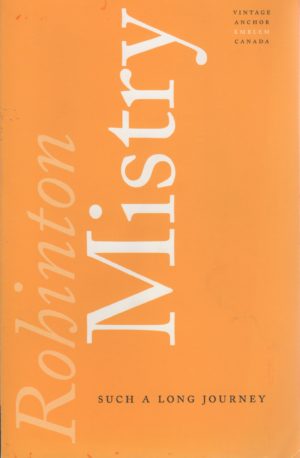
Such a Long Journey by Rohinton Mistry (2012. Vintage Anchor (Canada). ISBN978-0-7710-5704-5)

I was in Thunder Bay, Ontario this summer for a Finnish festival. I was riding around with my host, Ron Harpel, and stopped in at Chapter’s, the Canadian equivalent of Barnes and Noble, looking for a book to read. My intention was to buy Circus at the Edge of the Earth by my friend and internationally known Thunder Bay author, Charlie Wilkins. But alas, the largest bookstore chain in Canada did not have a single Wilkins title in stock, much less his first memoir. I settled for Such a Long Journey even though I’d not heard of the book’s author, Rohinton Mistry, because of the back jacket blurbs. I wasn’t disappointed.

The novel is well written in a style that reminds me, due to its reliance on mysticism and ritual, of Native American fiction (think Erdrich or Alexie or Grover). Mistry sometimes wanders a bit off the beaten path, tossing in asides and “howevers” that distract from the overarching plot but, in the end, the clarity of the author’s storytelling brings the plot back into view. Throughout the effort, Mistry carefully and adeptly gives us snippets of Indian culture, history, and Zoroastrian practices (the main character, Gustaf Noble, is of that religious minority; learn more at: https://en.wikipedia.org/wiki/Zoroastrianism) so that, as we are entertained by the fictional story, we learn a bit about one of the largest nations on earth and one of it’s least examined religions. Here’s a snippet that portrays living in a mosquito infested slum and the protagonist’s constant battle to keep his family safe from pestilence and vermin:

“Perfect, said Gustav, clearing the dining-table. He placed the round shallow dish under the bulb and filled it with water. When the surface grew still, the light bulb’s reflection steadied and shone brightly, tantalizingly, under water. Then the mosquitoes started to dive in. One by one, abandoning the real bulb, they plunged unswervingly suicidal in their attempts to reach the aqueous, insubstantial light. Somehow it was a greater attraction than the one hanging from the ceiling.”

My only criticism of this novel is that, as concise and crisp as the writing is, I was ready for more revelatory prose surrounding Prime Minister Gandhi (Indira) and the alleged corruption in her administration which is an almost unspoken accusation behind much of the action and plot involving Gustav and other characters, major and minor, in the book. Then too, the friction between Noble and his eldest child, Sohrab, while eventually resolved, could have used a bit more time on the stage. But over all, this is a good, good read. Not, as proclaimed, on the jacket, a great novel but one that surely whets the appetite to read more Mistrys (pun intended!).

4 stars out of 5.

Peace.

Mark


Posted in Books | Comments Off on A Fine Effort

They Were Champions

1947

I grew up in Piedmont Heights. My dad was an undersized kid and not particularly athletic, a boy who never participated in organized high school sports. He was book smart and blessed with flawless memory, traits that allowed him to become the first person in his family to earn a college degree. My mom was pretty and petite. Raised by parents who valued books and music and art, Mom wasn’t an athlete in any sense of the word, and even if she had been so inclined, there were no opportunities for her to participate in school sports in the 1940s. Girls took home economics and learned to sew and cook and handle roles of domesticity. Girls did not, in 1946, the year my mom graduated from high school, shoot pucks or grab rebounds or head soccer balls as members of varsity athletic teams.

After graduating from Denfeld in 1945, Dad enlisted in the Army. He wasn’t around when Lloyd Holm took over the reigns of the Denfeld boys’ basketball team in 1946. Holm inherited a talented but undisciplined group of young men. The new coach worked the boys hard, instilling in them the notion that, alone, each of them was gifted, but together they were a force to be reckoned with.

Coach Holm’s vision of what could be culminated in a thrilling 46-44 victory over Crosby-Ironton on the storied hardwood of Williams Arena. My dad, as I said, wasn’t around to witness the one and only time Duluth Denfeld grabbed the brass ring and won the state championship in basketball. But Mom, who graduated from Denfeld a year earlier and remained in town to attend St. Scholastica, convinced Grandpa Jack to drive her and three of her girlfriends to Minneapolis to see the big game. Mom returned to Duluth with an appreciation for what those 10 young players accomplished.

My dad completed his obligation to Uncle Sam and married my mom. Over the years, as my parents raised a family, they shared the legacy of the ’47 Hunter team with my brother, my sister, and me as an example of what hard work and dedication to task can accomplish.

But to me, the boys who dispatched Crosby-Ironton in that championship game were more than just photographs hanging in the Denfeld gym. Those boys became men who became role models for a wire-rimmed, skinny, unathletic kid who lived on Chambersburg Avenue.

Though better suited for debate or speech, I found myself trying to emulate the ’47 team. I participated in varsity skiing and football, even though my talent for sports was marginal. I pushed myself athletically because Tessier, Nace, and Monson weren’t just names of long-forgotten heroes. Those men were, along with team manager Bob Scott, my friends. They were my hunting and fishing and skiing partners. And they were my mentors: men of integrity who helped guide me through life.

Sadly, all those members of the team have passed on. But on Oct. 8, when the entire 1947 boys’ basketball team was inducted into the Denfeld High School Hall of Fame, my friends were not only present in spirit; their voices could be plainly heard above the din of the audience seated in the storied Denfeld auditorium.

At the induction ceremony, Ken Sunnarborg introduced the members of the ’47 squad who are still alive and who were in attendance: Sunnarborg, Eugene “Pug” Norlander, Howard Tucker, and Keith Stolen.

After brief remarks, Sunnarborg turned the mic over to Norlander, and Norlander had a surprise in store for the family, friends, and alumni in attendance. A woman with no connection to the school discovered a sleeve of 78-rpm records for sale in a far-distant garage. After purchasing the records, the woman realized the discs contained the complete radio broadcast of the 1947 Minnesota State Basketball Championship Game. The woman read the players’ names printed on the album cover, used the internet to find Norlander, contacted him, and sent him the record.

Those at the hall of fame gathering heard the climactic final two minutes of the 1947 championship game — digitized to a quality unknown in the 1940s and complete with announcers, crowd noise, players’ grunts, the squeak of rubber sneakers against wood, the bang of leather on steel, and the swoosh of ball through net — for the first time in 70 years.

“Monson grabs a rebound.”

“Nace passes the ball.”

“Tessier takes the shot.”

As the voice of the radio announcer faded and as the present-day audience rose to its feet and applauded, tears formed. Tears of joy as I considered what it was like for my mom and her girlfriends to be at Williams Arena that night. Tears of sadness for the passing of friends, once young, then old, now gone. Tears of pride for being part of a unique and timeless bond shared by generations of Denfeld graduates.

May today’s Hunters — both young men and young women — carry on the proud legacy of clean play, dedication to community, and mentoring that made the 1947 state basketball championship team worthy of induction into the Denfeld Hall of Fame.

(An edited version of this piece first appeared in the Duluth News Tribune)


Posted in Blog Archive | Comments Off on They Were Champions

Follow Me Boys (Reprised)

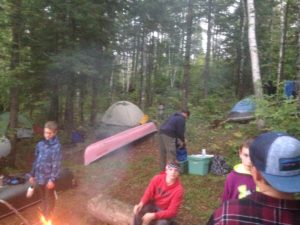
Troop 106 Camping in Munger's Field

Troop 106 Camping in Munger’s Field

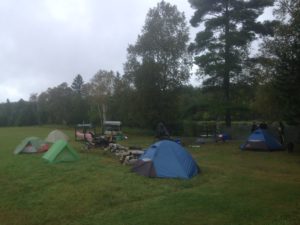
OK. Confession time again. I’m borrowing the title of this piece from the book and the old Fred MacMurray movie of the same name. I don’t remember much about either beyond the fact the story involved an adult leader and Boy Scouts. Anyway. On with the story. A few weeks back, I signed up to assist wrangling and guiding seven Scouts and two other adults down the Cloquet River. The route was from my house to the landing off the Bachelor Road: a modest trip, seven miles or so by water, an easy five hour paddle in good weather. There are four DNR tenting campsites (similar to the BWCA sites many of you might be familiar with: clearings in the wilderness complete with a steel fire ring and, somewhere close by, a pit latrine) along the way where paddlers can pitch tents. A perfect route for novice canoeists. Given the water was high, the result of late summer deluges, there was little chance the boys would spill into the dark, black water of the Cloquet.

Friday night. I made apologies as the Scouts and their parents set up camp in my backyard. Seems, as always, I was double booked. I had to make an appearance at a birthday party of a colleague a few miles away. After setting up my tent, and with promises of being back before dark, Rene’ and I drove off. The forecast was problematic: drenching rains were promised. By the time I returned, a storm had briefly doused the campsite and everyone was tucked into their sleeping bags. I released Kena, my black Lab, from her kennel, let her do her business, and then the two of us clambered into my tent.

“Judge Munger?”

A male voice woke me up from a fitful sleep. I grabbed my cell phone. 4:05am. Kena remained curled against my hip, seemingly unconcerned by the intrusion.

“Yes?”

“Trooper Smith. State Patrol. I have a search warrant for a blood draw.”

Crap.

I’d forgotten that I was “on call” for the weekend; which, in judicial parlance means I needed to be available to sign legal documents for law enforcement. My eyes focused. I unzipped the tent to a downbeat of wicked rain. “Yes. I’m here.”

The Trooper handed me an application and warrant. I studied the documents by headlamp. The officer swore to the contents of the documents. I signed them. Then, he was on his way. Kena put her head down and returned to snoring.

In the morning, a light rain, interspersed with infrequent squalls, stalled over the river. As the sky lightened from black to gray, boys and dads struggled out of their bags. I started a fire. Older Scouts filled pans with water for oatmeal. Orange drink was mixed. Bags of apples and oranges emerged from the food bins. Breakfast bars were opened. By ten, the mist and rain diminished enough to dry out the tents. We broke camp, loaded the canoes, and slid them down the muddy bank into the current. I wore hiking sandals to steady the canoes as boys and dads took up their seats. The mist returned, at times pummeling us with more significant rain. The sun remained absent. The wind whipped up. Paddling became more of an effort. The group ducked into Hunter Lake, an ox bow off the main channel, taking time to investigate an old Scout camp, a beautiful piece of property, Camp Bunkowske. “Wonder why this isn’t used anymore?” was a question that boys and dads asked more than once as we explored. I knew the history of the place and shared what I knew. And then, we were back in our canoes, headed downstream. Rich changed positions with a young Scout, becoming the stern man in his son’s canoe. My new partner took the bow seat in my 18′ Grumman square stern and promptly launched into a dissertation on just about every topic under the sun. My new partner’s chatter never stopped. I tried to maintain patience, which, as anyone who knows me will attest, is a fragile component of my persona. Despite the multitudinous questions and answers launched between bow and stern, we got on just fine.

Hunter Lake.

Hunter Lake.

Troop 106 pushed on. The younger Scouts interjected frequently, “Are we there yet?” “Just around the next bend,” I’d reply as rain dripped off my waterproof bush hat. My lie briefly quelled the questioning but only for the time it took another Scout to draw his breath and bring the query ’round. Shortly after noon, we landed at Twin Pines campsite, our destination and lodging place for the evening.

Paddling the Cloquet.

Paddling the Cloquet.

Twin Pines.

Twin Pines.

After staking down my tent and unrolling my sleeping pad and bag, I threw on my life jacket and took a stab at tossing a dew worm and spinner into the tannin stained water of the Cloquet. I had one hit but landed no fish. After a hot lunch, with the rain gone but the sun remaining stubborn, I claimed my mummy bag and took a short nap. My neck was giving me grief and it seemed that even the cushion of a PermaRest wasn’t enough to let me slumber. But tired from the short paddle and the exertion making camp, I was soon asleep. In the late afternoon, we explored the ridge behind the campsite, following a four wheeler track for a mile or so through residual legacy white and red pines. After a dinner of brats, hot dogs, mac and cheese, and s’mores, we sat around the campfire as night descended. As the sky darkened, a pair of otters chirped and splashed nearby, oblivious to human visitors. A deer (we never did see whether it was a buck or a doe) swam from one side of the watercourse to the other. A train rumbled across a bridge downstream. The locomotive’s lonesome whistle reminded us that, though we were surrounded by forest, we weren’t far from civilization. A Barred Owl hooted. Bats swooped in and out of the trees. As night fell, the sky opened up and we tried to guess constellations.

Morning fog, Twin Pines.

Morning fog, Twin Pines.

In the morning, after  a breakfast of steaming coffee, hot chocolate, oatmeal, breakfast bars, and fresh fruit, we policed the campsite. “Leave no trace” means exactly that. Rich and his son found a tree frog in their tent. I’d heard the amphibian calling earlier in the morning when I got up to do my business. I placed the frog away from the hubbub of breaking camp. img_3525

A short paddle brought us to Bowman (Side) Lake, another ox bow, where the troop rested and considered the warming morning. I tossed worm and spinner with no success. My canoeing partner grew reflectively silent. We paddled past the Beaver River’s concourse with the Cloquet and an osprey nest built atop power poles. We made the Bachelor Road landing ahead of schedule, unloaded our canoes, and waited for transportation back to Munger’s Farm.

The group, minus two.

The group, minus two.

End of the line. DWP bridge in the distance.

End of the line, the DWP bridge in the distance.


Posted in Blog Archive | 4 Comments

Another Stunning Collection

linda

The Sky Watched by Linda LeGarde Grover (2015. Red Mountain Press. ISBN9780990804772)

Speak English. Forget the language of your grandparents. It is dead. Forget their teachings. They are ignorant and unGodly. Cleanliness is next to Godliness. Indians are not clean. Your mother did not teach you to be clean.

(from “Everything You Need to Know in Life You’ll Learn at Boarding School”)

Indian boarding schools. Creation myths. Cultural references. Family. These are the compass points of a new poetry collection by Duluth poet and author, Linda LeGarde Grover. A confession. I grew up with Linda’s siblings. Of the 14 LeGarde children, I knew four of them fairly well before age thirty: Nancy, two years older than me; Jerry, a year ahead of me in school; Susie, a classmate at Lincoln Jr. High and Denfeld H.S., and Jimmy, who played shortstop on my law firm’s softball team. I’ve also had the pleasure in my later years of spending time with Linda at book signings and other writerly events. So take this review for what it is: opinion tainted by familiarity. That having been said, if these poems of Ojibwe life and dreams and spirituality weren’t damn good, well, I’d beg off and tell Ms. LeGarde I didn’t have the time to review this book. But that’s not the case.

There’s a Zen-like quality to LeGarde’s verse and prose poems, the wrapping of myth into history into sadness into joy that reminds me of the Finnish epic saga, The Kalevala. Though the mysticism that is so often the cornerstone of Native American contemporary writing (think Erdrich or Northrup or Alexie) may be found in some of these poems, front and center, LeGarde isn’t heavy handed in applying aboriginal beliefs and magic to her remembrances. Instead, the connections between spirit and flesh, reality and fantasy, are more subtle, less onerous for non-Native readers, allowing us access to a world that, while seemingly shrinking due to the monolithic advance of American culture, continues on beneath the fabric of everyday life. LeGarde’s periodic reflections of being raised in the non-Indian world while being taught the “old ways” at home and within her family, the clash of cultures being omnipresent and somewhat daunting, rise from the page, easily accessible but poignant.

Our little sister is the only blond in our family. As children we were fascinated by her coloring, her hair that lightened to an ice frost in the summer, her cheeks that bloomed with a red fire in the winter. Winters she became the sun, summers the moon.

(from “Mary Susan”)

On the critical side, a few of LeGarde’s poems left me scratching my head as I tried to decipher their meaning or simply did not rise to the level of the rest of the collection. But these minor deviations in authorial quality are momentary, fleeting, and rare. What one is left with, after having spent time with Ms. LeGarde, her family, her traditions, her ancestors, is a feeling of love. And hope. And respect.

4 and 1/2 stars out of 5. Read a poem or two each evening before bed. You won’t be disappointed!

Peace.

Mark


Posted in Books | Comments Off on Another Stunning Collection

Garrison, We’re Gonna Miss You!

gary


Mark Twain. Will Rogers. Garrison Keillor. Each generation seems blessed with a humorist who, instead of standing off in the distance and pointing out the incongruities in American life, stands shoulder to shoulder with ordinary men and women. Our homegrown satirists have descended into the muck and mire of race and politics and religion to identify the best and the worst of America. Using words as sharp as a surgeon’s scalpel, our beloved social commentators have made us understand how far we, as a nation, have come and how far we have yet to go. Now the best of them, a man who combined music and poetry and narrative to reflect on our national pulse, is hanging it up.


I was just a kid behind the wheel of a battered Chevy Chevette negotiating I-494 from my apartment in Bloomington to downtown St. Paul on my way to my first “real” job as a process-server; going to law school at night. On those early morning drives, I’d tune into Minnesota Public Radio (MPR) and listen to The Morning Show, a program featuring musical guests scheduled to be on A Prairie Home Companion (PHC), Keillor’s iconic Saturday evening radio variety show. Charlie McGuire, Leo Kottke, Prudence Johnson, Bill Staines and a plethora of other musicians enlivened my morning drives. Hailing from late seventies Duluth—the rebirth of the Arrowhead’s arts and culture and music scene still decades in the future—The Morning Show’s cavalcade of music was a revelation. In addition, faux advertisements and commentary and puns and jokes intertwined with the music. It all added up to an auditory experience unlike anything I’d ever encountered. I was hooked. My love of all things Keillor became engrained in my Northern Minnesota soul. Once I married my sweetheart and Rene’ joined me in the Cities, we made frequent trips back to Duluth. During our drives home, we tuned into MPR and listened to PHC.


Decades passed. Rene’ and I are still together. We’ve raised four sons and we’re now grandparents. Our boys grew up listening to PHC on family vacations. Our boys have also seen Mr. Keillor at the Fitzgerald Theater and at the Minnesota State Fair Grandstand. They‘ve grown up listening to The News from Lake Wobegon. They’ve been raised on Garrison’s wicked political satire. Assessing Mr. Keillor’s impact on my family and the countless other American families who tuned into his broadcasts is difficult. One doesn’t want to exaggerate. That would be, well, so un-Norwegian, so un-Lake Wobegonian. And yet, it’s markedly true: Garrison Keillor’s renditions of Americana have been like no other. Is the show’s draw its not-so-subtle nostalgia, a desire for a simpler time, a more innocent world? Or is it simply the great music that draws us in? Or a mixture of the two?


It’s Friday night. Labor Day weekend. I’m sitting next to my wife beneath the soaring steel canopy of the Minnesota State Fair Grandstand. Over the course of three hours, a seventy-four year old man who’s endured health scares, multiple marriages, and occasionally disappointing book sales (as all fiction authors and English majors must!) stands in a pristinely white suit (perhaps unconsciously claiming the stage persona of Samuel Clemens?), and leads the house band and guest musicians through gospel, opera, choral arrangements, folk, rock, and swing. With help from the omnipresent radio acting company, current presidential candidates make appearances as voices for GPS devices and a skittish private eye meets The Donald. We laugh. We sing. We applaud. The hour grows late. The host, cast, and musicians take a final bow. The old man at the center of it all says he’ll be back next year. Fireworks explode above the emptying stage and illuminate the night sky. We rise from hard seats and head towards the parking lot.


Very soon folk musician Chris Thiel, a member of Nickel Creek and the Punch Brothers, will begin hosting a very different sort of Prairie Home Companion. There will be no news from Lake Wobegon. Guy Noir will no longer sleuth the airways. Longtime sponsors The Ketchup Advisory Board and Powdermilk Biscuits will pull their advertisements. But rural America’s voice won’t be absent from our culture. Mr. Keillor will continue to narrate The Writer’s Almanac; a podcast I listen to for inspiration every morning before I write. He’ll pen novels set in the little town that time forgot. He’ll craft essays for The New Yorker and national newspapers where he’ll challenge us to aspire to be better than we are. And maybe, just maybe, on Labor Day weekend, 2017, the tall, gangly man in the white linen suit will climb down from the grandstand stage, microphone in hand, and sing “America the Beautiful” with ten thousand fellow Minnesotans.


Things change and, as families drive across this great land, their car radios tuned to MPR, or as dairy farmers listen in as they muck out their barns, or as older folks settle into recliners listening in as they wait out winter, it’s unlikely that Chris Thiel will make folks forget Garrison Keillor. But as the old man himself might say, “Give the kid a chance. You might like what you hear.”


I know I will.

Peace.

Mark

(c) 2016

(An edited version of this essay appeared in the Duluth News Tribune on 09/11/2016)


Posted in Blog Archive | Comments Off on Garrison, We’re Gonna Miss You!