A Working Vacation

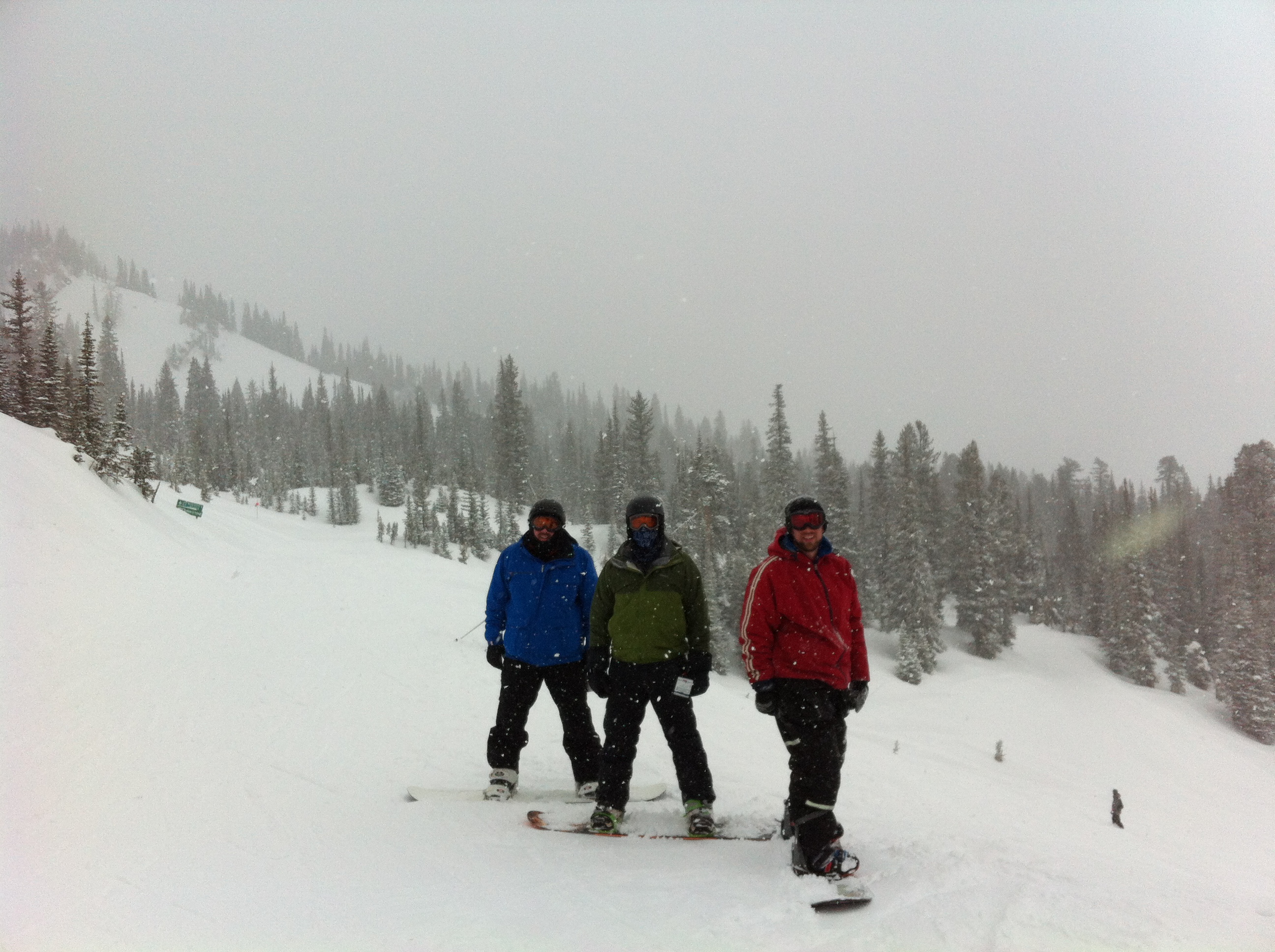
Matt, Chris, and Dylan Munger at Bridger Bowl

So here we are once again in Big Sky Country on a ski vacation with Duluth’s quintessential ski shop family, the Ski Hut. There’s some debate how many years Wes Neustal, and now his son Scott, have organized this mass exodus of Duluthians to ski Bridger Bowl, Big Sky, Moonlight Basin, and, at times, Showdown and Red Lodge. It’s something more than twenty and less than forty years. That’s all that’s known for certain. My wife Rene’ and I have made the trip at least seven times over the past decade, usually with our oldest son Matt, his wife Lisa, and Jack, our youngest son. This year, grandson AJ is along for the ride (he’s 9 months old and he’s a couple of years away from skis). Dylan, our second oldest, was here for a few days, down from his home in Williston, ND with his significant other, Shelly. Chris, our third son, drove out with us. He’s been here before. My mom and my step-dad, my sister and her husband and their two girls, and a host of their friends are among the 200 plus Minnesotans taking over the Bozeman Comfort Inn. Gene Cook, the owner of the place, always greets the mob from Duluth with a smile and a warm handshake. And his staff…what can you say? They are simply the best. Year after year we tromp through the hotel, dragging ski and snowboarding equipment behind us, all with the knowledge that we are as welcome in Bozeman as if we had been born here.

Jack brought along a buddy, Nate Sich, who, on his first trip to the mountains, has boarded everything in sight, including the Headwaters at Moonlight.

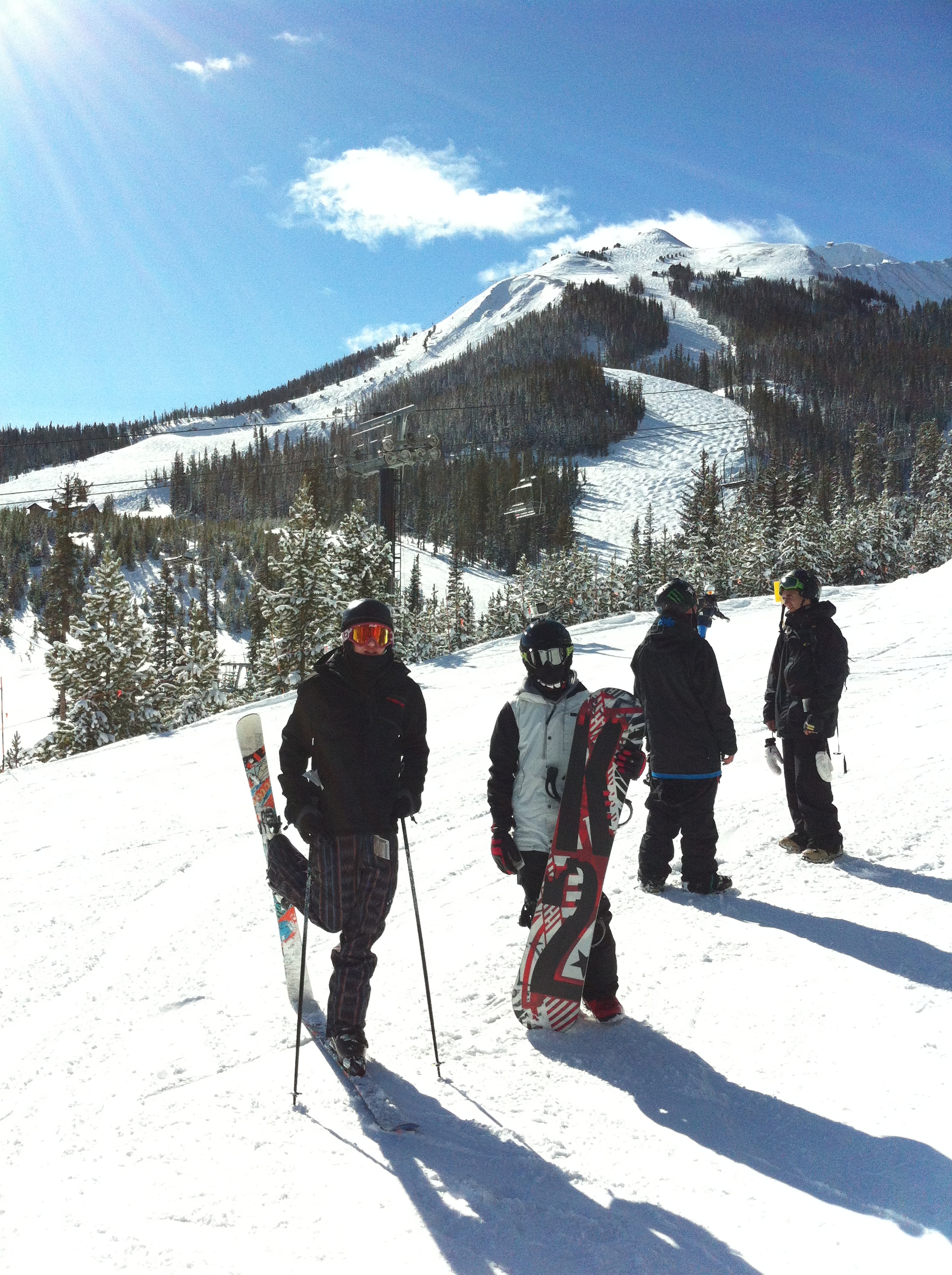
Jack Munger and Nate Sich at Moonlight Basin

My wife Rene’, who broke both her tibia and fibula in a nasty slip and fall just before Christmas, isn’t in any shape to ski. But she’s a trooper, making lunches for the boys, doing babysitting duty with AJ when asked, and reading a novel during the quiet moments at the hotel or in the chalets. She’s gone right now, as I type this blog, to Big Sky with Matt and the crew. Next year, she’ll be back on skis, cruising the blues and greens at Bridger on her silver skis.

Just before we left Duluth, I got the OK from my doc to ski. I haven’t been able ski all year because I had shoulder surgery in October and ended my PT just a week ago Monday. It was exactly a week ago today that Doc Klassen at Essentia saw me and cleared me to go on this trip. Since we left the next day, I was pushing the envelope a wee bit. But that’s the Munger way. The shoulder has, due to Doctor Jeff’s surgical prowess, held up fine. Other than a twinge here and a sore night there, it’s handled the best skiing Montana has to offer. And since this is the first time all four Munger boys have been in the mountains with their father, I am grateful beyond measure for the good doctor’s skill.

Last night, Rene’ and I and my mom and step-dad drove to Livingston, just a short jaunt down the freeway, after another snowy day at Bridger. Given that my last book, Laman’s River is partially set in Montana, I scheduled a couple of events at bookstores in Big Sky Country. The folks at Elk River Books in Livingston were kind enough to set up a reading at their store last night. Though the weather was a bit tough and the crowd was meager, I had a great time reading from and discussing the book with fellow poets and writers. If you are ever in downtown Livingston, check out this cozy, sweet little bookstore featuring new and used books. You won’t be disappointed.

In a couple of hours, I’m slated to be at Montana State University at the bookstore for a signing. Hopefully, it won’t be just me sitting there, staring at the walls. But one never knows when one schedules events in places far from home…

The highlight of the trip has been spending time, even “cozy time” in the car, with my sons, Nate, my wife, and the rest of my family. Seeing my grandson’s smile against the bright Montana sunshine is an image that eludes description. He’s the light of my life, along with my boys. And what can I say about Rene’, the rock of my crazy life as a semi-famous writer from Minnesota?

Before I forget, I wrote a little piece for “Reflections West”, a literary radio program on Montana Public Radio that is airing twice during this week on MPR (that’s Montana Public Radio for you Minnesotans!). But those of you in places other than Montana can listen to the essay at:

www.reflectionswest.org

One more day of skiing and then, the Munger clan faces a long ride home. Here’s hoping the box of books in the back of the Pacifica is a bit lighter on the return trip!

Peace.

Mark


Posted in Blog Archive | Comments Off on A Working Vacation

Catch up with Mark

It’s been a while, loyal followers. The best that can be said is I am one tired lad. I started teaching at UWS again at the end of January. Two classes a week, two nights a week. In addition, I’ve taken on the role of Assistant Scoutmaster at my son’s Boy Scout Troop, which eats up another night of the week. And of course, I’ve been working hard on the editing of Sukulaiset: The Kindred, my sweeping novel of WWII Finland and Estonia. I went into that project with trepidation as to the scope and breadth of the potential story and, so far, my fears have proven valid. It is a big story and a big book that needs a trimming, just like Governor Chris Cristie could stand to lose a few pounds. Recently, I spent three nights at Amazing Grace meeting with pre-readers, getting valuable feedback on story, plot, character, and all things Finnish and Estonian from folks I trust. I also received much feedback via email from folks who couldn’t meet with me personally.

Here are a few choice comments from people who’ve read the manuscript:

“There are too many breasts.”

“You dwell on menopause waaaaay too much!”

“I was confused by the changes from first person to third person.”

“You need a character list and maps.”

“Maps would be really good.”

“Have you thought about some maps?”

“What’s with all the breasts?”

“You need more about Elin and Matti at the end of the story.”

“I didn’t get the link between the opening and the main plot.”

“Has anyone said that maps would be a good idea?”

And so on…

Anyway, with all that’s going on in my personal and professional life, the novel has taken second stage. I think part of the reason I’ve put it on the back burner is the very fear and dread that loomed when I began to work on the massive story some three years ago: I just don’t know if I can pull it off. This is, after my uncle’s biography, the biggest, most demanding project of my twenty-plus-year writing career. I need a breather. I need to stop and consider whether the story can be salvaged in a format that will make me proud to say “Yes, I wrote that book.” Right now, there are bits and pieces and characters and scenes I can say that about, which would be fine if I wasn’t trying to hammer the thing together for a summer 2013 release around Finn Fest in Houghton-Hancock. But that’s my goal and, if I can’t do it, well then, I can’t do it.

Once I get in the groove of teaching (don’t get me started about all the technological challenges I’ve faced teaching an ITV course), I hope to be able to pull myself together and get back at the novel. Hope does, as is often said, spring eternal. In the meantime, I’ll strap on my cross country skis (nearly done with my shoulder rehab), head out for the woods and the new snow, and consider what it is I want out of this writing thing.

Say a prayer for me, will you?

In the meantime, if you want to hear an excerpt from the manuscript, head out to Beaner’s Coffee Shop on Central Avenue in Duluth this Sunday, February 10th, from 1-3. Lake Superior Writers is sponsoring a series of readings by local poets and authors (including me) entitled “Fire and Ice.” Should be a wonderful afternoon of quality readings from quality folks, including former and current Poet Laureates of Duluth.

Also, you can catch up on what I’ve been up to by logging onto the Rural Lit R.A.L.L.Y. website where there’s a feature interview with me. The link is:

http://rurallitrally.org/

And by the way, since when have there ever been too many breasts?

Just wondering.

Peace.

Mark


Posted in Blog Archive | Comments Off on Catch up with Mark

A Night to Remember

I was nervous. Usually the programs I do at libraries or writing groups center around my gig as a self-published author. Not this time. The Program Committee of the Grand Rapids Library wanted something different from me, something relating to the inner struggles and demons of  creative writing. So, as I prepared to give my talk, working on an outline and drawing considerable expertise from Bird by Bird by Ann Lamott, and The Writing Life by Annie Dillard (with a little Julia Cameron thrown in for good measure), I was nervous.

Who am I to be giving writing advice to anyone? I have a history and political science degree, not an MFA.

There’s this thing that happens to all writers, I think, and I am no exception, when we have worked at our craft for a few decades without achieving commercial success or fame. While all writers harbor self-doubt, for those of us who choose to self-publish and then talk about the experience, well, the term “self-doubt” isn’t an adequate measure of the level of inadequacy we harbor. So putting it all out in front of twenty to thirty relative strangers is a daunting experience for even someone as brash as me.

Driving from Duluth to Grand Rapids last night, I managed to calm my nerves by listening to the Black Keys, a CD my third son gave me for Christmas. He’s a creative soul like me still trying to find his muse in words or music. He understands what makes me tick when it comes to putting words out into the world for public scrutiny and the Black Keys wasn’t something he shared on a whim. The music helped and soon, I was pulling into downtown Grand Rapids to grab a bite to eat at the Chinese buffet.

Before eating, I stopped in at Village Books, the town’s only independent bookstore, and chatted with Mike, the owner, about the state of indies in a world dominated by Amazon, Walmart, and Barnes and Noble. It’s tough duty, selling books retail these days, especially in the midst of a recession and against the recent tidal wave of eBooks and eReaders. The indies, including Village, are dear to this writer’s heart, because they are the little engines of local commerce that put my work into the hands of avid readers. Sure, I sell through Amazon and the other giants, and my latest novel, Laman’s River is available for eReaders. But the indies are where I meet my loyal fans face to face and as I left Mike and his wife to their work, I was saddened to think that progress may include the disappearance of such places.

My friend Randy and his wife Kath met me in the library parking lot as I was hauling in a bin of books to sell after my talk. I got to know the McCartys when Randy and his book club selected Suomalaiset as a book for their group some years back. I’ve been blessed with their support for my writing for nearly a decade; support that includes a bed at their lovely home on Lake Pokegama whenever I’m passing through. Their presence on a dark night, as snow flurries danced around us in the parking lot, did much to buoy my spirit and reassured me that the evening wouldn’t be a total disaster.

And then, it was time to begin. My anxiety lifted as the crowd laughed at the appropriate times and seemed genuinely engaged by my presentation. I finished my talk in exactly one hour, the marker I was hoping to hit. A dozen or so folks asked serious and well-reasoned questions at the end of the lecture. By then, I was completely relaxed and at ease with what had transpired.

It was a good night, a very good night.

The library was closed, the public had left, and the lights were off when Randy, Kath, and I made our way outside. We said our goodbyes in the parking lot.  I loaded my unsold books into the Pacifica, took off my coat, climbed into the car, and headed home. The snow had stopped. The Black Keys were playing again. And I was happy I’d agreed to share my time and my passion with the good folks of Grand Rapids, Minnesota.

Peace.

Mark

Posted in Blog Archive | Comments Off on A Night to Remember

Two Great Ladies, Down But Not Out!

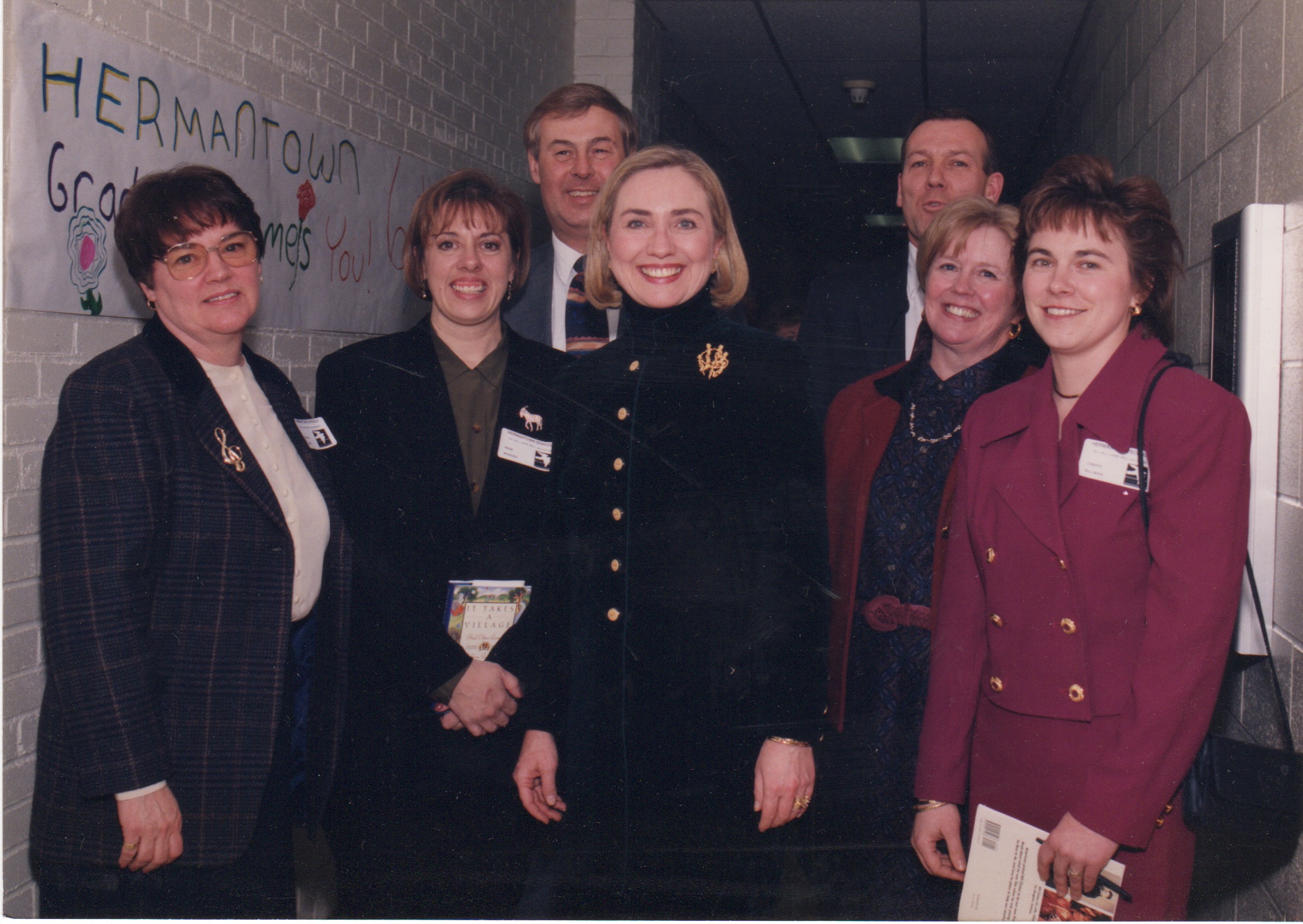
Rene’ Munger, First Lady Hillary Rodham Clinton and Hermantown School Board (1998) @ Hermantown Middle School

If you look really, really close, you’ll see my wife holding her copy of Madame Secretary’s bestselling book, It Takes a Village. The occasion? Students from the Hermantown Elementary School were invited to meet then First Lady Clinton, along with their teachers, a few local politicos, and select volunteers who helped set up the event (including me: I was a lowly attorney at the time and my price of admittance was some labor and sweat the night before the event) to talk about the challenges facing educators and children. Senator Wellstone and Congressman Oberstar were also there, sitting on chairs next to Hillary, the three adults surrounded by a sea of little kids, including my son, Christian. Chris even got a hug from the First Lady: At the end of the event, as she was walking out of the middle school gym, Hillary spotted Chris’s big brown eyes and sweet dimpled smile. She couldn’t resist and somewhere in the family archives, their encounter is preserved for posterity. But that bit of family trivia isn’t the point of this little blog.

The day Hillary came to Hermantown, my wife was a long-serving member of the Hermantown School Board. Hillary was (and is) a role model for Rene’ and many other women around the world. So when my wife heard that the First Lady was coming to visit, well, you can guess the level of excitement in our home. Unlike other political events of recent memory involving our area featuring national figures, Hillary’s visit was not one based upon ideology or party labels: She was visiting Hermantown as an ambassador for children, promoting parental and community involvement as a means to nurture kids. Her message was that teachers, even the best and most dedicated, cannot lead our children to adulthood on their own: It truly takes our communities, our villages, acting in concert to rear our young.

When the above photograph was taken, my wife was working on her Master’s in Art Therapy at UWS. She was already committed to focusing her life’s work on kids. She was further inspired by Hillary’s example and for the past 13 years, Rene’ has worked as a mental health therapist in some of NE Minnesota’s most challenging schools.  But, just a few weeks ago, my wife suffered a horrific fall on ice, breaking both bones in her lower left leg and dislocating them to the point she required surgery and the placement of two metal plates and twelve screws to help her bones mend. Rene’ will eventually be healed enough to return to her work. It’s not an issue of if but a matter of when.

Hillary, of course, went on to be elected Senator from New York. Then, in 2008, she ran a classy and tough-as-nails presidential campaign against a young upstart named Barack Obama. She didn’t win but, given her popularity and appeal across political lines, her powerful intellect, and her knowledge of world affairs, President Obama’s selection of her as his first Secretary of State was a prudent political statement. Now Hillary too, her time as Madame Secretary coming to a close, has fallen ill. The blood clot in her head is an unfortunate turn of events for a great woman, a female role model likely poised on the edge of another presidential run in 2016. Even though the situation may seem serious, I believe that Hillary will also heal and return to her life of public service.

Two great women. Down, but not out.

Pray for them both if you are so inclined.

Peace.

Mark


Posted in Blog Archive | Comments Off on Two Great Ladies, Down But Not Out!

Stories of Heartache and Bliss

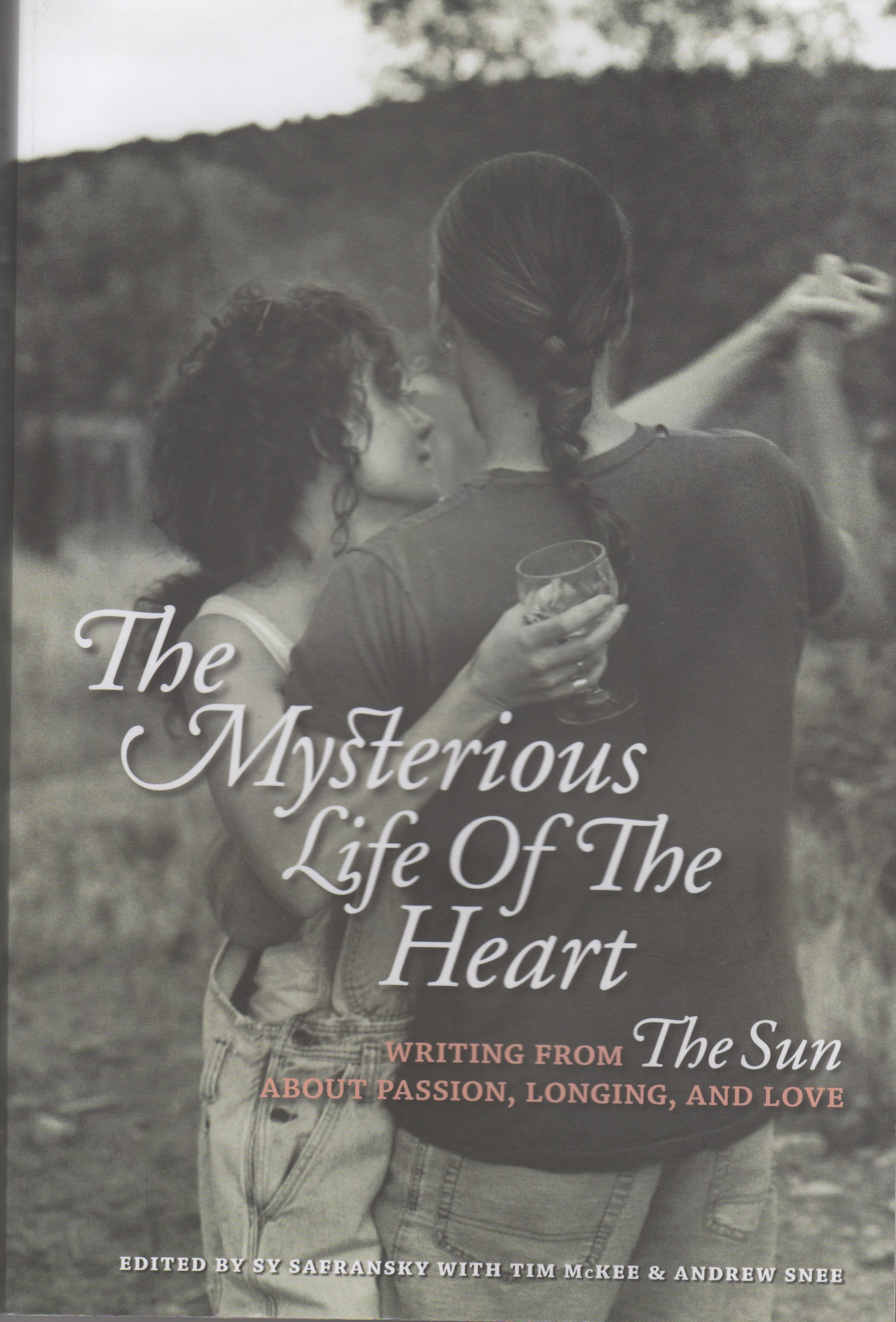
The Mysterious Life of the Heart edited by Sy Safransky, Tom McKee, and Andrew Snee (2009. The Sun. ISBN 978-0-917320-04-0

I’ve been a subscriber to Sy Safransky’s little experiment in literary journalism, The Sun, off and on now for almost twenty years. It is one of only two literary magazines that I subscribe to, Glimmer Train being the other. Modern Americans, it seems, don’t appreciate short fiction, or quality personal essays, or poetry to the same degree their readerly ancestors did. Remember when every major magazine, Look, Life, Saturday Evening Post, Ladies Home Journal, and the like contained a short story or two, a handful of poems? Well, most of those magazines are gone, and with their demise, short fiction, accessible and read by main street America has, to a large extent vanished as well. What remains are specialized literary magazines published by boutique presses, like Glimmer Train, or literary journals published by universities. The one exception to this generality is The Sun: Like it’s namesake, Sy Safransky’s bold little experiment in creative writing for the masses, a magazine that features personal essays, quality photography, thought provoking short fiction, modern poetry, and feature interviews with some of the most advanced and controversial thinkers of our day, burns bright and omnipotent. This collection is Sy’s attempt to pull fifty pieces of literature and poetry from the magazine’s extensive catalog of past work together to address a common theme: Love.

True to the vibe and heritage of The Sun, even the few essays or short stories in this collection that have a touch of humor to them contain sorrow and bittersweet reality. But that’s OK if you know in advance, before you crack open the book’s cover, what you’re in for. This collection is nothing if not consistent. Issue after issue, The Sun prints letters from its readers who are cancelling subscriptions because the writing in the magazine is “too dark, too depressing, too close to the bone.” Exactly. So are these stories, and, to a lesser extent, these poems. Take, for example, my favorite piece in the collection, “Red Flamingo Looks at Red Water” by Katherine Vaz, a tale of a forty-something mother, who, having lost her only child, a daughter, to a traffic accident that she witnessed, tries to reconcile her feelings for her husband (he was walking the girl across the street when the five year old slipped his hand and was hit by a vehicle) with her loss. Powerful and vibrant, the story held my interest not with voyeuristic morbidity but with the grace of its prose:

I don’t know how to rescue Henry from this. I would like to supplant the sensation of impact with sounds of sad beauty. At the music store, I find a CD of the Portuguese fado singer Misia. Fados are the traditional songs of fate, mournful; a singer risks disappearing into the heat of them. Misla has a Louise Brooks-style bob haircut and full lips ans is send to bring modern sensibility to this music of the past. Henry thanks me, inspects the CD, turns it over in his hand, sets it out of view, but does not play it.

Some folks who are pre-reading the manuscript of my latest novel, Sukulaiset: The Kindred (a novel of tragedy and turmoil set in WWII in Estonia and Finland) have made comments similar to those who write The Sun and either ask for their money back or state they are tired of tragedy and violence and loss to the point that they don’t want to read about it anymore. I understand this world weary view. But whether a piece of writing is one full of light and hope, or one based upon sorrow and loss, good writing is good writing. That’s what Safransky has cobbled together here: a collection containing more than enough heat and light to burn away the dark pall of heartache and loss.

4 stars out of 4.


Posted in Books | Comments Off on Stories of Heartache and Bliss

The Lamb of God Explained

The Myth of a Christian Nation by Gregory A. Boyd (2005. Zondervan. ISBN 978-0-310-26731-7)

To be sure, there is much to be admired in an Evangelical theologian who understands the hypocrisy of many Americans who label themselves “God fearing, fundamentalists” but who evince hate and animus and disgust towards those they do not agree with politically, socially, or theologically. That’s how Gregory Boyd begins his message of restoring the Kingdom of God and ignoring the Kingdom of the World and it remains his singular message until the last chapter in the book.

There’s no doubt that Boyd’s message: Placing yourself under folks who disagree with Christ’s message of universal love and sacrifice (to the point of martyred death) rather than ruling nonbelievers from above (or being in a position over non-Christians or other sinners by means of worldly power) is exactly what Jesus was driving at. And, as a self-styled Liberal Christian (having been born and raised Episcopal and having joined the ELCA Lutheran Church a year ago), I was gratified, in an “over them” sort of way, that an Evangelical (Boyd) was pointing out the very large sticks I’d always smugly discerned protruding from the eyes of conservative Evangelicals who judge other folks (like me) on moral issues such as abortion, same sex marriage, and the like. But Boyd’s premise, that Jesus never judged anyone, including sinners, extends beyond moral debates surrounding contemporary social issues of our time. His line of thought becomes far more troubling when you distill his premise to its essence as he does in the last chapter of the book.

The concept Boyd advances at the end of The Myth of a Christian Nation is simple enough: Yes, there are bad people and even bad governments. Such folks and forces have existed ever since The Fall. Boyd’s analysis is that God’s former view of things was to allow men to work it out, to see if his chosen people, the Jews, couldn’t sort through the discord and the sin and become a unifying and dominating force in the world. That idea didn’t work, and, by the time of Jesus’ coming, the Romans had taken over most of the known world, ruling over the Jews and other nationalities by installing the Romans’ version of the Kingdom of the World. Boyd argues that, no matter how moral, no matter how just a war may be (including WWII to free the world of Hitler and save the last of the Jews; or the hunting down and killing of those behind 9/11/2001), such wars are of the Kingdom of the World and have nothing to do with the Kingdom of God. He cites Jesus’ own words, and those of the early Christians like Paul, to draw a red line: Christianity does not, even in cases of self-defense, acquaint the use of violence of any sort with the Kingdom of God. Period. No exceptions. It goes without saying that the hypothesis behind the author’s discourse is indeed theologically and, ultimately, sound. If every Christian simply “turned the other cheek” (even when confronted with the rape of a loved one, or a murderous crazy person in an elementary school with assault weapons) over time Christ’s admonition to turn the other cheek will prevail and establish the Kingdom of God here on earth. If every Christian refused to fight and instead offered our opposition (in politics, war, and on moral questions) love instead, well, Boyd’s premise would likely see fruit: War, poverty, envy, and all other sin would eventually disappear.

But here’s the rub. Boyd forgets an important caveat in his pronouncements on the road to blueprinting the Kingdom of God. We are not Christ and, so far as I can tell, never will be like Christ because, as hard as we try to strive for Christ-like sacrifice and perfection, we are not part of the triune God. We are simple human beings and will remain so, subject to our emotions, our anger, and our struggles.

My brother judge Dale Harris passed this book on to me. When I told him I respected much of what I’d read (I was about 2/3 of the way through the book when we spoke), Dale said: “Wait until you read the last chapter. He lost me there.”

I won’t say Mr. Boyd lost me in the last chapter, where he attempts to persuade his readers that Christians cannot, if they serve the Kingdom of God, resort to self-defense or answer their nation’s call to military service under any circumstance. I understand his point and I don’t think I have the background to challenge his theology. But I remain unconvinced that humans have the genetic makeup to do exactly what Jesus urged us to do, especially if it requires us to watch loved ones or other innocents lose their lives or their dignity to evil.

4 stars out of 5. This book challenges beliefs held by not only Evangelicals but all people of faith, Christian and non-Christian alike.


Posted in Books | Comments Off on The Lamb of God Explained

They Were Teachers

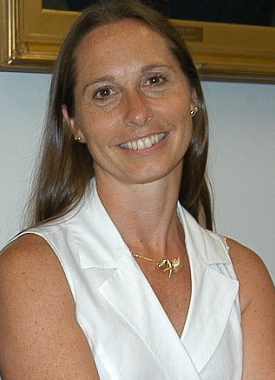
Dawn Hochsprung, Principal, Sandy Hook Elementary

It has been happening all too often in America. Men and women, mostly women, have been gunned down in our schools by folks who have grievances, real or perceived. In what should be a place of sacredness and quiet and contemplation or, alternatively, a place of lively discourse and love and vibrant excitement, our public school teachers (and I include in that label anyone, including the custodians and lunch ladies who work in our schools and serve our kids) are being killed by madmen with assault rifles and handguns. No one can gauge the loss that the most recent shooting in Newtown, Connecticut inflicted upon that small suburban community. No one who was not there can theorize what the last moments of life were like for the twenty first graders who were brutally executed by a gunman who, with seeming ease, killed his own mother while she slept, took her assault rifle and semi-automatic handguns, and set out to wreck murder and mayhem on the most vulnerable of our society. But we do know that, with those twenty little children were six teachers who, as reported by survivors and the physical evidence, perished in that maelstrom trying to save the lives of their students. Notice that I have emphasized the word “teacher”. I have been troubled by news reports of the shooting that tell us twenty children and six adults died in the tragedy. Yes, they were adults. But more importantly, they were women who had dedicated their lives to ensuring the education and safety of our children. They were grandmothers, mothers, sisters, and wives who had chosen to become educators in the public schools. To simply label them as adult victims, in my view, diminishes who they were and the importance of their role in American society.

We all, I think, can remember a teacher, or two, or three who made a difference in our lives. As a writer, I have dedicated a number of my novels to English teachers I had in junior high and high school, so large was the impact of those women (yes, they were all women) upon my urge to write. This is not to discount the men who also instructed me and provided me with an education through my thirteen years of public school, four years of public university, and four years of private law school. They too made a difference in how I viewed the world, how I came into my own, how I chose to live my life. But there’s something about great female teachers and young students, a bound that forms, I think, akin to the bond of mother and child, that is unique and amazing. I mean no disrespect to the fine men who teach in elementary schools by making this observation: It’s just something that seems to me to be true.

Today, please take a moment to remember the teachers of Sandy Hook Elementary School and pray that the folks who shepherd our children from infancy to adulthood never again have to shield students from gunfire in our schools. I’ll leave it to others to begin the much-needed dialogue about weapons and mental illness and video games and the like. I am simply too sad, too heartbroken at the images of teachers being taken from their students (and little kids being taken from their families) to engage in political discourse on this gray and cold December morning along the banks of the Cloquet River.

Some of the Victims (Students and Teachers) of the Sandy Hook Shooting

May the teachers and children of Sandy Hook find eternal peace and rest and their families and friends find comfort in knowing that all of America mourns with them.


Mark


Posted in Blog Archive | Comments Off on They Were Teachers

A Different Sort of Christmas

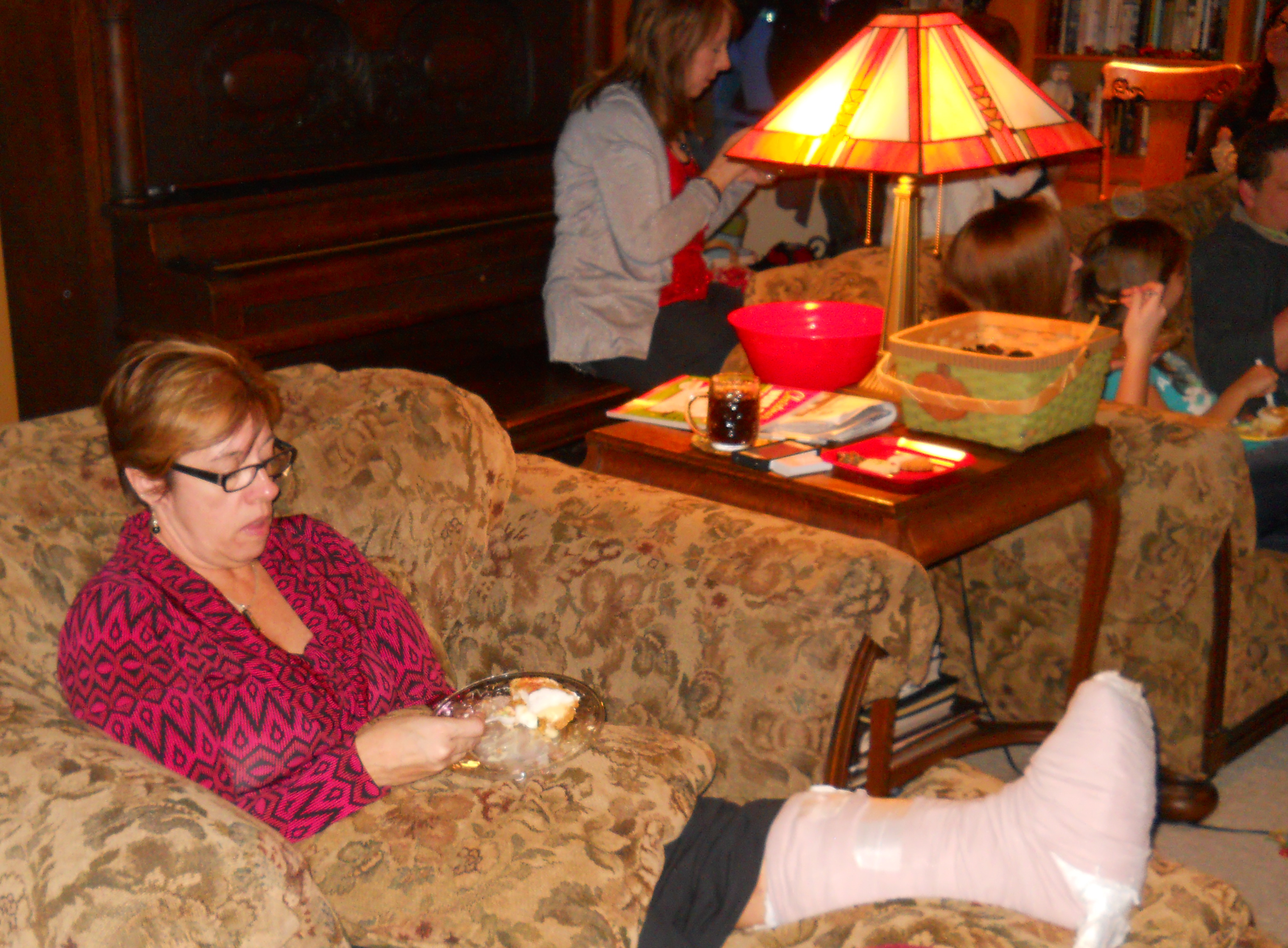
Rene’ eating her pie

Over the years, the Christmas traditions enjoyed by my wife’s side of our family, the Privette side, have changed. When Rene’ and I first dated (and early in our marriage) my mother-in-law, Mercedes. and my father-in-law, Don, had their six children, spouses, significant others, and their sole grand child, Amy, at their old house on West 3rd in Duluth’s West End to celebrate Christmas. But when Rene’ and I moved to the country in 1984, Christmas moved with us. Over the years, out here on the banks of the Cloquet River, we’ve snowmobiled, ice skated, cross country skied, had visits from at least two different Santas, and watched our kids and those of Rene’s brothers and sisters get married and have kids of their own. Accomodations have been worked out so that now, instead of celebrating Privette Family Christmas on Christmas Eve, we schedule it on a weekend before Christmas that works for most, if not all, of my wife’s family.

Yesterday, they were here in en masse. Greg, Rene’s older brother, Diane, her older sister, and Sharon and Colleen, my wife’s younger sisters, and most of their families joined us for a potluck celebration of family, tradition, and old stories. But things were different this year for me; and likely also for my lovely wife who usually orchestrates the entire event to ensure over two dozen folks are happy and well fed.

First off, this year’s gathering took place on the one year anniversary of the shooting in the Cook County Courthouse. Many of you know that I was the judge in the middle of that horrific event. Now, as I’ve said before, I wasn’t a hero on 12/15/2011: No, not at all. I was simply a bystander to tragedy when a disgruntled litigant (who’d just be convicted of criminal sexual conduct by a jury of his peers) decided to vent his upset with a handgun and shoot the lead prosecutor on the case and the father of the young victim within close proximity to where I was standing, talking to the jury. I think I would have been OK, essentially untroubled by the anniversary, but for two things that occurred recently.

You’ve all read, I’m sure, that the prosecutor in that case is alleged to have been involved in similar, if not identical, conduct to the actions he prosecuted. That news not only threw the bucolic community of Grand Marais into a tizzy; it struck me very, very hard since I’d developed a professional admiration for the prosecutor during the course of the trial and its unscripted aftermath.The news of these new suspicions and allegations against someone I respect caused me to begin to relive the events of December 15, 2011.

Then, just this past week, we learned of the inexplicable shootings in Newtown, Connecticut. Again, coming as it did within days of the anniversary of my own involvement in a shooting, any reported instance of madness involving guns and innocents would have hit me hard. But this one was so evil, so manifestly wrong, well, there’s just no way to measure the impact it will have on all of America, let alone me. Seeing school children in tears, their teachers scrambling to move them to safety, and hearing of the twisted events one man orchestrated inside what should be a place of kindness, peace, and learning for children; well, the affect on all of us is indescribable.

Then there is the personal. My wife, as you can see in the above photo, is on the mend. On Monday, she slipped and fell on black ice, severely fracturing her left ankle. Understand, as I type this, I’m still recovering from shoulder surgery, just beginning the long process of rehab myself. So we found ourselves (once Rene’ had her ankle pieced back together with plates and screws and the skill of surgeons and nurses), two cripples trying to pull together Privette Family Christmas with a dark cloud hanging over the world. But it all worked out. Rene’ had much of the planning done before her accident so there were only a few errands left for me to run.

There are also the factors of age and time to contend with. The patriarch and matriarch of the Privette clan, Don and Merc, both passed on within the last two years. Their absence is obvious and palpable whenever their children and grandchildren and great-grandchildren gather, but the loss of Rene’s parents is even more noticeable at Christmas.

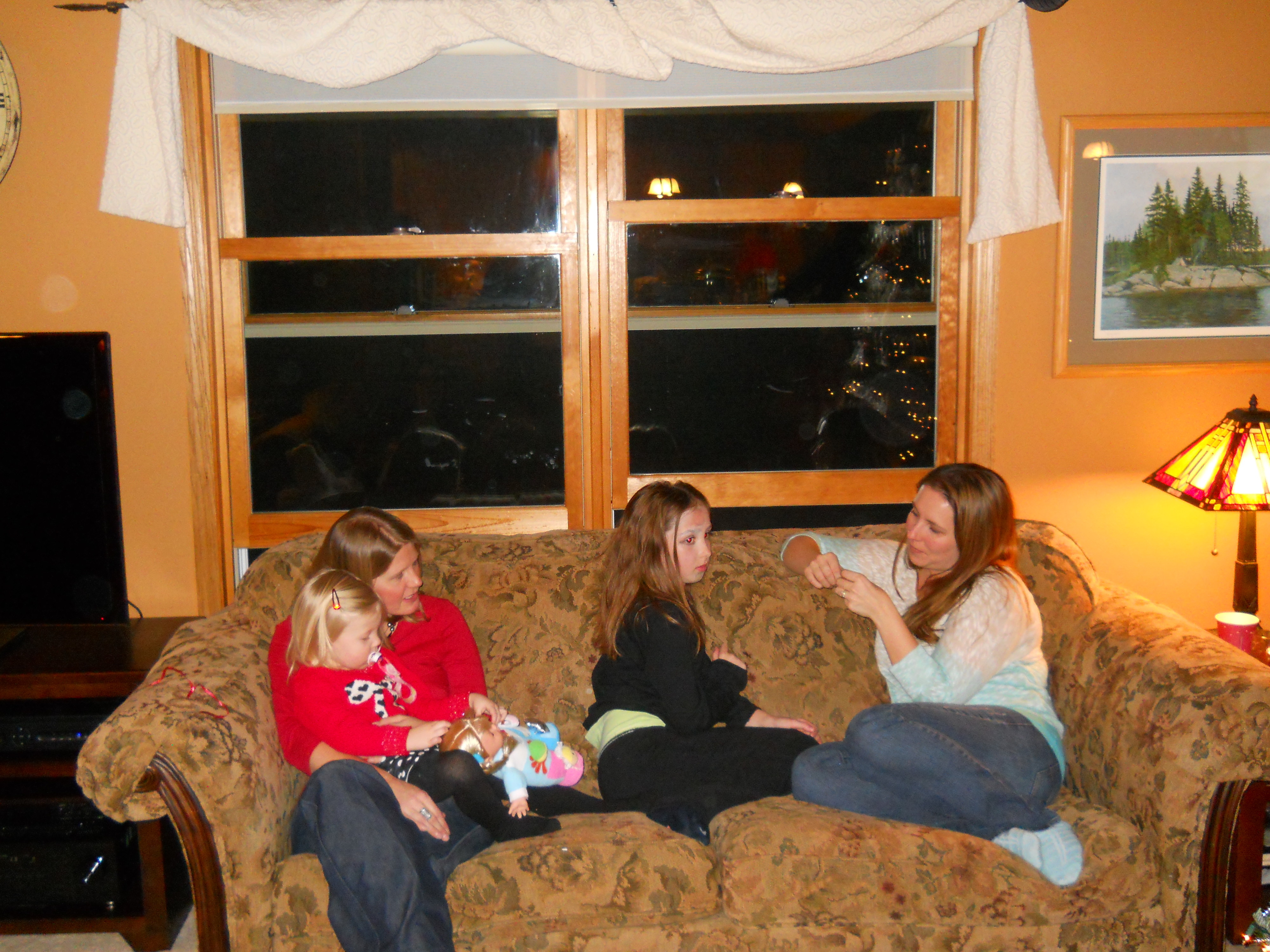
Addison and Sara Privette and Mya and Amy Bourdeau

Still, in the face of uncertainty and angst, the gathering came together. Despite my wife’s precarious condition, despite the inclement and treacherous weather (rain, snow, sleet and then ice), and with the help of our son and daughter-in-law Matt and Lisa, our son Jack, the inspired cleaning abilities of my sister-in-law Diane, and the willingness of all the Privette clan to pitch in and bring more food than an army division requires for a month long campaign, Privette Family Christmas, including the relatively recent tradition of playing the dice game for wrapped, undisclosed presents, came off with out a hitch. Against the backdrop of Cook County and Connecticut, for a few brief moments, there was a nothing but love, laughter, and the promise that little children bring to this season in our home.

For that, I am truly thankful and feel truly blessed.

Sue and Cloe Privette and AJ and Lisa Munger


Here’s praying that you have a glorious Christmas and New Year.

Peace.

Mark

Posted in Blog Archive | Comments Off on A Different Sort of Christmas

The True History of a Small Press


I came across the following blurb in the Proctor Journal this past week and it got me to thinking:

10 Years Ago (2002)

Judge Mark Munger will sign his books Ordinary Lives, River Stories, and The Legacy at Northern Lights Books and Gifts…

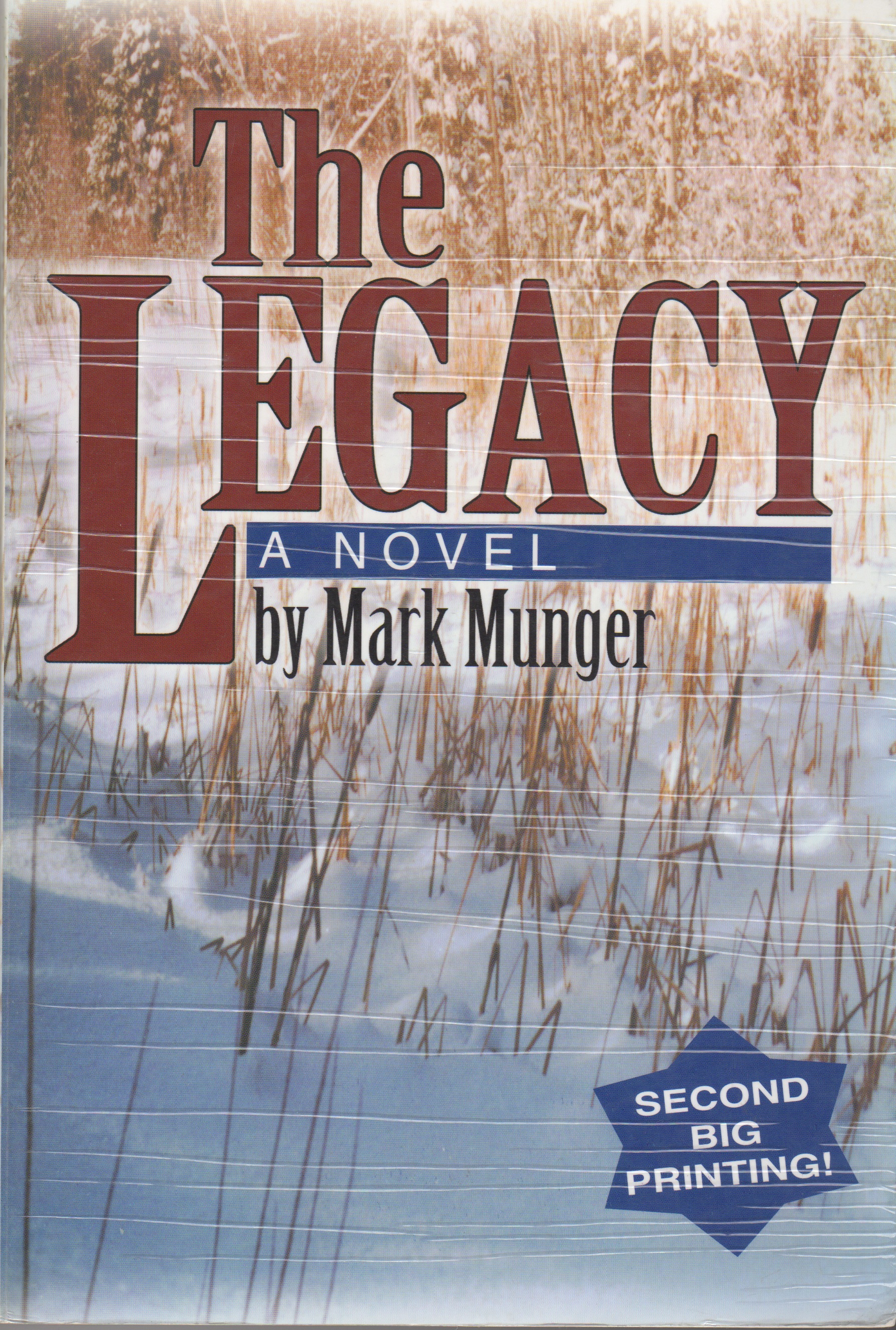
That passage brought me back to where this all began. My first novel, The Legacy, was published in October of 2000 by a local publisher other than Cloquet River Press (CRP) and had a print run of 1,000 copies. That run was sold out before Thanksgiving, leaving the book’s original publisher and me (the newly-discovered author with the puffed out chest) with no books to sell over the holidays. I suggested a second run. The publisher agreed on one condition: 2,000 additional copies of the book would be printed but, if at the end of the year, any inventory remained unsold, I would buy the books back from the publisher. The deal sounded good to me but then, as a first-time author having just sold out the first run of my debut novel, anything that kept my name in the public eye sounded good. Over the next year (2001) we sold another 1,200 copies. Not bad for a regional writer and his first novel. But as the year drew to a close, the publisher still had 800 copies of The Legacy in inventory: 800 copies that I was responsible to purchase at cost. With my wife’s permission, I borrowed money from our son Chris’s college account (the money was paid back, honest) and fulfilled my half of the bargain. But what to do? I was now the proud owner of boxes of fiction stored in my basement that I had no idea how to sell.

That’s how CRP got its start: as a vehicle to sell copies of The Legacy. I managed to figure out how to obtain a business name from the Minnesota Secretary of State, make contact with distributors get my novel into bookstores, open a business bank account at Wells Fargo, and eventually, with my eldest son Matt’s help, set up this blog site.

But what to do about the two collections I had sitting in the hard drive of my computer? How was I supposed to get my other stories formatted and printed into books if I didn’t know squat about the craft of creating a book?

Early in 2002, I stumbled upon a company called InstantPublisher.com (IP), an online printing service that started as a firm dedicated to printing church cookbooks and, with the advent of digital laser printing technology, entered into the world of book publishing. I figured out how to submit my drafts to IP and my wife Rene’ figured out how to create cover art that fit IP’s templates. We then went to work creating books.

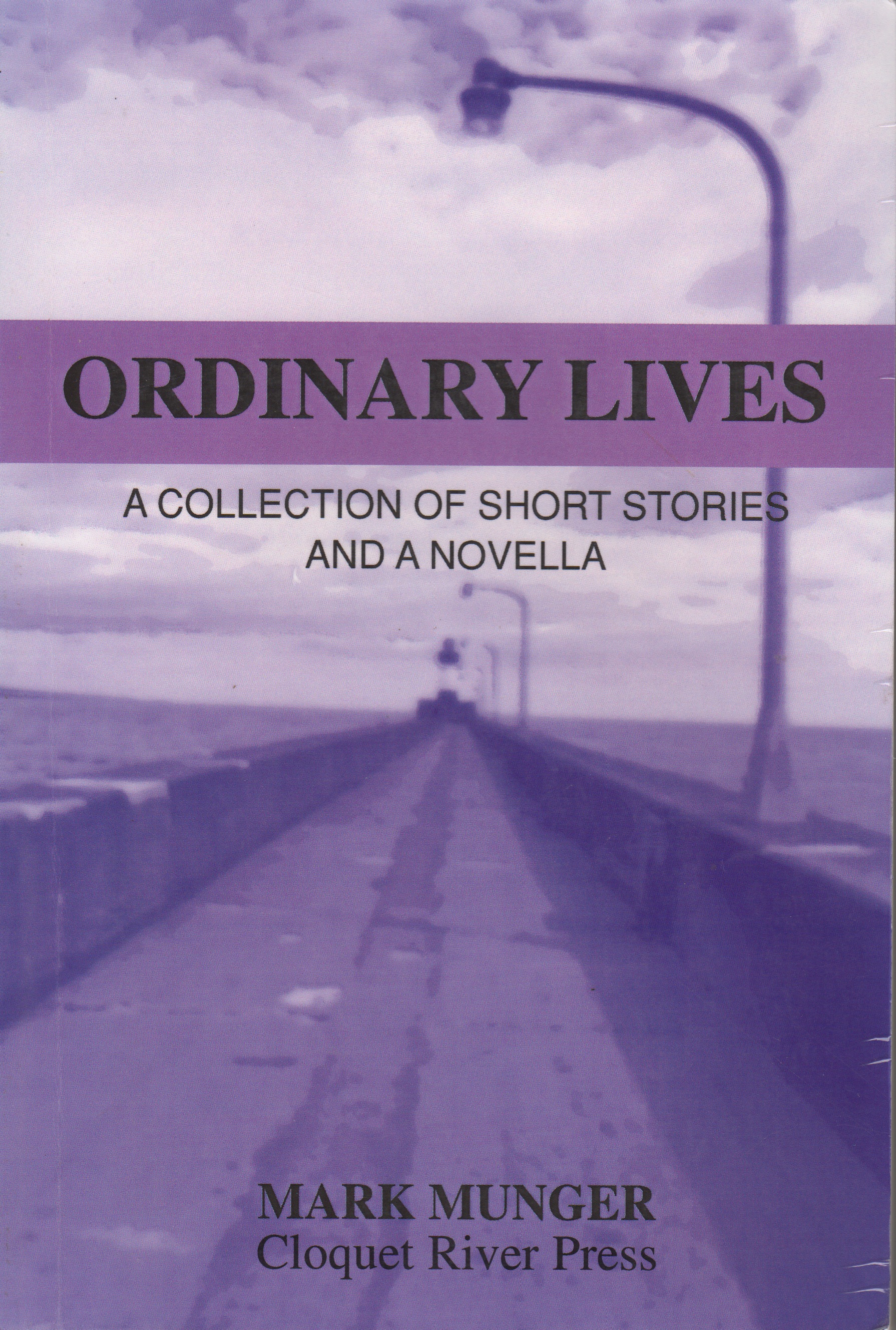
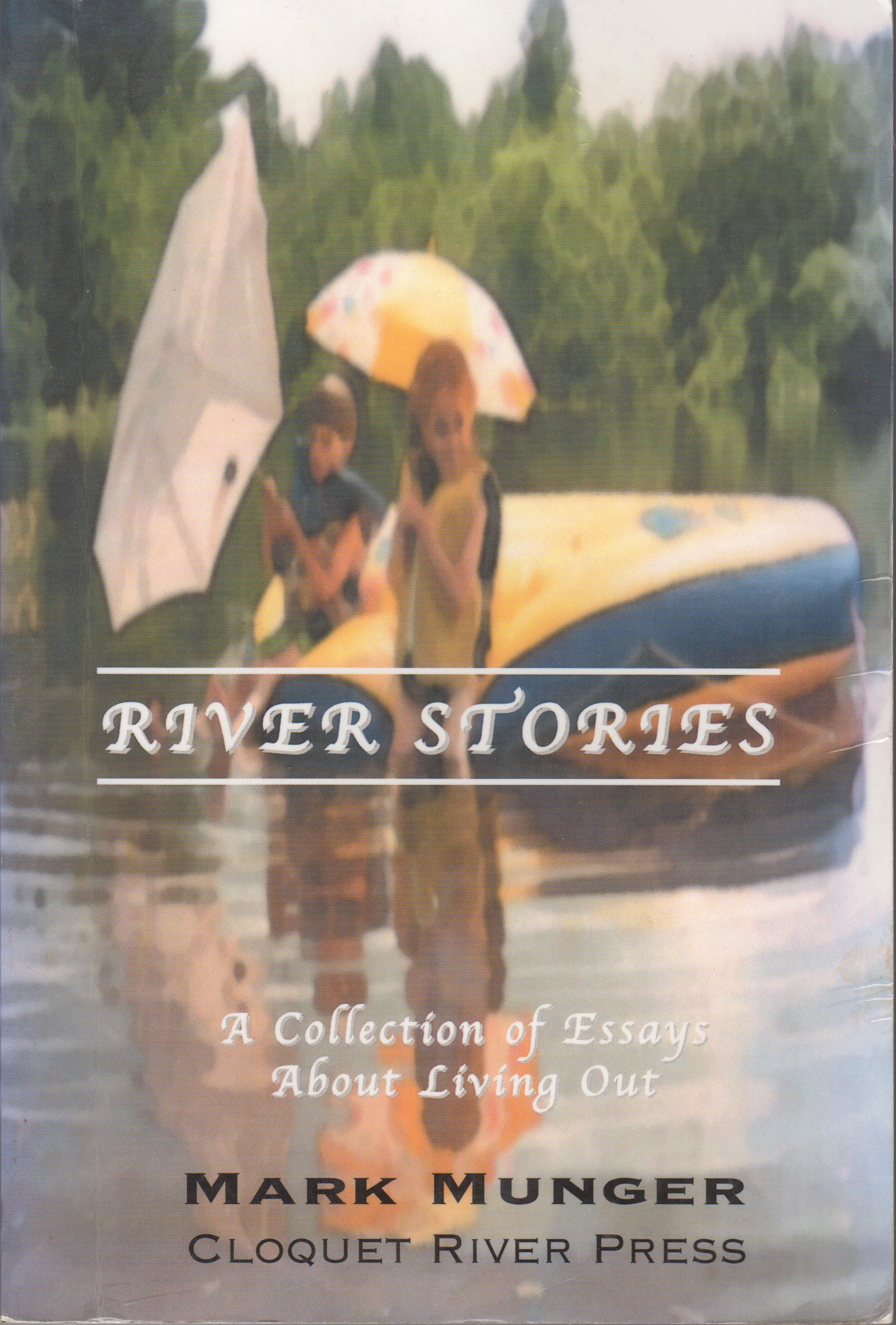
The first two CRP titles, Ordinary Lives, a collection of short fiction I’d been writing for a decade, and River Stories, a collection of essays I’d written for the Hermantown Star, were the beginning of my adventure in the world of self-publishing.

Both books were printed in very limited (25 copies per title) runs so that I could ensure myself that the quality of IP’s process was at least equal to the traditional offset printing process that had created The Legacy. When the books arrived at our house on the banks of the Cloquet River on a windy, rainy day in May 2002, I was nearly as excited as when I’d first held a completed copy of The Legacy. For those of you who’ve not poured your heart out on the page and waited patiently for the words you’ve written to return in the form of a finished book, well, the only experience I can equate holding a brand new title in your hands with is that of holding a child, your child, for the very first time. Don’t get me wrong: It’s not quite the same. But it’s close.

Though I’d ventured into the world of self-publication in 2002, I still tried mightily to locate a literary agent who could connect me to a mainstream publisher: a big New York operation that would pay me a fat advance and publish my work. Despite dedication to task, it didn’t work out that way. I have enough rejection letters to paper the room I write in with several hundred left over for alternative use in the commode! My big break never came so I plowed ahead with CRP, churning out books like nobody’s business, oblivious to the mountain of red ink I was creating.

For you see, the vanity book business isn’t generally susceptible to get-rich-quick schemes of its authors: Even those of us who (and I say this with as much modesty as I can muster) achieve a small measure of artistic success and a loyal following don’t usually see a return on our financial investment. Never mind being paid for the time we spend writing, editing, and creating our books, labor which will never, ever be compensated. No, for us, the little guys and gals dreaming big dreams of fame, fortune, and success at the end of the self-publishing rainbow, reality is being satisfied that your work is being read, not financial stability.

Oh sure, I know. John Grisham started as a vanity author. He had thousands of copies of A Time to Kill sitting unsold in his basement when he optioned his second book, The Firm, to a New York publisher through a literary agent (the traditional path to writerly success). Dickens. Clemens. Woolf. These are all folks who walked the self-publishing path at one point or another in their careers. So it is possible for someone like me, someone whose words flow into the world of ideas by means of my own sweat, to make it, to become financially viable. But for every Grisham, I’m afraid, there are a thousand Mungers. That’s just the reality of today’s literary marketplace.

After my two collections tested the water, I found there was a modest demand for my writing without an established publisher. So I kept at it. And at it. And at it. In early 2003, my second novel, Pigs, A Trial Lawyer’s Story, came out. My best selling work to date (Suomalaiset: People of the Marsh) was released by CRP in 2004 and led my wife and I to Finland in promotion of that historical novel. A second collection of essays from my days as a newspaper writer (Doc the Bunny and Other Short Tales) followed. My first foray into contemporary, book club-style women’s fiction, Esther’s Race, was published in 2007. Mr. Environment: The Willard Munger Story, my first (and I promise, my only) stab at biography hit bookstores in 2009.  And this past March, a sequel (of sorts) to The Legacy (Laman’s River) came out both as a trade paperback and, for the very first time, as an eBook.

9 books in 12 years. Some might wonder whether I’ve spent enough time crafting each story, each manuscript, cramming so many words into so many books in such a short time frame. But here’s the thing: I began writing seriously in 1990. While I worked on and marketed The Legacy to agents, I also wrote the short fiction that became Ordinary Lives, submitted essays to the Hermantown Star for eight years (stories that were compiled later in River Stories and Doc the Bunny),  and hammered away at the lengthy and autobiographical Pigs, so that, by 2002 when CRP was formed, I had a body of work in reserve, ready to be transformed into books. After that, other than the biography (which was a five year endeavor of love in memory of my late uncle) each novel has taken, on average, 1 and 1/2 to 3 years to create and release.

To be sure: Not every story or essay or chapter or scene I’ve written over the past twenty-two years has been great, or, in some cases, even good. And I’ve learned to rely upon friends, experts, and relatives to function as first readers; to self-edit my work using their criticisms; and then hire a professional editor to put the finishing touches on my sentences and paragraphs. Still, there are errors. Still, my books venture out into the universe in less than perfect form. And still, the red ink flows. But here I am, on the cusp of sixty years old, nine books to my credit and a tenth being vetted by my trusted first readers as I write this piece. Why do I insist? Why, after a decade of butting my head against the concrete wall of the world’s greater indifference, do I continue on, do I allow CRP to continue its existence? The answer is very simple: I have stories to tell and folks seem to enjoy them. It’s as simple as that.

So, in this tenth year of Cloquet River Press’s existence, despite the red ink, despite the frustrations of being undiscovered (or barely discovered), me and my little press will continue on so long as there are folks out there who want to read my words. If you like what I write, it wouldn’t hurt to tell other folks about CRP, its books, and this blog.

One never knows.

Peace.

Mark


Posted in Blog Archive | Comments Off on The True History of a Small Press

1059 Miles, 4 Libraries, 3 Bookstores, 2 Big Lakes, 49 Books, and Santa

Silver Creek Tunnel

The week began with my iMac being left at CW Technologies in Duluth for a new hard drive courtesy of Apple. It ended with me selling a couple of books to a childhood friend at the Bookstore at Fitger’s in Duluth. Between those two events, I spent a week of my vacation becoming intimately familiar with the controls of my 2008 Chrysler Pacifica, rekindling old acquaintances, reading from my books to strangers, and making new friends.

Monday, November 26th. I’m on vacation. I drive from our house on the Cloquet River into Duluth to drop off the computer. I received an email from Apple advising me that my iMac had been flagged as having a defective drive. The nice lady at CW Technologies sees my arm in a sling (shoulder surgery) and offers to carry the iMac from the van into the store. The errand done, I head home, load bins and boxes of books into the Pacifica with one hand, and begin my week long book tour to promote Laman’s River. I drive the back roads to the Silver Bay Public Library, meet Julie, the librarian, and set up a small display of my books. A dozen or so folks (including fellow author Wayne Johnson, and his former law partner, Pete Morris) show up to hear me read from and discuss my latest murder mystery. It’s dark when I begin my trip back down the North Shore, towards home, a cold wind buffeting the van as I negotiate the twists and turns of Highway 61.

Tuesday, the 27th. My morning begins at the West Duluth Kiwanis Club. I was invited by Tom Ward to give a presentation about Mr. Environment: The Willard Munger Story to the group. I eat breakfast and read the paper at McDonald’s and then show up at Asbury Methodist Church around 9:30am, ready to regale Kiwanians with stories of my uncle’s life. Thirty or so folks, including my cousin Patsy (Willard’s daughter) are in attendance and seem to enjoy learning details about my legislator uncle’s personal and early life. Then I head north on US 61 (again!) in the steel blue Chrysler, the cargo bay loaded with books to sell.

Grand Marais Harbor

Grand Marais. I pull into downtown, intent on talking to Beth Kennedy, owner of Birchbark Books, one of two independent bookstores located

Coast Guard Station, Grand Marais

in the sleepy little fishing and tourist village. A week before, as I was finalizing an event at the Grand Marais Library, I learned that the town doesn’t allow

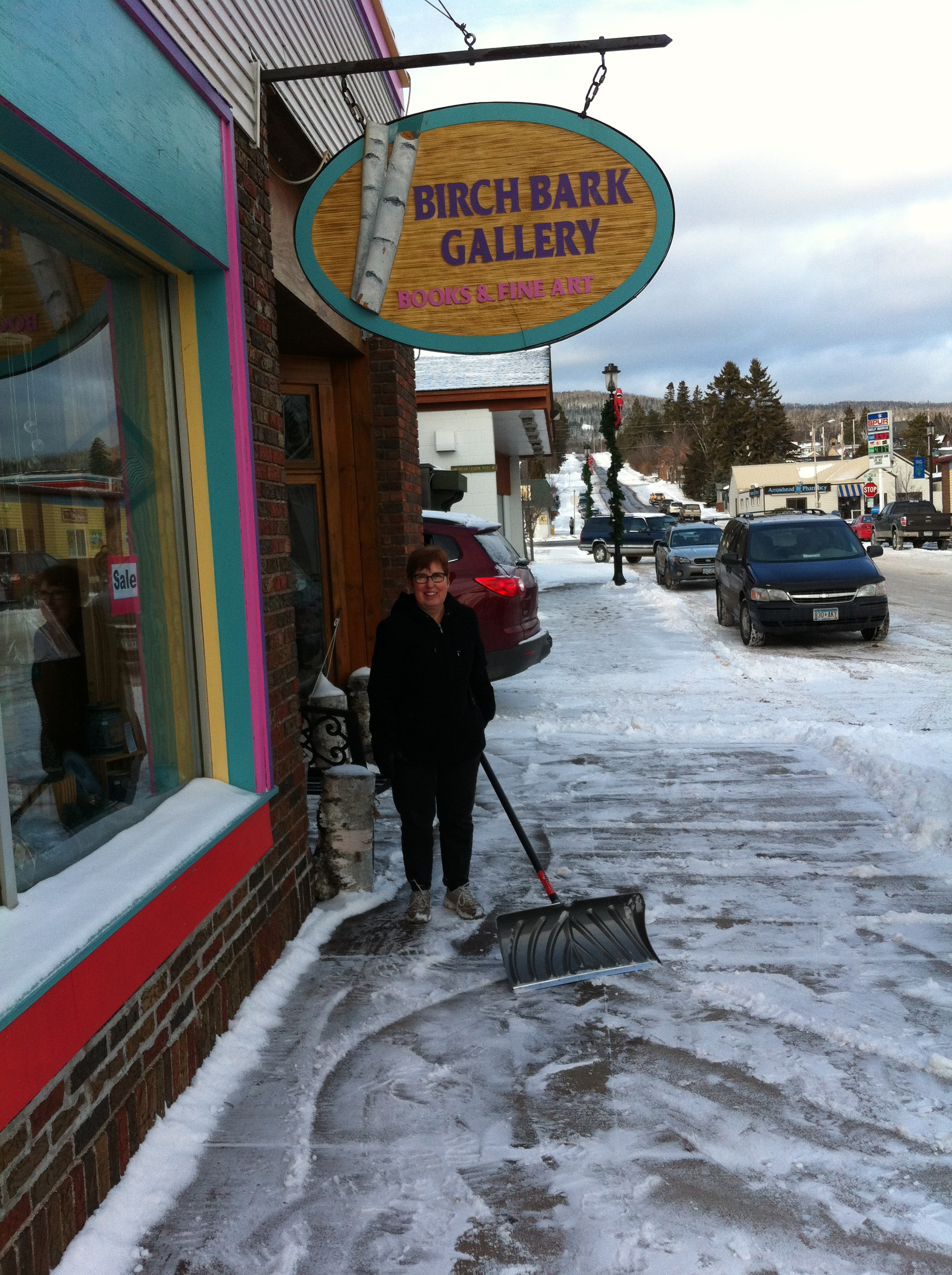
authors to sell books, even their own work, without obtaining a peddler’s license and passing a background check. Linda, the librarian, apologized for the mix-up: She understands that the purpose of doing a reading and discussion of Laman’s River is twofold: To educate the public about the ins and outs of writing and publishing and to sell books. The second half of that equation (the selling books part), along with an occasional mileage stipend from a sponsoring library, keeps me moving forward. Without being able to sell books, my trip to Grand Marais won’t fund itself. Linda suggested I approach Beth and see if she wouldn’t be willing to step in and sell my books at the last minute: Beth, being a bookstore owner and all, means she doesn’t need a peddler’s license. Beth agreed to attend the event and hawk books for me. I find her shoveling snow off the sidewalk in front of her bookstore and thank her profusely for her kindness. Then I drive to the Cook County Courthouse to drop off excess inventory: My next gig is across the international border where I’ll participate in a reading at the Mary Black Library in Thunder Bay, Ontario and I don’t want to pay duty on books I won’t likely sell in Canada.
 

Beth Kennedy and Birchbark Books

At the border, I hand a nearly expired passport to the Canadian custom’s guy. He asks if I am bringing anything into Canada. I tell him, “yes’ some books to sell”. He flags my entry and I have to talk to immigration. An immigration official has me take a seat inside the border station while he determines whether or not I’m a dangerous character. Cleared by whatever internet protocol Canadians use for that sort of thing, I bring my passport and duty sheet to a cashier. While waiting for immigration to clear me, the cashier and I talked about my arm being in a sling and his own need for shoulder surgery. When the cashier discovers the small number of books listed on the duty invoice, he looks at me and says, “What the hell” before crumpling the paperwork into a ball and tossing it in the trash. “Have a nice stay,” he says, waving me through without requiring me to pay duty on the books.

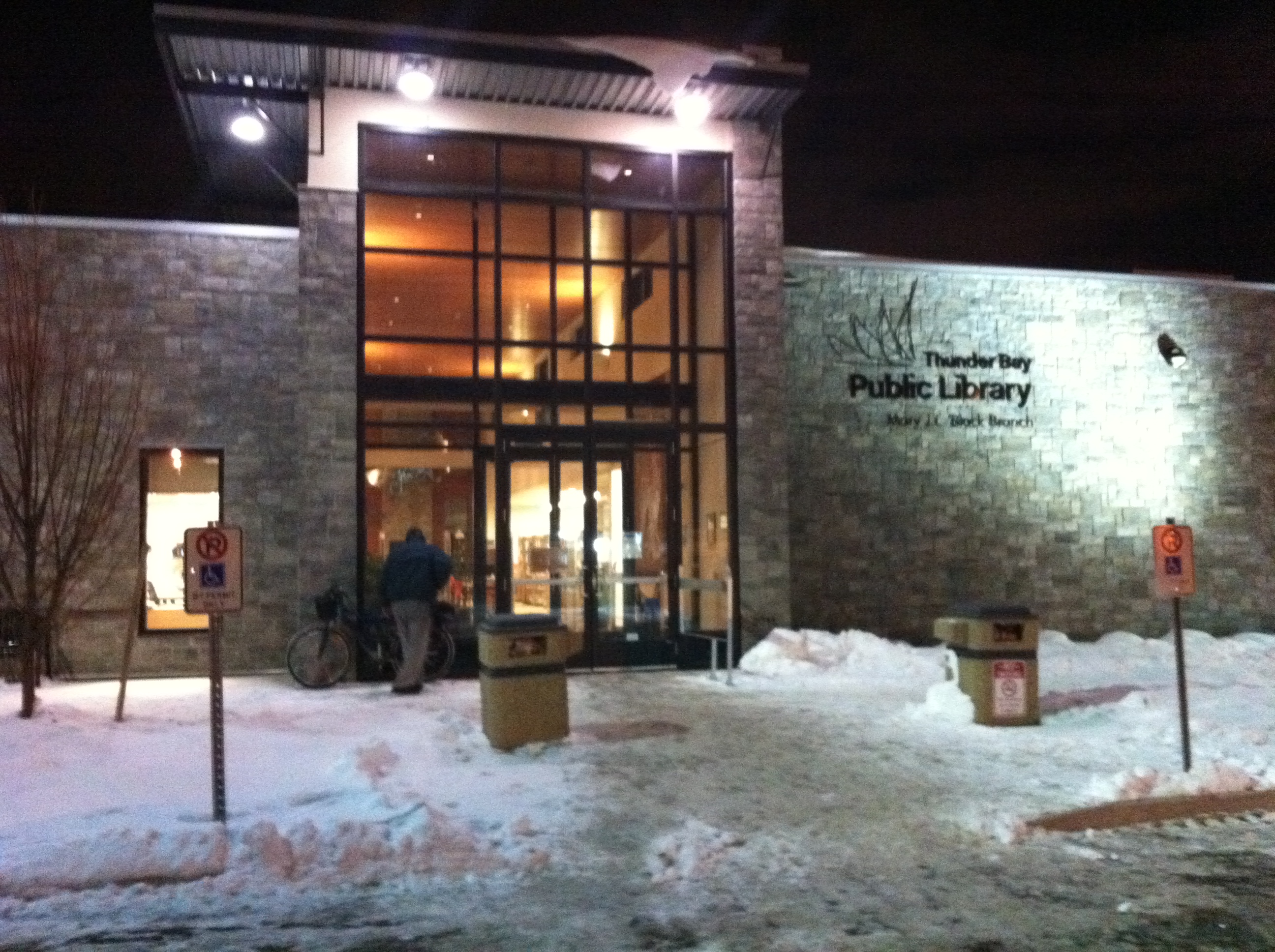
I check into the Prince Arthur Hotel in downtown Thunder Bay, an old railroad hotel that I always stay at when I’m in town. After settling into my room, I cross the street to eat at Armando’s, my favorite Italian restaurant in Thunder Bay. I learn from the owner that this will be my last meal in the place: At his wife’s insistence, he is retiring from the business. I eat my penne pasta with sausage and mushroom, slowly sipping a nice glass of Merlot, and lament the passing of an institution. After dinner, I fire up the Pacifica, travel across town to the library, where I share a few short passages from Laman’s River with a crowd of 20-30 interested members of NOWW (Northwestern Ontario Writers Workshop). I meet up and have a nice discusssion with some old friends and fellow members of NOWW including author Lyle Nichol. Lyle and I make plans for breakfast at Hoito on Wednesday morning. I drive back to my hotel room, the sky black, the wind howling in from Manitoba, call my wife to say goodnight, and read a bit before exhaustion leads me to sleep.
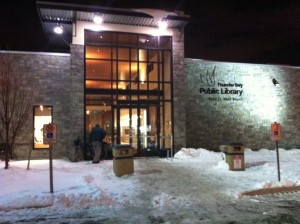
Mary Black Library, Thunder Bay, ON

Lyle and his wife, Vicki, came down to Duluth in May of 2009 for the launch of Mr. Environment, a touching show of support for an American writer they barely know.

Hoito (“Care”): Finnish Labor Hall, TB, ON

I remember their kindness fondly as Lyle and I eat pancakes and eggs and drink thick black coffee the next morning at Hoito, a cafe located in the basement of the Finnish Labor Hall on Bay Street. Sadly, Vicki is not feeling up to par and unable to join us but Lyle and I talk writing, politics, and life, rekindling our fledgling friendship.

Back in the States, I stop in at the Cook County Courthouse in Grand Marais and retrieve co-workers Kim and Nancy for lunch. Jean, a young lady who works in the county attorney’s office, tags along. We have a nice meal and then, I head over to the library for another reading from and discussion of Laman’s River. I am worried as I meet Linda, the librarian, and set up my book display. It’s nearly 2:00pm, the time for my talk, and there are only a handful of hearty folks milling around, waiting for me to begin. And then, the room begins to fill until every seat in the place is taken. The talk goes well. Beth sells some books. All is right with the authorly world as I pack up and head south again on No. 61, tired but extremely fulfilled.

Thursday. I meet my Aunt Susanne (a fellow writer) and her husband Wayne at Blackwoods Restaurant in Two Harbors. I’m the guest of the Friends of the Two Harbors Library: I’ll give yet another reading and participate in another discussion of my new murder mystery. The impetus for my sojourn up and down the North Shore is obvious: much of the story takes place on the North Shore or in Duluth. A nice crowd shows up at the library. I take questions and try to answer them as best as my road-weary mind can, and then, with darkness hanging over the road, I head home to my wife and son.

Friday, November 30th. The end of the month and nearly the end of my travels. I kiss Rene’ goodbye, tell Jack to “listen to his mom”, and put the Pacifica through its paces once again. This time, I’m headed west, to Grand Rapids, to sign and sell books at a nifty little independent bookstore in town, Village Books. I wander into the mall a bit ahead of schedule. The clerk and I make an executive decision to move the table I’ll be sitting at from inside the store to the corridor in front of the store’s display cases. Business is slow at first but then, as I talk to two ladies bell ringing at a nearby Salvation Army kettle (and convince them to order copies of my Finn novel, Suomalaiset from the store because I’m sold out), I begin to sell books to Itasca County folks. Randy McCarty and his wife Kath show up near the end of my shift. I’m staying at their lovely home on Lake Pokegama. In return, I’ve offered to buy them dinner. Randy rides with me to a nearby hotel where we have a great meal accented by lively and intelligent conversation. At the McCarty estate, I meet Maggie, a 14 year old yellow Labrador and stroke her soft fur as the McCarty’s and I drink hot chocolate and talk some more. In the study where we sit, we’re surrounded by a private library of 4,000 books, all of which, I believe, the owners of the house have read. After exhausting the topics of books, politics, and life, I find my borrowed bed and sleep hard, as if drugged.

Leech Lake


Saturday. It’s a new month. I rise before the McCarty’s, make myself a pot of coffee, take a hot shower, read a bit, and wait for my guests to awaken. When they finally wander into the home’s study, we gather in the kitchen where I eat hearty oatmeal and gulp down more coffee. After breakfast, I hug Kath, shake Randy’s hand, and vamoose. The morning is foggy: Driving to Park Rapids proves taxing but manageable. On my way to Beagle Books, I stop at the casino in Walker to deliver one of my wife’s mosaic garden benches to a resort owner. Rene’ met the man and his wife in Hackensack, at a local art fair, during the summer. The couple commissioned Rene’ to make a bench and, over the fall, Rene’ pieced together a beautiful display of a blue heron on a northern lake. The guy lifts the bench and legs from my car into his pickup. “She did a great job,” he says. I’m on the phone with Rene’ so I hand my iPhone to him so he can thank my wife. He chats for a while, says goodbye, pays the rest of what he owes, and we part. I fire up the van and head west on Minnesota 34.

Time passes slowly when you have no customers. I sell a single copy of Laman’s River during the course of my two hour stint in Park Rapids. After the success of my North Shore trip and my time in Grand Rapids, I am disappointed that my event at Beagle Books isn’t more productive. But I’ve driven as far as Cleveland, OH and spent time at the Barnes and Noble there selling no books. So I gather my patience, wait out my time, and then, once again, the sky shrouded in gray, I head home.

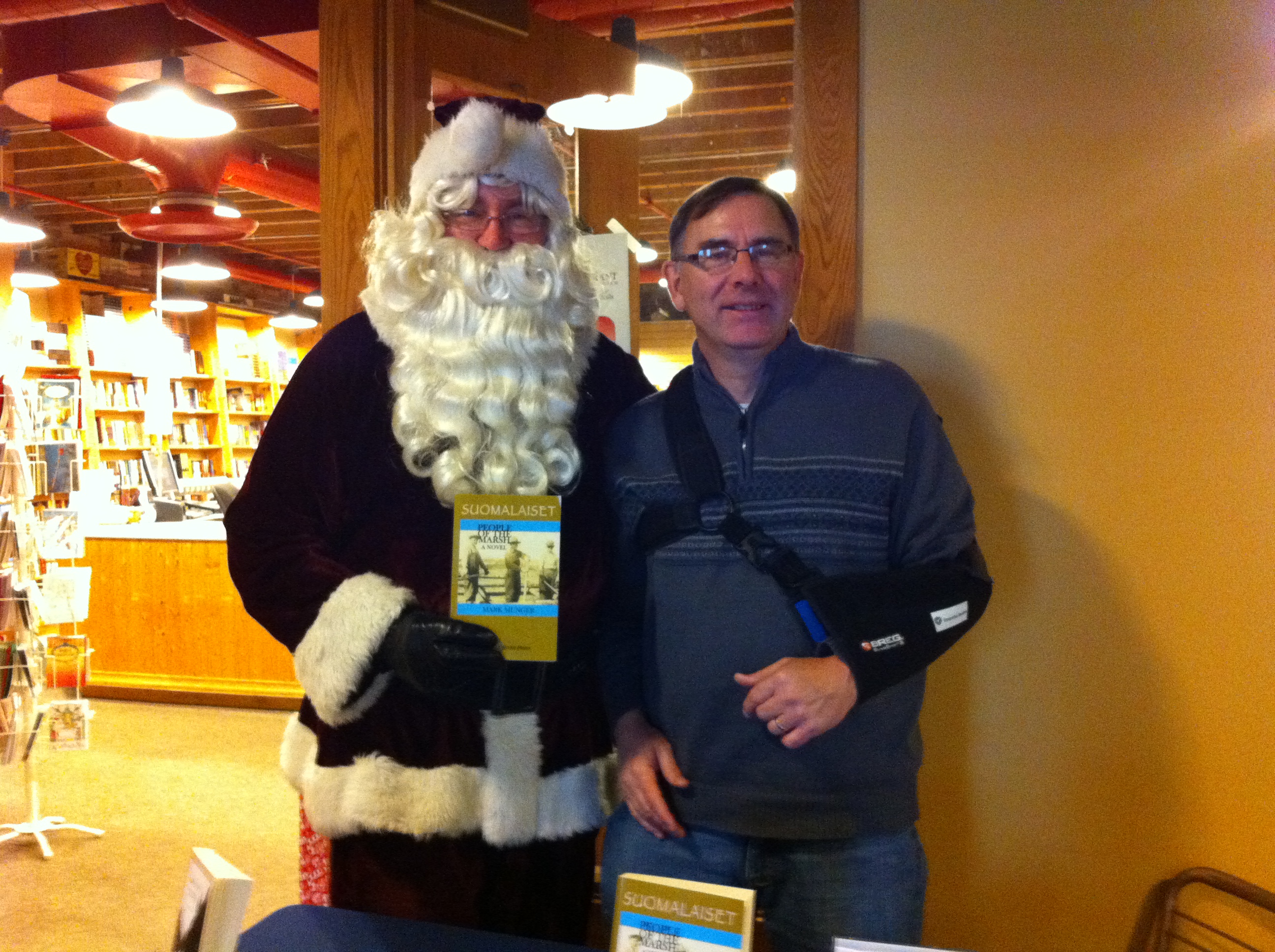
Finally. It’s Sunday morning, December 2: The last event of my week long book tour is at hand. Jack, Rene’, and I attend worship at Grace Lutheran and then I am off to the Bookstore at Fitger’s in Duluth. Sally  (the manager of the store) promotes local authors: stocking the shelves of the quaint and vibrant store with the work of dozens of relative unknowns like me. My childhood friend Monica wanders up and buys a couple of books. Some strangers peruse the titles on my table and buy as well. Sales are modest but enough to satisfy my need for assurance that my work has value. And then, near the end of the afternoon, near the conclusion of an exhausting week,  it happens. St. Nicholas himself saunters up to my table, picks up a copy of Suomalaiset and begins talking to me in Finnish. I don’t know the language beyond a few pat phrases but I sense Santa is intrigued by my book. And that’s how I my book tour ends: I gain Santa Claus’s endorsement. What more could an author ask for?

Peace.

Mark
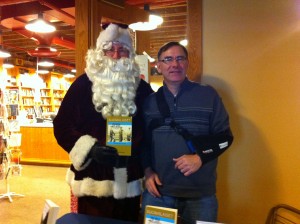


Santa, the Author, and “Suomalaiset”



Posted in Blog Archive | Comments Off on 1059 Miles, 4 Libraries, 3 Bookstores, 2 Big Lakes, 49 Books, and Santa