Birdsong that’s a bit flat

Night

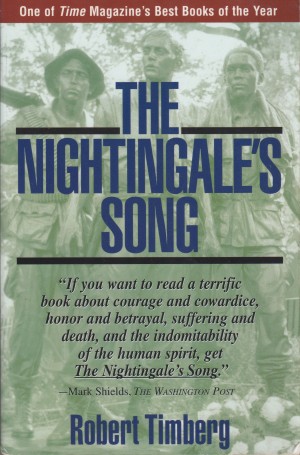
The Nightengale’s Song by Robert Timberg (1995. Touchstone. ISBN0684826739)

Hmm. Well, what to say about a book that one of my brother judges gave me to read with the recommendation that it’s “one of my favorite books”? Granted, Dale Harris is entitled to a certain level of bias towards the subject matter. He’s a Navy man and Timberg’s book, a look back at five men involved in both the Vietnam War and Iran Contra, profiles five Annapolis graduates: Senator John McCain, Lt. Col. Robert McFarlane, former Sen. James Webb, Lt. Col. Oliver North, and Adm. John Poindexter. So I’ll give my friend a pass on the hyperbole he attached to the book as he handed it to me a few months’ back. But having plowed through the 543 pages of this tome at odd hours of the night and on weekends, I won’t be making a similar proclamation in this review.

Not that the book didn’t hold my attention. It did. Particularly the early portions of the story involving John McCain’s hijinks at the Naval Academy and the scenes depicting his time spent in captivity in Hanoi after being shot down during the Vietnam War. In his treatment of McCain, a man who has enured both my admiration (McCain-Feingold) and my contempt (Sarah Palin), Timberg’s portrait is detailed and, at times, deeply moving. So too is the way he touches upon the rivalry between Ollie North and Jim Webb beginning with a still-hallowed boxing match at the Academy (North won). But the scenes devoted to McFarlane and Poindexter aren’t nearly so concisely painted, leading to a level of boredom and confusion created, perhaps, by a skilled writer biting off a bigger chunk of a historic story than is warranted. How’s that? I found myself confused trying to follow the five separate and distinct biographical sketches Timberg uses to explain the linked narrative of Vietnam and Iran Contra. The result is that I came to an understanding there are connections between America’s failure in the southeast Asian conflict and the scandal that nearly undid Reagan’s presidency. (A note to Reagan fans here: Timberg equates, without ever saying as much, the former president’s intellectual capacity with that of a B-level actor playing the role of his life.) But the details of Iran Contra are, at least for me, buried in the vignettes depicting the five principals. So far as I could discern, the author never arrives at a narrative that explains what happened during Iran Contra, what the end game was, who was actually involved, and how high the scandal reached. I get it was an “arms for hostages” slight of hand orchestrated by North, and to a lesser degree, Poindexter and McFarlane. But the details, at least for me, remain murky even after finishing this marathon read.

There’s value in revisiting moments in history where our democracy has come off the rails. I think that was Timberg’s intent, to explain what happened during Iran Contra within the context of our nation’s sad experience in Vietnam. I’m not so sure he accomplished his goal, though, in attempting to state his case, the author does explore five distinct and unique men who served their nation, albeit with varying levels of honor.

3 and 1/2 stars out of 5.

Posted in Books | Comments Off on Birdsong that’s a bit flat

Thanks, Finlandia Foundation!

FinnFoundLogoBW

Today I received a check from the Finlandia Foundation representing a national grant from the Foundation in support of my novel-in-progress, Sukulaiset: The Kindred  a novel of the Holocaust, WW II, and Karelian Fever set in Finland, Estonia, and Karelia. The Foundation is a national organization whose primary goal is to inspire, celebrate, and connect members of the Finnish American community. The Foundation is the most important sponsor of Finnish culture, history, and arts in the United States. The book will debut at Finn Fest in the Twin Cities in August (2014) and be released to the general public in the fall of 2014. Thanks to the Foundation and to Gerry Henkel of The New World Finn and Jim Kurtti of the Finnish American Reporter for supporting the grant application. SukuRedoMore information about my appearance at Finn Fest and the October launch of the book at the Theater of the North in Fitger’s will be announced as details are finalized. Thanks to the Foundation and to Gerry Henkel of The New World Finn and Jim Kurtti of the Finnish American Reporter for supporting the grant application.

Peace.
Mark


Posted in Blog Archive | Comments Off on Thanks, Finlandia Foundation!

Another Hawai’i Read

Mark

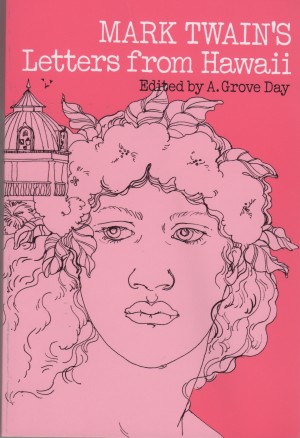
Letters from Hawaii by Mark Twain (1966. University of Hawai’i Press. ISBN 978-0-8248-0288-2)

I bought this book on my way home from Hawai’i. I spotted it in the airport bookstore on Oahu and I was intrigued, after reading Jack London’s collection of Hawai’i related tales, to read what Mr. Twain had to say about Hawai’i of the early 20th century. I wasn’t disappointed.

Oh, there are a few boring letters from Twain back home, to California, where Twain was living in at the time of his voyage to Hawai’i in 1866. The chapter on sugar cane production might be interesting to modern-day sugar cane farmers, agricultural historians, but likely no one else. But there are enough rollicking, riveting displays of Twain’s sense of humor and his ability to prettify travel narrative for most casual readers. A collection of articles Twain wrote for the Sacremento Union, the paper that underwrote the trip, the topics in this book range from descriptions of beautiful Hawaiian maidens swimming the surf in the altogether to Twain’s wry observations regarding Hawaiian legislative politics. Here’s a classic passage:

The mental caliber of the Legislative Assembly is up to the average of such bodies the world over-and I wish it were complimentary to say it, but it is hardly so. I have seen a number of legislatures, and there was a comfortable majority in each of them that knew just about enough to come in when it rained, and that was all. Few men of first-class ability can afford to let their affairs go to ruin while they fool away their time in legislatures for months on a stretch.

Twain invented a traveling companion (likely his own alter ego), the inflated and bumbling Mr. Brown, as a foil for some of the scenes depicted in the stories. In a passage discussing Brown’s seasickness, the author is reveals his descriptive and comedic talents:

He seemed as distressed and restless, at intervals-albeit the rule of his present case was to seem to look like an allegory of unconditional surrender-hopeless, helpless, and indifferent-he seemed as distressed and restless as if my conversation and my anecdotes were irksome to him. It was because of this that I as last dropped into poetry. I said I had been writing a poem-or rather, been paraphrasing a passage from Shakespeare-a passage full of wisdom, which I thought I might remember easier if I reduced it to rhyme-hoped it would be pleasant to him-said I had take a few liberties with the original…(After reciting the poem, Twain continued)…As I finished (reciting the poem), Brown’s stomach cast up its contents, and in a minute or two he felt entirely relieved and comfortable. He then said that the anecdotes and the eloquence were “no good” but if he got seasick again, he would like some more poetry.

The author’s best known work from his Hawaiian journey is Burning of the Clipper Ship Hornet at Sea, a tale which is contained in this volume. While the details of that tragic sinking (and Twain’s portrayal of the heroic efforts of the crew to reach the islands) are impressive, my favorite passages from his letters back to the mainland are those where he is immersed in the strange and almost fictional creation of the young Hawaiian nation. For while the Hawaiian culture had been around for centuries, the unified independent nation of Hawai’i was, at the time of Twain’s visit, a very recent development, the whole having emerged from a collection of separate fiefdoms on the sundry islands to form an interesting, if short-lived, kingdom modeled after Great Britain.

A fine way to learn what it was like to be a tourist on the major islands of the archipelago back at the dawn of steamships, the telegraph, and American expansionism.

4 stars out of 5.

Posted in Books | Comments Off on Another Hawai’i Read

Come Visit Me Next Saturday!

SukuRedo

No, the new book still is not done. Right now, it’s at Scribendi, the editing service I use, going through a professional proofread before I put the final touches on the manuscript. The plan is to have copies of Sukulaiset: The Kindred available for purchase by my Finnish friends at Finn Fest 2014 (08/07-10/2014) in downtown Minneapolis. I’m calling that a soft launch of the book. Then, sometime in the fall of 2014 (late September/early October), I’ll launch the book officially here in Duluth with the assistance and support of the Bookstore at Fitger’s. Plans include using the Spirit of the North Theater, having special guests (musical and non-musical) in attendance, making sure the bar is open, and reading a few passages from the novel in hopes of generating “buzz” about the book. But that’s in the future.

Next Saturday, May 17th, from 11:00am-3:00pm, I’ll be doing my first book event in nearly a year at the Duluth Public Library. Stop on down to visit with me and a plethora of other local authors (some famous, some infamous) selling their books and talking about their writing. It’s all part of what the library is billing as Local Authors Day. For a roster of the folks who’ll be in attendance log on to: http://www.duluth.lib.mn.us/programs-events/authors-day/. The Fishing Opener will be over. Summer will be looming. You’ll need a good book or two for the forthcoming hammock time. I’ll have copies available of every title I’ve ever written for the first time in many, many years. Come on down and buy a signed Munger book or two to add to your collection of fine regional books!

Peace.

Mark

Posted in Blog Archive | Comments Off on Come Visit Me Next Saturday!

Five from the Road

Queen

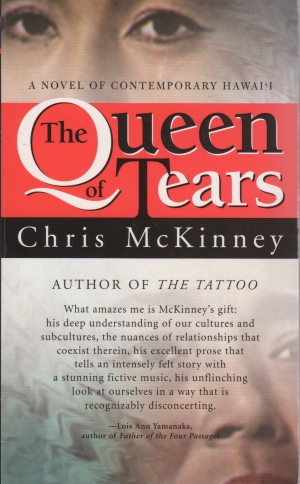
The Queen of Tears by Christ McKinney (1999. Mutual. ISBN 9970400595)

These five “quickie” reviews involve books I read on my recent trip to Kaua’i and Oahu, Hawai’i. The first of the selections, The Queen of Tears, is a mass market paperback I picked up in the gift store at the Marriott where we stayed in Lihue, Kaua’i. The author, Chris McKinney, is an instructor in the English Department at Honolulu Community College. I selected the book because it had a local connection. I often pick up regional short fiction or novels on my travels so as to delve deeper into local history and culture.

Soong Nan Lee is an aging Korean American, having immigrated to Hawai’i after the Korean War and after establishing herself as an actress in Korean B-movies; historical dramas in which she frequently played the lead female, cast in those roles by her movie producer husband. As Soong Lee looks back on her life, we learn family secrets, the source of Soong Lee’s stubborn independence, and are provided glimpses of contemporary Hawai’i as seen by various members of Lee’s dysfunctional family. The novel weaves together the traditional and the modern, the oriental and the American, to form a well paced and intriguing read.

Though the end is a bit predictable, all in all, the story is well crafted.

I have another of McKinney’s books on my Kindle awaiting a bedtime read. I’ll let you know what I think about that novel once I finish it.

4 stars out of 5.

Mountains

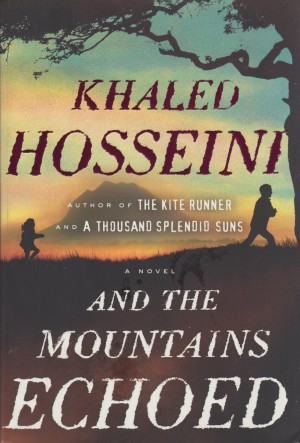
And the Mountains Echoed by Khalid Hosseini (2013. Riverhead Books. ISBN 9781594631764)

Another in Hosseini’s novels exploring an area of the world (Pakistan and Afghanistan) we Americans only know (from television) as an unforgiving morass of seething anti-Western rhetoric and hate, while not as surprising or as compelling as The Kite Runner, this is an engaging and lovingly told generational story set in rural Afghanistan, Kabul, Paris, and America.

The story of Pari, a motherless little girl, and her big brother, Abdullah, this tale alternates between first and third person narratives (a technique I’m using in my forthcoming novel, Sukulaiset: The Kindred). If you loved The Kite Runner and appreciated A Thousand Splendid Suns, you will heartily enjoy this read.

Not a masterpiece but a pretty darn good book!

4 1/2 stars out of 5.

Reader

A Kaua’i Reader Edited by Chris Cook (1995. Mutual ISBN 1566478324)

This is another local book I picked up while on vacation in Hawai’i. I bought A Kaua’i Reader from the Talk Story bookstore in Hanapepe on the western shores of Kaua’i. Intrigued with the thought of reading a collection of short stories, essays, legends, poems, and songs about the Garden Island to broaden my perspective, I must say that, in general, this volume was the least engaging of the books I devoured while on vacation The essays by Chris Cook (who also served as the editor of the collection) are well written and worth the effort. The journal passages lifted from the “discoverer” of the islands, English sea captain James Cook, were also informative. But I found some of the material from old travel articles and the translation of ancient stories and legends to be a bit boring, if not tedious, and, despite their alleged cultural connection to the island, not all that instructive.

My favorite piece in the book is Jack London’s fictional treatment of the rebel leper, Ko’olau, who held off government forces that came to Kaua’i to remove him to Moloka’i due to his leprosy. As painted by London’s prose, Ko’olau is a mythical freedom fighter, a legendary force in opposition to the government akin to Crazy Horse or Chief Joseph. A fine, fine story, leading me to buy a collection of London’s work written when the Californian visited the islands.

Overall, a bit disappointing but a gem here and there that make the total package worth the effort.

3 and 1/2 stars out of 5.

London

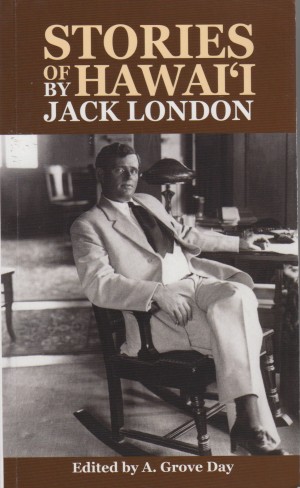
Stories of Hawai’i by Jack London (1986. Mutual. ISBN 0935180087)

Anyone who has read “To Build a Fire”, one of London’s classic Yukon stories will immediately recognize the genius in this collection. London crafts a sequence of short fiction that is breathtakingly sparse yet eloquent, finely tuned, and imaginative. And, unlike the more staid and direct essays and non-fiction contained in A Kaua’i Reader (bits of history that were written with an eye to educating the reader about the Garden Island) London teaches the reader in subtle and entertaining ways without being preachy or pretentious.

London wrote these stories after building a yacht, the Snark, and sailing the new boat on its maiden voyage from the author’s home in San Francisco to the islands in 1907. He returned to Hawai’i in 1915 and 1916 (as the Great War was raging in Europe) and collected more bits of local lore and legend from which to craft short fiction. Of the other tales in the collection, my favorite is London’s characterization of a Chinese Hawaiian’s personal relationship with his mother depicted deftly in “The Tears of Ah Kim.”

The book ends with two essays London wrote of his experiences, the best of which, “A Royal Sport”, describes the author’s attempts at surfing.

Well done and a perfect introduction to the islands.

4 and 1/2 stars out of 5.

Hotel

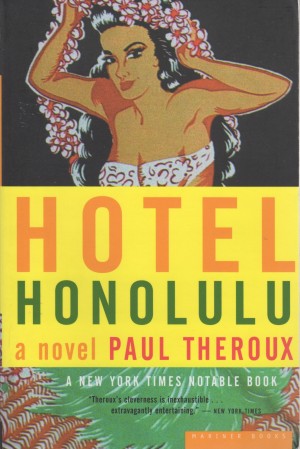
Hotel Honolulu by Paul Theroux (2001. Mariner. ISBN 0618219153)

Sex. There’s a lot of it in this book. I like sex. I like reading about sex. I liked reading about sex in this book. I liked this book. Got your attention?

Theroux writes about Hawai’i as an outsider, in the persona of a down-and-out novelist who, because he can’t write anything that makes him money (sound familiar?) winds up managing a tourist hotel in Honolulu. Not one located on famed Waikiki but one located a street or two away from the frothing Pacific, in a seedier, less desirable part of the city. In many ways, this is an intimate portrait of a man, his wife, his struggles, and their love set against an unlikely, quirky backdrop of transient humanity that flows in and out of the hotel. All of the characters Theroux spends time with become folks we care about, people we want to get to know better. In some cases, we’re granted fuller, more in-depth interviews with these visitors; and in other cases, the tourists and locals taking brief turns on Theroux’s stage disappear without so much as a “farewell”.

As a fan of Mosquito Coast (one of this author’s best known works) I was expecting a bit more dark and a bit less levity in the author’s prose. But I found Theroux’s mix of social commentary, humor, psychological profiling, and yes, sex, to be a satisfying and complete read.

A master story teller at the top of his game.

5 stars out of 5.

Peace.

Mark


Posted in Books | Comments Off on Five from the Road

Singing the Penny Evans

Mark at LawLawPalooza.

The Author at LawLaw  Palooza.

My name is Penny Evans and I’ve just gone 21

I am a young widow in the war that’s being fought in Vietnam

I have two infant daughters and I do the best I can

Now, they say the war is over, but I think it’s just begun.

((c) Steve Goodman)

Nervous? You damn well better believe I was nervous. When I decided I’d sing something at this year’s LawLaw Palooza (the annual fundraiser for the 11th District Bar Association’s Volunteer Attorney Program) I had no idea what I was doing. Sure, I sing a passable tune in the shower and I can sing adequate harmony to Eagles’ or CSNY classics while driving my blue Pacficia. But climb up on a stage in front of 250 folks, including childhood friends, family, judicial colleagues, and brother and sister lawyers, and carry a tune?

What the hell was I thinking?

I haven’t sang in front of a microphone since 1973, my senior year in high school, when my Episcopal church youth group put on a youth service and I sang “I Don’t Know How to Love Him” from Jesus Christ Superstar to a congregation of maybe fifty folks. I was fairly certain, as I considered whether to try my chops forty-one years later, that my voice hadn’t gotten sweeter with age. But I had watched the previous year’s event at the Mitchell Auditorium at St. Scholastica from the cheap seats and had thought, Those folks are having a lot of fun. I had even emailed my pal, guitarist and singer, Mark Rubin, right after the show and proposed that we collaborate on something the next time ’round. A year passed and I was asked, along with Sally Tarnowski (a sister judge with a great sense of humor) to MC this year’s show. My email to Rubin came back to me.

Maybe Zevon’s “Lawyers, Guns, and Money”…

I’d seen the Wallflowers do the song with Jordan Zevon, the dead musician’s kid, on Letterman. Their version blew me away. The wheels started turning. I said “yes” to the MC gig. I pondered the song.

In the end, I decided to stick with something familiar, something I knew by heart. Steve Goodman’s “The Ballad of Penny Evans”, the most beautiful protest song ever written, came to mind. I first heard the song when my 19 year old wife-to-be and I sat wide-eyed and in awe, along with a hundred or so other UMD students, in the Kirby Student Center and listened to Goodman himself perform the ballad a Capella. Just Stevie standing, his guitar hanging from his back, in front of a mic stand, alone, one man and his music against the tragedy of war. Brilliant. Poetic. The song was, and is, everything I love about folk music and folk musicians.

I can do “Penny Evans”.

Without much thought, I emailed Amy, the young lawyer who recruited me to MC, and let her in on my plan to “do something” during the show. Now, folks who know me know that statement could mean any number of things, including things that might not be suitable for a benefit concert. But Amy didn’t pry. She just said, “You’ll be great.”

Then I heard a cut of “Don’t Let Us Get Sick”, a Warren Zevon ballad that recalls, in its essence and vibe, the great Irish laments. Jill Sobule covered the song on the Zevon tribute album, Enjoy Every Sandwich and hit the song out of the park. ( http://www.youtube.com/watch?v=tEWmkHc3zGk.) I didn’t know the lyrics but, as the tune only has two verses, I thought it was something I could learn in a few months’ time.

I’ll do them both.

I kept my little secret from everyone. I practiced the tunes, driving to and from work, a Capella, at the top of my lungs, until I was literally sick of the words.

I think I can do this.

Like many authors (Amy Tan, Steve King, Dave Barry), I’m a frustrated rock star. Or folkie. Or bluesman. Lacking the talent to learn an instrument (elementary school piano lessons aside) and a very limited second tenor range to my voice, never having sang true four part harmony in public, I turned to putting words down on paper to feed my creative muse. I haven’t hit a home run with my writing either but at least I’ve kept myself productive enough to satisfy whatever demons are lurking in the depths of my artist’s soul. Thinking it through, doing two songs, just before intermission, a Capella, wasn’t brave, as some have said who witnessed the attempt: it was downright foolish. That said, I wanted to keep my practice sessions wholly private and undiscovered. Even my wife, Sally-my co-MC, and my staff at work, all of whom attended the event, remained in the dark. The only one who knew I was “up to something” was Amy. On the printed program for the event, my time to shine or fail was simply noted as “TBA”. To be announced? To be avoided? Whatever.

As the week of LawLaw Palooza crept towards the fateful evening, my stomach churned. My voice creaked and groaned. I began to worry that I’d spit into the mic, that I’d forget the words to one or both of the songs, that I’d simply look out into the crowd and decide, “No way in hell.” And then I was there, with Sally, doing our routine in tuxedos, bantering with musicians, all the while realizing the dreaded time was but moments away.

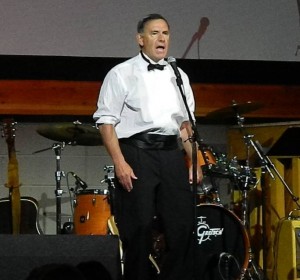
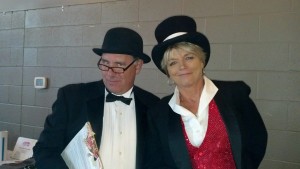
They say that when you become a judge, lawyers will laugh at your jokes and revel in your stories no matter how stupid, insipid, or convoluted they might be. Maybe that’s what folks did after I stood in the spotlights, my tux jacket off, my hair streaked with sweat, my shirt sleeves rolled up, and belted out my two songs, claiming my ten minutes of fame. Or maybe I actually did Steve and Warren and my departed friend Collin (a musician and human being of the first rate to whom I dedicated my efforts) proud. I’ll never really know. But despite the time spent in the john, the anxiety, and the trepidation, I had a whale of a good time singing the Penny Evans.

Here’s to next year…

Mark Singing "Penny Evans"

Mark Singing “Penny Evans”

Peace

Mark

PS To see Stevie do the Penny Evans justice, go here and marvel at a wondrous song and singer.

http://www.youtube.com/watch?v=j6W_a2U-bIU.

Mark and Sally.

Mark and Sally.


Posted in Blog Archive | 2 Comments

Four in the Morning

Steve Galloway and Me.

Steve Galloway and Me.

I couldn’t sleep. Anxiety and self-doubt and apprehension swirled ’round my brain.

Why did I agree to do this?

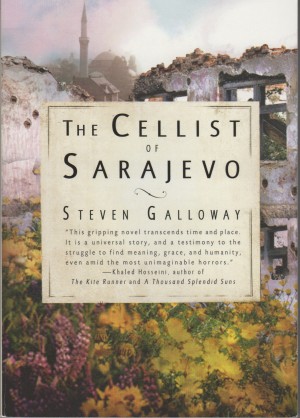
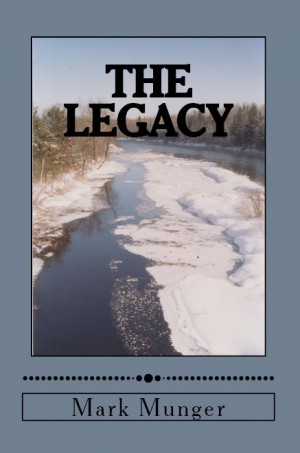
I’d been approached by Mary Lukkarila of the Cloquet Public Library towards the end of 2013 about participating in the One Book event being sponsored by local libraries. Steven Galloway’s The Cellist of  Sarajevo was the novel Northland communities were going to read, discuss, and celebrate. My connection to the event was twofold. First, I’m one-quarter Slovenian and the book is about the former Yugoslavia. And second, my novel, The Legacy covered some of the same ground as The Cellist in that my first book tried to give folks a bare bones understanding of the age-old conflicts embedded in the Balkans. Mary followed up on our Facebook conversation with a link to Patra Sevasitades, the coordinator of the event through the Duluth Public Library Foundation. In indicating my interest, I didn’t consider the ramifications of what I was being asked to do. As a writer struggling to be read, any publicity of my work, my involvement in the world of books, my craft, is welcomed as a possible link to that one person, that one connection that will bring my fiction to the attention of the “powers that be”, i.e., the New York publishing world. Saying “yes” really wasn’t that difficult.

When Mary and I and Patra sat down for a quick lunch at a Chinese eatery near the Duluth courthouse, they laid out preliminary plans for a week of activity related to Galloway’s novel. My part would be to lead a discussion of the book at the Cloquet Public Library. The format and the date and the time of the event would be dependent upon the author, his schedule, my schedule, and our collective imaginations. I suggested an interview style format, an informal dialogue between myself, the interviewer, and Steven, the interviewee. Both women liked the concept but no commitments were made. Patra said she was thinking of putting together a separate event, a panel of experts on the Balkans who could put the imagined story of The Cellist in historical perspective. I suggested she contact my friend and former State Representative Mike Jaros, a native of Bosnia, where the book is set. Patra liked the idea. We parted with promises to stay in touch.

I called Sally, the store manager of the Bookstore at Fitger’s, and asked her to set aside a copy of The Cellist for me but, due to a old man brain fart, I didn’t pick the book up for two weeks. Once I dove into the novel, I was amazed. 

This reads like a long prose poem. Very lyrical.

I sped through the novel, reveling in the book’s structure (four interrelated stories centered around the siege of the city), the main characters, and the sparse beauty of the author’s style. I posted a review of the book on this site, giving The Cellist of Sarajevo 5 stars out of 5 (you can use the search engine above to find and read the review) and finalized the event in Cloquet with Mary and Patra. And then, I waited.

That’s not really true. I read the book again while on vacation in Hawai’i. After the second reading, I put together a theme and a direction for the upcoming interview, part of which was, I have to say, bold and a bit over-the-top. Given that many folks would not have read the novel by the time of the One Book celebration, I decided to read small samples of Steven’s prose featuring the four main protagonists. I’d use the passages as a springboard for a larger conversation about the research behind the book, his writing style, and the genesis of the tale. The fact that I had the hubris, the nerve, to tackle reading a best-selling author’s work in public, with the author sitting beside me, well, that either declared my genius or my desperation for attention. In any event, that was the plan. I’d then move on to discussing the writing life, a topic that many non-writers find fascinating (“How do you find the time to write? When do you write? Where do you write? Have you always written?” are all questions I get asked at book signings and events). We’d finish with questions from the audience, hopefully coming in just under an hour, allowing time for folks to meet Steven and buy signed copies of the book. I tackled organizing my train of thought on the airplane on purloined recipe cards.

The event, as finally realized, was to be a lunch time discussion. The timing of the interview required me to finish my morning court calendar on time, drive from Duluth to Cloquet, do the gig, and then dash back for an afternoon of probate hearings and adoptions. After my work day was over, I had to teach at UWS. Later that evening, I was to have dinner with the folks from the library, Sally from the bookstore, and the author at Midi restaurant at Fitger’s. A very full day, and one, as suggested by the title of this essay, that began at four in the morning with me staring wide eyed into inky darkness, awakened by the specter of failure.

The morning sped by. My court reporter Deb and my law clerk Rachel accompanied me to Cloquet. I invited them because I figured I’d have at least an audience of three to hear what Steven and I had to say: my two employees and my buddy Bruce, who works nearby and promised he’d show up. I pulled the Pacifica into a parking spot on the street in front of the library. We didn’t park in the library parking lot because the lot was full.

“That’s a good sign,” Deb said in a helpful voice, trying to calm my observable anxiety.

“Sure.”

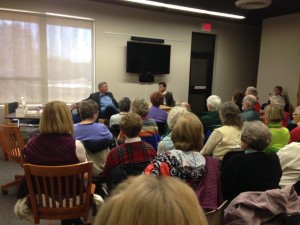
The room was jammed with folks eager to hear about the book. The library staff wrangled every available chair. It was standing room only. Steven and I shook hands, engaged in small talk, walked to the front of the room, were introduced, and began our discussion. I watched his face when I dove into his work and read the first passage depicting the Cellist  in my voice, not his. I discerned no adverse reaction from the Canadian author to my interpretation of his work. My heart lifted. I knew we were going to be OK.

It was, as I posted on Facebook, a splendid hour spent with a gifted author.

Thanks to the Cloquet and Duluth libraries for involving me in this wonderful event.

Peace.

Mark

CellistLegNewCov


Posted in Blog Archive | 2 Comments

Hawai’i By The Numbers

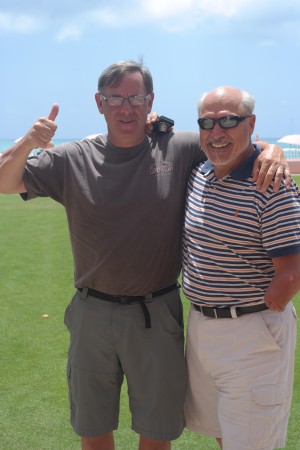
Mark and Ron, Waikiki Beach.

Mark and Ron, Waikiki Beach.

9: The number of Longboard Lagers that a retired Marine gave me when my pal Ron and I were grilling steaks in the courtyard of the Marriott Ko Olina on Oahu, Hawaii. The guy was leaving the island early due to a family emergency and was unloading stuff from his refrigerator that he couldn’t take with him. Semper fi.

5: I kept five of the beers from the Marine and shared them with Ron.

4: The number of the gifted Longboards I gave to a diminutive Japanese tourist who, though he didn’t speak a lick of English, surely understood my friendly intentions when I plopped four beers down beside his grill.

2: Rene’ spied two moongooses (Wiki says you can also use “mongeese” but that sounds weird) during our stay at the Marriott on Oahu. I only saw one, right next to the reflecting pool, as it stalked prey in the middle of the day. They were introduced on the islands to control rats, an experiment that never worked because the moongooses decided to eat birds rather than rats. They do not exist on Kaua’i or Lana’i but do breed prolifically on all the other islands.

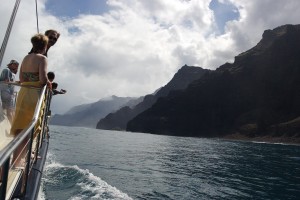
2: On our catamaran trip alongside the west coast of Kaua’i, we spied a mother and calf bottle nose dolphin.

12 or more: During the same boat excursion, and at numerous other times during our stay on Kaua’i, we had the opportunity to watch humpback whales playing in their winter calving grounds.

Napoli Coast, Kaua'i.

Napoli Coast, Kaua’i.

50-100: Again, on our catamaran trip, we saw Hawai’i’s iconic spinner dolphins in great numbers. Much smaller than the familiar bottle nose variety, spinners get their name from leaping high in the air and spinning 360 degrees. We saw calves with the mothers, the babies not much bigger than a bedroom pillow.

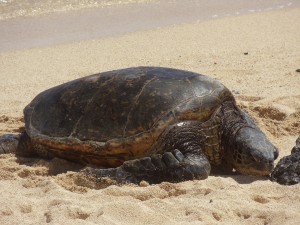
10-20: Green sea turtles are another of the threatened species we saw in Hawai’i. As a reminder as to what they look like, here’s one that took a nap on the beach next to us on Poipu Beach.

DSC03904

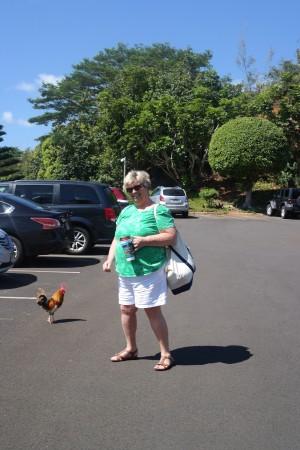
Billions and billions: OK, so I am exaggerating. But there are a whole hell of a lot of chickens roaming around Kaua’i, seeming very unconcerned since there are no mongooses on the Garden Island to eat them. Here’s one that seemed to like our friend Nancy McVean.

SAMSUNG CSC

50-60: We found this number of secretive parrots (actually rose billed parakeets) on Kaua’i. The parakeets are another invasive species to the island. We viewed them at the courthouse in Lihue, Kaua’i. I was skeptical when Dicky, a smooth talking local salesman, told us about the nightly roosting flights of these small green birds to the royal palms lining the front yard of the courthouse. They came, just like Dicky said they would, at dusk, when my wife’s $900 camera was out of juice.

35: How many dollars I spent for my bowl of soup (bouillabaisse) for lunch at the Royal Hawaiian Hotel on Waikiki Beach in Honolulu, Oahu. Most expensive and best seafood soup I’ve ever eaten.

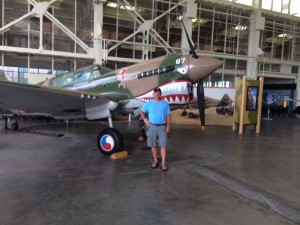
1: The number of P-40 Warhawks at the Aviation Museum of the Pacific on Ford Island, Pearl Harbor. I had to have my picture taken with the plane since my pal and fellow writer, Wayne Johnson of Silver Bay, MN was one of General Chennault’s Flying Tigers and flew the plane in China over 70 years ago. You can find Wayne’s book and order a copy from Amazon.

Mark with the P-40

Mark with the P-40


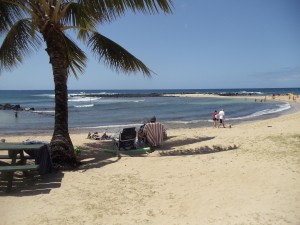
40+: I swam in the Pacific every day, sometimes three or four times a day, during our two-week trip. Here’s just one of the beaches I swam at.

Poipu Beach, Kaua'i.

Poipu Beach, Kaua’i.

16-20″: The number of inches of snow my poor kids and friends from Duluth had to put up with while we were enjoying days of sun and 78-82 degree weather.

1: I only bought one t-shirt on the trip, from Kaua’i Coffee company, after Rene’ and I toured the plantation just outside of Koloa.

2: I couldn’t resist returning to Talk Story Books for a second visit. As I write this, I’ve just exhausted my supply of books to read, ending my reading in Hawai’i with Short Stories of Hawai’i by Jack London.

6: The number of books I actually read on this trip. Here’s the list:

The Cellist of Sarajevo

Stories of Hawai’i

Kaua’i Reader

And the Mountains Echoed

Hotel Honolulu

Queen of Tears.

0: My wife loves the Australian guy (Alex O’Loughlin) who plays Steve McGarrett on the new version of Hawaii Five -O. And while we met many lovely Aussies on our vacation here in Hawaii, and while my wife spent most of each day on “McGarrett watch”, she never found him. She did find the headquarters for Five-O (actually the Supreme Court Building in Honolulu) but not Steve in the flesh. I guess she’ll just have to lust after the celluloid version.

3: Is the number of folks I love more after this fabulous trip to paradise. Thanks to the McVeans and my wife for making this one of the most relaxing and enjoyable vacations I’ve ever taken.

Aloha. Until we meet again…

Mark

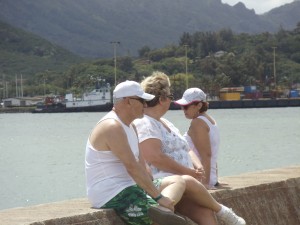
Ron, Nancy and Rene', Lihue Harbor, Kaua'i.

Ron, Nancy and Rene’, Lihue Harbor, Kaua’i.


Posted in Blog Archive | Comments Off on Hawai’i By The Numbers

Remembering Major Carlock

National Memorial Cemetery of the Pacific

National Memorial Cemetery of the Pacific

I didn’t set out to find him. In fact, when Nancy McVean suggested that Rene’ and I visit Punchbowl cemetery during our time in Honolulu, I had no idea what she was talking about. The Arizona? Sure, everyone has seen Tora, Tora, Tora, or the more recent Pearl Harbor, or newsreel footage of F.D.R. addressing Congress on December 8, 1941 giving his “day of infamy” speech. And Diamond Head, Waikiki, and the iconic State Supreme Court building used by Hawaii-Five-O as its headquarters in the television series, are familiar to anyone over the age of five. But Punchbowl cemetery? Never heard of it. And I doubt if any of you, unless you are from a military family or background, know that it exists.

The cemetery’s official name is the National Memorial Cemetery of the Pacific. The cemetery sits on top of an extinct volcano known as Punchbowl crater that looms behind downtown Honolulu. The site has clear vistas of Diamond Head, Pearl Harbor, and H-1, the freeway leading to the Marriott complex where we are staying. The ride up the twisting roadway to the crater is reminiscent of Duluth’s Skyline Parkway except that palm trees and exotic tropical foliage line the steep roadside instead of birch, maple, and pine. I’m glad we agreed to Nancy’s suggestion: my visit to Punchbowl proved to be the highlight of my visit to Oahu.
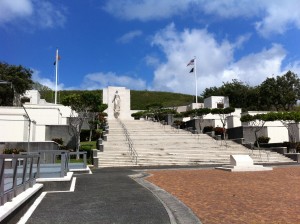
The Memorial at Punchbowl

The Memorial at Punchbowl

What appears curious driving into the banyan-tree-shaded main drive of the cemetery is that there are no headstones. Each soldier, sailor, Coastie, airman, or Marine who has been placed here for his or her eternal rest is equal in stature and rank despite whatever position he or she may have held in the military or in life. There are no ornate headstones or sculpted monoliths adorning the graves; only meager footstones with the individual names and other basic information, including the names of spouses if the spouse is similarly interned.

Workers carefully mow grass, trim brush, and manicure the site with reverence. Graves flow out from the white marble memorial that sits at the far end of the field of green, the banyan trees leading visitors to the shrine like so many sentries watching over the dead. I look back, over Honolulu, and admit that Nancy was right to insist that we visit Punchbowl.
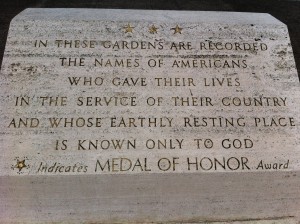
Plaque

Plaque

This is no ordinary monument but one of several located around the world paying homage to MIAs; American servicemen and women from WWII, Korea, and Vietnam who died in the service of their nation but whose remains were never recovered. Here the carved names of over 28,000 men and women, who, as the plaque suggests, rest in far flung corners of this earth, are identified so that the living can pay their respects to those who served. The marble wall  holding the names of the fallen is the only place where distinctions are made: Individuals awarded the Medal of Honor have a gold star affixed next to their name on the wall.

As Rene’, Ron and Nancy McVean, and I make our way up the stairs of the memorial and take in the colorful panels that display information about the war in the Pacific, the Korean Conflict, and the Vietnam War, the germ of a thought, a memory, intrudes.

I wonder if Mr. Carlock’s name is here?

I’m just old enough to have held a draft card. I turned 18 in 1973 and despite my concerns about Vietnam, I did my duty and registered with Selective Service. Though the last call-up of lottery numbers was in 1972, priority was still assigned to potential draftees until 1975. In 1974, my lottery number was 53. Had the draft actually been held and I wasn’t in a deferred status (or, as my mother suggested, hiding in Canada), I would’ve been slogging through the rice paddies of Southeast Asia with leeches stuck to my face, an M-16 cradled in my arms, and fear in my eyes.

I was, as most of you know, politically savvy in my youth. A Humphrey supporter, I’d been behind the war effort in Vietnam until Bobby Kennedy and Dr. King turned my heart. After my conversion, I marched with the long hairs and the peaceniks in front of Duluth’s federal courthouse in opposition to the war. All this is background so that you can understand that the Vietnam War touched me in ways that left vivid, if somewhat dim, memories and emotions. This history bubbles and boils within me as I stand on the steps at Pacific Memorial Cemetery thinking about one man, one pilot, who lost his life in Vietnam.

My parents built a new house in the Piedmont Heights neighborhood of Duluth, MN in 1968. We moved into the place during the summer between my eighth and ninth grade years. I learned that a war widow, Mrs. Lois Carlock, a slender, kind, mother of two kids, a boy and a girl, lived in a white house just up the block from us. Somehow, maybe through my parents, maybe through other neighborhood kids, I learned that Lois’s husband had been a combat pilot in the war, had been shot down, and died.

Standing in the clean, warm air of Oahu, I remember the fallen pilot because I’d coached his son in football. Jeff Carlock was born in 1962, making him about ten or eleven when I coached him. But beyond recalling that tidbit and the name “Carlock”, I find myself clueless. I’m unsure that Mr. Carlock was actually MIA. I also have no idea what branch of the service he was attached to. Being he was a fighter pilot, and being I know something about the military (I’m honorably discharged from the USAR), I know he had to be Air Force, Marines, or Navy. With this slender information in mind, I visit the cemetery chapel and try to remember more.
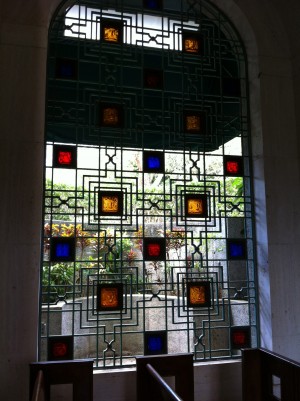
Chapel window

Chapel window

God doesn’t intervene. No heavenly revelations spur my mind to detail. I leave the sacred space and descend stairs seeking marble walls where the names of the Vietnam missing are immortalized in stone. I start with the Navy and the Marines. I look through all the “c’s”. I don’t see the name “Carlock”.

Maybe it’s spelled “Karlock”.

Nope. I read the names on the walls depicting lost airmen and soldiers. I search amongst the fallen, the lost. I find his name.
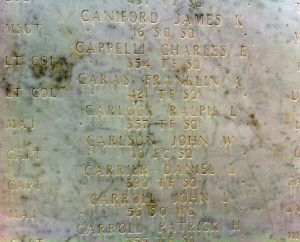
IMG_1330

But I’m skeptical. The inscription lists Major Ralph Carlock’s state of residence as Illinois.

I thought he was from Duluth.

Using my iPhone, contemplating a father being taken from his children, a husband from his wife, a neighbor from his neighbors, I research the name on the Internet. I confirm that Major Ralph L. Carlock, the name inscribed into the white marble of the Pacific Memorial Cemetery, is the man I’m looking for. On March 4, 1967 while flying over Laos, Major Carlock’s F105 was hit by enemy fire. The plane crashed and the pilot died. The major was lost to jungle until his grave was discovered after the cessation of hostilities. Lois Carlock was still alive when her husband’s remains were shipped state-side in 2003. Sadly, Lois (born Lois Johnson on 02/11/1938 in Duluth), died on 07/02/2004, not long after Major Carlock was re-interred on American soil. Today, Lois rests next to Ralph in Sunrise Memorial Cemetery in Hermantown, MN, the couple finally reunited after nearly forty years of separation.

I don’t know what happened to the little boy and girl who played in front of the white house on Leonard Street in Piedmont Heights just up the hill from where I grew up. I hope they’ve lived full and complete lives despite losing their father when they were very young. I also hope they know that Major Ralph Carlock’s sacrifice hasn’t been forgotten.

Peace.

Mark


Posted in Blog Archive | 4 Comments

Reading Theroux in Paradise

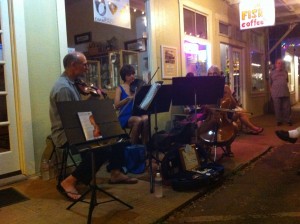
Classical trio, Hanapepe, Kaua'i.

Classical trio, Hanapepe, Kaua’i.

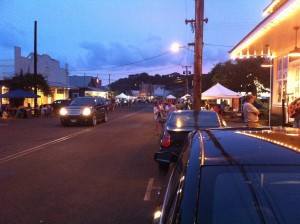
Friday night in Hanapepe, Kaua’i, Hawai’i. The little town was once the home to the bloodiest labor dispute in Kaua’i history (the September 9, 1924 “Hanapepe Massacre” wherein striking Filipino sugar cane workers clashed with police, resulting in twenty deaths on both sides of the dispute). The old town portion of Hanapepe is ablaze in light, its shops and galleries and eateries open for business until 9:00pm, its sidewalks packed with additional food and craft and trinket vendors, discordant sounds of classical, Hawaiian, folk, blues, rock, and country music echoing from Bert’s Auto Repair on the south end of the drag to the Talk Story Bookstore on the north. Rene’ and I and the McVeans, Ron and Nancy, our tour guides for our first trip to the Garden Island (actually, our first trip to any Hawaiian island) stroll into Art Night in Hanapepe, an event that occurs every Friday night in this small hamlet amidst the crumbling buildings and ruined dreams of immigrants. Maybe that’s too harsh a portrait of old Hanapepe town. There’s charm here, whether you are a car junky, like my buddy Ron, who finds Bert’s endlessly beguiling, or my wife, the artist, who could spend the rest of her life pondering the genius of other painters, sculptors, and artisans in the myriad galleries and shops. The place is, despite the ugly decay of the Aloha theater looming above it all like a pillar of diminished prosperity, alive with visitors and locals alike, young, old, and all ages in between.

Main street, Hanapepe, Art Night.

Main street, Hanapepe, Art Night.

We haoles (white people; visitors to the islands) separate and wander the singular street the festival is confined to, stopping to listen to good or bad music (there are plenty of both), to gawk at good and bad art (the same), and to eventually find a bite to eat from one of the sidewalk vendors. Rene’ opts for a freshly baked chicken pot pie. I leave her in line and totter off, my scarlet red skin, once a badge of honor in my spring-break-in-Daytona-days now a mark of an aging, clueless tourist, in search of more authentic island fare. I find a wagon selling teriyaki beef with Hawaiian side staples: cold macaroni salad and white rice. I order my food, buy Rene’ a bottle of water, and wait. And wait. And wait. Island time. The meals aren’t pre-cooked and stored on a hot plate. Each meal is started as it is ordered, making for fresh, succulent beef, but very long, restaurant-like delays. When my name is called, the young lady serving me apologizes. The white rice that comes with the dish is still cooking.

“Another ten to fifteen minutes, OK?”

I shake my head.

“How ’bout we substitute another scoop of macaroni for the rice?”

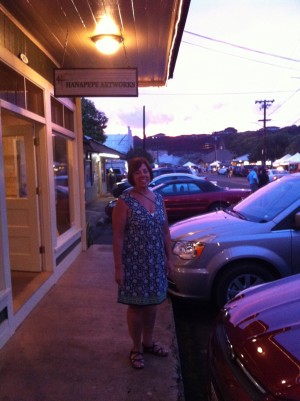
Rene' at Art Night.

Rene’ at Art Night.

“OK.”

“I put some extra beef in, because you wait so long…”

In between leaving my wife and ordering my food, I’d made a quick detour to cross the famous swinging bridge of Hanapepe ( where I was nearly run over by some island kids skate boarding the fragile span with glee: they were, in their devilment, extremely polite, saying “excuse me sir” as they zipped past me in the dark).

I make it back to where my friends and my wife are eating freshly baked native cherry pie under a cloudy but dry night sky. As I open my meal container, I’m pleasantly surprised. The young lady has piled on the teriyaki soaked prime rib to the limits of the styrofoam lid.

“This is good.”

After downing my meal, I walk across the street to the western most bookstore in America, Talk Story Books, just to say hello. The four of us had been in the store two days earlier, on our way back from Waimea Canyon. I’d asked one of the owners, Cynthia, if they had The Tattoo by Hawaiian author Chris McKinney. I’d read The Queen of Tears, one of McKinney’s later novels I’d picked up in our hotel’s gift shop and liked the story and writing.

“I’m not familiar with his stuff.”

I’d smiled and handed Cynthia one of my Cloquet River Press business cards.

“I know the feeling. I’m a writer who suffers from the same disease,” I’d said through a smile. “Any suggestions as to a good novel on Hawaii? And not Michner. I’ve read Michner.”

The store owner had padded off and returned with Hotel Honolulu by Paul Theroux. I had nodded, accepted the book, and looked some more.

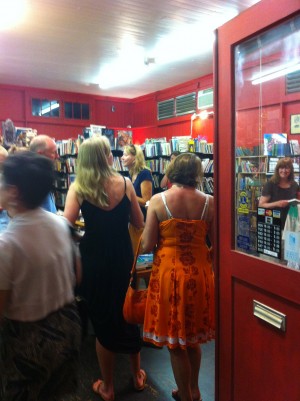
Cynthia greeting customers inside Talk Story.

Cynthia greeting customers inside Talk Story.

Tonight, as I step onto the front steps of the bookstore, Cynthia sees me and extends her hand.

“I’m liking the Theroux.”

“I remember. I thought you would.”

She returns to her other customers. I resist the urge to venture inside the bookstore and buy another book in an attempt to help one of the surviving independent bookstores in its battle with Amazon. I don’t go in. I still have the Theroux and Jack London’s Stories in Hawaii to get through. I find Rene’ and the McVeans. We find empty seats in front of a trio of classical musicians and listen to Vivaldi and other familiar composers for a bit as the streets empty, vendors pack up their EZ-UPs, and the festival winds down.

The sky is dark as our rental car speeds south to Lihue. I’m soon asleep in the back seat.

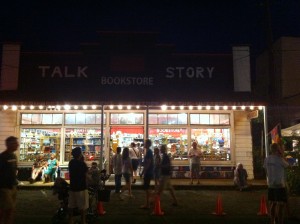
Talk Story

Talk Story

Aloha.

Mark


Posted in Blog Archive | Comments Off on Reading Theroux in Paradise