
Dicky’s Parrots

The author waiting for parrots.

The author waiting for parrots.

Kauai. The Garden Island. A virtual paradise for endangered species including monk seals, green sea turtles, and humpback whales, the island is also home to many species that, well, weren’t here when Captain Cook “discovered” this island, the first of the Hawaiian islands he landed on, back in 1778. I use the word “discovered” gingerly here, with ethno-sensitivity, since the British weren’t the first human beings to find these beautiful atolls. No, that discovery was made by brown skinned men and women and children in out-rigger canoes equipped with sails some more than a thousand years before a white dude walked ashore. The original Hawaiians came from the Marquesas Islands and were of Polynesian derivation, bringing their own language, culture, and religion to the islands long before Cook deigned to “discover” them. Anyway, when they arrived, the Polynesian explorers found all sorts of unique and interesting critters on the island, including one mammal: the Hawaiian bat. Oh, you’ll find plenty of other mammals now roaming Kaua’i, including feral pigs, which were brought over by the original Polynesian settlers and then allowed to roam free across the Garden Island such that they are now hunted as pests. And of course there are ever present, constant, annoyingly obnoxious feral roosters seeking feral hens.

There exists an urban legend that these noisy fowl were released due to Hurricane Iniki in 1992. That, according to many other sources, is just not the case. Chickens were brought here, as were hogs, by original islanders in their canoes and have been running around loose on Kaua’i ever since. Other islands in the atoll have feral chickens too but they are controlled by another invasive species, the mongoose, which was imported from India to deal with another imported pest, the rat. Unfortunately, rats like to sleep during the day and are active at night, whereas the mongoose likes to hunt during the day and sleep at night, which means the rat and the mongoose rarely cross paths but the mongoose do hunt and eat both feral chickens and their eggs, reducing the populations of free roaming chickens on the other Hawaiian islands. The mongoose has not been introduced on Kaua’i, sparing not only the obnoxious chickens but also the indigenous and non-indigenous songbird population of the Garden Island.

So what does all this biospheric history have to do with the title of this blog? Well, our pals, Ron and Nancy McVean, in the process of owning the timeshare that we are staying at, are occasionally required to sit through meetings and sales pitches from the nice folks at Marriott. One of the characters they’ve met up with during these meetings is a guy by the name of Dicky Chen. I think I’ve got the name right. He’ll likely correct me if I’m wrong. Anyway, Dicky is one of those fast talking, gregarious salesmen who, when white folks wander onto Kaua’i and fall in love with the place, can spot their lustful desire for a piece of paradise a mile away. He’s good at what he does, putting tourists and locals together to make deals. He’s also a pretty good source for local legends, history, and stories. One tidbit of Kaua’i lore he shared with the McVeans got us all hooked on the mini-adventure that’s the source of this story.

“If you show up at the old county buildings around six o’clock in the evening,” Dicky confided to a group of tourists he was driving to dinner, “you’ll see the parrots of Kaua’i coming in to roost on the big royal palm trees in front of the courthouse. It’s quite a sight.”

I was, I’ll admit, dubious that Dicky was being straight with us. I had the feeling we were being set up for the Kauaian equivalent of a snipe hunt. Sure, just like snipe are a real bird, there are, in some corners of the world, wild parrots. But here? Come on. But my wife and the McVeans were convinced of Dicky’s veracity. And so, last night, we got into our rental Nissan and drove the five minutes to the county courthouse to wait for the splendid return of the roosting parrots.

Ron waiting for parrots.

Ron waiting for parrots.

Rene' waiting for parrots.

Rene’ waiting for parrots.


Rene’ brought with her the very expensive (I told the story elsewhere) Samsung digital camera I bought her for Christmas. She was armed with a telephoto lens that couldn’t help but capture the bright, brilliant green hue of the promised tropical birds as they thundered into the treetops surrounding the public square. We were there well before dusk. There were no other bird watchers around. Cars and trucks sped by on Lihue’s main street without so much as a sideways glance. The locals were likely immune to the legend of the parrots and the only birds in the square were a couple of noisy roosters, some sparrows of unknown lineage, and a few cooing mourning doves (also introduced and not native to the island).

“We’ve been had,” I kept saying to Ron as we sat on the front steps of the courthouse, scanning the empty sky. “Dicky is laughing his ass off.”

Nancy and Rene’ sat in the car, waiting the birds. Ron shook his head.

“Dicky’s pretty straight. I think they’ll be here.”

“Chickens don’t count. Doves don’t count. I’ll give Dicky his due if parrots, or parakeets, or pheasants show up.”

“What about peacocks?” Ron asked. “They start with a “p” too.”

“If a flock of peacocks shows up, I’ll give Dicky his due.”

But despite the banter, I continued to disagree. I was convinced we were on a Kauaian snipe hunt of epic proportions. I could imagine Dicky Chen, at the next owners’ meeting spotting my friends, looking up from his notes, smiling, and asking the McVeans how they liked the parrots.

And then a damn lime green parrot showed up. Never having seen a parrot in the wild, I didn’t know what to make of the first bird until more parrots glided through the darkening sky and landed in the the palms.

“They’re here!”

Rene’ climbed out of the car armed with her $900 camera, ready to snap photos of exotic birds. Nancy carried her iPad, hoping to snap a picture or two with the only camera the McVeans with them. Someone, I won’t say who, forgot their real camera back in the room. I had my iPhone on me, not much use given that the zoom on an iPhone 4 isn’t very accurate. We were all relying on Rene’ and her Samsung to come through for us.

The birds started to whirl and dash into the square in flocks of a dozen or more. There was still enough daylight left to capture the iridescent greens of the little birds against the blue black sky if my wife hurried, unlimbered her camera, and shot fast.

“My camera’s dead.”

Rene’ stood there with a hunk of plastic, glass, and inert battery, and watched helplessly as waves of little green birds swirled and dove and landed. I withheld comment and took some photos with my phone. Crappy photos, like the one below, in which the elusive parrots of Kaua’i appear as small black smudges against the night sky.
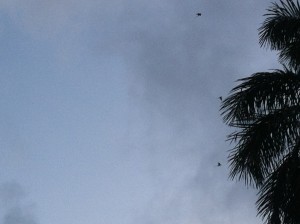
The nearly invisible parrots of Lihue.

The nearly invisible parrots of Lihue.


I also managed to turn my camera’s video function on. Unintentionally. I ended up with an 18 second video of: birds crying and swooping (about five seconds worth) and thirteen seconds of me discovering my iPhone was in video mode, had eaten up the last of my storage, and that my phone, like my wife’s camera, was very much useless for taking any more pictures.

“We’re coming back tomorrow night,” Rene’ vowed as we watched the little green birds settle in the palms. “I’m gonna charge my camera and we’re coming back.”

No one disagreed.

My faith in Kauaians was fully restored, though, in the end, Dicky’s information was, as I suspected, not entirely accurate. The birds that captivated our attention last night were not parrots. They are not indigenous birds. They are feral rose-ringed parakeets (see http://www.kauaibirds.com/introducedbirds.htm). Here’s what they look like if you have a camera with a functioning battery and zoom.

img_rose-ringed-parakeet_01

Rene’ will have to wait until tonight to see if she can take a picture as detailed as the one above!

Thanks, Dicky for an interesting evening, one that very few haole get to experience.

Aloha.

Mark
 

Posted in Blog Archive | Comments Off on Dicky’s Parrots

In Hawaii with Ernest

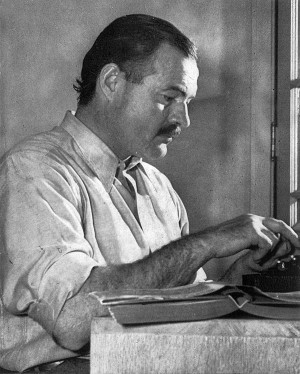
Ernest Hemingway

Ernest Hemingway

Hawaii. The crash of waves. The pound of surf against the beach and the black volcanic rock that lifts this hotel, this land, and the people of Kaua’i out of the Pacific Ocean. Why am I thinking of my idol, my long-departed mentor, my comrade-in-words who died of a self-inflicted shotgun blast in 1961, when I was only six years old and just beginning to understand the power of the written word? I have no earthly idea. But I am.

The sky here at far western the edge of America is hazy blue, dotted with veinous, thin clouds of greyish white. A child screams somewhere below the space my wife and our friends the McVeans call our temporary home. Eight stories above the sand, the water, the barges entering the harbor at the end of thick steel cables attached to tugs, I sit and tap out words. I am compelled to this. I am destined to do this. And always, looking over my shoulder as I sit behind my MacBook Air, is Papa. For better or for worse, he is the writer I have, on my writerly journey, sought to emulate relative to style. Not lifestyle, you understand: literary style.

Ernest was, to be sure, a misogynist. I do not seek, in my attempts to craft the great American novel (or one solid, memorable short story that will live on after I am gone) to re-create Ernest’s loathing for women. That’s right. Ernest, in my humble view, loathed women. Oh, he loved sex. That seems patently obvious by the fact he was married four times and that, in between the rocky reefs that each of those marriages floundered, he bedded other women. Faceless, nameless, egoless women. Tokens played in the slot machine of life, at least as the gentler sex is portrayed in the master’s prose. If I have one thing over Ernest in the writing department it’s that (at least this is my hope; for self-criticism is always an iffy game) I view women as superior, not inferior, to men in many respects. Honesty. Loyalty. Level-headedness are all generic attributes I’d attach to the feminine gender. Characteristics that most men, including me, lack when push comes to shove. Anyway, here I sit, listening to feral roosters crow (a hurricane busted chickens out of their pens in the early ’90s and now the entire island of Kaua’i is overrun with their offspring), waves slapping silica, and the occasional cry of a beach volleyball player who has bested his or her foe at the net, all the while thinking of Hemingway.

I’m not sure why. I mean, this isn’t Papa’s ocean. The author’s water was the blue green warmth of the Caribbean, an entire continent to the east. His islands were not these islands but instead the Keys of Florida and pre-Castro Cuba, where American machismo, money, power, and prestige reigned supreme until a little man in a fatigue cap upset paradise. And yet. The blue water outside the harbor breakwater is part of the same vast plain of salt water that tickles all of the islands of the world save for those puny excuses, those little slashes of landfall, that disturb inland lakes and landlocked seas. Perhaps the surf and the gulls and the wind, especially the night breeze, which massages Rene’ and I while we sleep in our comfortable resort bed with the sliding doors open to the ocean, is enough to evoke the ghost of my mentor. But why? Why waste my time, my precious vacation moments, considering a writer who, in the end, cut his life and his muse short? I have no wish to emulate the tragedy of his familial life or his end game. No, unlike Ernest and another great writer, Dylan Thomas, I will likely, at some point, “go gently into that good night”. I have grandchildren (oodles of them I expect: we have four sons) to look forward to. There will be, I am certain, many more nights like last night, sitting with good friends in an outdoor bar, sipping Kona beer and eating flatbread, gazing at my wife. Ernest was a genius when it came to the succinct, the terse, and the economic ordering of words on a page. But he was a fool when it came to living. Yes, I know that’s a harsh indictment of a man who suffered from a mental illness. But in moments of lucidity, Ernest made choices. He made decisions that led a great and talented writer to leave behind those he loved and those who loved him. Ernest Hemingway walked in the world, reveled in the world, but never loved the world. I won’t make that same mistake, regardless of how well or how poorly my writing is received.

Hear the surf? It’s whispering to us, telling us that tomorrow will be a very good day.

Peace.

Mark

Posted in Blog Archive | Comments Off on In Hawaii with Ernest

Biskey Ponds

Biskey Ponds Entrance

Biskey Ponds Entrance

Anita Anderson, an energetic and youthful daughter-in-law of friends, had posited the question to me more than once as our paths crossed in Fredenberg Township, the little slice of heaven we both call home:

“Have you skied Biskey Ponds yet?”

My answer has always been the same: a very sheepish “no”. Sheepish because, as a cross country skier, it seems only natural that, given that I knew Ellen Biskey (a Fredenberger who welcomed our family to the township but passed away too young) and given that I have lived “in the neighborhood” for over thirty years, I would’ve checked out the trails before now. But I hadn’t made it over to the Biskey trailhead on Fish Lake before this past Sunday. Too bad. I’ve shorted myself on some pretty awesome skiing and sightseeing.

White Pine Alley

White Pine Alley

I couldn’t have picked a better day to check out Biskey. It was sunny and clear. The temperature hovered in the teens. There was only one other vehicle in the muddy parking lot as I pulled in, my spirit engaged after a good morning sermon from Pastor Phil at Grace Lutheran; my belly full of pancakes, hot coffee, and sausages cooked up and served by the youth of the church to raise money. Turns out, the van that was already at Biskey had been full of young women and their mothers, all of whom were enjoying the bright sunshine and brisk air on skinny skis. I encountered two of the young ladies as I crashed on my ass at the bottom of a big hill, my skis caught in the icy track, the speed too much for my old legs to handle. The condition of the track was the only downside to a perfect day: due to forty degree weather this past week, the track was rutted ice, making some of the long, steep downhill runs a bit more than even an experienced skier could handle. But at fifty-nine, crashing on cross country skis in front of two young women doesn’t carry with it the indignity that would have been present in my teens. Without so much as a blush, I picked myself up, said my hellos, dusted off my wool ski pants, and kept on moving.

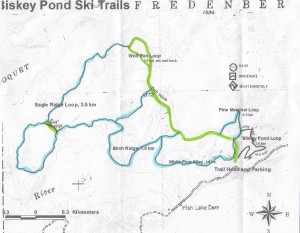
Biskey’s terrain makes for a very engaging and bountiful ski. There are plenty of steeps, both up and down, as one winds his or her way west, from the parking lot, to the Eagle Ridge Loop and back. There are small alluvial ponds dotting the landscape, resting in hollows below the narrow spines of hogsback ridges, the ridges being where the designers of Biskey Ponds ski trails placed the narrow tracks of the trail system. There are towering red and white pine plantations. There are clear cut tracts where new birch, seemingly unaffected by the disease that has decimated mature birch trees over much of the surrounding terrain, have sprouted reminiscent of  the plantings by the French forester in the great novella, The Man Who Planted Trees. And of course, there are clumps of ever-present aspen that have emerged in the cut overs, their slender trunks crowding the landscape like so many green hairs awaiting a barber.

Groomed Trail

Groomed Trail

Red Pines, Eagle Ridge Loop

Red Pines, Eagle Ridge Loop


After stopping mid-point in my hour long ski to re-wax (the crusty snow tore off wax as fast as I could apply it), I encountered another couple, the wife or girlfriend in the lead, the male partner of the equation huffing and puffing behind his beloved, moving towards me as I merged onto Wolf Run, the most modest grade in the trail system. I’d over dressed for the day and was sweating like a hog when I vacated the track to let the couple pass. A few more strides and I arrived at the base of a steep hill. I herringboned up the incline, claimed the flats, skied a few more meters, and then, much too soon, my first visit to Biskey Ponds was over.

Noted outdoor writer and educator, Andrew Slade recently discovered Biskey and experienced an epiphany similar to mine:

“I can’t believe I waited so long to check it out. I want to go back and see what I missed.”

(http://bestnorthshore.com/biskey-ponds-ski-trail)

Of course, Slade has a better excuse than I do for procrastinating. He isn’t a Fredenberger who has been invited countless times by Keith and Anita Anderson, two youthful neighbors (and founders of the trail system) to check out Biskey Ponds. I really have no excuses to offer as to why it took so long for me to drive the five minutes from my house on the Cloquet River to Biskey. The fact that I can get up, strap on my skinny skis, and ski through the thick aspen, balsam, and maple forest out my back door on a trail I cut twenty years ago doesn’t really address why I ignored my neighbors’ invitations. But, after battling a sore neck and shoulder for the past two weeks, conditions that kept me from my morning exercise routine and allowed malaise to set in, I needed to do something active and energetic. My time on Biskey Ponds’ trails was just the medicine I needed. My ardor wasn’t dampened by the the three spills I endured or the poor snow conditions on the trail. Breathing clean air and gliding through the last of winter’s quiet in such a bucolic setting was tonic for this old man despite the aches and pains I’m feeling today.

Trail Map

Trail Map

You can find Biskey Ponds by logging onto: http://www.skinnyski.com/trails/traildetail.asp?Id=641 and using the map feature on the site to locate the trails. No state ski pass is required to visit Biskey but you should leave a donation (suggested amount between $5 and $10) in the donation box provided at the trailhead. Given they are predicting another snowstorm for the Cloquet River Valley, there’s still plenty of time to give this local gem a try.

Peace.

Mark


Posted in Blog Archive | 2 Comments

Touchingly Optimistic

pinki

Smile Pinki (2012. Smile Train)

I received a DVD copy of the 2008 Academy Award winning documentary, Smile Pinki, unsolicited in the mail a few months back. The movie sat on my writing desk for a bit because the subject matter of the film was too personal, too emotional, for me to confront. Last night, I finally watched the DVD and I am glad I did.

Many of you know that our fourth son, Jack, was born with a cleft lip. The cleft was completely unexpected. My wife had undergone extensive genetic testing while Jack was in utero because my wife was 40 when our son was conceived. The testing showed nothing abnormal,. We were both surprised when Jack was born with a significant cleft. However, he was thankfully spared the other, more serious complications that accompany such an impairment: a cleft palate or a heart defect. Cleft issues arise during a fetus’s 4th-12th week of gestation, usually around the 7th week, which is approximately the time the fetal heart is forming. Our hypothesis, unsupported by any scientific studies, is that Jack’s cleft occurred when Rene’ was exposed to insecticide being sprayed at a condominium we were renting in Cancun. My wife was exactly seven weeks pregnant when she stepped through a cloud of what we believe was DDT lingering in the condo. Like I said, this scenario is only a hypothesis, though according to at least one website, environmental factors are believed to play a part in the formation of clefts. (See http://en.wikipedia.org/wiki/Cleft_lip_and_palate). In any event, Jack’s situation was unforeseen but given the sophisticated level of health care most Americans are able to access, Jack had corrective surgery on his lip six weeks after birth. Dr. Willie Portilla did a marvelous job. So instead of a childhood of speech issues, low self-esteem, and teasing from other kids, Jack endured only a brief period of being fed through a syringe (the cleft made the suction necessary for bottle or breast feeding impossible), a little discomfort, and follow-up out-patient cosmetic surgery when he turned six years old. He was, thanks to the luck of his birthplace, spared the sort of life memorialized in Smile Pinki.

The movie depicts the journey of two children, Pinki and another young boy born with severe cleft lips, in rural India. The images of the Indian countryside, the agrarian lifestyle, and the extreme poverty of the parents of these children is heartbreaking. Add to this background the social isolation and lack of education each child experiences due to their clefts and you have the makings of an very, very emotional story. But the point of the film, well played and unfurled with deliberate respect for the children by the director, isn’t tragic but hopeful: Through the auspices of Smile Train, an international organization that accepts donations for the treatment of cleft palates and lips around the world (each surgery costs an average of $250 so the repairs are a bargain for the donors and the kids!), the viewer witnesses the process of finding Indian children in need of surgery, the screening and prioritization of their cases, and the actual operations. Five months after treatment, you are reintroduced to the beaming, wide, confident smiles of children whose hope has been renewed and restored.

This is a short film of great visual power that will leave you in tears. But the tears you will shed will be ones of joy and admiration for the courage of the children, their families, and the medical professionals working to deal with an issue that impacts 1 in 700 children. In fact, according to one of the physicians interviewed in the film, India alone has a backlog of over one million untreated cases of cleft.

Jack is a fortunate young man. He was born in a era and in a country that provided him with a level of sophisticated medical care children in places like rural India and China and Africa can only dream of. To help kids around the world in a small way, a modest way, Cloquet River Press donates 10% of all proceeds from the sales of its books to Smile Train. But you, and I, can do more. Why not think about mailing off a check to Smile Train today? I know I will.

Peace.

Mark

Posted in Blog Archive | Comments Off on Touchingly Optimistic

A Solid Effort

frozen

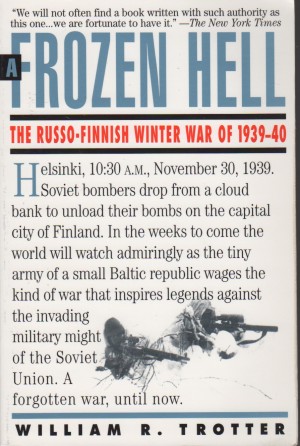
Frozen Hell by William R. Trotter(1991. Algonquin. ISBN 1565122496)

When my old scoutmaster Arnie Erickson passed away, he left a legacy of service to youth, his church, his family, and his community. He also left William Trotter’s scholarly treatment of Finland’s titanic struggle with Communist Russia during the winter of 1939-1940, Frozen Hell, which his daughter Jan passed on to me because of my affinity for all things Finnish and the fact that my current writing project (Sukulaiset: The Kindred) incorporates the Winter War into its storyline. Despite my love for Arnie and the subject matter, I was a bit reluctant to dive into the book, mostly because I’d completed my research, had just finished a couple of non-fiction books for pleasure (I like to switch my reading between non-fiction and fiction to keep things lively), and, to be truthful, I was sort of “finished” with all things Finnish as they relate to the manuscript. But in deference to my friend and her departed father, I cracked the spine on Trotter’s work and I am glad I did.

Similar in tone and pace and authority to Henrik Lunde’s Finland’s War of Choice, a more recent (2011) look at the Continuation War (the war in Finland which followed the Winter War) Frozen Hell is well organized, detailed, and thoroughly researched. Folks who have read Talvisota (The Winter War) Antii Turri’s gripping novel covering the same time period and topic, and who reveled in the exposition of character good fiction allows, will find only small doses of similar revelation in Trotter’s more staid and scholarly work. Trotter does give us a fairly thorough and, despite the author’s obvious fondness for the Finns and their sisu, honest biographical of the leading Finnish military figure of the era, Karl Mannerheim. There are briefer, more cursory histories of minor officers and politicians as well, all of which add flavor and color to the facts of war. One ancillary protagonist who Trotter spends a bit of time discussing near the book’s conclusion is Life Magazine photo journalist, Carl Mydans, a figure I’d come across while searching for a photograph to use as the cover for Sukulaiset. Mydans is a remarkable figure in the history of modern photography. Collections of his work are held by Stanford and other prestigious institutions. Mydans, along with his wife Shelley (also a professional photographer), covered World War II for Life in Finland and China. Intriguingly, Trotter actually ends his rendition of this epic David versus Goliath struggle with a scene where Mydans is identified by Finnish soldiers as an American, who then proceed to confront Mydans. I won’t spoil the ending here but, suffice it to say, Trotter’s treatment of Mydans, as brief as it is in this non-fiction dissection of the Winter War, is so compelling, it begs a full-blown biography of Mydans’s remarkable life and career. Similarly, when the author laments that no one has produced a well-written English language biography of Mannerheim,  (who is, arguably next to composer Jean Sibelius, Finland’s most famous person) I paused and thought:

Hey. You’re an excellent writer. Why don’t you pick up your own challenge and the Field Marshall’s life story?

Trotter is a master of revelation and detail, which, at times, can lead to the reader being inundated with facts, searching for the thread of story. But the author is assertively blunt in debunking the claim that many Finns are prone to invoke: That while Finland didn’t defeat Stalin’s hordes, it certainly did fight the Russian Bear to a standstill, causing The Soviet Union to sue for a less attractive peace. Though he heaps praise on the Finnish fighters, who, with scant air support and virtually no armor, did indeed stand toe-to-toe with a far superior enemy, and, as in the chapter depicting Finland’s greatest victory during the short-lived conflict (the battle of Suomussalmi where small units of Finns on skis encircled and wiped out far larger Russian divisions, leading to the summary execution of the Russian commanders when they fled), Trotter lays down the law with respect to the legends of Finnish victory. The end result of the four months of fighting known as the Winter War was, at best, a dress rehearsal for a larger, more violent conflict that would begin less than two years after the ink was dry on the armistice between the Finns and their neighbor to the east. And the end result of the celebrated Winter War, which saw the Finns reeling back towards Helsinki in near collapse, was nowhere near a military “victory” for the beleaguered Finns. Did the fight prove the measure of Finnish resolve? Surely. Was the Winter War a warning to Stalin that, if he wished to reclaim Finland as part of his empire, more blood would spill? Absolutely. But a victory for the Finns? Trotter debunks that myth with a mountain of evidence in this fine effort.

4 and 1/2 stars out of 5.


Peace.

Mark

PS Unable to obtain permission to use Mydans’s work, I located an excellent repository of war photographs depicting the entire Finnish/Russian conflict from 1939-1944. The Finnish Defense Forces maintain an archive of such work, free and reproducible to the public, at http://sa-kuva.fi/. The photo I finally settled on to be the cover art for Sukulaiset can be found below. I hope you agree it is an extremely powerful image.

MM

SukuRedo


Posted in Books | 2 Comments

Sunday

Ski Trail, Cloquet River

Ski Trail, Cloquet River

I’ll come clean. The photo wasn’t taken yesterday. It was taken a few Sundays back when the dogs and I made a long loop on the ski trail in the woods behind my house. I was skiing on trails I cut twenty years ago, when our three oldest boys were still in school and Jack, our youngest, wasn’t even an inkling. I would have taken a photo yesterday for this blog if I hadn’t essentially shoveled myself to exhaustion. I worked so hard and so long out in below zero temps, I simply forgot to snap pictures. So the above photo, which was at least taken on a Sunday, will have to do.

When I got up yesterday dressed in my jammies and thick bathrobe, I  meandered into the kitchen and punched the buttons on the coffee maker before waddling over to the back door to read our outdoor thermometer.

Twenty-one below. Christ, I thought as almond wafted from the percolating coffee maker into the still, quiet Sunday air, will it ever get above zero?

I’m a Minnesota boy. I’ve endured all sorts of winters; cold and snowy, cold and snowless, spring-like and wet, and all combinations in between. There was the mega storm of my youth, 1962, I believe, where the power went out over most of Duluth due to tons of heavy, white snow snapping off electrical cables. My dad and mom loaded up our old 1961 Dodge Dart station wagon, the first car we ever owned with a third seat (it faced backwards which made for an interesting ride) with my brother Dave and I and headed to my uncle’s motel in West Duluth. We stayed with Willard a few nights while crews worked like beavers to restore power. Then there was the winter of 1991, the great Megastorm that dumped three feet of snow on us on All Saints Day, the earliest blizzard I’ve encountered during my nearly 60 years on Earth. And there was the -44 day in February of 1996, in the midst of a cold snap that coincided with our old farmhouse being torn apart for remodeling. Below zero, I can handle. Arctic below zero, temperatures below -30 are another matter entirely. But if you lump all of these experiences together, they don’t approach this winter. They just don’t. Hell, I’ve recorded six mornings driving into work this year with temps below -30. Six. That’s gotta be some sort of record, don’t you think?

Yesterday, after I checked the temperature, let Jimi Hendrix, our miniature Dachshund outside to do his business,  and released Kena, our exuberant Labrador pup from her kennel, I ventured into the basement. Rene’ and I were bound and determined to make it in to church as a family, which meant rousing  Jack, who has the entire lower level of our home to himself, from slumber. But it turned out that Jack was battling stomach flu and, despite the fact I got him to leave his bed, was in no shape to worship.

I’ve been battling an issue with my neck and left arm, disconcerting symptoms I won’t bore you with. Suffice it to say, as I tugged on my insulated Carhartt jacket and bibs, pulled my winter boots over thick wool socks, donned gloves and a hat, I wasn’t looking forward to another day facing bitter cold. But the wood rack was empty. The sidewalks were  treacherous. And there was an ice dam looming over our back porch. All of these things needed to be addressed and with Jack down for the count, it was left to me to handle the chores.

Outside in the cold, as I chipped away at the stubborn snow covering our porches and sidewalks, Lexi, my son Matt’s Labrador, joined the throng of dogs milling around my feet. The sun was high and bright. On the rare occasions when I stopped to take it all in (like when I was on the roof, knocking snow and ice onto the ground to clear a path in case, just in case, the weather ever turned and the snow on our roof began to melt) well, the promise of spring held by the big yellow globe teased my face. After clearing the roof, porches, and sidewalks of snow and ice, I set about digging a path to our woodpile; the neatly stacked oak only a suggestion in the deep snow behind the dog run. On the way home from church, I’d purchased two new shovels from Menard’s. Seems all the snow we’ve moved this year wore out the shovels we had on hand. New shovel in hand, I dug a channel from the driveway to the wood pile through hip deep snow. While dragging a plastic sled piled with wood, I had to dodge Kena and Lexi. The labs found a tennis ball buried in the snow and proceeded to invent a game which involved one dog holding the ball and teasing the other dog into a frenzy by placing the ball on the snow, tempting theft, only to snatch the yellow ball up and dart away. An hour later, the wood bin was full.  My neck sore, my left knee throbbing from climbing stairs with arms full of dry oak, I put Kena back in her kennel and found my way into the house. I peeled my Carhartts off, gulped down tumblers of cold water and climbed to the master bedroom where another episode of Band of Brothers was waiting for me on DVD.

When I got out of bed this morning, tired and still stiff from yesterday’s cold and chores and in no mood to face Monday, I padded my way across the cool hardwood floor of the kitchen to gander at the thermometer.

Twenty-three below. When will it end?

I have no idea. Do you?

Peace.

Mark

Boy Scout Camp 28, Cloquet River.

Boy Scout Camp 28, Cloquet River.


Posted in Blog Archive | Comments Off on Sunday

Revelations of Genius

bruce

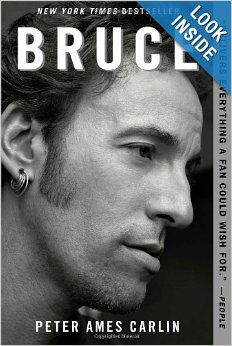
Bruce by Peter Ames Carlin (2013. Touchtone (Kindle version) ISBN 9781439191835)

Simultaneously reading biographies of two of America’s most beloved and iconic (and misunderstood) singer/songwriters is a first for me. I generally alternate between fiction and biography, rarely reading two novels or two memoirs in a row. But, for some reason, maybe because I’m slated to MC a musical variety fundraiser in April, or maybe because the stars were aligned, or maybe because I simply couldn’t resist peeking into the private lives of Bruce Springsteen and Johnny Cash, I ended up reading Robert Hilburn’s spectacular treatment of the Man in Black (see below for review) in print and Peter Ames Carlin’s fine depiction of the life of the Boss on Kindle at the same time. And I have to say, between the two books, it’s hard to pick a clear winner. I give the edge to Hilburn’s effort if only because the story, sad as it may be, is complete, whereas Springsteen’s story has yet to conclude. Which, while it makes for a less sensational read, is a very good thing for those of us who love great lyrics and songs.

The Boss is here, looming small and afraid of his father during his early life, to loud and unapologetic as he decides, as an established superstar of rock, to call it quits with the E Street Band. If you’ve never seen a Springsteen concert, Carlin’s depiction of the man in this biography highlights in vivid detail the one attribute of the Boss that will linger with you long after you leave an E Street Band live show: Bruce Springsteen is the hardest working showman to ever pick up a Fender. There is no one, I repeat no one, in the music business who even comes close. That trait, Springsteen’s working class ethic, something as ingrained in the man as his social anxiety and his need to seek solitude, claims center stage in this story.

Much like Robert Hilburn does in Johnny Cash, Peter Carlin builds a fairly traditional linear depiction of Springsteen’s life. The poverty, the angst, the father/son conflict, the familial tragedy of losing a sister at a tender age all form the boy who, after finding solace in music and his innate genius as a songwriter, becomes the Boss. The tortured genius of Van Gogh or Hemingway or Woolf comes to mind when you plow through the interpersonal and professional hallmarks of Springsteen’s life depicted in this book. But whereas the lives of those creative forces all met with sad and bitter ends, at least as of today, the Boss has overcome his internal and external demons to remain an authentic American voice. Much of Bruce’s survival appears to be the product, at least as the story has unfolded to date, of his relationship with his wife and fellow E Street Band mate, Patti Scialfa: the mother of Springsteen’s  three children and, at least at portrayed from a distance by Carlin, the center of the Boss’s mental stability and his universe.

Carlin had enough access to Springsteen and his immediate family, friends, and the band during the research and writing of this book to bring new insights and clarity to one of the 20th century’s truly great artists. And, as pointed out by the success of High Hopes, Springsteen’s most recent album (another quality effort that incorporates Tommy Morello from Rage Against the Machine into the band’s intimate and incestuous fabric to add another layer of musicianship and change to an already excellent discography) the water carrying bucket of the New Jersey Devil has not yet reached the bottom of the well of his creativity.

Give a listen to “American Skin”, a song written about the shooting of an unarmed immigrant to America by four New York cops, and let the music convince you if Carlin and I cannot: The best is yet to come.

http://www.youtube.com/watch?v=nghqjBwZTiE

4 and 1/2 stars out of 5.

Peace.

Mark


Posted in Books | Comments Off on Revelations of Genius

Not “Walk the Line”

Cash

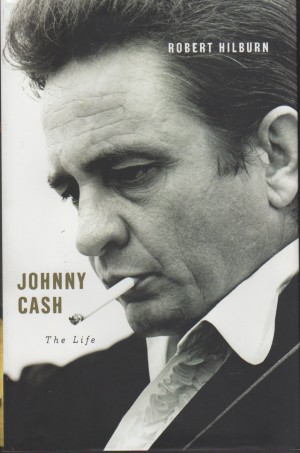
Johnny Cash: The Life by Robert Hiburn (2013. Little Brown. ISBN 9780316194754)

Like many kids of the 1950s, I grew up catching bits and pieces of the Man in Black’s life over the six decades he was one of country music’s icons. I remember my pal Bruce Patterson playing an 8 track of Johnny’s Folsom Prison Blues over and over and over again in the early 1970s in Bruce’s 1960s vintage Dodge (back when it wasn’t a classic car; just an ordinary Dodge). But I wasn’t a country music fan and I didn’t stop and listen long enough to appreciate the crossover appeal of Cash’s lyrics and melodies. Despite my fondness for wordsmiths like Neil Young, Bruce Springsteen, Mary Chapin Carpenter, and Bob Dylan, I never placed Cash in that same vein. Hell, up until a few years ago, the only album I owned with Johnny singing and playing on it was the original Highwaymen collection (Waylon Jennings, Kris Kristopherson, Willie Nelson, and Cash).

I do recall, in moments of early teenaged boredom during the Vietnam War, sitting down on the davenport in the den of our tract house an evening or two to watch the old Johnny Cash variety show on television. But I wouldn’t classify myself as a fan. In fact, I wasn’t even mildly interested in the man or his music. That all changed when I saw Walk the Line, the movie made after Johnny and his beloved second wife, June Carter Cash, passed away. That movie compelled me to sit up and take notice of Cash as a man and a musician. Not long after watching the flick, I stumbled onto a discount copy of a CD memorializing a VH1 Storytellers session featuring Cash and Willie Nelson. Just two old stalwarts of the country music scene sitting on stools, plucking acoustic guitars, playing their songs. Magic. I was hooked. So when one of my sons (or my wife, I can’t recall) gave me Hilburn’s quintessential biography of the Man in Black, I dove in. And I am surely glad I did.

The demons that Joaquin Phoenix so expertly brought to life on the screen in Walk the Line, playing opposite to Reese Witherspoon in the role of June (she won an Oscar for her work) pale in comparison to the tortured soul Hilburn exposes in this biography. One was, upon watching the final credits of the film, left with the impression that, once Johnny and June got together, the Man in Black substituted true love for the amphetamines he was popping like M&Ms. In fact, while Cash did manage brief periods of sobriety from the late 1960s forward, he was never able to totally escape the allure and palliative effects of pills. Up until the day he died, folks around him continued to worry over the amount and extent of his reliance on prescription medications to keep Johnny upright and moving forward. This revelation, one quite unexpected given the message of the movie, is aligned with another storyline that Hilburn weaves in contrast to the legend depicted in the film. Again, my view of the Cash/Carter love story was wrapped up in the notion, presented convincingly in the movie, that Cash pursued Carter; that it was his undaunted quest for love that eventually won her over. Not true. June Carter Cash, at least according to the author, despite reservations about Johnny’s drug use, was every bit as interested in leaving her husband for the singer as Cash was interested in leaving his wife and four daughters for his new-found love. The level of anguish and torture that both Cash and Carter, along with their families, went through during the breakup of two marriages, as well as the decades of unproductive session and recording work that followed Cash’s early fame as a Sun Studios artist are detailed here, exposing a pained and flawed, yet humble and God-fearing soul far more complex than a two hour movie could ever hope to capture.

How good is Hiburn’s work in this book? Well, he convinced me, during the last segment of the tale, where he lovingly writes of Johnny’s resurgence as a songwriter and bedrock of folk, rock, country, and crossover music under the guidance of 21st century music impresario and producer Rick Rubin, to immediately buy two of the American albums that Rubin cut with Cash shortly before Carter, and then Cash, passed on. The author’s depiction of the resurgent power of Johnny Cash’s lyricism, and his ability to make other songwriters’ work his own, is best endorsed by the fact that at least two of the records Rubin made with Cash won Grammy awards. In addition, video critics heralded the music video of Cash performing “Hurt” (a tune written by Nine Inch Nails front man, Trent Reznor) as the best music video ever made.

Don’t take my word for it. Watch the video yourself at:

http://www.youtube.com/watch?v=3aF9AJm0RFc

then buy the book and be prepared for one great read featuring one of America’s most troubled, yet talented musicians.

5 stars out of 5.

Peace.

Mark


Posted in Books | Comments Off on Not “Walk the Line”

A Nice Little Story

Sand1

The Sand People by Jim Trainor (2013. Up North Press. ISBN 9781490936789)

When an evangelical friend of mine sent me three of Trainor’s books for Christmas out of the blue (we don’t exchange gifts) and I looked at the title of this novel, the author’s background, and the subject matter, I was actually ready to repackage the whole lot and send it off to our local recycling shed. But something intervened. Maybe it was my curiosity. Maybe it was my love for my friend (I’ve known her for over fifty years) or maybe, just maybe, it was the hand of God. I am, in the end, a believer in small miracles-the sort of things that make life sweeter and brighter on an every day basis. That’s likely what happened here. A small intervention from the Creator convinced me to read instead of pitch. And I am pleased that I did.

Karen and Kevin Langford, the protagonists of this tale, are a couple with two kids, careers, a mortgage, and a barely functioning marriage. Life, as it does for many married couples, seems to have gotten in the way of lust and love. Trainor sends the couple to Hawaii for a second honeymoon where the author interweaves Karen’s longing for intimacy and touch with a cast of intriguing locals, including Father Mitch, an Episcopal priest down on himself and his luck. We also meet the earthy Hanna, the devilishly handsome and charming Steve, and Callie, an aging woman who has, in the end, more wisdom than the rest of the cast. There’s enough action and intrigue to keep sophisticated readers interested in the story, and the book, despite being self-published, is well edited. I found nary a typo or mistake over its 300-plus pages. I liked this book. Liked it enough to spend President’s Day finishing it. And yet…

“Write as if your parents are dead.” This quote by American short story writer and novelist, Anne Lamott is one that serves me, I hope, well. I’ve tried, in my fiction, to make sure that, though what I write might be too sexual or violent or disturbing or raw for my parents to enjoy, I do not let my fear of losing their respect and love color my stories. That’s one of the things you must do as a writer: learn to avoid “safe”. Safe is writing like you wrote in high school English. Safe is always hiding the rugged, the ripped, the torn, the blackened parts of human existence in hopes the you don’t offend. Now I know, as an ordained Episcopal priest, Jim Trainor likely isn’t interested in writing a male version of Fifty Shades of Gray. Or maybe he is. But that’s not this book. The author is a decent storyteller and writer who has, in the end, chosen not to offend. The problem with taking such a safe path is, even though a character such as Mitch is exposed as having demons, they are soft and cuddly little buggers with velvet covered pitch forks; not roaring, nostril flaring bastards bent upon causing pain and agony. Had Trainer stretched his writer’s skin just a tad bit more, the characters and story would have rang more true, as Hemingway would say.

Then there is the lack of narrative. I love dialogue, and the exchanges in the book, for the most part, are steady, reliable, and written with veracity. But there is scant little narrative between the spoken words. If I had to guess, I’d say about 10% of the book is narrative and the other 90% is speech. This computation goes against another idiom of fiction writing: Show, don’t tell. Have the characters’ actions, rather than their words, convey meaning. Trainor is an experienced writer who avoids out and out speechifying (think John Gault in Atlas Shrugged). But there is so much dialogue in the book that this reader longed for descriptive passages to break up the constant banter between the actors on the stage.

To be fair, I did enjoy The Sand People and I found myself considering the people I love and how I treat them in my day-to-day life. Do I take them for granted? Am I paying enough attention to the things that really matter in human existence: family, friends, and God? At times, Mitch’s character became a bit preacherly. But it wasn’t to the point of distraction. The story, despite some missteps, affected my heart and mind in memorable and spiritual ways. Since that was Rev. Trainor’s likely intent, I’d say his effort was successful.

3 and 1/2 stars out of 4.

Posted in Books | Comments Off on A Nice Little Story

A Cupboard Full of Vinyl

AJ the Helper

AJ the Helper

I first began collecting albums (you remember them, don’t you: vinyl records that held approximately 40 minutes worth of music?) back in the late 1960s. My mom belonged to the Columbia Record Club and let me order a couple of records off her membership. If you’re over fifty, you probably belonged to Columbia or RCA or one of the other record clubs at one time or another in your youth, am I right? You know, the ones that had ads in every magazine printed back in the day, including Boys Life? The concept sounded simple enough and, well, too good to be true. For a buck you could select five or six stereo LPs (that’s a “long playing” record to you whippersnappers) to be delivered to your doorstep via the U.S. Postal service. You were then required to buy a set number of albums over a limited period, say three years, at greatly inflated prices. If you failed to buy the other records, Columbia or RCA would have a bill collector hunt you down and corner you and beat you with a big stick. Or something close to that in terms of verbal and telephonic harassment. Despite the downside, my mom was a member and, as I said, let me pick out a couple of albums when I was in junior high.

Being a patriotic seventh grader and not yet opposed to the war in Vietnam, the first record I ordered was Barry Sadler’s Ballad of the Green Berets (for more on Sadler, see http://en.wikipedia.org/wiki/Barry_Sadler). I know, I know. I had poor taste in music. But Sadler’s corny single, “The Ballad of the Green Beret” rose to No. 1 in the charts in 1966. I bought my copy (which has since been lost in various life changes and moves) in 1967, when I was still a wide-eyed young Boy Scout. But you know what? I can still sing the words and as bad as a vocalist as Sgt. Sadler was, he had the right to say what he believed in song just like those protesting the war, including the author of my favorite set of anti-war lyrics of all time, Steve Goodman (“The Ballad of Penny Evans”; see http://www.ivorytowerz.com/2006/12/ballad-of-penny-evans.htm) had the right to have their say as well. We can debate Vietnam some other time. Suffice it to say, when Sadler’s album arrived, I learned every damn word to his anthem of service and patriotism. Every damn word.

The second album I bought with my mom’s subscription was more mainstream: Dave Clark Five’s American Tour (1964). I wasn’t a Beatles fan but I did like Clark’s “Glad All Over” which, in retrospect, is really a knock-off of the Beatles sound and style. I bought the album, helping my mother meet her quota and avoid the debt collectors knocking on our door.

My Godmother, Pauline, who now lives with my old man (long story, buy me a beer and I’ll tell it!) had two vivacious daughters, Susie and Patty, both much older than me, who bought me my first “real” rock and roll record: Crown of Creation by the Jefferson Airplane. I especially liked the first song on the disc, “Lather”, the story of a thirty-year old who realizes, in sudden fashion, he has to grow up. You can listen to this great tune at:  http://www.youtube.com/watch?v=dGzJJUQbjdM. I was never a huge JA fan but I still have the record, carted with me from my family’s first house on Chambersburg, to the place my old man still owns along the banks of Miller Creek, to the college apartment I shared with Rich, a pot smoking chemist I met while working at General Cleaning, to my basement apartment with my high school buddy Wayne in Bloomington, to apartments I shared with my new bride in the Cities, to our first house on St. Marie Street in Duluth, to the two homes we’ve owned in the country. That album is still in my collection, buried in a cupboard of the great room of our home along the banks of the Cloquet River. I haven’t listened to it in years. But I know it’s still near perfect, unscratched, waiting to be played.

Which brings me to the photo at the top of this blog. Four years ago, my three oldest sons (or maybe it was just Matt; I forget) bought me an Ion digital turntable. You’ve seen these slick gizmos, right? Record players (shows how old I am!) that can convert the analog sound of a stereo LP into a digital sound wave computers recognize. Essentially, the technology lets you take old albums and make them into new MP3 files so you can haul your favorite old tunes along with you on your iPhone or iPad or iMac wherever you go. Sounds easy, right? Not so fast. When a person doesn’t use the device for four years (I think my son Chris tried it once, three years ago), guess what? By the time I got around to trying the gizmo, proudly setting up my laptop and CD recorder/player in the extra room of our house where the turntable resides, the device’s software was out-of-date. Expired. Undaunted, I went on the web and downloaded the updated version of EZ Vinyl Converter and then spent five fruitless hours pounding my head against the wall. Oh, I was able to pull a track off the album I was using as a test run, Alchemy: Dire Straits Live and get it to play. But as soon as I wanted to pull another track off, the whole damn thing got messed up. I gave up.

Jersey Devil LP

Jersey Devil LP

The album to the left is a rare 1972 recording of Bruce Springsteen and some of his mates, including the Big Man (Clarence Clemons) but not the complete E Street Band. You can hear drunks in the background (the LP was recorded on a shitty tape recorder in a bar) and there’s lots of popping and hissing and unintended distortion. But hey, it’s the Boss, right? Anyway, I thought it was an album worthy of spending another day with the Ion turntable trying to figure things out. So yesterday after church, I plugged everything in again and put the disc on the turntable. After about two hours of making mistake after mistake (all four of my sons would have solved the riddle of the device’s software in five seconds) I finally figured it out: All I had to do was uncheck the “automatically separate tracks” box and simply do that task manually for recording to go smoothly. Man, what an idiot!

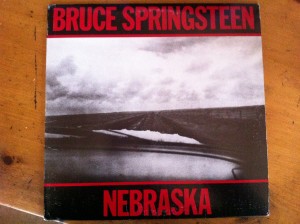
Why Springsteen you ask? Well, good question. I first heard the E Street Band back in 1978. I was at a law school party. Someone kept playing Springsteen’s 1975 triumph, Born to Run, over and over and over. I wasn’t smitten. I wasn’t impressed. Back then, I was a CSN&Y and Eagles fan. The Big Man’s sax threw me. I’d never liked the Stones because of their reliance on brass and that prejudice leaked into my dislike of the E Street Band. But over time and with the purchase of The River (1980: shortly before I graduated from William Mitchell) I became a fan. And then, when I got around to buying Nebraska (1982), I was hooked. That’s why yesterday, in addition to converting the old Springsteen bootleg album, I converted my vinyl copy of Nebraska into digital format. And then I tackled the double live album by Dire Straits. I was still hard at it, five hours after I’d started, when my grandson AJ stopped over for dinner. That’s him, at the top of this blog, helping grandpa move into the 21st century.

IMG_1067

Thanks, AJ, for the help, and Bruce, for the music:

http://www.youtube.com/watch?v=TS28SrKEL68

Peace.

Mark


Posted in Blog Archive | Comments Off on A Cupboard Full of Vinyl