Not A Time to Kill

SycRow

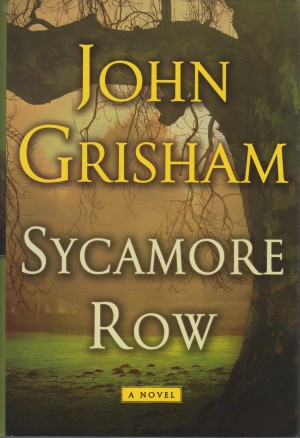
Sycamore Row by John Grisham (2013. Doubleday. ISBN 9780385537131)

Jake Brigance, the down-and-out lawyer who defended African American Carl Lee of murder in Grisham’s debut novel, A Time to Kill, is back on center stage in this novel set in Clanton the county seat of Ford County, Mississippi. Race again features prominently in this story, a will contest between the black housekeeper of a wealthy white recluse who hangs himself in the throes of terminal cancer and the dead man’s estranged daughter and son. What starts out as a powerful drama with an evocative setting akin to Grisham’s best literary effort, A Painted House, quickly descends to a level of predictable familiarity all too common in this author’s more recent efforts. There’s not much deception or surprise in the story line and the characters are the usual assortment of crooked defense lawyers, unscrupulous investigators, and dim-witted hangers-on. There’s enough legal intrigue to interest an attorney-turned-judge in pursuing the tale to the finish line but I seriously doubt if readers looking for suspense or legal tom foolery will find the overall read up to par with John Grisham’s best such as A Time to Kill, The Client, or The Firm.

A major barrier to Jake’s success during the trial phase of the plot seems to be his failure to strike a bigoted white juror whose teenage daughter was raped by a gang of black men. Brigance didn’t ask the embittered man poignant questions about race, which, after all, is the main theme of the litigation and the book. The grieving father is left on the jury as a decision maker and a potential problem. Despite the author setting the reader up for fireworks surrounding this juror, there isn’t even smoke, much less fire as the plot winds to its expected conclusion. The minor character of the bigoted juror simply fades away, never becoming a factor in the jury’s deliberations. This disappearing act, along with a deposition scene in Alaska, along with several other pat legal scenes plopped down in the storyline of the novel, simply don’t ring true.

Had the author continued with the literary style and pace of the first three chapters, this book would be among Grisham’s best. For whatever reason, the plot and writing slid back to the safe and secure patterns of past Grisham novels, making the book readable and somewhat interesting but far from memorable. Fortunately, the novel’s ending returns to the tenor and linguistic accomplishment of the story’s opening chapters but this artistic rebirth is simply “too little and too late” to propel the book towards a solid endorsement for folks who aren’t a rabid fan one of the world’s most prolific authors (33 books since A Time to Kill was published in 1989).

Wikipedia (http://en.wikipedia.org/wiki/A_Time_to_Kill_%28Grisham_novel%29) confirms what I have always suspected: That Grisham drew inspiration for A Time to Kill from Harper Lee’s great literary and legal classic, To Kill a Mockingbird. Grisham obviously tutored himself in the writing process by reading great novels back when he first began his literary career and it showed. Maybe it’s time for John to take a deep breath, read some good books, and attempt  to find the old magic.

This isn’t a terrible read but it was, given the greatness of some of this attorney-turned-author’s past work, a bit of a disappointment.

3 and 1/2 stars out of 5.

Posted in Books | Comments Off on Not A Time to Kill

No Miracle But…

Ruins

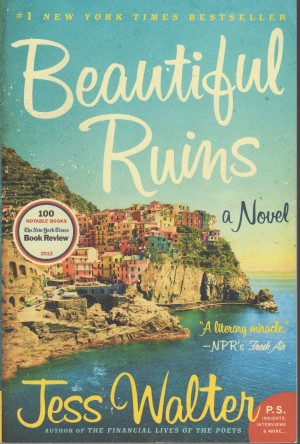
Beautiful Ruins by Jess Walter (2012. Perennial. ISBN 9780061928178)

Italy. Richard Burton. World War II. “The Pitch”. Illegitimacy. A tiny fishing village. Cancer. Punk rock. An aging talent scout/agent. “The Deal”. Each of these concepts/settings/attributes can be found interwoven with a pretty good yarn in Beautiful Ruins.

Pasquale, an aging Italian hotelier, is on a quest to find Dee Moray, a B-list actress he once met in Italy when she was pregnant with Richard Burton’s son, the product of the acting legend’s boredom during the filming of Cleopatra when his one true love, Liz Taylor, is otherwise occupied by her husband, Eddie Fisher. If this tidbit of plot sounds like a soap opera, don’t be fooled. Walter is a gifted writer who throws in scenes from the Donner disaster and a bit of combat writing as well to keep the reader on his or her toes as he weaves a very plausible, if somewhat cliche’ (Michael Dean, the agent, is about as stereotypical a character as they come) tale of familial dysfunction, Hollywood power, and love. The settings, the rugged coast of Italy, the Fringe Festival in Edinburgh, the Universal lot, and Seattle all ring true. The dialogue is crisp and believable. I found the meandering storyline and scene changes akin to watching a Robert Altman flick. And emulating Altman at his best, whether it’s Nashville or A Prairie Home Companion isn’t bad mimicry. The scenes featuring Burton at his drunken, tempestuous best, as always, steal the show.

The cover includes a blurb from one of my favorite NPR shows, Fresh Air that proclaims the book to be “a literary miracle.” That’s hype. This isn’t Lonesome Dove or Anna Karenina or East of Eden. But it’s a book well worth reading.

4 and 1/2 stars out of 5.

Posted in Books | Comments Off on No Miracle But…

Reflections on a Sunday Morning

PigsNewCov

The other day I noticed a comment my friend, Sally Anderson, the manager of the Bookstore at Fitger’s, had posted on Facebook. Seems Fox News was doing a piece on the status of independent bookstores in our region without bothering to interview the manager  of the only independent bookstore in the region. The post bugged me but I wasn’t bugged at Sally. I was bugged at the state of writing, books, publishing, and bookstores in these United States of America and the fact that, since I started hawking books (a term I love to use; sorry if I’m being repetitious) back in 2000 when The Legacy was first published by Savage Press, we’ve lost so many bookstores in the Northland. Think about it. A little over a decade ago, we had the Bookstore at Fitger’s, Sunhillow Books, Northern Lights Bookstore, a little Indie tucked in the back of DeWitt Sietz (where the fish market is now)in Duluth and J.B. Beecroft in  Superior providing local readers with independent access to great books. All of them, including the very successful and nationally renowned Northern Lights, with the exception of the Bookstore at Fitger’s, are now history. This isn’t a trend that is unique to Duluth/Superior. There’s a great article up at http://oedb.org/ilibrarian/12-stats-on-the-state-of-bookstores-in-america-today/ that chronicles the demise of the little corner bookstores that all readers, myself included, love to spend time in. While the article tries to put a positive spin on the current state of affairs, two statistics leaped out at me when I read the piece.

First, the US had some 4,000 independent bookstores open for business in the 1980s. We now have something over 2,000 stores still in business. And second, as of 2011, Amazon had cornered nearly one-quarter of all book sales, not including eBook sales, in the US. Coupled with this loss of physical bookstore space across our land, and Amazon’s emergence as the largest seller of books in America is the fact that, with the introduction of Amazon’s Kindle, 30% of all adult fiction purchased in 2010-2011 was in the form of an eBook. 30%. That of course means readers who bought the e-version of a novel were unlikely to buy the print version, which means in turn, less sales for brick and mortar bookstores, including megastores Barnes and Noble (BN) and Borders.

Borders, of course, has itself closed its doors. Whether you enjoy the concept of big box retail bookstores like BN and Borders (or Chapters to our north in Canada), the loss of 600 retail outlets selling books and music across the country is not a good thing for authors famous or, as my son Dylan says, semi-famous like me. Every bookstore that is shuttered, whether owned by a corporate giant or your neighbor, is one less place for me, or John Grisham, or Garrison Keillor, or Margaret Atwood to sit behind a table in the middle of a cozy store on a dreary, rainy day, meet folks, chat about our writing, and maybe, just maybe, entice a sale. But even when stores or chains (remember, we once had a Waldens here in Duluth, up at the Mall?) fade away, the stores that remain behind, particularly the remaining BN locations, have, due to decreased sales, changed their retail footprints. Walk into a BN store today. What do you find? A larger area devoted to greeting cards. Space, considerable space, devoted to BN’s electronic reader, the Nook. Aisle upon aisle of toys and games, a sideline that, so far as I can recall, didn’t exist in BN stores ten years ago. Along with BN’s shift in focus from being a book and music store to something more diverse has come an attitude, at least in my mind, that regional authors like me are unlikely to be invited to a book signing. This despite the fact that the industry still insists on its archaic and economically devastating return policy: A BN store may order 10 books. If I show up and sell 5, the other 5 are likely to be returned the next day or maybe a month or two down the line for full credit. Often times, the books returned are dirty and torn from customers fondling (but apparently not buying) them on the shelf. The returned books often become paper in my recycling bin, a loss to my little enterprise. Independent bookstores (Indies) usually order only what they actually want or need and return few books. But sadly, there are so few Indies left, their impact, against the corporate weight of BN and Amazon is slight. Sigh…

Sally’s post got me to thinking, thinking about the economic and promotional ride Cloquet River Press has been on during its 12 years of existence. I’ve had some great experiences meeting folks and talking about my stories from Akron, Ohio to Calgary, Alberta. From Thunder Bay, Ontario to Denver, Colorado and all points in between. My loyal blog readers have followed my travels back and forth across Minnesota, Wisconsin, North Dakota, and Iowa as I attended outdoor craft festivals in an attempt, as independent bookstores have retrenched and as the corporate monoliths, BN and Borders have either reduced their stores or become extinct, to add direct sales to the mix. Remember B. Dalton stores, once owned by Target, and later, part of the BN empire? Bookstores in a shopping mall like any other shop. Walden’s fitting that same model. All gone. My efforts to supplement the closure of smaller corporately owned and family-owned bookstores worked for a while. And then 2008 hit and the whole damn world of disposable spending went in the tank. You’ve read my posts. I’ve given up on that model. It’s been two years since I last set up my EZ-Up and tried to sell books in the rain to strangers. I miss the interaction with my readers and potential readers. But I don’t miss the uncertainty of the skies or the loss of my leisure time that each such event entailed. But back the main point of this post.

Recently, you all have been reading announcements (I hope!) on Facebook and on this blog that I have successfully converted all my work, including my novels, into eBook format available on Kindle, Nook, and Kobo. Most of you don’t know that the Indies have their own eReader, the Kobo, available at selected independent bookstores or online at http://store.kobobooks.com/en-us/.

The problem for Indies in selling the Kobo is that the store receives some money from the sale of the device but very little thereafter when a customer downloads an eBook. Every eBook sold to an Indie customer is sort of a self-inflicted gunshot wound. But given the status of the bookselling industry, little guys like me really don’t have much choice: It’s either go digital, and include the “big boys” (BN and Amazon) in the conversion or starve. I’ve had Laman’s River , the first book I released simultaneously as a trade paperback and an eBook , up on Kobo for over a year. I’ve sold one copy to a Kobo user. One. Now, to be fair, sales of that title and all my other titles on Kindle and Nook are very modest. But I’m at least paying back the conversion costs with those sales. Not so with the Kobo versions of my books. Still, I will continue to include Kobo in the mix due to a sense of fairness and my fondness for the little guy, the independent bookseller.

But there’s another issue facing folks like me. The initial printings of my more recent novels have significantly undersold when compared to my first three books. The Legacy has sold over 3,000 copies. The same is true for Suomalaiset. Pigs, my second novel, has sold over 1,500. Anything over 1,000 copies sold by a self-published, regional fiction author is considered a “bestseller”. My more recent offerings, Esther’s Race and Laman‘s River, while receiving the same positive, critical support from readers as the earlier novels, have not sold as well. Granted, those novels came out in 2007 and 2012 respectfully, during the worst recession we’ve seen since the Great Depression. But for a small company like CRP, the loss of sales has been a troubling circumstance. Unsold inventory is not a good thing when trying to balance the ledger.

Which leads me to this point and the point of the new cover of Pigs you see above and the new cover of The Legacy you’ll find below. Create Space (CS), a tentacle of the Amazon octopus, is a godsend for little authors like me with backlisted (formerly out-of-print) titles. CS has formatting software that makes converting an existing manuscript via PDF into a new book, complete with a new cover. Free of charge. Yes, that’s right: Free of charge. And the cost to print a book through their print on demand (POD) printer is modest, very competitive to what I pay commercial printers to print my books. The main reason for going with CS for my out-of-print books is that I can order them one at a time as customers order them (hence the term “print on demand” or POD). No upfront costs. No inventory. No red ink. There are some technical drawbacks to the process in terms of making the same POD version of my books available to brick and mortar stores like the Bookstore at Fitgers, details that I won’t bore you with here. And yes, I am cognizant that by “feeding the beast” in this way, I am likely hurting, rather than helping, the Indies I love and cherish. But I am an author. I want folks to be able to find and read my books. Given the way of the world, I have little choice in the matter.

With apologies to my friends and supporters in independent bookstores everywhere, it’s a path I need to walk.

Peace.

Mark

LegNewCov


Posted in Blog Archive | Comments Off on Reflections on a Sunday Morning

Missing One Side’s Viewpoint

Custer

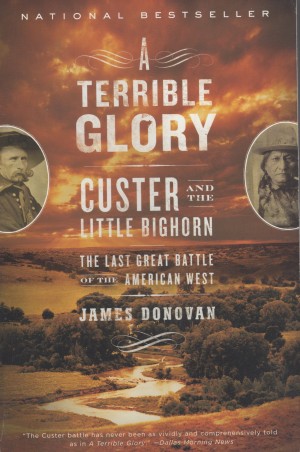
A Terrible Glory: Custer and the Little Bighorn by James Donovan (2008. Back Bay Books. ISBN 9780316067478)

I am a huge Custerofile (I made that word up). I visited the battlefield where Custer and over 250 of his troopers perished on June 25, 1876 as a young child, and having grown up in the era when television dramas were primarily exaggerated portraits of the old west (Gunsmoke, Maverick, Have Gun will Travel, Bonanza) or fictionalized tales of World War II, and being a kid prone to dreaming stories, the Little Bighorn loomed large in my youth. I’ve read just about every historical account of the battle placed in print and in fact, my historical research paper at UMD (my senior project) was an exploration of how the portrayal of Custer changed from fallen hero to scapegoat over the decades following the 7th Cavalry’s defeat at the hands of the Sioux and Cheyenne. My favorite account of the disaster (the word is loaded, I know; it wasn’t a disaster for the prevailing force of Native Americans protecting their way of life) is Son of the Morning Star by Evan S. Connell. Why? Because, I think, Connell managed to capture the story from both sides of the conflict, giving the legend of George Armstrong Custer a fresh and respectful analysis that included a reflection of what the Native Americans opposing General Terry’s expedition were grappling with as three columns of pony soldiers and infantry moved against men, women, and children of the Sioux and Cheyenne nations. I was hopeful that Donovan’s book, the latest in a series of investigations into the battle, would follow a similar path, perhaps adding nuance and detail that Connell’s work did not. But such is not the case.

There is precious little discussion of the Plains Wars from the perspective of the leaders of the various bands of Lakota, Dakota, Cheyenne, and other tribes that ultimately gathered along the valley of the Little Bighorn in 1876. Not that Donovan forgets the other side of the equation. He does, from time to time, reflect upon the atrocities committed in the name of land, greed, gold, and progress against the Sioux and Cheyenne from 1860 through Wounded Knee. The book is not completely devoid of such analysis. But the overall tenor of the book is devoted to a detailed inspection of the actions of Custer and his subalterns on the days before, during, and after the great battle. There are only bits and pieces; shards of historical reference to the other side of the conflict. In this way, my preference is for Connell’s earlier effort as a more complete, more literary, more balanced view of the story.

That having been said, Donovan’s writing is crisp and descriptive, his scholarship is exemplary, and in the end, his steady review of the aftermath of what happened to Captain Benteen, called the “Savior of the Seventh”, and Major Reno, often portrayed in film and print as a cowering shell of a man during the battle, is thorough and evenhanded. Not the best of all the many books on the subject but, for someone interested in history, particularly history involving the enigmatic boy general, Donovan’s effort is well worth reading.

4 stars out of 5.

Posted in Books | Comments Off on Missing One Side’s Viewpoint

Mark Goes Shopping for a Dress

Mall of America

Mall of America

The news was expected. Our second son, Dylan, and his long time significant other, Shelly Helgeson, got engaged over the Christmas break. The normally recalcitrant and emotionally reserved young man “popped the question” to his lady on Christmas Eve and presented her a rock the size of a small potato. She, of course said yes. But, as anyone who has gone through the process of modern marrying knows, the engagement is just the “tip of the iceberg”, so to speak. The next decision for the fated couple is: When? Well, the date was quickly set: September 20, 2014. Less than ten months away. Then, of course, come the really, really difficult decisions: Vegas or big wedding? Religious or civil ceremony? Big party or small gathering? The kids have settled all those issues, including where to hold the reception. The actual location of the ceremony (religious, which makes all the assorted parents smile) is still in the wind, though not for lack of trying. Seems the person in charge of such things at Sacred Heart in Duluth is no longer in her position. We’re all waiting to hear back as to whether the date selected by the kids is still available. If not, a change will need to be made. But of course, for the two mom’s involved in the process, more so for the mother of the bride but almost as important for Rene’, the mother of the groom, is this looming question: “What will I wear for the wedding?”

Now we guys, we have it easy. As the father of the groom, I will join my three other sons, Matt, Chris, and Jack, renting tuxedos along with the other guys in the groom’s wedding party. Simply show up, allow someone to tuck a tape measure up your crotch, stand around for a few moments feeling awkward, pay the tab, and the deed is done. All of the lamentations that accompany the decision making the two moms must go through are lacking. The choices are made for we men and there’s no allowance for deviation. I like simple. I like being a guy in a wedding. I wouldn’t want to be girl in this crazed process, bride, bride’s maid, or mom, for anything. Too many choices to be made. Too many decisions about my least favorite thing on the planet Earth: clothing.

So what’s up with the snapshot of the carnival at the Mall of America, you ask? Well, typically, I like to stay as far away from my wife and her clothes shopping as possible. After 35 years of marriage, I know the traps that a female on the hunt for a dress to wear at a formal event can set for her significant other. Been there; not falling for that. But sometimes, you just can’t say “no”. Like when your wife wants you to drive down with her to shop for a dress to wear at your second son’s wedding. So, a week ago tomorrow, when my wife proposed that I plop my wide ass in the driver’s seat of the Pacifica and join her in her sojourn to the Twin Cities on her vision quest, I had little choice. I said “yes”.

When we arrived at the Mall of America parking ramp in Bloomington, it was filled to the brim with cars and trucks.

“It’s pretty damn full,” I muttered, still a bit reluctant in my role as supportive husband.

“I wonder what’s up?”

The reasons behind the packed house at the Mall on a below zero Saturday in January became readily apparent as we stood at the railing on the 3rd floor of the shopping center and looked down on a huge crowd gathered in front of the mall’s stage. We’d wandered down from the tundra and walked smack dab into some sort of national cheerleading competition. The hallways were crammed with preteen and teen girls of all shapes, colors, and sizes walking with parents, watching other girls performing routines on the stage, or shopping in between their events.

“I think we found the reason for the packed parking lot.”

My wife nodded.

“I’m starved,” she said, looking around for the nearest eatery.

“Twin Cities Grill?”

“Sounds good.”

That’s one thing about the Mall of America. Whether it’s the Twin Cities Grill, Crave, Tony Roma’s, or a host of other classy joints, the chow is pretty darn good. Far better than the food court at the Miller Hill Mall in Duluth. The Twin City Grill has a bit of something for everyone. Our lunches were perfect. But the delay in the inevitable dress shopping was short-lived.

Mother of the Groom

Mother of the Groom


“Call me if you find something you want me to see,” I offered, standing in the bustling throng of girls in short skirts, shorts, sparkles, and war paint.

“I will. I think I’ll check out Macy’s and Nordstrom’s. Let me guess. You’re going to Barnes and Noble.”

Indeed. We went our separate ways, connected eternally by not only love and vows, but by technology. I wandered around the BN store on the main floor of the mall, reminiscing about the two occasions the store had me come down and do readings and signings of my books. That was a long time ago, when BN was more interested in local authors. With Amazon and eBooks kicking the shit out of bricks and mortar bookstores, it’s nearly impossible for a little regional writer like me to get his face behind a table hawking books in any of the BN stores throughout the state. As I strolled around the store, stopping to peruse a copy of the Qua ran,  a sacred text I intend to read sooner than later, I grew weary of thinking about the status of books in America. I left the store and ambled around, people watching.

Like so many couples today, the message I received from my wife via cell phone wasn’t audible but in the form of a text.

“Frustrated. Can’t find anything. Looking for coffee.”

“Where are you?”

We made plans to meet in the food court for a cup of coffee. I met my wife at the top of the escalator.

“There’s nothing for summer out yet,” Rene’ said as we sat near a railing in the food court and looked out over the carnival atmosphere of the Mall of America. “It’s all winter stuff. Stuff for old women and little girls.”

“Nothing for a voluptuous, mature babe?”

My wife ignored my tainted compliment.

We left the big mall and spent some time at Rosedale, one of the old standbys my wife likes to visit when she is in a serious shopping mood. Again, Rene’ couldn’t find a dress she liked, one suitable for the mother of the groom.

In the end, we headed back north, dressless but happy. We made our ritual stop at Tobie’s in Hinckley for pastries and something to drink. The apple fritter and the cold milk I devoured as I drove home seemed a perfect end to a day with my wife.

Legoland

Legoland

Peace.

Mark

Posted in Blog Archive | 2 Comments

Lacking Grace

Red

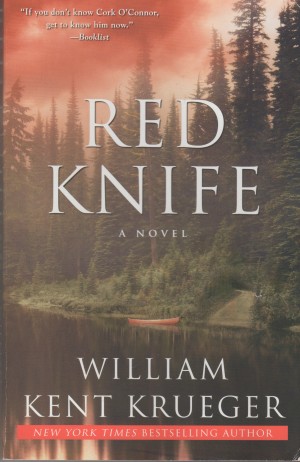
Red Knife by William Kent Krueger (2008. Atria. ISBN 978-1-4165-5675-6)

There is no question that Krueger is one of Minnesota’s most beloved and avidly read authors. Along with Brian Freeman, John Sanford, and Vince Flynn, he forms the North Star State’s pantheon of mystery/detective/thriller writers with national audiences. There is also little question that this author can put fingers to keyboard and create stellar work. Witness my review of Ordinary Grace (see the “Reviews” tab above and click “Books” or use this blog’s search function at the upper right) wherein I wrote:

Anytime an author writes outside his or her genre and tries something new, regardless of the result, they deserve respect. Here, Krueger, much like John Grisham did with A Painted House not only tested the waters of literary fiction but he swam confidently across them.

I rated Ordinary Grace 5 stars out of 5, a level of esteem for a writer that few achieve in my reviews. So when my aunt and fellow writer, Susanne Schuler, mailed me her copy of Red Knife, I was eager to take up the fictional journey of Krueger’s Irish/Ojibwe protagonist, Cork O’Connor. I hadn’t visited the fictional town of Aurora, Minnesota (not to be confused with the actual NE Minnesota locale by that name) since Purgatory Ridge, the second book in the series. I was hoping that the tired writing that eventually enters into all successful authors of a series had been reinvigorated and ingrained with the literary tenor of Grace. Unfortunately, it hadn’t.

It’s not that Red Knife isn’t well written. There’s no question this author knows how to lay down sentences into paragraphs into pages into chapters. But rather than being propelled along by a suspenseful, engaging plot, I found myself sort of drifting through the story, like the canoe on the book’s cover. The players, including Cork, pretty much emulate cutouts standing inside a child’s dollhouse; there’s little unveiling of their inner demons, their pasts, their dreams. I found myself feeling like, as one reviewer wrote on Amazon, watching actors reading lines on a movie set rather than having all my senses engaged in the active task of reading. In addition, the citizen reviewers who have taken Krueger to task for the simplistic and bloody ending are right on: The carnage doesn’t add anything to the story and it goes against type that Cork O’Connor, a generally virtuous protagonist,  would suddenly capitulate and join in the slaughter.

I also wonder about the Ojibwe community of Minnesota and how they view this tale. Not that folks who write shouldn’t attempt to write outside their experiences. So far as I know, Mr. Krueger isn’t Native American, or at least, not a member of the Minnesota Chippewa Tribe. Lacking an ethnic tie to a racial or cultural group being portrayed in a novel isn’t a bar to writing about that group. Hell, in Esther’s Race, I wrote in the first person as an African American, twenty-something, female nurse. If anyone can be criticized for writing about a culture, a skin, that he knows nothing about it would be me. It can be done but it is, I fear, a very delicate task to write outside of one’s ethnicity and gender. Simply tossing a few Ojibwe words or cultural and spiritual references into the mix doesn’t save this tale from coming off as condescending and false. One white man’s view. Others may disagree.

This is a spoiler alert: If you are going to read the book, skip this paragraph! Then there is the final scene in the book. I can’t really explain why the author decided to take a very minor character, a young Goth teen who was a friend of one of the other more visible teens in the story, and make him the centerpiece of a wholly unrelated, exploitative, and unnecessary second coda. Darrell Gallagher’s swan song, where the disaffected youth shoots up the high school Cork’s daughter Annie attends, mimics, in very deliberate ways, actual events that took place at Red Lake High School on the Red Lake Ojibwe Reservation in northwestern Minnesota in 2005. It is unsettling that Krueger didn’t bother to disguise his lifting of the facts and circumstances of that tragic day whole cloth from newspaper accounts in attempt to further sensationalize his fictional story. The addition of the final scene adds absolutely nothing to the main plot. I’ll give you that it’s well written and worthy of exploration in its own right, perhaps with the deft hand and sensibility shown by Krueger in Ordinary Grace, but that’s not what the author does with that scene in this novel.

This is not a terrible book. But as I’ve said in the past regarding other well known authors, the question to be asked is: If the name on the cover wasn’t William Kent Krueger, would this story have been published? Just wondering.

3 and 1/2 stars out of 5.

Peace.

Mark


Posted in Books | Comments Off on Lacking Grace

Diminutive Tales

Short

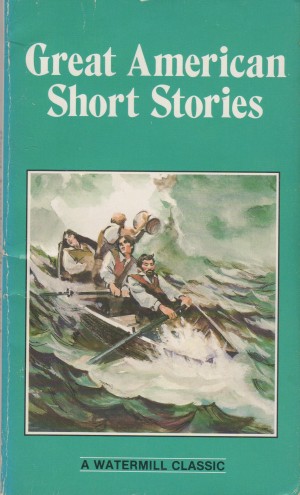
Great American Short Stories (Anthology. 1986. Watermill. ISBN 0-8167-0798-7)

One of my three older sons left this book behind on the family bookshelf. It was likely an assigned text in an English class at Hermantown High School that either Matt, or Dylan, or Chris slogged through. Not that my boys aren’t readers. All three of them read for recreation in their own way. But I doubt any of them would have picked this book up and read it but for scholastic compulsion and consequence. This very small (105 pages) collection of short fiction somehow found its way into our upstairs bathroom, which is where, over the past several months, I’ve perused these iconic tales from five American master storytellers. There are some very familiar classics in this collection (like “Occurrence at Owl Creek Bridge” by Ambrose Bierce,”To Build a Fire” by Jack London, and “The Gift of the Magi” by O. Henry). There are two other stories that I wasn’t familiar with, “The Open Boat” by Stephen Crane, and “A Village Singer” by Mary Wilkins Freeman, both of which are also American very well done.

At the end of the 19th and the beginning of the 20th century, short fiction was abundant and accessible to every reader in America. Many writers wrote a short story a week, sold their tales to magazines, and made a living feeding the literary hunger of mainstream America. Sadly, contemporary magazines that feature good, concise short fiction as their contribution to American letters are now the equivalent of the California Condor: nearly extinct and very hard to find. Oh, there are university-sponsored and not-for-profit niche’ publications still providing literary fiction in small doses to readers. But the old days of Look, Atlantic, Ladies Home Journal, and scores of other monthlies featuring short fiction as the centerpieces of their offerings to the American public are long in our past. Reading this thin volume takes a reader back to the era before radio, television, and the internet, back to a time when words on paper were the means of communication. My favorite story in the book? London’s “To Build a Fire”. As I type this, the mercury hangs below zero outside my writing studio in NE Minnesota once again. That fact alone is enough to create a connection between reader and writer in a tale where London profiles a neophyte visitor to the boreal lands near the Arctic Circle who, along with his dog, sets out from the safety of one cabin to meet up with his mates holed up in another remote camp. There are only two characters in the tale: the human and his dog and London does a masterful job of exploring what each of his players experiences during their respective journeys.

A fine way to spend a few moments of time with some very memorable folks.

4 stars out of 5.

Peace.

Mark

Posted in Books | Comments Off on Diminutive Tales

Enough Already!

Shoveling the Rood

Shoveling the roof

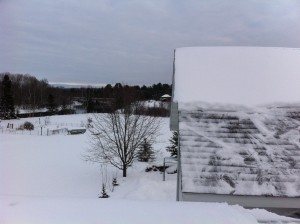
The photo above was taken before Christmas. It was one of the many below zero days we, as hardy Northlanders, recently endured. -15F that day, to be exact. Since then, I’ve recorded three days colder than thirty below (-34, -32, and -31) on my car thermometer. Here in the Cloquet River Valley, our weather is usually closer to what’s being experienced in Hibbing or Tower or Embarrass (despite the fact we’re only about ten miles as the eagle flies from the airport) than Duluth’s reported temps.

Speaking of eagles. It’s 7:35am on Saturday as I type this, listening to Ramblin’ Jack Elliot tell a story on West Coast Live on KUMD. There’s no sunrise to greet me as I cobble, first a book review (see below) and then this blog. It’s a gray, dismal, northern Minnesota January day. But the fact that a bald eagle just flew within fifty feet of my iMac, and that it’s nearly twenty degrees above zero outside, well, those facts alone make it worthwhile to be in this place, in this house, living this life.

Anyway, back to the photo. The roof of our house has one place that’s susceptible to ice dams and the all-too-familiar leaks that follow. You can’t really see it in the photo but just below the freshly shoveled shingles, three roofs meet in one place, creating a niche, if you will, perfect for the formation of ice. Ice that, if permitted to perpetuate, will eventually stop the flow of the melt, which in turn, will cause the water to seek the easiest path, which in turn, will seep into the house. That’s happened twice in our 14 years in this house. I don’t want it to happen again. And so, shortly before the craziness of Christmas (both sides of the family were here on two different days to eat, drink, play the dice game for awful presents, and generally have a pretty good time), I donned my Carhartt insulated bibs and jacket, winter boots, gloves, and stocking hat, pulled out our extension ladder, found a couple of snow shovels, and dragged my tired old ass up onto the roof of the house. Four hours later, I had the suspect areas free of snow. I was dog tired and ornery. But all the snow I’d tossed from the roof loomed up at me from the front sidewalk. I took a short break and then, after another half hour of shoveling, the deed was done. At least until the next big snow.

I love snow. I’m a downhill and cross country skier. I also own snowshoes, though I rarely use them, preferring instead the steady glide of skis to tromping through knee high powder on aluminum and mesh. But the point is, with the temperature hovering close to deadly for most of the holiday season, my opportunities to ski on the trails that run through our land have been limited. Since November, I’ve only been able to get out on my cross country skis twice. I haven’t yet made it to Spirit Mountain to test my knees against gravity.

Kena loves -15!

Kena loves -15!

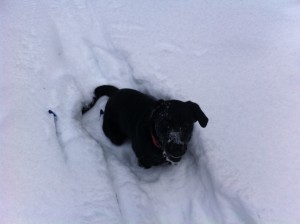
The photo on the left is from one of my two recent excursion into nearby woods. That’s Kena, our seven-month-old Labrador, looking quizzically at her master, as if to ask, “So why, Old Man, are we stopping here?”

Kramer

Kramer


General Custer, Survivor of the 1918 Fire

General Custer, Survivor of the 1918 Fire

The dog on the far right is Kramer. He’s a rescue dog that my third son Chris brought home one weekend from River Falls, WI, where he was going to school. Kramer’s up there in years and, unlike Kena, who bounds through the snow like Tigger on Quaaludes, Kramer is content to follow behind my cross country skis, ambling patiently from place to place, staying firmly on the trail. The day these photos were taken, it was -15, the warmest it had been in a week. When I stopped at General Custer, my favorite white pine on the place, and laid back in the deep snow to take photos, Kena promptly jumped on my crotch to lick my face. Daisey, the third dog in my “crew”, stood off to one side watching the pup, satisfied to be outside of our heated garage where she and Kramer had been holed up during the deep freeze. The problem with taking photos of the tree? Beyond the fact there’s a dog’s hind end obscuring the bottom right hand corner of the shot is that I laid down on my back in the snow, my skis still on, to take the shot. I also momentarily forgot my age and the stiffness of my joints. It took a hell of a lot of effort to become vertical! I made it, but not before Kena had, in ways too indecent to describe in this family blog, her “way” with me.

Maybe the title of this piece is a bit over the top. I mean, I’ve spent 51 of my 59 years on Planet Earth either in Duluth or here, in Fredenberg Township along the banks of the Cloquet River. I should know that winters come and winters go. Some are cold and snowless. Some are warm and snowless. Some are cold and snowy. And some are just plain cold. Penetratingly, isolatingly, demandingly cold. How this winter will shake out in the next three or four months (one never knows, as last year showed us, what season April belongs to) is left to God and caprice. But though I relish the occasional below zero day; a day full of still, calm, windless moments of intense silence as proof that I am still alive; I’ve had enough cold for awhile. Bring on the snow. I want to slap on the boards and head over to Spirit Mountain for a few hours of night skiing. There’s nothing better than standing above the green, red, yellow, and white lights of the most beautiful city in Minnesota waiting to pounce on a mogul. Maybe I’ll see you there. I think we’ve had enough below zero weather for a while, don’t you?

Peace.

Mark


Posted in Blog Archive | Comments Off on Enough Already!

Edible but No Feast

Under

Under Two Flags by Ouida (Marie Louise Rame’) (Amazon Digital Services (Kindle version). ISBN B004NBYX28)

Like many boys who grew up in the 1950s and 1960s, I was an avid reader of Classics Illustrated comic books. The series attempted, fairly successfully, to convert beloved novels from the 19th and early 20th century into what we now call graphic novels. The condensed, illustrated format of Classics Illustrated introduced me to A Tale of Two Cities, Ivanhoe, Les Miserables, and Under Two Flags, a fairly forgotten and obscure novel of the French Foreign Legion by Marie Louis Rame’, an English novelist and contemporary of Dickens, who wrote under the nom de plume, Ouida. You can learn more about this prolific author (over 40 books) at: http://en.wikipedia.org/wiki/Ouida. But as all things Wiki, be advised I found a slight error in the narrative. The article claims that Under Two Flags “describes the British in Algeria.” That’s not accurate as you will learn below. Ouida has been called a writer of romantic/historic novels. With respect to Under Two Flags I would agree with the categorization.

The first half of the novel takes place in England, where we are introduced to Bertie Cecil, the illegitimate son of a British peer, whose tainted blood is a family secret. Secrets are a common thread throughout the plot of this lengthy, at times, cumbersome exercise of Victorian prose but, in most instances, the author conceals the truth from the reader with a fairly adept hand. At times, the wordy style (think a clumsy Henry James or Charles Dickens) gets in the way of a pretty fair story. Bertie’s fall, due to his gambling, his sense of honor, and his younger brother (who has learned all of Bertie’s less admirable qualities) is swift and extreme, sending the former playboy/cavalry soldier into hiding to avoid criminal prosecution as a forger and thief.

The blackguard fallen noble re-appears as a corporal in the French Foreign Legion posted in the deserts of Algeria where the indigenous peoples, sons and daughters of Mohammed, aren’t too keen on being part of France’s Second Empire under Napoleon III. Reinventing himself as the heroic common cavalryman, Louis Victor, Cecil flaunts death and leads his fellow soldiers into battle with acclaim only to have his superior officer (a Frenchman known unaffectionately as the Black Hawk who has guessed Cecil’s upper crust roots if not his identity) continuously discipline and belittle the former British officer.  Rounding out the cast of characters is Rake, Cecil’s aide de camp who left England with the fallen man and the only person who knows Louis Victor’s past, and Cigarette, a half French/half African child of the army who adds not only comic relief to the tale but is a wickedly vicious unofficial soldier for her beloved France. Enigmatic and post-pubescent (though hardly mature) Cigarette saves Ouida’s novel from being a patterned parade of expendable Victorian characters. Diminutive in stature, unschooled but educated in the ways of men and the world beyond her tender years, Ouida conceals nothing of the inspiration behind this wonderful creature of fiction: There are multiple references in the story to others perceiving Cigarette as the second coming of Joan of Arc. The connection is not subtle but labeled as such by the author, making this reviewer believe that Ouida didn’t think her readers were well-read or smart enough to make the link on their own. Talking down to your audience is never a good thing for a writer to engage in and this sin is one that does, in the case of Under Two Flags, find itself repeated. Still, despite this flaw of faith on behalf of the author, there’s enough action in the second half of the book to interest male readers and enough romance to draw in, to use Ouida’s phrase, the “delicate sex”. As far as action goes, the ending is a bit too theatrical and implausible; not one of the better imaginings within the text. The horse racing scene in the English portion of the tale, along with the battle scene that sets up Louis Victor’s fate and Cigarette’s being honored by a Marshall of the Legion in the Algerian section, are well written. The desert battle scene in particular causes one to feel the searing Algerian sun and inhale the odors of sweat, horse, blood, and fear.

All in all, not a great book but a fairly good read. Especially since you can access it on Kindle for free!

3 and 1/2 stars out of 5.


Posted in Books | Comments Off on Edible but No Feast

Joulu (Christmas)

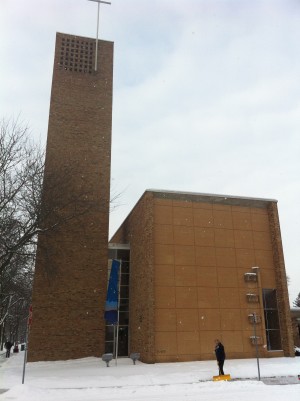
Christ Church Lutheran, Minneapolis, MN 12/14/2013

Christ Church Lutheran, Minneapolis, MN 12/14/2013

Light snow fell as I pulled out of my brother and sister-in-laws’ place. My Garmon GPS was tuned to Christ Church Lutheran, an enclave of Finnishness in a Minneapolis neighborhood a stone’s throw east of Uptown. The freeways from Lakeville to the big city were relatively clear. Traffic was light. It wasn’t until I pulled off the Interstate and onto city streets that the significance of the snowfall made it’s presence felt. Throughout the night, a good five or six inches had accumulated on the roads, causing no end of slick intersections and the possibility of collisions. But the all-wheel-drive on my Pacifica acquitted itself admirably. I stepped out of the warm car into winter and shuffled my shoes through the accumulated powder towards a freshly shoveled sidewalk. Two men were working the business ends of shovels with dutiful determination, making ready for Joulu, Finnish Christmas, at the church. I was there as part of the tori, the marketplace, to hawk my best selling regional novel, Suomalaiset: People of the Marsh to folks of Finnish extraction. I was also hoping to sell a few copies of my latest book, Black Water, a recently printed collection of my outdoor stories. I was even optimistic that some copies of Laman’s River (my most recent novel) and Mr. Environment: The Willard Munger Story (a thick-as-a-brick biography of my legislator-uncle, Willard Munger) might get sold.

I hadn’t done a book event outside of Duluth in nearly a year. I’ve been concentrating my efforts on converting my older novels into eBooks, polishing my manuscript (Sukulaiset: The Kindred; also a novel about the Finns and related peoples), and experimenting with CreateSpace, Amazon’s publishing arm. As I’ve written before, I’m done with outdoor art and craft festivals. My EZ-Up tent is relegated to a storage building that holds tons of household crap looking for a home. The weather. The economy. The time. They did me in, made me realize I had to find a better way, a more efficient way, to promote my writing, than sitting in a tent all summer long trying to sell books to strangers. But I haven’t given up on indoor events and when I read an article in New World Finn promoting Joulu and touting the architecture of the church, I just had to sign up.

Plaque at the Church

Plaque at the Church

Inside Christ Church’s education and social wing, I found my table space in a classroom off a hallway. Venders were already set up along the main corridor of the church’s annex. Outside, across a snowy courtyard, the sanctuary of the faithful sat, empty, waiting for sinners. Entering the classroom, I was greeted by the only other vendor occupying the space, potter Lenore Lampi, whose birch-inspired ceramics are so realistic, you half expect a red headed woodpecker to land on a piece’s surfaces and begin hammering away. We introduced ourselves. Lenore, far more market savvy than I, placed a small table outside the door to our room where she displayed a sample of her work and a copy of Suomalaiset.

“Should help draw folks in,” she said.

Table at Joulu.

Table at Joulu.

We talked a bit about her art and my writing. She hadn’t read any of my books but offered that she might buy a copy of Suomalaiset for her son, a Twin Cities filmmaker. Traffic was light but, as the time for the Joulu buffet, the centerpiece of the church’s celebration, loomed, folks began to trundle in from  the snow. The hallway was soon bustling with hungry Finnish Americans, their spouses, children, and friends. A few passers-by trickled in. I began to sell books. The funk that had plagued me for most of the past year (due to poor sales and seemingly unappreciative customers) lifted.

“Finns buy books,” I said to Betsy Norgard, a member of the local chapter of the Finlandia Foundation I met at Joulu. Betsy wasn’t a complete stranger. She was someone I’d corresponded with in an attempt to drum up support for my application to the national Finlandia Foundation seeking a publishing grant. “I always do well wherever Finns are shopping.”

I learned that Betsy is a book editor. She expressed interest in taking a crack at Sukulaiset. A connection was made with plans to further discuss her fee.

Other patrons stopped and bought more books. Willard and Suomalaiset were the day’s big sellers. Traffic was moderate but steady. I couldn’t help but smile.

During a lull in the action, I wandered off to the basement and found a hot bowl of Finnish sausage soup. Finns insist on putting rutabagas in everything. There were big chunks of my least favorite vegetable (OK, that’s a lie. Brussel sprouts are my least favorite but rutabagas are a close second!), along with carrot and potato floating in brine. It was quite a feat dodging the crowd, an over-filled bowl of soup in my hands, as I climbed the stairs. But lunch was delicious and book buyers continued to stop in.

I received warm greetings from folks who’d organized the event, including Dan Salin, the person I’d emailed about renting space. They were all gracious and kind, wholly unperturbed that a non-Finn had infiltrated their festival. As the afternoon waned and I still hadn’t been inside the sanctuary of the church, I left my table, walked across the open space between the wings of the building, carefully opened the door to the church, and found a place to stand and listen to hymns. Of course, the lyrics were in Finnish. It didn’t matter.

The courtyard.

The courtyard.


In the end, I sold more than I’d expected, made a few new friends, firmed up some important contacts within Minnesota’s Finnish American community, and maybe, just maybe, found an editor for Sukulaiset who can correct my misspellings of Finnish words.

Christ Church Lutheran.

Christ Church Lutheran.

Peace.

Mark


Posted in Blog Archive | Comments Off on Joulu (Christmas)