
Why We Live Here

Jack and Rene’ Munger, Fish Lake

I had forgotten. It’s not like, over the past 12 years as I scurried about hawking my books at summer craft festivals, that I didn’t have time for the occasional weekend day off to go fishing. But with nearly every summer weekend booked at this event or that event, from Ely to Hackensack to Grand Forks to Iron River, Wisconsin for more than a decade, relaxing days in a boat, or on the banks of a favorite brook trout stream, or in a canoe on the Cloquet River have been few and far between. This summer, as you’ve read before, I am not doing any festivals or events. That’s right, not a single one. My change of heart, or business plan, or direction began a couple years back when, after another summer of wind, rain, low sales, and constant running, I put away my EZ-Up tent for good. I decreed, to my family’s delight, no more outdoor shows. No more crossing my fingers as I drove my Pacifica north, south, east, and west with a constant and dedicated eye on the weather. That’s where the great decline, or the great awakening (you choose which, I cannot) occurred. It wasn’t that great a leap, after a very difficult time researching and writing Sukulaiset: The Kindred, the long-awaited (at least by me and a few of my Finnish friends) sequel to Suomalaiset: People of the Marsh, for me to decide that I needed to slow down and take some time to live life rather than chronicle it or invent it on the page.  Writing is like that. Sometimes, a story will come to you as whole cloth, woven and complete. Other times, you have a germ of an idea, as I did with Sukulaiset, but the fibers are stubborn, the loom is cranky, and the weaving takes a lot of time, patience, and love. Any way, after three years of starting, stopping, changing, editing, and finally being satisfied with the end product that will one day become my 10th book, I decided it was time to fish.

Sunday. My wife and I worked like dogs to tear apart our old rose bed and remake it into a much less confused and difficult plot of trees, shrubs, and wood chips. It was truly a team effort. Then, with the lawn freshly mowed from the day before, I raked piles of grass into neat little humps, fired up the gasoline trimmer, and finished the lawn work. By the time I was done with chores, which I’d started in early morning light, it was past noon. I grabbed my copy of The Racketeer by John Grisham and headed towards the river. There, another summer delight that had eluded me for a couple of years awaited. Hammock time, time spent with a firm pillow under your head, a ball cap blocking out the sun, and a good book in hand, is another of summer’s gifts. But again, I’d been delinquent in reserving hammock time over the past couple of summers. In fact, last summer, I didn’t make it into my hammock a single time. Not once. Shame on me, right? This Sunday, I managed to get myself situated in the embrace of canvas and read for a bit but the flies were insistent and eventually, I wandered back to the house for lunch. Despite the abbreviated nature of my time in canvas, there was something transcendent and holy about the effort and it got me to thinking about all the things I’d missed over the past summers spent trying to build an audience and sell my novels to strangers.

“You want to go fishing later this afternoon?” I asked Rene’ back in the house.

“Sure. Where?”

“Fish or Island Lake,” I replied, naming the two largest lakes within a five minute drive of our house.

Understand, this suggestion was made with some queasiness on my part. My boat and its 35hp Force outboard hadn’t been in the water since last fall. I’d charged the battery, replaced the gas line, replaced some rollers on the trailer, installed new seats (thanks, Rene’!) and stitched gaping holes in the canvas storage cover  but I had yet to fire the motor up to see if the darn thing would run. Still, even in the throes of doubt, fishing sounded like a pretty good way to end a nearly perfect weekend in the country. If the motor didn’t run, well, it didn’t run. No use getting excited about things you can’t change, right?

The author and “the big ‘un”.

After filling up at the local bait and convenience store (the Minno-ette), we trailered the boat to the public landing on Fish Lake. It was an absolutely gorgeous Minnesota summer day. 75 degrees. A slight breeze. Occasional, non-threatening clouds. I backed the boat and trailer down the ramp and into tannin stained waters while Jack gave me constant instructions as to the proper way to back up a trailer and a boat. He is something of an expert on the subject, having just this week earned his Driver’s Permit. So of course, I accepted his critique without comment. Eventually, the boat was launched, the Pacifica and trailer were parked in the adjacent lot, our gear was loaded, and the big moment arrived.

I should have had more faith. The motor caught and purred like a kitten on a teat.

“I was worried,” I said to my wife as we pulled away from the landing. “I didn’t know if the new gas line would work or not.”

Perhaps I spoke to soon. A few hundred yards away from shore, the Force began to sputter.

“What’s wrong, Dad?” Jack asked.

I didn’t reply. I simply slowed the motor down, hoping that last winter’s gas was the issue and not something major. The old gas apparently cleared. The pitch of the Force sounded healthy again. We motored on.

“Right there, by the loon sanctuary is a good place to fish,”Jack suggested as we approached a small clump of weeds, rocks, and shrubs sticking out of the water.

“OK.”

We anchored and rigged up our rods with plain hooks, sinkers, bobbers, and leeches or dew worms. It was only a matter of a minute or two and I was reeling in the first fish, a small sunfish, of the afternoon. That’s not the fish in the photograph. But the picture records my proudest moment of the day. The bluegill I caught was shorter in length than the leech it attacked. Perfect size, though, if you want to start a fresh water aquarium! Jack was soon in the game, landing fish after fish. Rene’ had line and reel problems (I confessed to her and confess to you it was my fault: I respooled the reel with new line and put too much on, causing snarls) but eventually, she too caught fish. When we were done, after reeling in a couple dozen sunfish, blue gills, one green sunfish, and a nice large mouth bass, we had a meal of fish on the stringer.

The catch.


“Where are we going for dinner?” Rene’ asked as the sun started to head towards the western tree line.

“How about the Eagle’s Nest?” I answered, selecting one of the three bars and restaurants on the lake.

“Whichever is faster,” my wife added. “I’m starved.”

The Force hit its top speed of 17 miles per hour on the run to the bar. The surface of the lake was calm as we passed pontoon boats, jet skiers, and fishermen. There were no surprises or glitches or breakdowns as we pulled into the Eagle’s Nest, tied the boat off, and bounced along the floating dock towards dinner. After a good meal and a couple of cold Amber Bocks, it was time to head back to the landing. We made the return trip without incident. The boat loaded quickly and with minimal verbal criticism from the newest driver in the Munger household.

Loon Island, Fish Lake.

Back home, Jack and I unloaded the Pacifica, put away the rods, tackle box, and life jackets, and pulled the canvas cover over the boat. Jack fed the dogs while I tied the boat cover down, dressed in long pants and a jacket, and headed to the river to clean fish. I’m not the best with a fillet knife but as the sun set and night overtook the Cloquet River Valley, I finished the job, sealed the fish fillets in a clean plastic bag, disposed of the offal, and stood on the banks of the Cloquet wondering why it had taken me so long to figure out how much I’d missed.

Peace.

Mark
Posted in Blog Archive | Comments Off on Why We Live Here

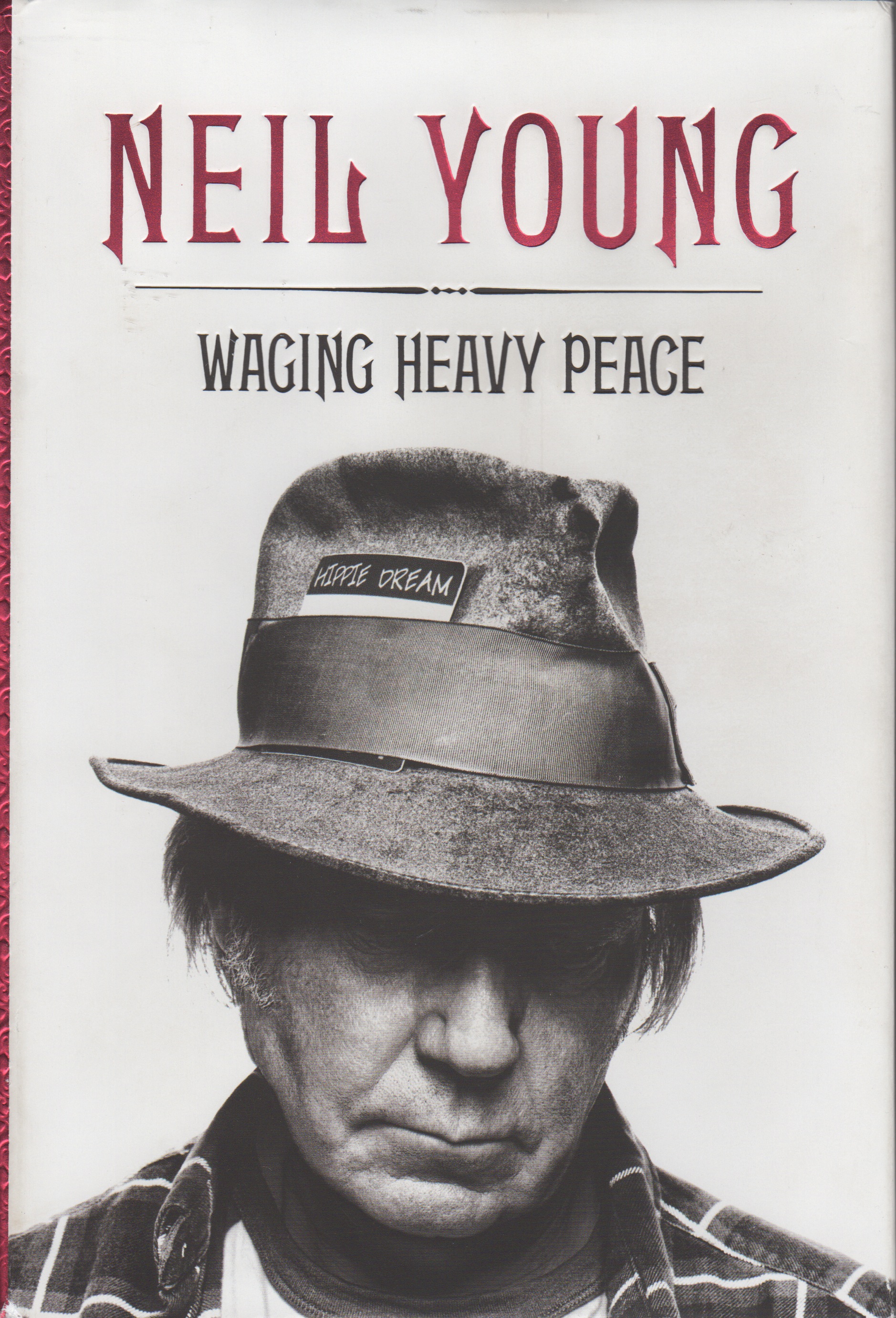
Neil Young’s Tome

Waging Heavy Peace by Neil Young (2012. blue rider press. ISBN 9780399159466)

I’ve said it before when I reviewed Young and Crazy Horse’s Americana: I love the guy. I came of age in the late 1960s, early ’70s listening to my buddies Jeff Tynjala, Mike Schiltz, Evan Wingness, Wayne Johnson, and Steve Cordes (can’t remember the name of their garage band but that doesn’t matter here) playing “Cinnamon Girl”, “Down by the River”, “Broken Arrow”, “Ohio”, and “Southern Man” at dances around West Duluth. I wasn’t musically talented enough to be part of a band: I tried a few times, always inspired by Young and my pals, but I didn’t have the chops and I don’t play an instrument. So I spent my nights, in my basement bedroom, listening to Four Way Street, Harvest, and Everybody Knows this is Nowhere until the tape on my cassettes wore thin. Over the years, I’ve stayed interested in this Canadian import’s career and life so that when I received a copy of Waging Heavy Peace as a Christmas gift, I was pretty sure I’d enjoy Young’s effort at autobiography. Well, I finally got around to reading the big book last week and I was sorely disappointed.

Here’s the thing: Though Young has some genetic writerly roots (His father Scotty was a noted Canadian journalist) and uses his native talent to great advantage in the short form, crafting song lyrics, he doesn’t have the ability to create interesting, memorable prose. His style, matter-of-fact, stream-of-consciousness dictation presenting disorganized and unrelated snippets of life without theme or direction, while perhaps fine in an album of ten songs, can’t carry a two pound book. I also think there’s a disconnect here that has manifested itself in Young’s attempts at film making. Back in the early 1970s, he tried to pull together Journey Through the Past, a film built around his more “Southern” influenced music. (Think “Alabama” and “Southern Man“.) It didn’t make it to the theaters. There have been, as related in this book, other serious efforts by Young at movie making over the years. None of them has ever made money or found critical success. It seems that this memoir fits in the same category as Young’s films and his attempts to experiment with long form story in music, as in Greendale, one of the worst albums Young ever made.

Another criticism of Waging Heavy Peace is the title. I love the word order. Love it. But my impression, naive, I now admit, was that the title had something to do with Young’s musical stands against the Vietnam and Iraq wars, sort of a follow up to his great documentary film and the music behind Living with War. That film was, in my view, a success because it wasn’t an attempt to tell a fictional story, the genre where Young usually falls flat on his face, but simply a memorialization of CSNY back out on the road, singing their songs, old and new, in protest against unnecessary war. But the title to this thick brick of a book has nothing to do with hippies or protests or veterans or peace in the world at large: it comes from Young’s attempt to create a more authentic sounding digital recording that preserves music for listeners the way musicians hear it in the studio. The “war” Young is speaking of is against MP3 players and Apple over the quality of the music.Which leads to another criticism of the book: While a chapter about PureTone and another about LincVolt (Young’s attempt to electrify a gas guzzling Lincoln Continental) would have been enlightening, the constant, non-sequential sermons on his experiments are distracting and, quite frankly, not all that interesting.

There are snippets of stories and scenes from Young’s life, from his youth in Winnipeg, his early days on the road, his domestic life, and from his tours and albums with Buffalo Springfield, CSNY, the Stray Gators, and Crazy Horse that are compelling. His devotion to Pegi, his wife of 35 years, and their two children, as well as his love for his son by another woman, all shine through and put the face of humanity on what otherwise seems to be a very self-absorbed and narcissistic tale. Someone else wrote that, whereas Shakey, the seminal biography of Young’s life, portrays the man in all his complexities including his ruthless protection of his music to the point of discarding longtime associates, band mates, and friends to keep the musical bus rolling, this effort is not nearly as revelatory. I have to agree. There is little “writing as if your parents are dead” here, the admonition that first year MFA students hear when they begin their writerly journeys and far too many attempts to justify actions or to name drop. There is also the simplistic tone of Young’s prose. While his song lyrics have been praised for their sparse beauty, Young’s creative genius in songwriting doesn’t carry over to his attempts at prose. Consider this scene from a visit Young and friends made to a Costco store in Hawaii:

My first big purchase was a set of replacement brushes for my Sonicare toothbrush, a product I am very pleased with. I really needed those and had been wondering how to find them. We wandered on through aisles of myriad products before we reached the book department, where Marc purchased several books for his little daughter, Leia. She is a beautiful and bright child who calls me Uncle Neil and asks me where my guitar is. We made a note to look for a guitar for her, but found only ukuleles at Costco. A plan was made to locate a music store. There were no records for sale at Costco except for local Hawaiian. I was happy for the locals.

Really? Did Young’s fans and the readers of what is supposed to be the definitive expose of his life really need to learn the brand of toothbrush Young prefers or his th0ughts as he walked through Costco? Or, ask yourself this: If it wasn’t Neil Young’s face on the cover of this very bland, disconnected, repetitive, unorganized ramble, would any publisher, including Cloquet River Press have released this book? I think not. The only positive I can really say about this memoir is that I didn’t toss it into the garbage can. I did that once with a book, with Until I Find You by John Irving. Irving’s novel was so terribly written, I didn’t get past the first 150 pages before I hurled it away in indignation. At least this memoir was something I was able to stomach to the last page. But that’s about it. Save your money. Buy Shakey instead. Better yet, if you want to really understand Neil Young and want a glimpse into his genius, do what I did while I was writing this piece. Listen to his latest CD with Crazy Horse, Psychedelic Pill (review to follow) and revel in the genius that, from time to time, surfaces from this Rock and Roll legend.


2 stars out of 5.

Posted in Books | Comments Off on Neil Young’s Tome

A Grand Tale

Ordinary Grace by William Kent Krueger (2013. Atria Books. ISBN 9781451645828)

72. That’s the ranking of William Kent Krueger’s latest effort on Amazon. 2,479,690. That’s the ranking of Laman’s River, my latest novel on the same website. Though the two books have about the same ratings in terms of readers’ reviews (4 and 1/2 stars out of 5 for both on Amazon; 4.17 for Ordinary, 3.89 for Laman’s on Goodreads; 4.5 for Ordinary, 5.0 for Laman’s on the BN site), I’ve never had a title crack the top 20,000 titles on Amazon, including The Legacy, my first novel which sold out its initial printing in 6 weeks. So far as I am aware, every one of Mr. Krueger’s novels has made the NYT’s bestseller list. Every one.

Why am I disclosing this information in a review of Mr. Krueger’s latest work of fiction? Simple. While, as a judge (my vocation) I may be somewhat thick skinned and able to “roll with the punches” so to speak, as an author (my avocation) my ego, at least thus far, is about as fragile as a DDT infected eagle egg. It’s tough, this self-publishing gig, especially now, my third decade into writing, my second decade as a published author. Few folks outside of a tiny cadre of loyal readers, family, and friends know who the hell I am. So when I review books written by folks who are from my “neck of the woods” and who’ve done well for themselves in the publishing world, given my fragile writerly self, I’m always on guard. I remain diligent that envy, the “green headed monster” I’ve written about in the past, doesn’t infect my critiques of other Minnesota authors. I am not perfect in this quest. This I know. But I am at least willing to recognize the flaw and try to address it.

That’s a long-winded introduction to this, my first review of a William Kent Krueger book on this site. I’ve read Purgatory Ridge and at least one other Cork O’Connor mystery penned by Mr. Krueger and while I enjoyed them, they weren’t what I would consider to be compelling reads. Entertaining. Well written. But not compelling. Ordinary Grace is a much different book than the formulaic fiction I’ve read from this author in the past. It is, in a word, grand. Grand in its literary tone, grand in its treatment of the folks who inhabit the story, and grand in plot. Grand. I’ve never used that word in a review before, but I think that slender word captures nicely my opinions concerning this period murder mystery wrapped in the guise of a literary novel. I see Ordinary Grace as sort of a Midwestern Rebecca told from the perspective of an adolescent boy.

Early on in the tale, a child’s body and the body of a drifter are discovered. Upon first encountering these revelations, I felt that Krueger might be borrowing too heavily from Stephen King’s coming-of-age masterpiece, Stand By Me. But my fears of authorial mimicry were soon alleviated. As the story unfolds, the main protagonist, teenager Frank Drum, emerges as a viable, believable character in this quiet yet riveting drama. As I was pulled deeper and deeper into the story, I discovered character-driven, literary fiction much different from anything I’d read by this author. And despite Krueger’s attention to each character’s psychology, Krueger doesn’t forget his roots. He builds a plausible, intriguing plot that unfolds in a thoroughly described small town placed along the sandy banks of the Minnesota River. There’s nothing missing in this story. Nothing.

I read somewhere that William Kent considers this to be his finest piece of writing. Having read but a few of his more traditional mystery tales a long time ago, I can’t support or deny the author’s claim in this regard. But I can say this: I hope to include writing this good in at least one of my books.

Anytime an author writes outside his or her genre and tries something new, regardless of the result, they deserve respect. Here, Krueger, much like John Grisham did with A Painted House not only tested the waters of literary fiction but he swam confidently across them.

A fine summer read and a story you will remember long after you close the book or turn off your Kindle or Nook or Kobo.

5 stars out of 5.


Posted in Books | Comments Off on A Grand Tale

Reading Vintage Maugham at the Lake

South Sea Tales by Somerset Maugham (1950. Perma Books. ASIN B000KU89E4)

I found myself at the Litman Camp on Elsie Lake in Ontario. I’d finished a collection of short stories I brought with and ended up perusing the bookshelves of the main cabin for something to read between walleye fishing, watching storms, taking sauna, and doing chores. I pulled this collection of Maugham’s stories about life in the orient down and began to read. There’s no question about it: If you’ve never read The Razor’s Edge or Of Human Bondage, these stories, really novellas in size, are a great place to inoculate yourself with a bit of Maugham. “Rain”, one of Maugham’s most famous short works, starts off the collection and sets the theme for many of the eight stories in this book. Maugham, a thoughtful, deeply intuitive writer, sets up a psychological conflict in each of the pieces.

The length of these tales is perfect for leisurely entertainment. My favorite story in the collection isn’t “Rain”, the piece most often cited to reveal Maugham’s talent as a master of short fiction, but “Red”, an evocative, titillating, sensual mystery of a stranger’s past revealed in bits and pieces over the duration of the story. A literary strip tease, if you will.

There are numerous configurations of these stories available from the usual retail suspects but all of the variations contain gems of writing that will entertain, enlighten, and amaze. The Perma version of the collection happens to be a pocket-sized hardcover; perfect for tucking into a back pocket and taking out on the lake.But whatever version you decide to read, South Sea Tales is sure to engage your mind and your heart. Consider this short passage from “Rain”:

When he was on deck next morning they were close to land. He looked at it with greedy eyes. There was a thin slip of silver beach rising quickly to hills covered to the top with luxuriant vegetation. The coconut trees, thick and green, came nearly to the water’s edge, and among them, you saw the grass houses of the Samoans; and here and there, gleaming white, a little church.

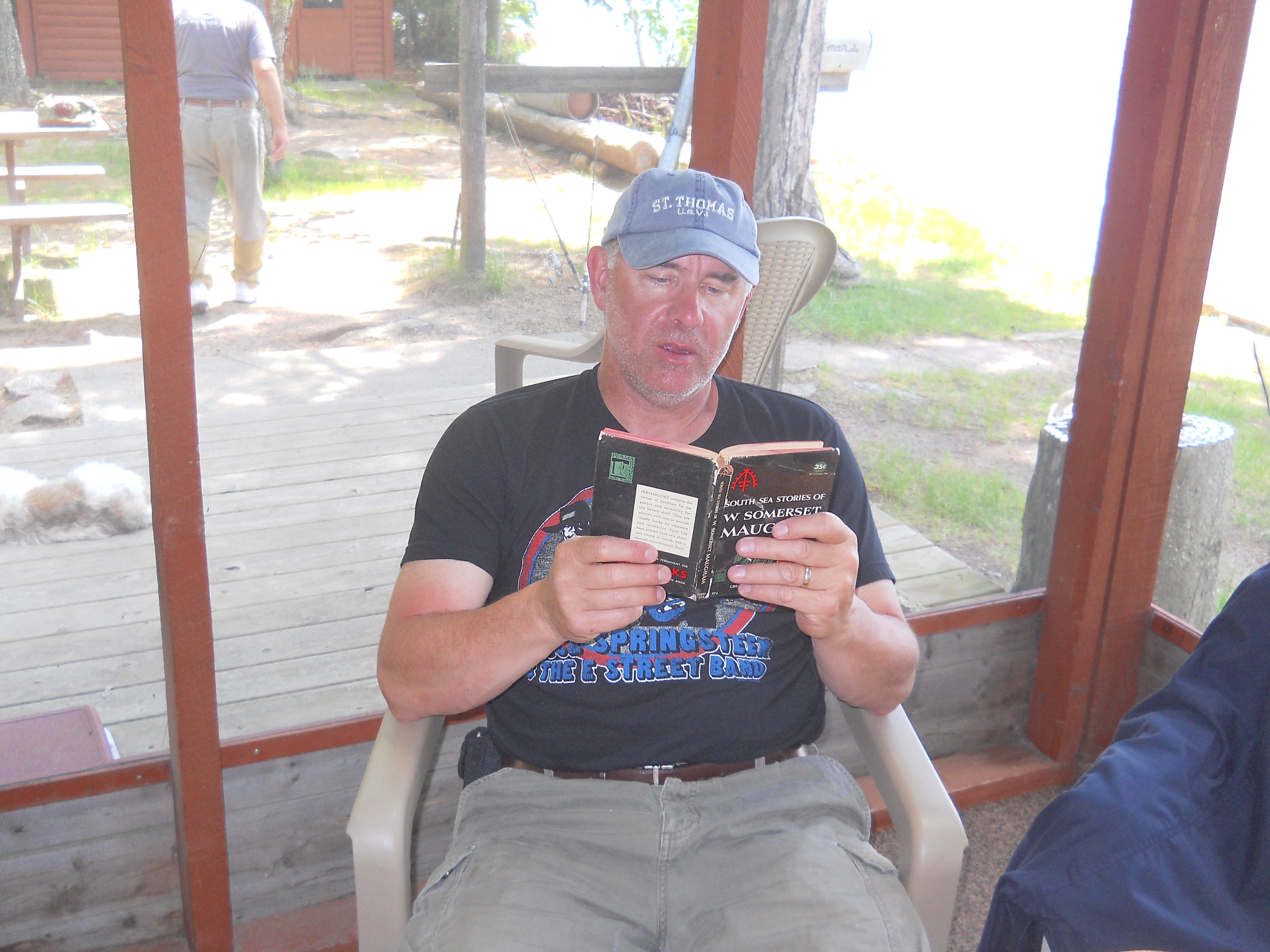
Take a gander at the photo below and decide for yourself. Doesn’t it look like I’m engrossed in the book?

4 and 1/2 stars out of 5.

The author reading Maugham during a break from fishing.


Posted in Books | Comments Off on Reading Vintage Maugham at the Lake

A New Crime Novel from Finland


Cold Trail by Jarkko Sipila (2007. Gummerus (Finnish). 2013. Ice Cold Crime (English). ISBN978-0-9824449-8-6)

 This is the fourth Sipila novel that I’ve had the pleasure to read and review for New World Finn. Previously, I took a “stab” (pun intended) at commenting on Helsinki Homicide, Nothing But the Truth, and Against the Wall. Of the three Suhonen/Takamäki police procedurals that I’ve had the pleasure to read, my favorite, with this latest effort included in the mix, remains Nothing But The Truth.

There’s really no mystery to the story that Sipila proposes here. Timo Repo, a Finnish ordinary man, slips his prison escort at his father’s funeral while serving a life sentence for killing his wife. Because of the prison guard’s ineptitude, the Violent Crimes Unit (VCU) led by Lieutenant Kari Takamäki is called upon to trail and recover the prisoner. Propelled by Sergeant Anna Joustsamo’s curiosity as to why a man who’d nearly served out his sentence would suddenly escape custody, the VCU spins into action, relying upon Joustsamo’s computer expertise and the street smarts of undercover cop Suhonen to not only track Repo but also dig into the crime that sent Timo Repo to prison.

As is the case with all Takamäki/Suhonen yarns, Jarkko Sipila gives his readers a detailed look at how the police machinery in Finland works, complete with a “under the curtain” exposé of internal politics, departmental jealousy, and the finer points of police work in a modern Scandinavian urban center. The author draws upon years of crime reporting to support this fictional tale and, as in past efforts, paints a believable and compelling rendition of a plausible scenario. Of particular interest to this reviewer (who happens to be a judge) is the fact that one of the minor characters caught up in the dragnet is Aarno Fredberg, Chief Justice of the Supreme Court of Finland, who, at some point in time, once heard an appeal of Repo’s case.

There’s much to applaud in this effort. Terse writing. Believable characters. Accurate dialog. But unlike Nothing But the Truth, which contained excellent character revelation (centered around the iconic Norse scalawag, Suhonen) and in-depth exposition of the motivations behind the actions of Sipila’s fictional creations, this effort continues the more genre driven minimalism of Sipila’s other works.

Consider this comment from my 2011 review of Nothing But the Truth:

(W)hile Sipila’s later works have been well written and concise, the sort of tight writing one wants in a beach read (which most crime novels tend to be), they lacked the revelation of character that, for me, sets a good book apart from its competition. After reading Nothing but the Truth this past weekend, I now know that Jarkko Sipila cares about the people who populate the Helsinki of his imagination. And in this reviewer’s humble opinion, that’s a huge plus.

The cast of characters in this earlier installment of the “Helsinki Homicide” series includes some of the same folks found in Sipila’s later work, including Kari Takamäki, (a Detective Lieutenant in the Helsinki Violent Crimes Unit) and Suhonen (an aging, hockey playing undercover detective in the same unit). Sipila clearly has a fondness for Suhonen’s lone-wolf personality: The author gives the shadowy detective center stage. But the writing (unlike the two other Sipila books I’ve read) doesn’t suffer from too much action and not enough humanity: Here, Jarkko Sipila gives us a full-blooded Suhonen, a character with a complete history and personality.

(Full review available under the “Reviews” tab or by using the search function above.)

I recognize that few police procedurals make the leap that I suggested in my review of Nothing But the Truth and that, in many ways, readers of genre fiction expect, and in fact, demand a certain formula be applied by the author to a new and imaginative plot. Familiarity, in the world of genre fiction, doesn’t breed contempt: it breeds sales. Despite this commercial need to bow to script, Jarkko Sipila doesn’t leave us completely uneducated with respect to the lives and specifics of the characters in this book. There’s a nice little subplot here regarding Takamäki’s teenage son and a bike accident that allows us to peek into the domestic life of the lieutenant and his family However, this diversion is only a brief, and in some ways, wholly unrelated pause in an otherwise plot-driven tale.

 In addition, though the details of the police work depicted in this story ring true, to my thinking Sipila ends up painting on a canvas with too many colors. What do I mean? Given the Takamäki subplot, it seems that, had the author concentrated on Takamäki as the focus of the story rather than shifting between essentially three primary police protagonists (Takamäki, Suhonen, and Joustsamo) this book would be on the level of Nothing But the Truth. Such concentration of characterization is what made Nothing such a great read: We learned to respect, fear, and empathize with the Suhonen character. Had Mr. Sipila employed his considerable writing skills in creating a similar individual portrait in Cold Trail, the book would have equaled, or perhaps surpassed, Nothing But the Truth.

 Still, for readers who enjoy Scandinavian crime novels and are looking for a quick beach or rainy-day-at-the cottage read, this is a good book to pick up and escape in.

 4 stars out of 5.

(This review originally appeared in the most recent issue of New World Finn Newspaper. If you are Finnish, or wished you were, you can subscribe to this great little periodical about art, culture, politics, and history at http://www.newworldfinn.com/.)


Posted in Books | Comments Off on A New Crime Novel from Finland

A Country for Old Men (with apologies to Cormac McCarthy)

De Havilland Otter Leaving Elsie Lake, Ontario

The trip started off inauspiciously. I was charged by my eighty-five year old father to arrive at the Country Inn Suites in Hermantown, pick up former Vice President Walter “Fritz” Mondale and his traveling companion, George Millard, by 6:00am. Wednesday morning of last week I tumbled out of bed, into the shower, brushed my hair and teeth (not with the same brush), loaded the Pacifica with my fishing gear, and headed south on Lavaque Road. I arrived at the Country Inn Suites on time, fully expecting Fritz and George to be waiting in the lobby with their gear. But the lobby was empty so I approached a young man manning the front desk. There was an aura of the Himalayas about the lad and an inflection of the Ganges in his speech.

“Could you ring Mr. Mondale’s room?”

The desk clerk checked his computer.

“No one here by that name.”

“Mr. Walter Mondale,” I insisted, putting emphasis on the surname of one of the most famous politicians in Minnesota history.

“Don’t see it.”

“How about George Millard?”

A quick scan.

“Nope.”

I knew instantly that Harry, my father, had “Mungerized, i.e., given me only part of the story on the expectation I’d figure out what was going on. It’s a common trait of Munger males to impart a portion of the story on the belief that the Munger male receiving the information will fill in the missing pieces.

“Oh, didn’t I tell you? They’re at the Country Inn Suites down on Canal Park. Come pick me up first,” Dad said after I reached him on my cell phone and explained the former vice president and his aide de camp were missing.

When I arrived at the familial homestead, Harry was standing outside, a pile of gear the size of Mt. Denali stacked in front of him.

“How do you expect to put all that in the Pacifica and still have room for George’s and Fritz’s stuff?”

Dad smiled.

“Relax. This is for all three of us.”

I managed to stuff everything into the cargo area of the Pacifica, including Dad’s rod holder, a seven foot long steel tube the size of a small culvert. We picked up the two wayward octogenarians on time, shared handshakes, shoved their ditty bags into the car, and headed north, up Highway 61, towards the border.We met my dad’s pal, Bruce Meyers, Sammy Perella (of Sammy’s Pizza fame) and Sam’s son Tony for breakfast in Grand Marais.

Our destination was Ignace, Ontario, where we would board one of Ignace Airway’s ancient but well-maintained De Havilland float planes (made in Canada, of course) for a twenty-minute flight into Elsie Lake. We were to be guests of Ross and Jay Litman, two of the late Jack and Helen Litman’s kids, at a fishing camp that has been in the Litman family since the late 1960s. The old guys in my car have been at the Litman place dozens of times over the years. This is only my third trip. Given the ages of my passengers, when Ross Litman (who also happens to be our local sheriff) asked me to tag along, I had little choice. While there may be some ninety-year-old walleye fishermen out there, tossing jigs on rock piles into the evening dusk, they’re about as rare as a Minnesota Twins sweep. So I cancelled all my other summer plans to make the trip.

A little history. My first visit to Elsie Lake was as a newlywed. My wife Rene’ and I were invited by the Litmans (both Jack and Helen were alive and in robust health back in 1978) to spend our honeymoon with the Litman, Mondale, and Munger families. I was in law school and we didn’t have much money so my new bride and I readily agreed. Sleeping on separate lawn chairs in a canvas tent under starry Ontario skies while surrounded by Secret Service agents, Mounties, and OPP (Ontario Provincial Police) because we were vacationing with the Vice President of the United States is a tale that we’ve recounted hundreds of times over the years. My other trip to the Litman place was five or so years ago. That fishing trip, similar to the one I was on, is not quite as memorable as my honeymoon but my recollections of that trip are filled with laughter, good fishing, politics, and great stories none-the-less.

It’s always unnerving, even if you are law abiding and have nothing to hide, to cross an international border. For me, its more harrowing coming back to the States than leaving. I think this is because, over the years, I’ve noticed that Canadian border agents tend to be more friendly, more willing to show their human side, than their American counterparts.This trip supplied further support for that perception.

“Weren’t you Vice President of the States?” a young, burly border officer asked as he studied Fritz’s passport.

“I was.”

“Under Jimmy Carter, right?”

“That’s right.”

“I loved that man. You did good work. You folks have a great trip.”

We drove away from the crossing, discussing how unlikely it would be for an American border guard to know who the premier of Canada was.

Litman Camp, Elsie Lake, Ontario

During the drive from the border to Ignace and the flight from Ignace to the lake, we counted eight moose of all sizes and genders browsing the boreal landscape. Seeing that many moose on a single trip was a first for me and gave me hope that, despite the dire condition of Minnesota’s moose population, these strangely configured relatives of deer will remain an iconic fixture north of the border. From the plane, Sammy and I spotted a big animal, likely a bull, browsing a clear cut just a few miles from our destination. We were still talking about the moose when we exited the plane to shake hands with Jay and Ross Litman on the dock of the Litman fishing camp.

Ross and his dogs see the Otter off.

Our group immediately lost Jay.With news that his first grandchild was about to be born back in Duluth, Jay left on the Otter that flew us in. He stayed with us long enough to help unload our gear, go over the menu with Sammy (Jay is an excellent cook and usually commands the Elsie Lake kitchen), take a quick dip in the lake, and head back for the emergent birth of a new generation of Litmans. (As of the writing of this blog, the baby hasn’t yet made his or her appearance: Jay’s hurried trip back to Duluth was based upon a false alarm.) After staking our claims to bunks in the bunkhouse, Ross assigned us to boats and, with full expectations of slaughtering the walleyes, we headed out. I was second mate on the pontoon boat with the sheriff, assisting with untangling snarls and snags involving the old guys and trying not to step on the dogs, all three of which insisted on being on the boat with us. The walleyes were biting but it took this author, a modest fisherman at best, some time to get in the groove. I watched everyone on the boat: The sheriff, George, Frtiz, and my old man land fish before I finally felt the tight, steady pull of  a cold water walleye on my line. Despite my mediocre success, the night was grand, with calm waters, a light breeze, few bugs, and the slowly setting sun reminding us that it was time to head in.

The next day, I fished with Sammy and Tony and we hit the “honey” hole with the others. All of us did well. At times, all three boats had fish on, sometimes doubles within a boat.

Sammy Perella and an Elsie walleye.

Whenever we weren’t on the water, catching walleyes, whitefish, lake trout, small mouth bass, and the very occasional northern pike, Ross was a whirling dervish. He was constantly organizing, lifting, toting, repairing; all at light speed. My wife and kids complain that I move too fast, that I don’t relax, that I’m constantly on the go. I don’t hold a candle to the sheriff in the mobility department. He’s a man, as best as I can describe it, in perpetual motion from dawn to dusk.

The author reading Maugham during a break from fishing.

It wasn’t all time spent on the water enticing fish with jigs and spinners tipped with worms and leeches. (My dad insisted on using strips of sucker belly on his lures. Our universal derision at his choice turned to envy when he started pulling in fish. Minnows, on the other hand, didn’t seem to tempt the very selective walleye of Elsie Lake.) When we weren’t fishing, Ross had us mowing, raking, organizing, cleaning, cooking, doing dishes, and toting. There’s a lot to do when a camp isn’t accessible by road and everything from gasoline for the outboards to toilet paper has to be planned for, accounted for, and flown in. But the good sheriff gave us time to read (I finished three books including two from Helen’s personal library that I will be reviewing on this site), sauna, discuss politics (imagine being seventeen year old Tony in the presence of four octogenarians, one of whom lived in Peru, another who was a US Senator, Ambassador to Japan, and Vice President, and two others who were trial attorneys with nearly a century of practice between them), play cribbage, and simply leave the world’s troubles behind.

I ended up functioning as a guide for my old man (didn’t really do the title justice) and Bruce (we found walleyes during intermittent rain in prodigious numbers despite my lack of guiding prowess), George’s perpetual dish washing partner, and mop and broom boy for the trip’s final cleanup. Late night runs down the dock and into the cold waters of a legacy carved into the Canadian shield, my skin prickly from the 195 degree heat of the camp’s wood-fired sauna, smooth, clear water closing over me as I descended to the pebbly bottom of the lake, capped off a wonderful time with four old men, a great backup cook. a wide-eyed teen, and one hell of a host.

Ross Litman, Sammy Perella, Tony Perella, and George Millard. The sheriff cleans our catch.

Maybe, if I promise to pick up the pace, Sheriff Litman will invite me back again.

Peace.

Mark

Yellow swallowtails at Elsie Lake.


Fritz Mondale, Bruce Meyers, George Millard, and Harry Munger.

PS On our way back through U.S. Customs, I teased the former Vice President that the American manning the booth wouldn’t recognize him. Turned out to be the case. The agent didn’t evince a hint of recognition, much less engage Mr. Mondale as his Canadian counterpart had. Fame, it seems, is a transient thing.


Posted in Blog Archive | Comments Off on A Country for Old Men (with apologies to Cormac McCarthy)

Good Morning, Midnight

Good Morning, Midnight by Jean Rhys (1974. Vintage Books. ISBN 978-0394710426)

Jena Rhys is, like an author I am reading right now, Edith Pope, a somewhat forgotten novelist of the Jazz and Post Great War Age. Her best known novel, Wide Sargasso Sea, is considered by many literary types to be a minor classic but it’s her earlier works, including this gem of a slender novel, that really let one peek into the writer’s head and see what drives the creative forces behind the work.

Here, we meet Sasha, an Englishwoman, in the throes of poverty, alcoholism, and despair as she wanders post-WWI Paris in search of fulfillment and love. Rhys writes from the heart here, as if she too experienced the rejections, the slights, the degradations heaped upon Sasha, a once pretty and now fading flower of femininity, whose only weapon, her sexuality, is in late, if not waning, bloom. Penniless, Sasha insists on maintaining airs to the point of using her last franc to buy clothes, to keep up appearances. There is a glimmer of hope in the form of two young Russians who meet and court her but in the end, she falls for a young man whose position in life and society is determined solely by his sexual prowess. Thinking Sasha to be a rich, lonely woman, the gigolo embraces her both physically and emotionally with disastrous consequences for the fallen protagonist of this finely crafted psychological tale.

If you have not read Jean Rhys, I would start here and then go on to her other works. A marvelous introduction into the library of a now forgotten pioneer of introspective writing.

4 and 1/2 stars out of 5.

Posted in Books | Comments Off on Good Morning, Midnight

Another Great Summer Read


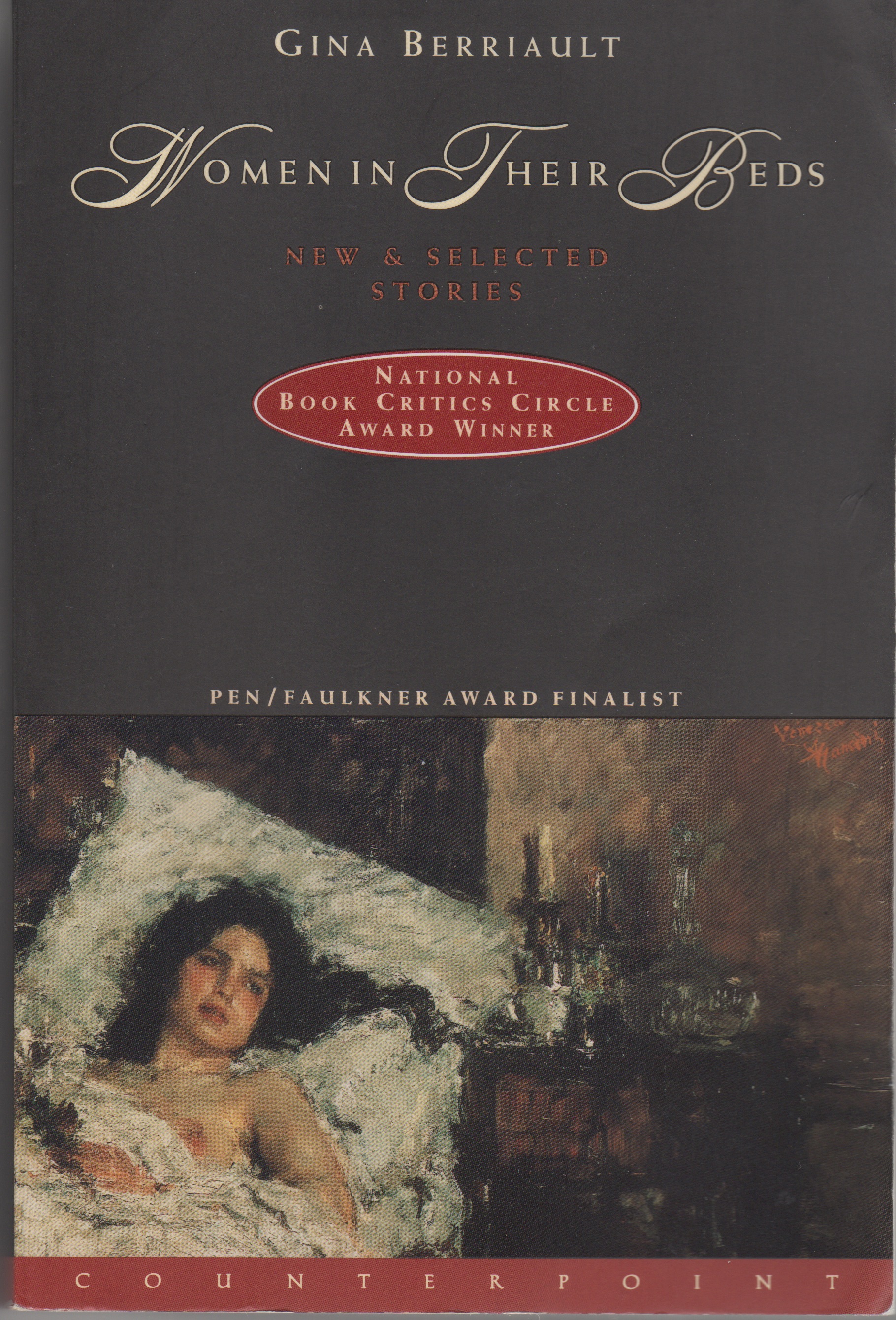
Women in Their Beds by Gina Berriault (1997. Counterpoint Press. ISBN 1-887178-38-4)

No, I did not buy this book just because of its title or the cover. Shame on you for thinking such shallow thoughts. I bought this book because I came across an article or something in Poets and Writers Magazine regarding Berriault’s work. I had never read any of Berrault’s fiction and thought I’d give it a try. I’m glad I did.

Berriault’s style is reminiscent of Hemingway but without the misogyny. You can feel Ernest’s presence in many of these stories,not repeated as cheap mimicry but as if Berriault had absorbed Hemingway’s best and endowed it with a feminine touch. It took me a story or two to understand and appreciate the author’s linguistic skill and style but once you’ve settled in, I promise you that there’s not a story in this collection that will disappoint you. The themes are universal, the characters, enticing, and the plots well contained. Many of the tales are set in northern California. But there are excursions to Denmark (“Isle of Ven”), and Mexico (“The Search for J. Kruper”) and characters of all races, socioeconomic levels, and intellects to enliven the journey. And above all, readers are left with the blessing (Berriault died in 1999 shortly after this book won numerous national awards) of a very gifted writer’s ability to write smartly but without pretension. Consider this passage from “Sublime Child”, a story about loss and love involving a young woman and the lover her mother left behind:

She closed her eyes and was carried to his chair and down into his lap, and felt his legs trembling under her. The past year was bearing fruit, and they were at last, she thought, easing Alice’s concern for them both. But opening her eyes to see his face, wanting frantically to find his face familiar to her, familiar as it had been when it was more dear to Alice than to her-for only that earlier face could reassure her that everything was right-she saw only his dark head cradled on her breasts. The sight of herself lying like a babe-in-arms in the midst of his consuming figure shocked her into imagining that Carol was coming from the kitchen and saw her enfolded there, her thin legs dangling down. No, no, don’t make me be my mother, she begged him, but it was only whimpering, and frightened by her inability to speak, she struck him with her fists.

This is an author who doesn’t avoid sensuality or love or sex but discretely reveals such passion, along with other human emotions, like a very gifted exotic dancer. The display of skin is achingly slow. The pace is languid. And the tantalizing time it takes to come to comprehension bears great reward for the reader.

Masterful.

5 stars out of 5.

You can find out more about Ms. Berrault and her work at: http://www.nytimes.com/1999/07/23/arts/gina-berriault-73-an-author-of-deft-novels-and-short-stories.html.

Peace.

Mark


Posted in Books | Comments Off on Another Great Summer Read

One of Ours: A Review


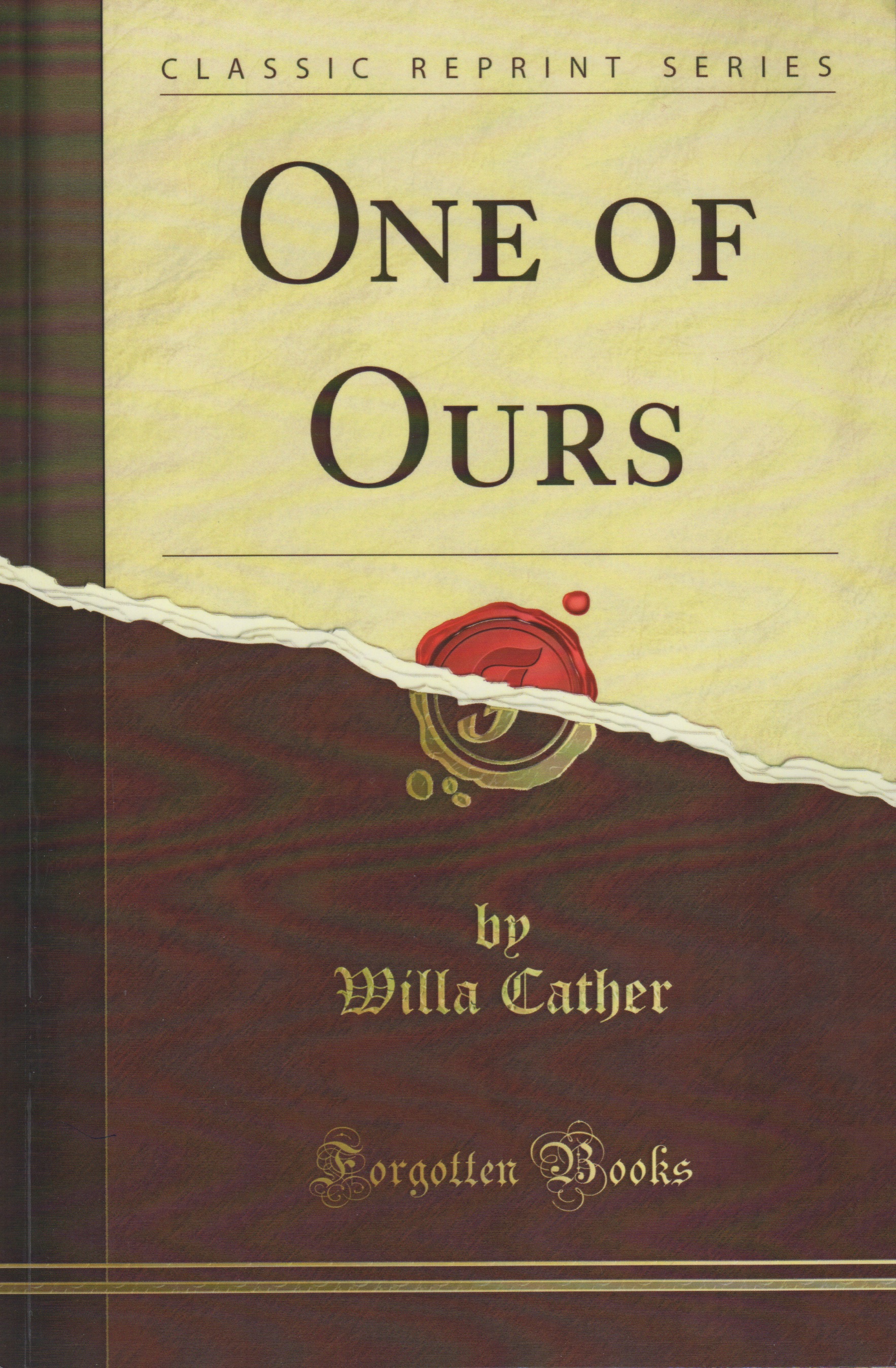
One of Ours by Willa Cather (1922. Alfred Knopf. Reprinted by Forgotten Books. ISBN 978-144003547-0)

 Most of us at one point or another in our reading careers have read Death Comes for the Archbishop, O Pioneers!, and My Antonia by acclaimed American Plains and Western novelist, Willa Cather. But few of us, I am fairly certain, outside of serious students of Cather’s work, have heard of, much less read, One of Ours, a tale that straddles two genres, that of Plains hardscrabble fiction and war novel. At first, attempting to meld those two distinct brands of invented lives might seem a bit awkward, forced, or even foolhardy. But in the end, in the hands of a master storyteller like Willa Cather, One of Ours satisfies both as to craft and plot. Set in pre-Great War Nebraska on the Wheeler place, a farm owned by Nat and Evangeline Wheeler, a large spread where the parents have raised their three boys: Bayliss, Claude, and Ralph,  One of Ours isn’t the stereotypical novel of hard luck and tragedy that we’ve come to expect from farm stories of its time.

          Though Nat Wheeler is a big, powerful man who owns much property, he is content to allow others to work his land, renting pasture and cropland to local farmers who are down on their luck. Cather’s construction of the fictional patriarch of the Wheeler clan is nuanced. One expects, at every turn of a phrase, to find some evil lurking in Nat, a man who is far more wealthy and prosperous than his favored mode of transportation, a rickety old horse drawn cart, lets on. But such revelations never occur. In addition, it’s not that the Wheeler patriarch spurns technology: he owns motor cars and uses the services of mechanized harvesters and, in one brief reference, even flies between Nebraska and Colorado to visit his youngest son Ralph, who has been installed as the head of the Wheeler ranching operations in the foothills of the Rockies. But despite his reluctant embrace of technology, in many ways Nat Wheeler is a throw back to another age, another time, when immigrant men busted sod, lived in earthen dugouts, fought nature, and tried to make a living on 160 acres of homestead land.

           Evangeline, the matriarch of the clan, comes off as loving, if a bit stereotypical. She is the devoted mother, the glue that keeps the family unit humming despite Nat’s sometimes indifferent and distant approach to child rearing. Mahailey, the Wheeler housekeeper, a Southern refugee from the Civil War living in the Wheeler home, is the tale’s comic relief. By dialect and attribute, she reminds me of Prissy, the servant in Gone with the Wind even though, somewhere in the text, we finally come to learn that Mahailey isn’t black but a poor white woman.

But by far the most interesting female character in the book is the asexual Enid, the woman that Claude ends up “settling” for when the true love of his life, Gladys, the local schoolmarm, appears destined to marry Bayliss Wheeler, the frugal, passionless eldest Wheeler boy. Whereas conventional storytelling might turn Enid’s coyness and reluctance towards physicality into eventual fondness and love for Claude, Cather avoids such scripted prose. Cather’s Enid stays true to her nature, which in large part, is driven by religious faith. Over time, Enid’s recalcitrance towards intimacy bedevils Claude to the point where he is on the cusp of enlisting in the Army to fight in the Great War. But before Claude can make such a bold and clear statement against his wife, Enid abandons the marriage to undertake a missionary journey.

         Cather then weaves, upon the twin departures of her main protagonists in the prairie tale—Claude to France and Enid to China—a fine depiction of trench warfare. The author’s descriptive powers capture the brutality, filth, danger, and respite of the latter months of the Great War, a conflict that introduced the world to poison gas, tanks, dogfights, submarines, and a host of other dastardly inventions bent on the destruction of fighting men. In many ways, the storytelling in the last third of the book, the portion devoted to Claude’s experiences in France, is reminiscent of Hemingway’s best: terse, manly, bold, and descriptive in a minimalist way. There are no excess adjectives or adverbs lurking in Cather’s prose, no embellishments or flourishes to wow the critics: Just plain, simple god-awfully good writing.

         This is a strong willed, well-told tale that melds the two genres of its theme into a cohesive story of family, love, angst, honor, and duty. My only critique of the book is that a story of this standing and caliber deserves far better formatting and editing than is provided in the current edition from Forgotten Books. The edition is replete with typos and errors in typesetting that diminish one’s ability to enjoy one of Cather’s least known, and best-written novels. Btu that having been said, it is a true joy as a writer and a reader, to explore, even in its diminished form, writing that delivers art and wonder in equal measure:


 Claude lay still, his arms under his head, looking up at the hard, polished blue sky, watching the flocks of crows go over from fields where they fed on shattered grain, to their nests in the trees along Lovely Creek. He was thinking about what Dan had said while they were hitching up. There was a great deal of truth in it, certainly. Yet, as  for him, he often felt that he would rather go out into the world and earn his bread among strangers than sweat under this half-responsibility for acres and crops that were not his own. He knew that his father was sometimes called a “land-hog” by the country people, and he himself had begun to feel that it as not right they should have so much land—farm, or to rent, or to leave idle as they chose.  It was strange that in all the centuries the world had been going, the question of property had not been better adjusted. The people who had it were slaves to it, and the people who didn’t have it were slaves to them.

I am not a huge eBook fan, preferring to consider my prose in the old fashioned way, but I have read both the Kindle version and the trade paperback version of One of Ours. Given the formatting issues addressed above, I’d recommend the eBook version of the novel as the better choice. (This Review originally appeared on the Rural Lit R.A.L.L.Y. website. Check out this great resource at: http://rurallitrally.org/.)

4 and ½ stars out of 5. This book holds up well across time.


Posted in Books | Comments Off on One of Ours: A Review

3 Reviews (Including a 2 for 1) Re: Ben Arthur

If You Look for My Heart (Novel, eBook) (2012. CreateSpace. ISBN 978-1451564754) and If You Look for My Heart (CD/MP3) (2012. sonaBlast Records.) Both by Ben Arthur.

I came across New York based musician Ben Arthur through my subscription to Poets and Writers Magazine. Arthur wrote a wonderful piece of acoustic guitar music set to Minnesota essayist Paul Gruchow’s words (see my blog about Paul and another fine Minnesota writer, “The Good Stuff” by using the search engine at the top of this page) that appeared in a recent P&W issue. I was intrigued by Arthur’s skills as a musician and also by the fact that he had apparently married his music to a novel he’d written, If You Look for My Heart.

The premise of the merger of the two art forms (prose and song) is an overt attempt to provide the consumer with an enhanced literary experience. The eBook version of the novel uses  embedded hyperlinks to the novel’s 12 songs so you get both words and music in one package. But if you buy the paperback or hardcover versions of the novel, you are required to buy the CD/MP3 through a separate purchase.

Being a failed (actually, never attempted) musician myself (like Minnesota musical icon, Leo Kottke, my voice is a bit like a goose fart in a snow storm and my piano playing died a slow and agonizing death years ago) but a somewhat successful regional novelist, I was intrigued by the idea of merging words and music, especially if technology allowed seamless navigation from story to song. So let me take on the technology first: It isn’t all that smooth. Whenever I came to a hyperlink to one of the songs connected to the story, I clicked the link and was sent to YouTube where the music was waiting. The “not so smooth” part of this equation isn’t that the links were slow or broken, but that I found jumping from the very monkish act of reading fiction straight into music a bit disconcerting and distracting. A wonderful concept but, for an old guy who grew up reading in solitude and relishing the peace that comes from such an individualized experience, the leap was simply too wide for me to negotiate.

To the novel. I disagree with the pundits on Amazon.com

(see http://www.amazon.com/If-You-Look-My-Heart/dp/1451564759/ref=sr_tc_2_1?ie=UTF8&qid=1369839671&sr=1-2-ent)

who rated the novel as “great” (5 stars) or “terrible” (2 stars). The writing isn’t bad and the action carried me along. But there wasn’t a character in the book who grabbed me by the heartstrings or slapped my in the face to make me take notice of his or her lot in life. Despite the emotionally charged issues tackled by  the tale (betrayal, adultery, longing, isolation), I felt like I was reading a script for Sex and the City or some other self-absorbed New York story even though the setting isn’t the Big Apple. Despite this mild criticism,  I don’t agree with the two-star Amazon.com review faulting  the book’s editing. Heck, as a self-published author, I’ll cut anyone trying this gig some slack! The minor errors in the text don’t distract a bit from the tale, such as it is.

All the same, there are many other novels out there more deserving of your reading time than this concise, predictable, fairly flat effort. But I give Arthur an “A” for ingenuity in his attempt to create a new art form. That takes guts.

3 1/2 stars out of 5 for the novel.

The music? Well, that’s a much different story (pun indeed intended!) Arthur is, so far as this non-musician can tell, the real deal. He is courageous in his eclectic use of genres on the novel’s soundtrack  including orchestral (“Prelude”), contemporary folk/pop (“If You Look for My Heart”), country/bluegrass/Americana (“Where I Belong”), and rap (“Love Your Enemy”) in the mix. There’s really not much to criticize on this fine album, one that stands on a higher plain of artistry than the companion novel.

41/2 stars out of 5 for the album.

Edible Darling by Ben Arthur (2004. Bardic Records)

Having read and listened to If You Look for My Heart and experienced the quality of Arthur’s musicianship, I ordered a second CD, an older effort, Edible Darling.

With a bit more electric “pop” than the soundtrack to the novel, this collection really rocks. There are tunes that remind me of Jude Cole (“Mary Ann”), the Wallflowers (“Tonight”), and Snow Patrol (“Broken Hearted Smile”). Arthur also displays a great sense of humor in the lyrical twists embedded in “Edible Darling” and “Keep Me Around”. There’s also a nice acoustic guitar number (“Instrumental #3) and a fine, fine ending tune, “Jesus”.

Add to this great harmonies, great musicians, and solid songwriting and this CD will make you wanna dance. It’s one of my favorites of 2013. My teenage son is trying to get me to stop playing Edible Darling in the Pacifica because it’s been playing non-stop for a month. In response, I just turn up the volume on “Mary Ann” and smile at my kid.

Hear’s (again, pun intended) what I mean: http://www.youtube.com/watch?v=K7gOEx-RhKI

5 stars out of 5.


Posted in Books | Comments Off on 3 Reviews (Including a 2 for 1) Re: Ben Arthur