
An American Family

Some day, it won’t be such a big deal. All of America will have experienced what my family and I experienced at Peace Church in Duluth, Minnesota on Saturday. In the very near future, the official union of two men or two women in marriage will no longer shock, amaze, or surprise the vast majority of us. But right now, it is something new, something different, something revolutionary. Maybe it shouldn’t be. But it is. At least to me.

My own evolution on the issue of same-sex marriage has been a long and winding internal dialogue between myself and God. Yes, I talked it over with God. Not that I ever believed same-sex relationships were sinful or evil or doomed or destined to bring down the American family as we know it. Hell, with over 50% of heterosexual marriages already ending in divorce, the tragedy of which I witness from behind my judicial bench, it wasn’t my thinking that there’s something unGodly about such unions. Ten years ago, in a conversation with a gay woman acquaintance who served on a board of directors with me, I was happy to show my progressive political bent by telling her I was “all for” civil unions between same-sex partners. But, I was quick to point out, I just couldn’t abide calling such arrangements “marriage”. She, of course, wasn’t impressed by my paternalistic view, a view that limited her expression of commitment and love to something legal but something less than marriage. I didn’t see her point then, a decade ago, but as time went by and I watched and listened to the debate fermenting around the country regarding the issue, I began to understand her position and the position of her gay brothers and sisters. Calling solid, loving, caring, and dedicated long-term relationships that American gay couples were engaged in anything less than marriage robs those citizens of not only the benefits that society and the law bestows upon married couples, it robs them of their dignity. Understand: I’m not exactly comfortable equating the gay marriage movement with the civil rights movement of the 1950s and ’60s as, so far as I know, there have been only isolated incidents of violence and hatred towards gay Americans. Unlike Black Americans, who experienced draconian institutional measures to ensure their subservience over centuries of American history, gay Americans experienced discrimination on a more personal and less systemic basis. The exception to my observation, it seems to me, is in the area of marriage: Just as ill-advised statutes precluded the intermarriage of the races, so too did statutes prevent two men or two women in a committed relationship from becoming a family recognized by law. In the end, like many straight Americans, the debate of the last decade changed my thinking on gay marriage.

Then too, like most of America, I’ve also experienced the “coming out” of a family member. Or, in my case, several family members and a close friend of one of my sons. Putting a face or faces on the gay marriage debate, making it personal, had an impact on me beyond political discussions on CNN and MSNBC. By the time I sat at Peace Church on Saturday afternoon and the beginning stanzas of one of my favorite songs, “The Rose” began to echo across the church sanctuary, my eyes weren’t just clouding over. I was gushing. My youngest son was embarrassed by my display of emotion. I wasn’t. I think I finally understood, as the music swelled and the words to the song carried high into the sacred air, the beauty of what was happening. As the couple joined each other at the altar and the families of the young women looked on, I remembered the two commandments Jesus said changed everything for everyone: Love God and love your neighbor. It’s that simple.

I’m not so ignorant or naive as to think the struggle for gay Americans is over. But on one Saturday afternoon in Duluth, Minnesota, I came to appreciate the appropriateness of the letters “WWJD”, letters that many young people wear on wristbands as they go about their daily lives, gay or straight. “What would Jesus do?” He’d applaud two people committing themselves to each other in love.

Megan and Melissa Landon with  AJ Munger (Photo by Matt Munger)


Peace.

Mark


Posted in Blog Archive | Comments Off on An American Family

Painting with Dylan

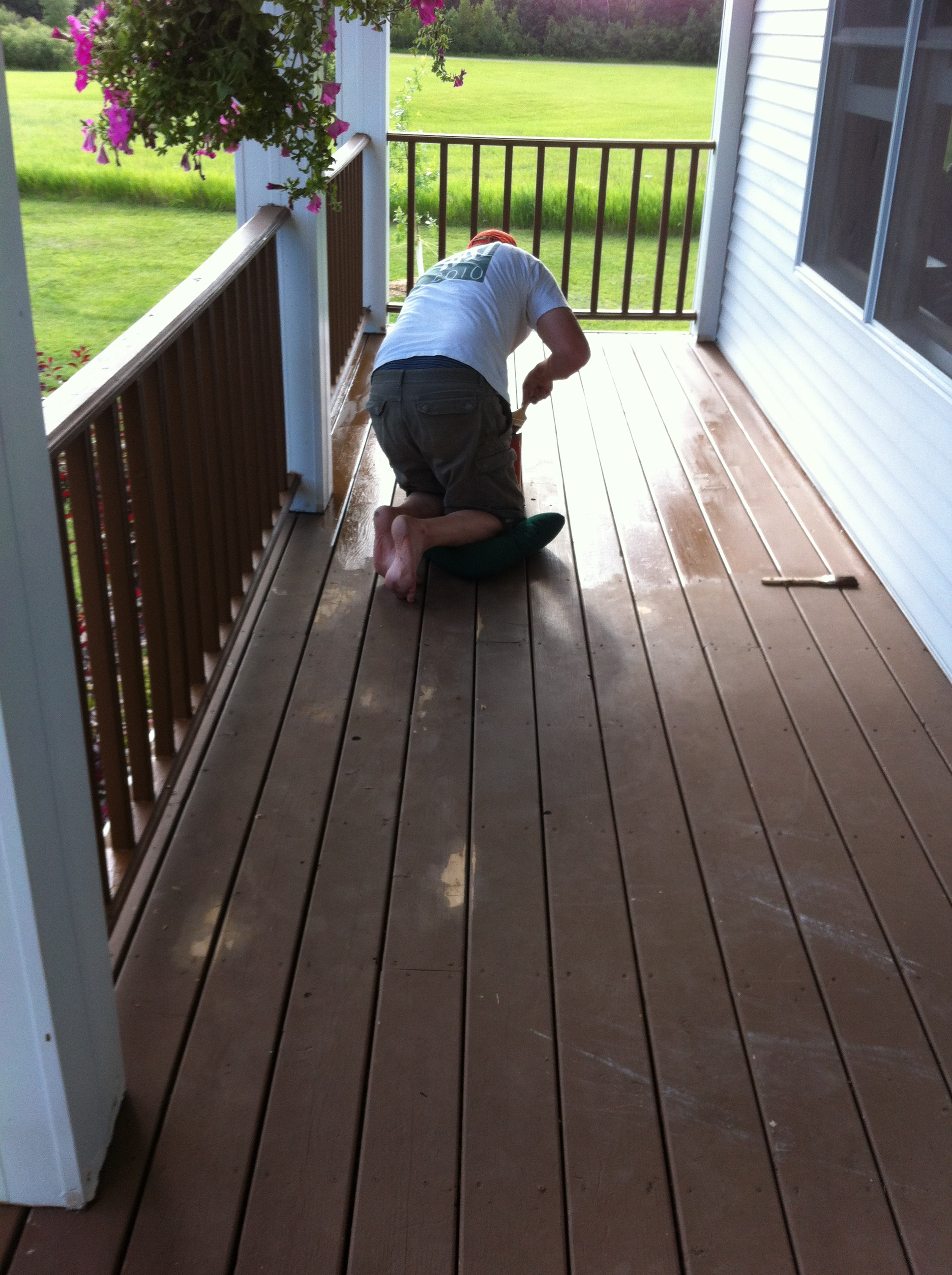
The author painting the front porch while listening to Dylan Thomas


As you can tell from the caption to the above photo, I’m not talking about my son Dylan Mark Munger or Duluth’s most famous native son, Robert Zimmerman. The title for this blog comes from my need, even when working on the “honey do” list while on vacation, to absorb the words of poets and writers who’ve gone before me and established themselves in the world. As you might have surmised from the past two weeks of book reviews on this site, I’ve been reading like a fiend during my time off. Yesterday, I finished River in the Wind a fine historical novel of Florida during the Seminole Indian Wars written by Edith Pope. My review of that novel will follow shortly. But the point is that throughout my two-week furlough from the litigation trenches, I’ve been hard at it, learning my craft as a writer by blogging, reading great and near-great books, and finally, listening to the voice of my favorite poet, Dylan Thomas.

Narrated by former American Poet Laureate, Billy Collins (who has recently been filling in for Garrison Keillor on “A Writer’s Almanac”) the Caedmon Collection I was listening to features 12 and 1/2 hours of Thomas reciting poetry, discussing writing, narrating some of the poet’s better-known short stories, and finally, participating in a live production of his stage play, “Under the Milkwood Tree”. One of my favorite tracks reveals the poet and others dissecting “In Country Heaven”, an unfinished epic poem that Dylan was working on when he died in November of 1953. The privilege of listening in while Dylan explains how he made word choices can’t be understated. But enough about Thomas. On to my part in the events of a few days’ past.

More painting to Thomas.


Clever of you. You caught the change in preposition from “with” to “to”. I’m not sure which is more appropriate. I mean, the drunken spirit of the Welshman was certainly “with” me as I crawled along on a cushion trying to keep paint from straying, But then again, he wasn’t there physically to assist me. He was, at best, an inactive partner in my enterprise; I was simply listening “to” his words as I crept across the cedar planks of our front porch. In any event, the first day I painted it was as hot as blazes and I caught a nice tan. There was enough breeze to keep the bugs off as I kept at it, diligent in my efforts, sweat pouring from my brow, from late morning into evening. Rene’ made me a nice lunch; a couple of tuna fish sandwiches, some cold grapes, chips, and a Hersey’s bar. Damn, that chocolate tasted good! After a brief respite in the shade, where my wife and I sat and talked over things that married couples talk over, it was back to a task that, every two years, is necessitated by the brutality of winter on flat, painted surfaces in northeastern Minnesota.

I should digress here a bit. Before I ever got to the painting part of the project, I had this exchange with my dear wife when she came home with two buckets of paint and new brushes.

“There’s a problem with the had rail on the left side of the steps.”

“How so?” I asked.

“The wood is rotting. It needs to be replaced.”

I glanced up from my cereal bowl and frowned. I wasn’t looking forward to painting for two days of my vacation, much less attempting carpentry beyond my ken.

“That’s the railing that collapsed last winter after the big storm,” I said confidently. “I put it back together. Put in some extra screws for good measure. It should hold up just fine.”

My wife’s face displayed the skepticism of a woman who’s listened to a husband’s excuses for the better part of four decades.

“It’s not very stable. I think it needs to be replaced.”

Of course, she was right. And despite family lore that declares I am incapable of admitting when I am mistaken, I told her so later that morning. Then I did my duty. I replaced the decaying railing (I’d saved a piece of cedar rail for just such a project) and re-anchored the other handrail just to be thorough.

The morning of the second day, Dylan and I were to tackle painting the back porch, a much less arduous task. The front porch is big but it’s not the porch’s flat surfaces that form the brunt of the work; it’s all the spars and the railings that take time. There are four sides to every post needing paint, along with a top and bottom rail. And it’s a job that requires being on a ladder in shrubbery to complete the outside surfaces. I didn’t count the number of spars I painted, but as I plugged along, it seemed as I finished one spar, another manifested. Despite my hallucinations, I finished the front porch before dark that first day. By 9:00am on the second day of my ordeal, I was back at it, stroking brown paint on the cedar spars of the back porch. And it wasn’t long before I had unwelcome company.

Why are there so many hornets buzzing my head?

If you’ve lived the country you’re bound to appreciate this feeling, more of a premonition than a realization.

Shit, there must be a nest under the back porch.

There’s a crawl space under the rear porch of our home. The day before, my wife had been under the porch putting away the hose and had banged her noggin on a wooden beam but hadn’t riled up the enemy. My mere presence, on the other hand, was taken by the guardians of the hive as a direct threat.

“There’s a hornet’s nest under the back porch,” I called out to Rene’ as she made coffee in the kitchen.

“Oh my,” she replied, “I was just under there and banged my head. I’m lucky they didn’t come after me.”

Armed with a can of Raid and the hose, I found the hive: a swirling intersection of nastiness the size of a volleyball tucked into a corner directly under where I’d been painting. I blasted the nest with insecticide and pummeled the pulpy mess with water. The insects’ home distintegrated. Angry yellow jackets threatened as I stepped back and let them have it with the Raid. The threat eliminated, I went back to painting. The rest of the job was completed without incident.

That evening, the furniture and log rack restored to the front porch, the back platform cordoned off to keep the new puppy and our three old dogs away, Jack and I settled into chairs on the south bank of the Cloquet River to fish.

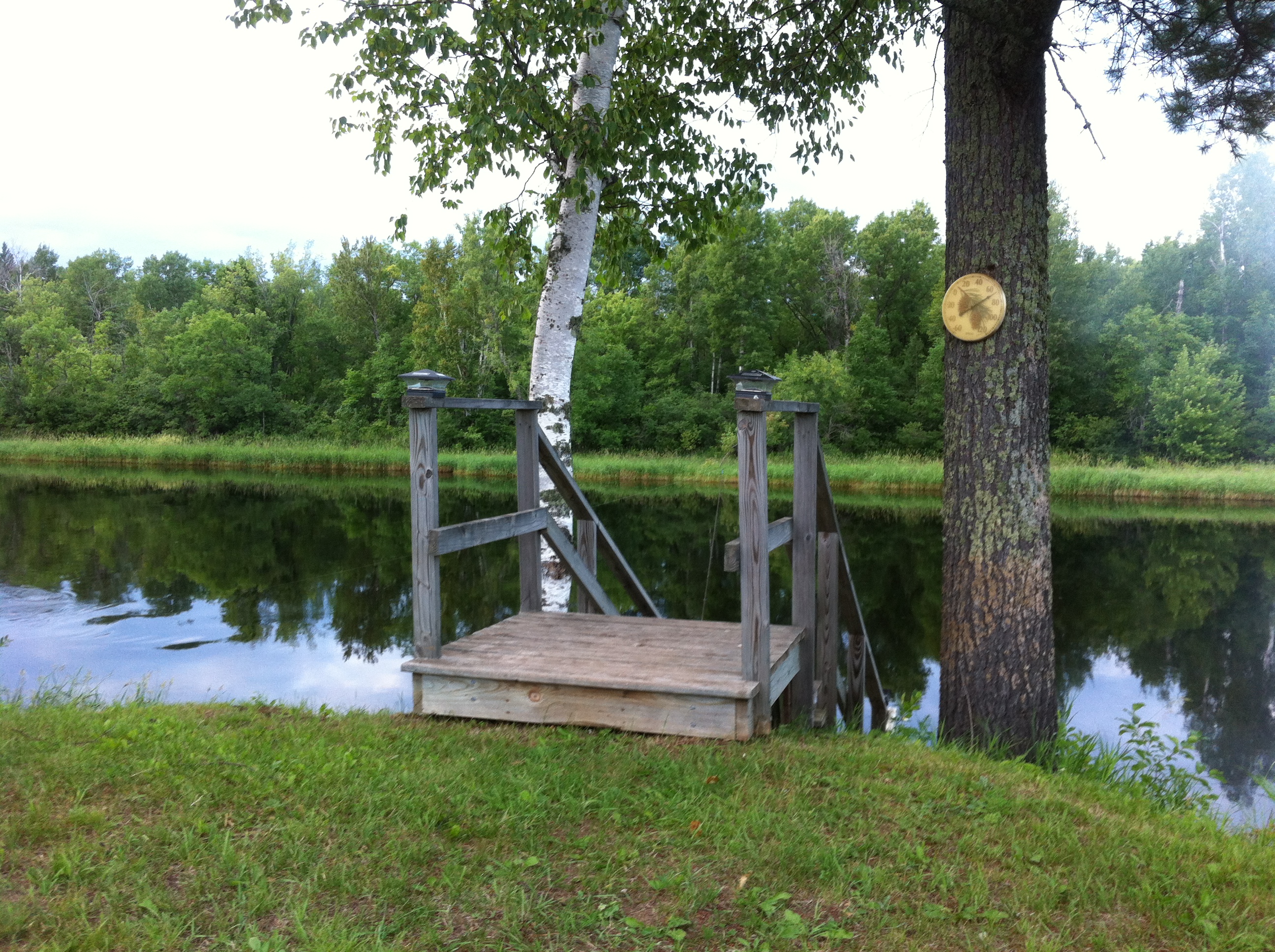
The Cloquet at dusk.

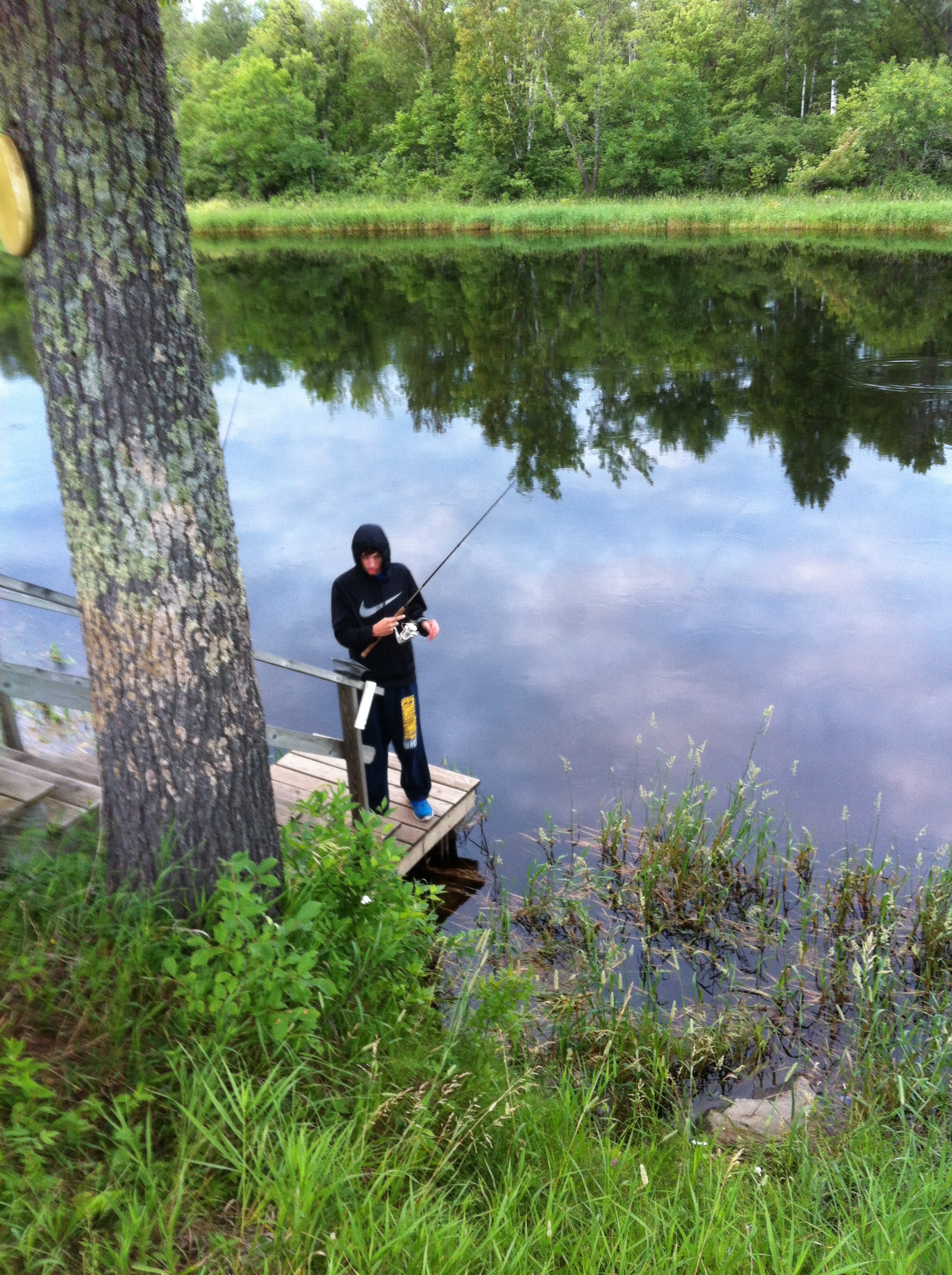
Jack rigs up his rod.


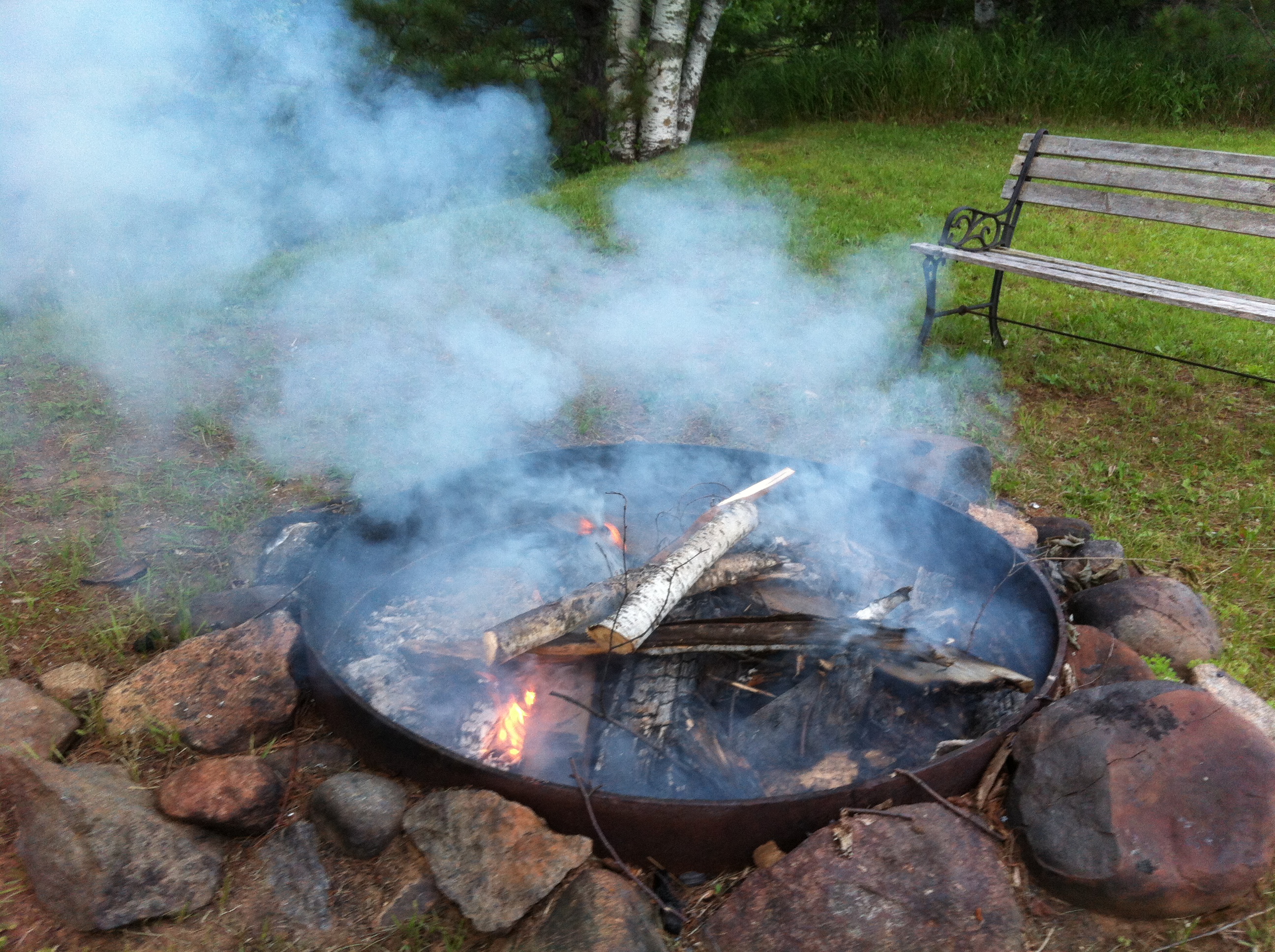
The campfire.


The writer toasting Dylan Thomas with a cold one.

Cool air kept the mosquitoes at bay. Kena, our new black Labrador pup, cavorted in tall grass. Jimi, the wiener dog, slept on a lounge chair. Over the next few hours, Jack and I pulled in two channel catfish  (Jack’s was the biggest at 3 and 1/2 pounds) and four red horse suckers. The fish went back to the black water to live another day. Rene’ joined us in her jammies.

“The porches look really nice,” my wife said as fireflies emerged and blinked over our field.

“Thanks. You were right about that railing,” I reiterated.

There was nothing really more to say.

Peace.

Mark

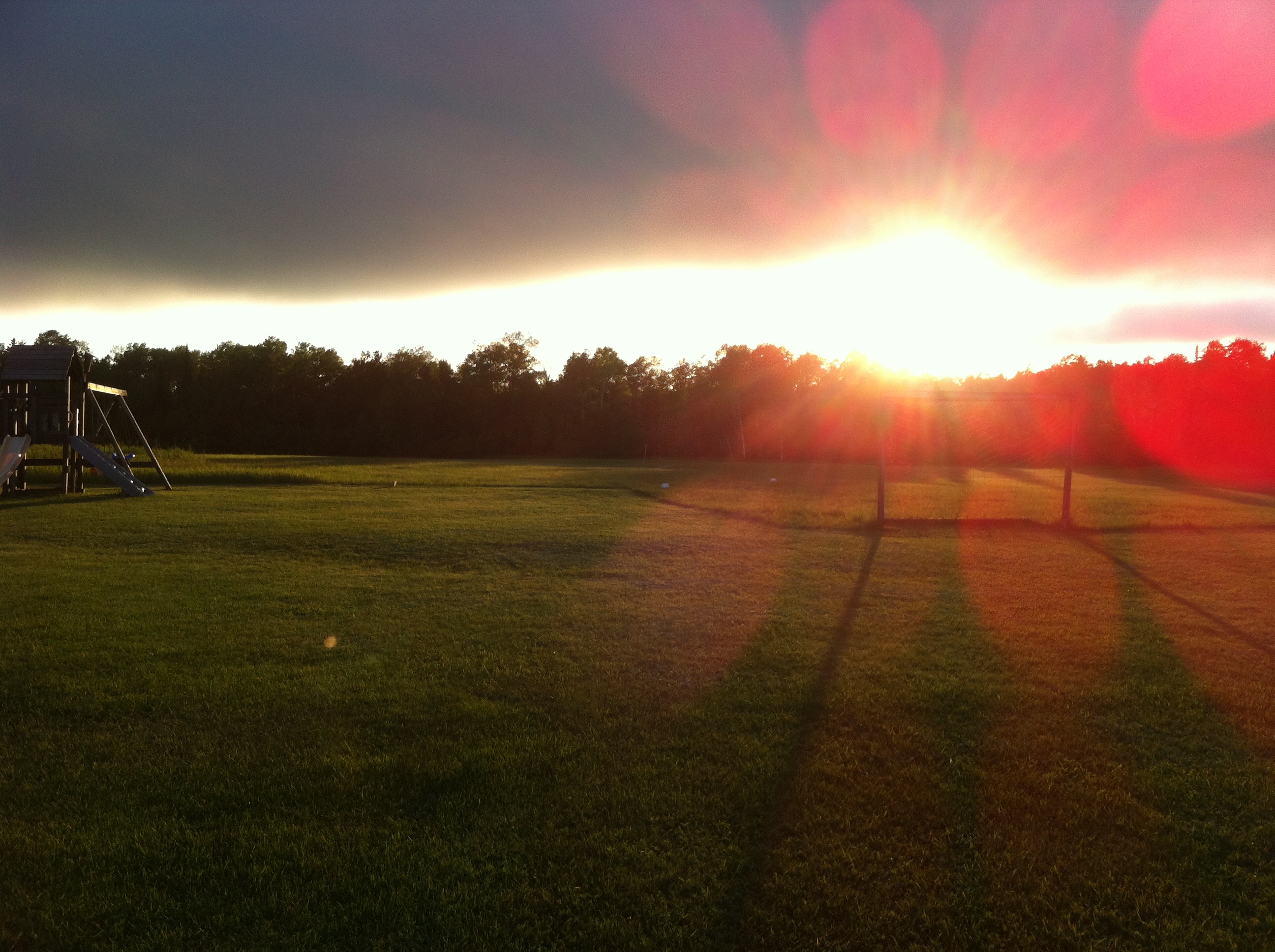
Sunset over the field.

Dylan Thomas: The Caedmon Collection is available on CD. ISBN 0-06-079083-0. You can order it through our local independent bookstore, Fitger’s at: http://www.fitgersbookstore.com/. You can also learn more about Dylan Thomas at: http://www.dylanthomas.com/. And if you ever find yourself in Ireland on vacation, don’t miss The Falls Hotel, which was once owned by Caitlin Thomas’s father (Caitlin was Dylan’s wife), Francis MacNamara, Jr.. The setting is exquisite and the food, quite good. Find out more at:  http://www.fallshotel.ie/.


Posted in Blog Archive | Comments Off on Painting with Dylan

O’Reilly Pulls No Punches

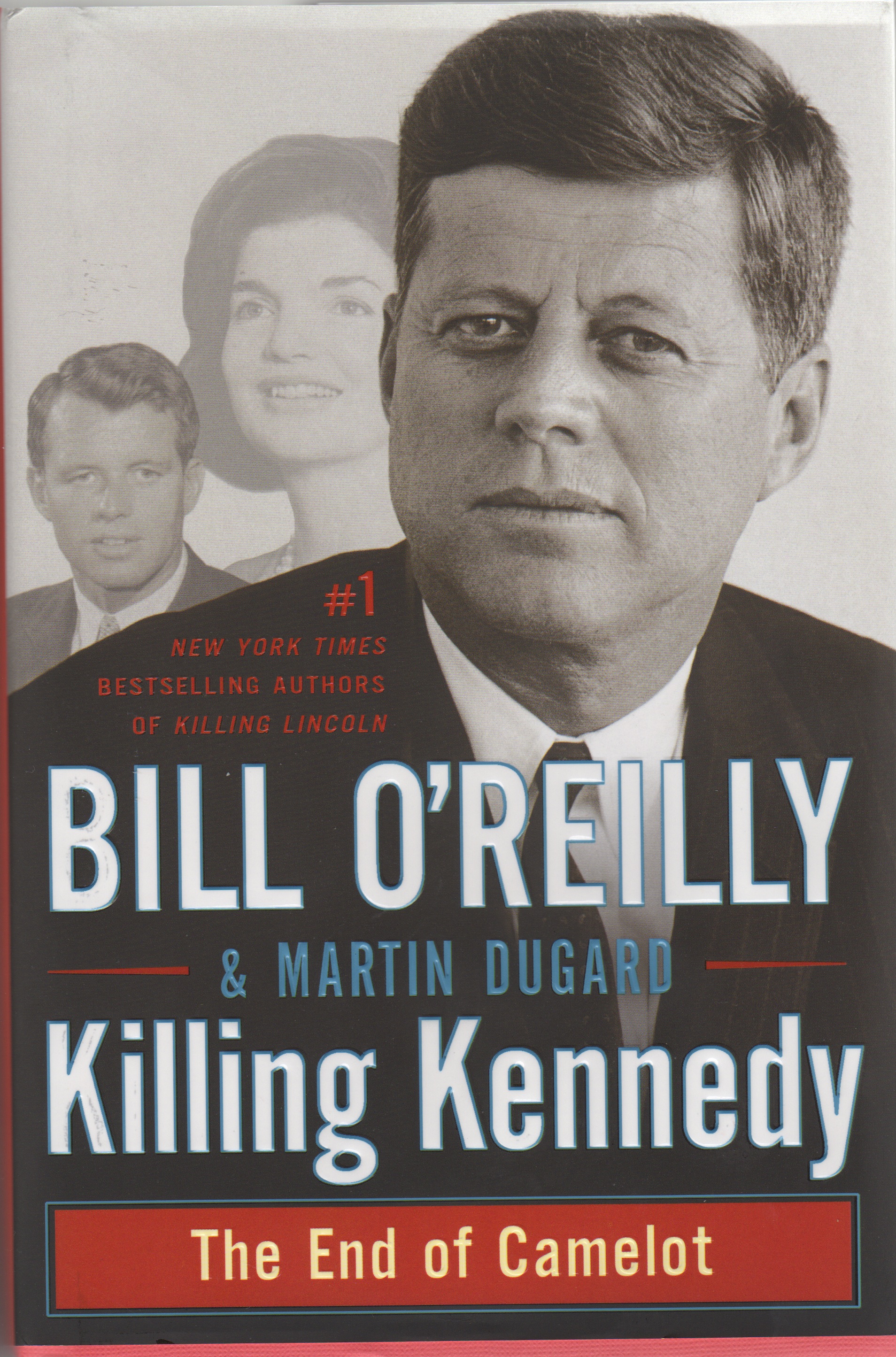
Killing Kennedy: The End of Camelot by Bill O’Reilly and Martin Dugard (2012. Henry Holt. ISBN 978-0-8050-9666-8)

This isn’t a great work of literature or a book that will make the critics proclaim that Bill O’Reilly is a great author. That having been said, this rendition of JFK’s life and his ill-fated appointment with Lee Harvey Oswald is portrayed completely and without the sort of ideological rancor that makes O’Reilly such a celebrity on the airwaves. The book’s use of past and present tense and the juxtapositioning of snippets from Oswald’s life with scenes from his target’s better known history all add to the feeling of impending dread that permeates this sad, sad, tale. To be sure, O’Reilly pulls no punches when it comes to his portrayal of Kennedy as a philandering womanizer. But he is careful to add that, after the Cuban Missile Crisis, wherein Jackie insisted upon being in Washington D.C. with her husband and their children if the world was going to end, Kennedy’s dalliances with actresses and employees waned, if not completely disappeared. The portrayal of Kennedy’s changed persona, as rendered by the able hand of the author, includes tender scenes of domesticity that make Jack Kennedy come alive. Memorably, the scene involving the death of infant son Patrick, the last of the couple’s offspring, captures the type of love Kennedy displayed in private for his wife and children:

Patrick Bouvier Kennedy died just two hours later. “He was such a beautiful baby,” the president laments…”He put up quite a fight.”

Kennedy is holding young Patrick’s hand as the child breathes his last. As the president absorbs the terrible moment, he is well aware that his grief is not private. The nurses, doctors, and his own staff watch to see how he handles this awful moment. Slowly, JFK leaves the room and wanders the hospital hallway, keeping his pain to himself.

The assassination sequence is, in a word, riveting. The plot and planning unfold slowly, painfully so, for of course, we know the ending to this story. But it is O’Reilly’s careful, if truncated, examination of Oswald’s troubled psyche and his opaquely inadequate motivation for selecting the president as a target (according to the author, Oswald had no beef with JFK’s politics but simply wanted to be part of a newsworthy event, something that would prove to his estranged Soviet wife that he too was a “great man”) that gives credibility to the author’s views and his rendition of history. The narrative is clear, unencumbered by needless adjectives and adverbs. Just simple, straight forward reportage graces the pages of this book. You’ll learn much about the man who became president and the villain who chose to kill him without a lot of fanfare or political pontificating, the lack of which makes Killing Kennedy a quick and excellent summer read.

4 stars out of 5.

Posted in Books | Comments Off on O’Reilly Pulls No Punches

A Refreshing Native Voice

Blasphemy by Sherman Alexie (2012. Grove Press. ISBN 978-0-8021-2039-7)

Ethnicity plays a role in most of my writing. From my first novel, The Legacy, which dealt with my maternal grandfather’s Slovenian roots in a historical context, to Esther’s Race, where I attempted to inhabit the skin of a twenty-something African American woman damaged by life, to my latest published work, Laman’s River, where I tackle the little known Mormon tenet of “the whitening of Native Americans” through intermarriage, I am always, it seems, subconsciously or deliberately writing about race, religion, and the differences between tribes of humanity. One of my favorite local authors, Linda Legarde Grover of Duluth, published a short story collection based upon her Native heritage entitled Dance Boots. Linda’s writing (you’ll find a review of the book in the archives section of this blog) has a mystical, lyrical quality to it, not unlike the voices one hears at indigenous drumming and dancing ceremonies. Well, after reading Sherman Alexie’s collection of short stories dedicated to and inspired by his own life as a Northwestern United States Indian (he uses the term throughout the collection as a term of self-description), I have to say: Alexi can flat out tell a story. Plain and simple. His style doesn’t avoid the mysticism and lyricism found in Grover’s prose but damps it down a bit and takes a different, albeit equal path, to perfection.

What do I mean? Let’s allow the author himself to show rather than having me tell. Here’s a passage from my favorite short story in Blasphemy, “The Search Engine”. By way of background, the female third person protagonist in the story is a university student enthralled with a little known Native poet. She finds a collection of his work in the college library, discovers she is the first person to check the book out since it was published in 1972, and begins a quest to find the author. The poet, a Native like the narrator, is a recluse, on the order of J.D. Salinger, though not nearly as famous. When the wide-eyed student and the old Indian finally meet up, he explains why he no longer writes:

He laughed. Corliss wondered how he could laugh. But she laughed with him and didn’t know why. What was so funny about the world? Everything! Corliss and Harlan laughed until the hearing-impaired  bookstore owner felt the floor shake.

“So what are the lessons we can learn from this story?” Corliss asked.

“Never autograph books for drunk Indians,” he said.

“Never have sex with women named after celestial bodies.”

“Never self-publish your poetry.”

“Never perform at open-mike nights.”

“Never pretend to be an Indian when you’re not,” he said.

He took off his glasses and wiped tears from his eyes. Two Indians crying in the back of a used-book store. Indians are always crying, Corliss thought, but at least two Indians crying in an original venue…

“I never wrote another poem after that night,” Harlan said.”It seemed indecent.”

Alexie’s voice is heard throughout this lengthy collection, both in the first and third person, in male and female guises, beginning with youth and into old age. He tackles all the elements of  contemporary Native experience with a deft touch, using humor, surprise, and introspection in equal doses. Some stories are lengthy, nearly novella like in scope. Others hardly fill a page, existing as mere snippets of postage stamp prose. But through all of the various voices and plots and characters, you will find nary a lapse in quality, nary a lapse in consistently magnificent writing. A National Book Award winner, this volume, like Grover’s Dance Boots (itself, a Flannery O’Connor Award Winner for Short Fiction), compels readers to consider a country within a country populated by tribes of indigenous people seldom discussed but always present.

5 stars out of 5. A book readers will devour and savor like wood-roasted venison.

Posted in Books | Comments Off on A Refreshing Native Voice

Eddie and Mark’s Excellent Adventure

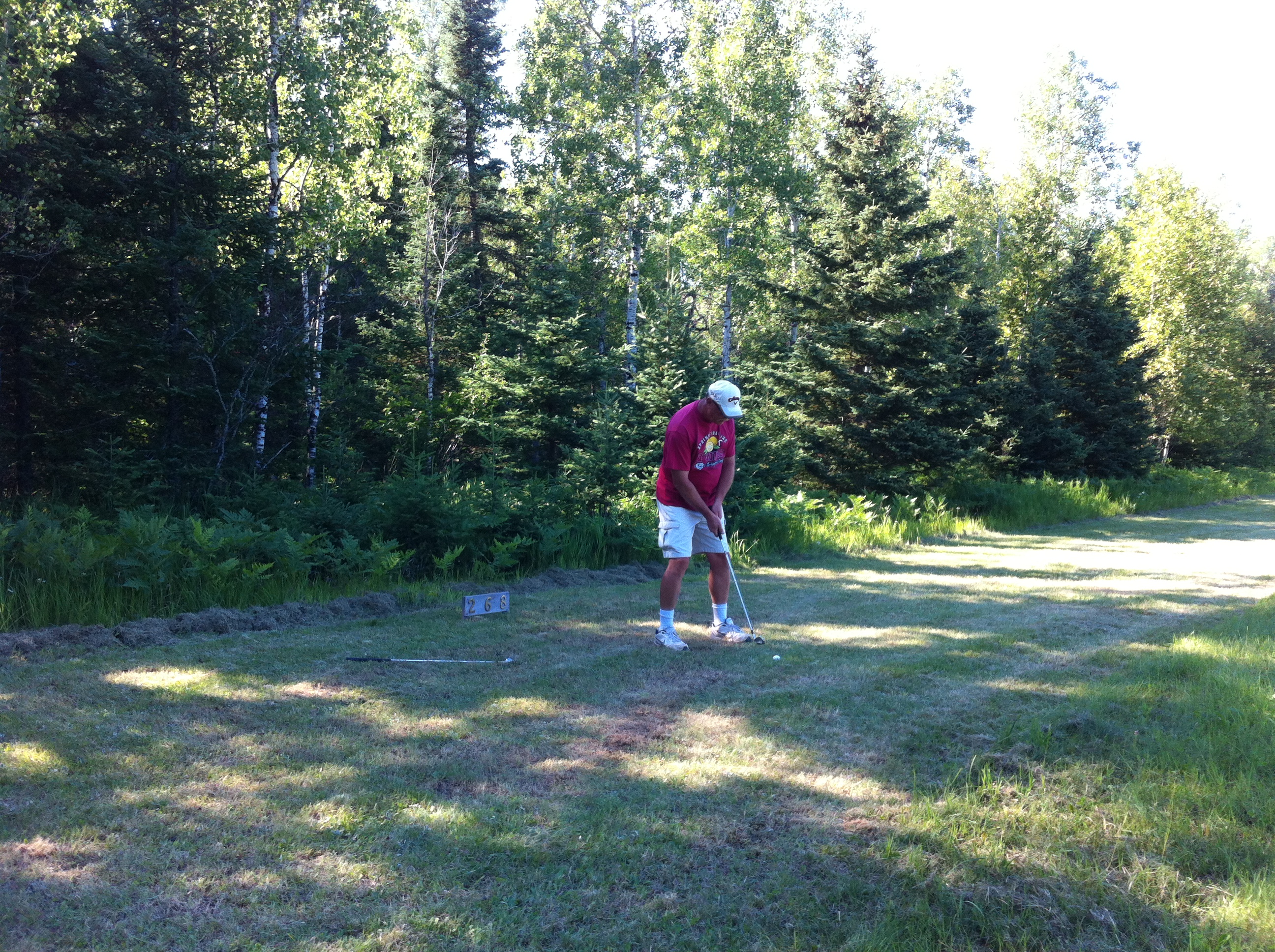
Eddie tees off a Hole #1, Catfish Acres Golf Club

My friend Dave Salveson, affectionately known to me and a few other old friends, as “Eddie” (in honor of his deceased father, Edwin, though we called Dave “Eddie” long before the real Ed went to be with his Norse ancestors), is the person I have known longer than anyone else on this planet except my mom and dad. Eddie and I have been running mates, best friends (if such  label can be accurately applied) since 1958, the year we met as neighbors in Piedmont Heights, a suburban tract that sits at the top of Piedmont Avenue in Duluth, Minnesota. My life (and Eddie’s part in that strange ride) will someday be chronicled in a memoir. For now, dear readers, be satisfied that, with all we’ve been through, Eddie’s as close as a brother. We’d do anything for each other. Including bouncing along side by side on dueling riding mowers. Which is exactly what we did this past Saturday.

Eddie’s a passionate and vastly superior golfer to my infrequent forays onto the links. Hell, he’s retired, has been retired from the Duluth Fire Department for nearly a decade. He golfs 4-5 times a week with a bunch of  other retired guys, hits the ball a ton and has a pretty good short game as well. An impatient man prone to expletives and wild club swinging when things aren’t going his way, Eddie’s even got that less flattering character trait under control. I know this because the day of our 40th year high school reunion I golfed with Eddie and fellow classmates Dave Michelson and Bruce Musolf. Michelson remains a close friend, someone I frequently hang out with. Bruce? I only see him at reunions but he’s another Piedmont boy, someone I’ve known, albeit not as closely as Eddie, for nearly my entire life. Anyway, I witnessed Eddie’s newly developed powers of self-control when, on the 17th hole at Nemadji during the reunion outing, he put not one but two shots into the water on a short par 3 after shooting a round in the mid-70s. Had he even bogeyed the 17th, he would have come in at an even 80. A pretty fair score for 18 for a guy whose handicap used to be higher than mine. On the 17th, instead of tossing the offending nine iron into the drink (which is what I had come to expect in rounds past when my friend’s temper got the better of him) Eddie simply cursed, waved the club over his head, and took the six he’d earned. Age brings wisdom, they say. In Eddie’s case, it’s also brought imperfect patience.

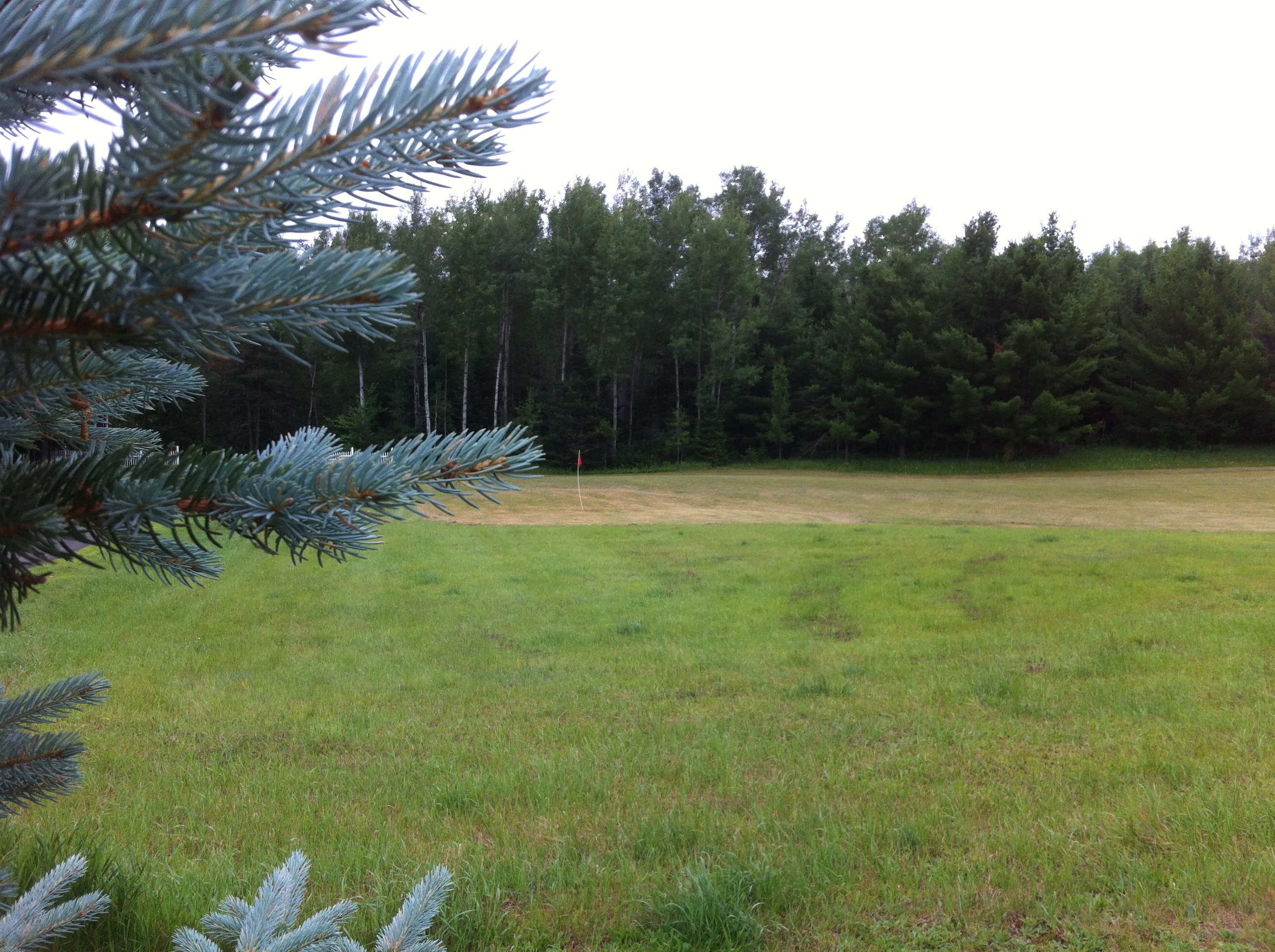
The point of the above digression is to explain that, as a result of the reunion golf outing, I asked Eddie to lend a hand mowing fairways and greens into the field surrounding our home. Every four or five years my wife Rene’ and I turn our freshly hayed field into “Catfish Acres Golf Club” complete with 9 holes (don’t ask how they’re configured; the geometry looks like Joan Rivers’s face!), tee boxes, and benches upon which to sit and to consider the world while awaiting to tee off. Then we invite friends and family up to hit little white balls into the woods (it’s a very tight course), share some laughs and a few beers or wine coolers, and picnic. Last time out, we even managed a bonfire down by the river with singer/songwriter (and sometimes St. Louis County Attorney) Mark Rubin serenading us with his guitar and voice. But the thing is, with my little John Deere rider, mowing the fairways and pseudo-greens (you can’t putt on the stubble we cut; you have to take out a five iron and mash the ball towards the hole), takes a good eight hours. So I thought:

Dave’s got a rider. He’s retired. All he does is do chores around the house and golf. Why not ask him to lend a hand?

I asked. He said “yes”.

Saturday morning. I was up bright and early, hitched a utility trailer to my Pacifica, got my fifteen year old son Jack and his buddy Nathan out of bed and into the car, and headed towards town. After dropping Jack and Nate at my eldest son Matt’s home (they were recruited for the day as porch painters) I made my way back up the hill to Dave and Sue’s where Eddie was waiting with his own John Deere riding lawn mower. To be accurate, Eddie owns a “real” John Deere. Mine is a cheaper model, a “Sabre made for John Deere” whatever the hell that means. We loaded Eddie’s tractor without incident, stopped at Menard’s for some red shop cloths (they make great flags when attached to 3/4″ PCV by screws), and headed home.

It was a nice day to mow. Warm, in the mid-70s, sunny, with a steady breeze to keep away the hordes of mosquitoes that’ve been plaguing our place. I pulled out my “Catfish Acres” file with the detailed (not so much) hand-drawn map of the course’s layout (why change a sure thing?) and we fired up our tractors. In four hours, we had the grass cut, the holes in place (we use buckets to give the golfers a bigger target), and four of the six flags planted. (I know I said it’s a nine hole course. We use holes more than once, with different tee boxes. Use your imagination, people!) Our wives were in town at a wedding shower and destined to  return for a picnic of steak and ribs. But you know what? We were so efficient, and Eddie’s “real” John Deere was so damn fast, that we finished early in time for me to drive Eddie back to town to take a shower and wait for Sue to come home. Back in Duluth  we unloaded Eddie’s rider (again without incident or injury). I stopped by Menard’s for more PVC. We were short two flag staffs and before Eddie and I could play, the flags needed to be in place and fluttering over all the holes.

Catfish Acres fairway, Holes 1 and 7


Eddie hitting from Tee# 2, 6, and 8

Rene’ made it home just about the time Dave and Sue rolled in. While the girls made dinner, Eddie and I pulled out our clubs, swatted newly aroused mosquitoes, and played the first 9-hole round on Catfish Acres for 2013. I lost five balls to the trees. Eddie lost one. But I had three magnificent chip-ins to offset my off-target tee shots. Neither of us lost our tempers and, as we wandered back to the house for dinner, without saying a word, two old friends agreed that our labors were successful, that Catfish Acres was ready for tournament play.

Game on. Here’s hoping you hit ’em straight!

Peace.

Mark
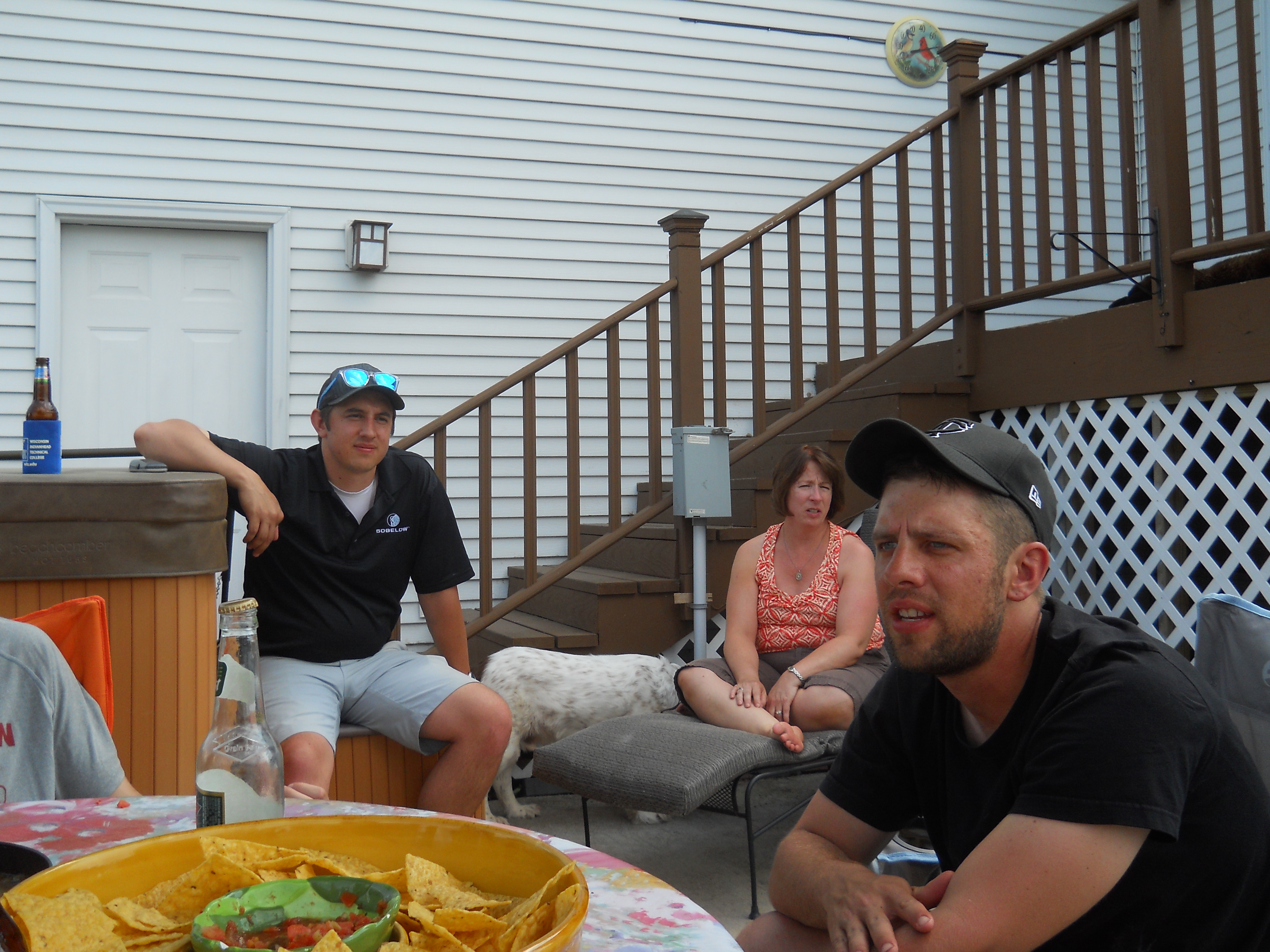
6th Hole, Catfish Acres

Posted in Blog Archive | Comments Off on Eddie and Mark’s Excellent Adventure

An Icon’s Story

Thomas Jefferson:The Art of Power by Jon Meacham (2012. Random House. ISBN 978-1-4000-6766-4)

Previously, I read (but didn’t review) Meacham’s book about Jefferson’s Republican idealogical successor, Andrew Jackson, American Lion, a book that had a limited scope in that the biography chronicled only Jackson’s time in the White House and gave scant background to the man’s roots, history, and ultimate end. I haven’t reviewed American Lion but if I had, despite the fact that it was well researched and written, I wouldn’t have rated it higher than 3 and 1/2 stars simply because of its abbreviated subject matter. Here, I am happy to say Meacham gives us the entirety of our nation’s third president. This is a complete, concise, and nicely crafted biography of one of America’s most beloved and misunderstood founding fathers. There is nothing left out, nothing missing from the life of Thomas Jefferson in this fine effort.

Meacham, a frequent guest on “Morning Joe” on MSNBC is a brilliant commentator on contemporary politics because he understands the undergirding of our two major political parties. In this volume, we learn of Jefferson’s love of republican democracy; the right of all landed, white males to determine their fate, and the fate of their newly formed nation, without interference from a monarch or a plutocracy of the rich. A rich man himself (at least until the end of his life when Jefferson died deeply in debt), Jefferson believed in the inherent wisdom of the common man (described, as above, as landed white men, a fairly exclusive definition of folks Jefferson trusted with the power of the ballot box) and one of his lasting legacies, beyond the Declaration of Independence,  the Louisiana Purchase, and the Lewis and Clark expedition was the formation of the University of Virginia; a place where the common man would be able to enlighten himself and improve his understanding of nature, mathematics, science, the English language, and a host of other subjects dear to Jefferson’s heart.

Meacham paints a portrait of Thomas Jefferson that doesn’t shy away from the controversies that afflicted the man. Included in this narrative is a detailed account of Jefferson’s apparent cowardice during the Revolutionary War when, as the Governor of Virginia, Jefferson left Williamsburg (the colonial capital of Virginia at the time) as Tarelton and other British military commanders overran the colony. Jefferson was criticized throughout his life for leaving Williamsburg. Meacham examines the historical record regarding this incident, never passing judgment on either side of the question, allowing readers to form their own opinions on the issue. Similarly, the oft-told story of Sally Hemings, Jefferson’s mixed-race slave and alleged concubine is related in the same even-handed fashion. Meacham places Jefferson’s early opposition to slavery in the context of a southern slave owner. Despite this contradiction, the author points out that Jefferson apparently tried (on a number of occasions) to abolish the practice of slavery with the caveat that freed slaves would be sent back to Africa. Jefferson’s reform efforts failed and he gave up the notion, never releasing his own slaves from bondage during his lifetime with the exception of Sally Hemings’s offspring. Each of Sally’s children were emancipated, per his promise to Sally, on their 18th birthday. This demonstration of mercy, along with historical records, and modern DNA evidence leads Meacham to conclude that Thomas Jefferson was the likely father of all of Sally Hemings’s children. But the author also points out the inconsistency of Jefferson’s logic in that the plantation owner never released Sally from her obligations to him as a slave: It was Jefferson’s daughter, Martha, a niece of Sally Hemings, who finally freed the woman after Jefferson died at the age of 83.

Here is a full-throated, vibrant portrayal of one of America’s brightest political minds relayed to the reader with a firm eye towards fairness and accuracy. The writing is spot on. Meacham accurately describes the complexity of a man who has been quoted by American political figures as diverse as Ronald Reagan (who cited Jefferson’s love of a small central government to support his own programs) and Harry Truman (who claimed Jefferson’s views on domestic and international relations formed the basis for his own foreign and domestic policies). This is a book that every student of today’s fragmented political arena needs to read. The two-party system began with Thomas Jefferson and, despite some aspersions to the contrary, its effectiveness to govern has ebbed and flowed, sometimes working well, other times, as the present gridlock in Washington demonstrates, stalling ineffectively. Those readers tempted to decry the current political reality would do well to read this book. They will learn that, in all likelihood, “this too shall pass…”

4 and 1/2 stars out of 5.

Posted in Books | Comments Off on An Icon’s Story

The Things I Did

Kena, the newest Munger.

Vacation. I needed it. Some of you who are loyal CRP blog readers know that the business end of the book world has been eating away at me over the past couple years. I didn’t go into this gig to become famous, or rich, or to get my name up in lights. I wrote, and write, well, because I can’t not write. A poor sentence but one that’s as true as the day is long. So here I am with two weeks off, knocking out a blog on a 85 degree day, the sweat falling from my forehead onto the keyboard in my writing studio due to the heat and humidity in equal measure, a fan blowing like the devil, stirring up hot, still air to little effect.  Where to begin?

Let’s start with the new black lab pup, shall we? Her name is Kena (which we are pronouncing Keena, though if we were true to the Celtic roots of the name, it would be pronounced Kenna). Anyway, since my sons Matt and Chris and I hunt pheasants every year in Ashley, North Dakota and since Matt’s yellow Lab Lexie has had a tough go of it the past couple of years (too much territory for one dog to cover), I have been on the make for a new hunting partner of the four footed variety. Oh, we have three other dogs around our place but not a one of them is a retriever or pointer, attributes that come in handy for ducks, pheasants, and grouse. Fortuitously, our youngest son Jack’s school bus driver has a female black Lab and had AKC pups for sale. Jack and I took a gander at the ten little Labs when they were still on the teat and fell in love. With all of them. Kena was the only female left when it was time to choose a pup and she came home shortly before the 4th of July. Since then, I’ve been getting up at 5:00am to make sure she’s out of her kennel before she poops or pees. It’s workng. Mostly. At least she’s sleeping from ten at night to five in the morning. But man, I forgot how much work a puppy can be! On the positive side, she’s not gun shy, seems to have a very active nose, and loves to swim. Again, all good attributes if you’re being asked to chase game birds for a living. I’ll start her on obedience training shortly and then, maybe some field training as well. Hope springs eternal in the eyes of Labrador owner.

With two weeks off, you might think I’d spend my time fishing or biking or traveling. Plans were made along those lines but circumstances changed, preventing Rene’, Jack, and I from going away for the duration of my time off. It’s for the best. When you have 53 acres of forest, lawn, pasture, and gardens to take care of, and, for the past decade, you’ve been chasing your tail as a self-published author running over hill and dale to sell books at summer festivals, well, let’s just say there’s some catching up to do around this place in terms of maintenance. The first major project of my time off was the demolition of our rose bed. I wrote a piece last year about weeding the roses. Two brutal days of thorns, sweat, swearing, and marginal success. Over the winter, Rene’ and I talked about having Lakehead Trucking come in with a back hoe and pull out the roses so we could plant some shrubs and trees and end our annual battle with the roses. So, a few Saturdays ago, I pulled out all the sandstone around the garden and stacked the stones for reuse. Then Lance from Lakehead came in and removed every last bit of rosy evidence from the place. Trust me; no tears were shed when the roses vacated. Rene’ and I then double-teamed the topsoil Lance left behind, shoveling dirt into a wheelbarrow and carting it across the lawn to the old rose bed. After the dirt work, Rene’ put in landscape matting, cut holes and planted trees, placed wood chips over the fabric, and put the sandstone back in place. It was a long and physically taxing process. But it was only the beginning of Rene’s garden improvements to the place. The roses conquered, my wife set about tearing out the grass surrounding our concrete patio. When Rene’ hit topsoil, she added dirt, rolled out landscaping fabric, planted shrubs, covered the matting with wood chips, and finished her creation with black plastic edging. I did some carting and wheeling of topsoil to the site but the vast majority of the work was done by my way too energetic wife.

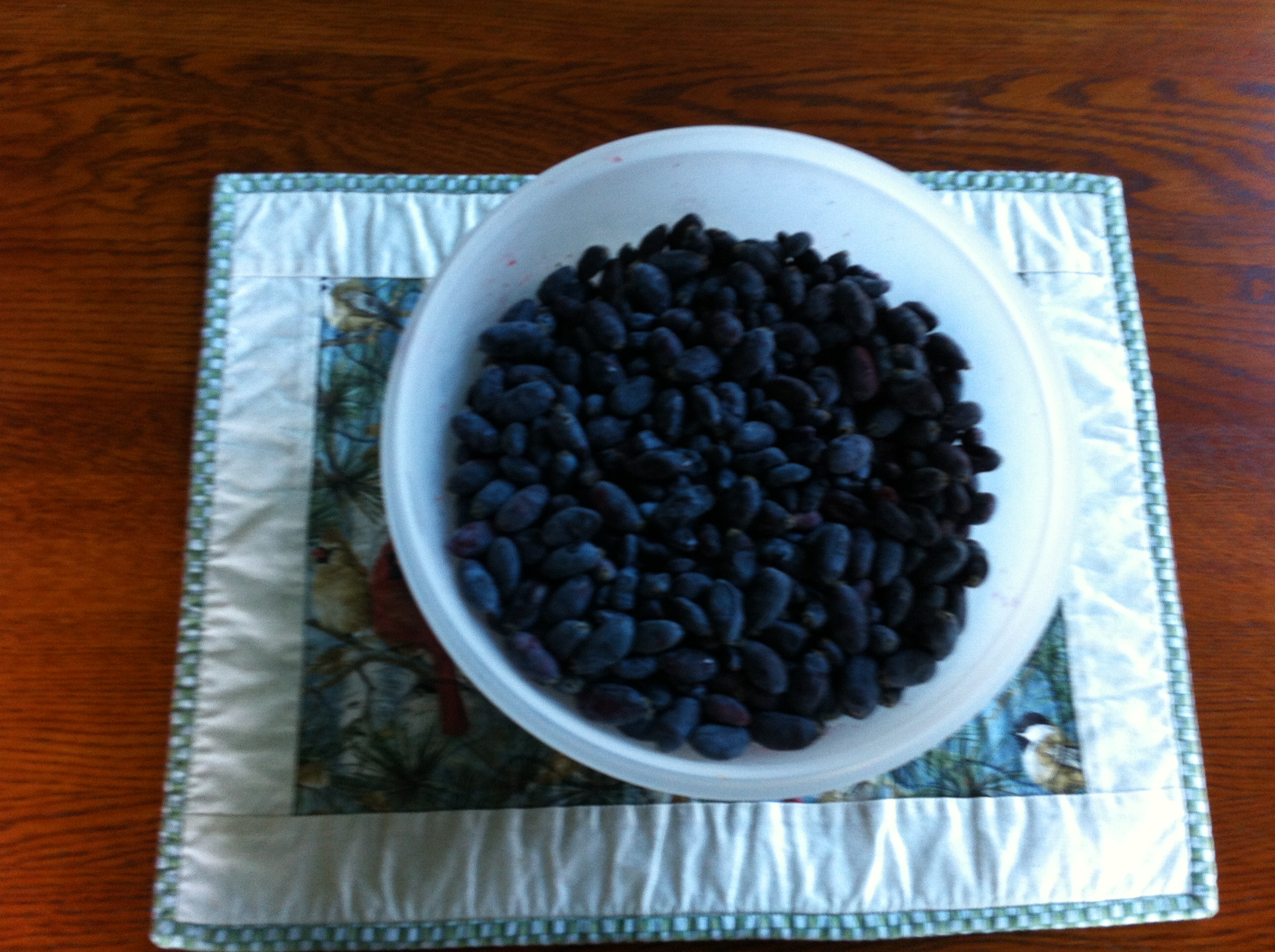
Russian berries, 2013

My wife is the landscaper, the flower gardener. She also, when called upon, works in the vegetable garden. In years past, when I’ve been on the road hawking books, she’s enlisted our sons to plant the vegetable garden in my absence. But this year, I’ve been primarily responsible for the plot. There was the first tilling just before Memorial Day. The planting of the seeds and started plants around June 1st. Then waiting, fingers crossed, that the whole damn thing wasn’t doused with buckets of rain (last year the entire garden was under water for much of June) or touched by the last frost of spring (it’s happened at our place as late as June 10th). This year was another wet June. The corn never germinated. The beans remained dormant. But most of the other plants; the carrots, the squash, the pumpkins, the potatoes, the onions, the tomatoes, and the peppers seemed to weather the storms. With as short a growing season as we have in the Cloquet River Valley, I wasn’t about to try and germinate corn after losing two weeks’ time. So I replaced failed corn with another row of tomatoes. The beans? I filled that row in with more squash, melon plants, and pumpkins. But with all the rain we’ve had, it’s a toss up as to whether the garden will produce bounty or only yield a wee bit at harvest time. That’s one thing you learn by having a vegetable garden. You appreciate the vagaries of what real farmers, folks who live off the land, experience. We hobby farmers don’t know the half of it. Our welfare isn’t tied to whether wheat germinates or corn pollinates or puddles in the fields recede in time for planting. But at least I have a basic understanding of how it all works.

Things are way behind out here in the Valley. Normally, our Russian berry bushes are ready to pick towards mid-June. I picked the big bowel shown above yesterday, July 17th, a full month after when I should be picking. The raspberries and black raspberries are no where near ready. The blueberries? Still green. The gooseberries? Slowly ripening. But the rest of the plants in the garden look darn good. We’ve been blessed this year, once the deluge of early June abated, with steady moisture and recently, with hot, humid conditions. When I look at the newly weeded rows of plants, their leaves shiny and uplifted to the blazing July sun, I am content.

Looks like it will be a good year.

After pulling weeds in 93 degree heat, I joined my wife and our friend, Sue Salveson, for a float from the Island Lake Dam down the river to our house. Despite all the hot weather, the river is up and running cold. No more than 66-68 degrees at best. Chilly when clouds cover the sun but refreshing when you’re sweltering, which we were. I spent the better part of an hour trying to inflate flotation devices stored under our  screen porch. In the end, I was able to find one lounge chair and two inner tubes that held air. Rene’ had to buy another floatie from the Minno-ette before we could begin our voyage. The rapids below the dam were brisk and frisky. The float usually takes a good hour and a half. It took less than an hour with the weight of the recent rains behind us. Lounging on old inner tubes, I managed to sunburn my belly and legs but a sweet southern wind kept the mosquitoes (of which there are legion after the rains) and biting flies (fewer in number but far more persistent) at bay for most of the trip. A quick dip at the end of the line and we were in the house, dressing to meet Sue’s husband Dave at the Blue Max Resort for early dinner.

Rene’ at Lester Park

Later that day, after saying our goodbyes to Sue and Dave, we drove our youngest son Jack and his buddy Nathan to Lester River to swim. Given that there’s a deeper, colder, faster river running by our back door, I think the venture had more to do with teenage girls in bikinis (we don’t have any of those in our backyard!) than swimming per se. But never-the-less, we toted the boys to town. After dropping the boys at Lester Park, we drove off to do errands. When we came back, Rene’ and I decided to take a gander. We’ve both been residents of Duluth for more than 50 years each and yet, inexplicably, neither of us has ever walked around Lester Park. We were amazed at the place’s beauty. Hidden right in the city, there are trees and rock formations, and rivers, and wildlife worthy of wilderness. Who’d have thought?

Amity Creek Falls, Lester Park

Kids swimming at “The Deeps”, Amity Creek

Rene’ and white pine, Lester Park


Bordered by Lester River and Amity Creek, the place was packed with kids and parents and grandparents trying to beat the swelter. There were cliff dives being made that would curdle the blood of any sane parent. Adolescent romances blossomed beneath the thick cedar and pine canopy. And shouts of joy rang throughout narrow canyons carved into billion-year old rock. It made me want to go swimming. Which is just what I did after we dropped Nathan off at his house.

Here’s to another week of vacation and hoping your gardens grow, your children smile, and you and your loved ones stay safe.

Peace.

Mark
Mark at Lester Park


Posted in Blog Archive | Comments Off on The Things I Did

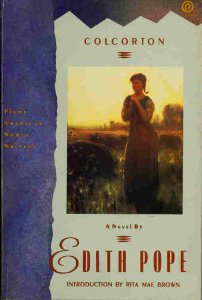
Discovering a Forgotten Author

(1992. Plume. ISBN 0-452-26324-7)

First off, don’t rely on the book jacket description of this forgotten work of literary prose from a now-forgotten author. There is indeed a family secret, as hinted in the blurbs on the novel’s back cover that weaves its way into this story of hardscrabble existence. But unlike the depiction of the revelation of that secret in the comments from the book’s rear cover, the mystery concealed deep within the history of the Clanghearne clan doesn’t reveal itself in the opening stages of this fine story: It unravels, as Abby Clanghearne’s life seems destined to, far into the tale, long after Jared Clanghearne, Abby’s brother, has met his untimely end.

           That having been said, this is one of those period novels written by an author readers haven’t heard of that is truly a “must” read for a number of reasons.

First, Pope is a quality wordsmith. That alone should be enough to compel you to search out this long out of print piece of fiction. But more importantly, I have the deep suspicion that one of our most revered and beloved pieces of Southern writing, To Kill a Mockingbird, had at least a shove at its inception, from this story, Race does play a part in this tale, a significant one. Though unlike Harper Lee’s masterpiece, where the issue of privilege and social standing due to the color of a man’s skin is tackled head-on, Southern discrimination against those of black or mixed race seeps into Colcorton like swamp water leaking towards a stream. I have no proof, of course, that Ms. Lee read and was inspired by this novel. I have only the rankest of suspicion on my side that there’s a kinship between the two tales. But I stand by my observation. I’ll leave it to scholars of the two authors to settle the debate.

            More importantly, Pope paints her characters, particularly the two female protagonists, Abby Clanghearne, the surviving matriarch of a nearly extinct and once proud clan, and her sister-in-law, Beth, Jared’s widow and the mother of the last Clanghearne  (Jad, the heir to the decaying mansion, Colcorton, the centerpiece of the diminished family estate) with as fine a brush as a novelist can wield. Abby’s a rough and tumble creature reminiscent of the frontierswoman Ruby Thewes in the literary and commercial blockbuster, Cold Mountain. It may well be that the similarities between Abby and Ruby are coincidence. Or it may be that Charles Frazier, another writer with Southern sensibilities, read Pope’s work before he constructed Cold Mountain. One can never be positive of the influences relied upon, consciously or subconsciously, by writers. But if you’ve seen the film version of Frazier’s masterpiece and you read Colcorton, I guaranty you’ll envision talented actress Renee Zellweger, who played Ruby in the movie version of Cold Mountain, playing the part of Abby Clanghearne.

            Pope’s use of the countryside; steamy, hot, wet, and full of danger real and imagined; is one of the most compelling reasons to read this book. The swamps and beaches and tidal marshes and wild creatures of the St. Augustine area come to life, much like the human characters in the story:

Staggering, she paused to watch an osprey drop through the sky like lead, his talons curving fiercely for the kill, his wings straight up like the wings of a sphinx. He hit the water with a smack and vanished in a plume of spray. Water flashed and fell from his pinions as the hawk beat his way upward, a fish moving in his claws. “Ay-ay,” Abby groaned in admiration. “Ain’t that a fine way to git your supper.

The land. It’s the land, as well as the family secret, that compels Abby Clanghearne to stay despite poverty, decay, and advancing age. And it is the land as depicted by Pope that forms as powerful a protagonist as Abby herself in the tale:

 The sky grew pink in the east. She could tell where the ocean ended. The water no longer looked flat: she could see the scooped out shadows of the swells. Silvery beams of light ran up to the top of the sky. The sand began to sparkle. The sun came out of the ocean, burning red. The waves stopped purring; then the surf began to roar. The wind had sprung up.

 Lord, to have the native or nurtured talent to write such a passage!

            In many ways, this is a simple story in terms of the cast of characters who take the stage, the very parochial and condensed setting, and the moral and ethical issues that are raised by the Clanghearne family secret. And yet, as with Harper Lee’s better-known novel, there is complexity in the seemingly common and ordinary lives depicted in Colcorton. That alone makes this novel worth devouring.

           Sadly, Edith Pope died fairly young and largely forgotten with but a modest body of work to her credit.  There is no Wikipedia entry regarding her life or career and her obituary (http://news.google.com/newspapers?nid=888&dat=19610201&id=E-4NAAAAIBAJ&sjid=EHkDAAAAIBAJ&pg=5959,61347) reveals little about the writer as a person. The article chronicling her passing indicates that Mrs. Pope died of complications from a long illness (rheumatoid arthritis) in 1961 at the age of 53 after having created one work of note.  Given how well Colcortan is constructed, perhaps that’s enough.

 4 and ½ stars out of 5.

 Note: This review first appeared on the Rural Lit R.A.L.L.Y. website, http://rurallitrally.org/. Log onto that website to learn more about this forgotten author. I’ve recently purchased a used copy of Pope’s historical novel, River in the Wind. I’ll let you know how that book reads in a bit…


Posted in Books | Comments Off on Discovering a Forgotten Author

Not The Firm or The Pelican Brief or The Jury

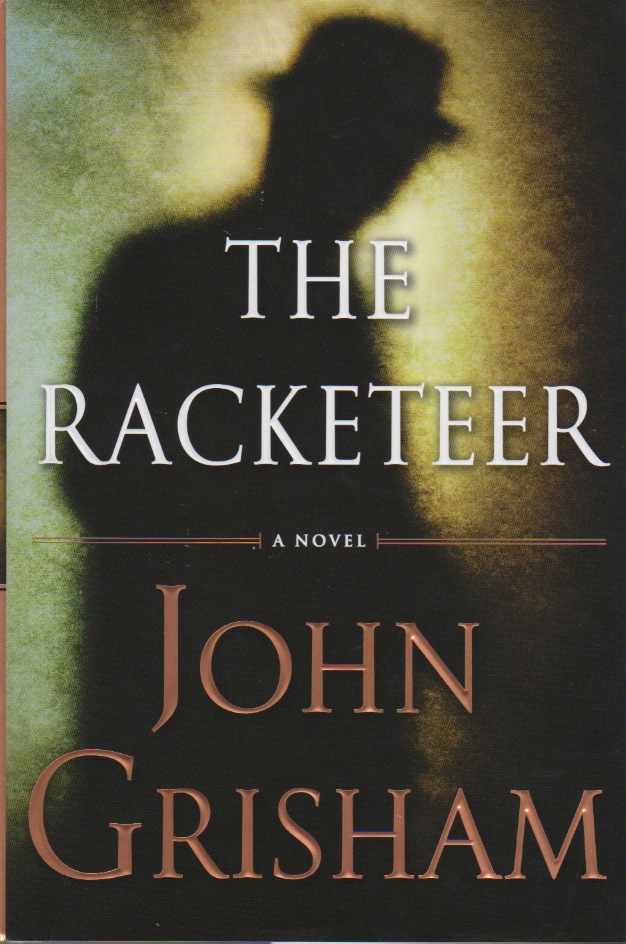
The Racketeerby John Grisham (2012. Doubleday. ISBN 9780385535144)

I must be honest here. As I’ve written before, formulaic fiction isn’t my cup of tea: I rarely read genre fiction. But when I do, I expect to be entertained by a fast paced plot (I stick to mysteries and legal thrillers if I am going to read commercial fiction) and sketches of interesting and quirky characters. That’s what Grisham, deemed by many critics to be the titular head of American barrister fiction, gave us in his earlier works. And, because he self-published his first novel, A Time to Kill, and because the man was, at one time, a practicing trial lawyer like I was, I’ve always had a soft spot for his work. But having read many of John Grisham’s novels, including his non-legal thriller prose and short stories, I’ve come to the conclusion that this author has been on cruise control for quite a while. The Racketeer does nothing to change my view.

Malcolm Bannister, the author’s first person protagonist, is in prison as this tale unfolds. He is, as so many of Grisham’s characters, wrongly accused and misunderstood. His fall from grace, orchestrated by an over-zealous United States District Attorney in the State of Virginia, was due to Bannister’s unconscious decision to represent a client involved in money laundering. What’s initially interesting about Malcolm is that he’s black. I was intrigued by Grisham’s attempt, as a Southern white man, to get inside the skin of someone removed from the author’s own ethnicity and experience. I’ve done this slight of hand myself (in Esther’s Race) and I know it’s no easy feat. Initially, the author’s expose’ of Malcolm stirred my interest. Grisham seemed headed towards creating a character that could drive this book towards literary light. Unfortunately, somewhere along the way, Malcolm became more interested in his cohort Vanessa’s breasts, which I fear, also distracted the author from plot and character development. Understand, I didn’t start out disliking the book and, in the end, it’s a tolerable read. But that’s about it. The plot becomes predicable. The characters, including Malcolm, flatten out into two dimensional cutouts. I’d liken the steady decline of this story to a party balloon with a slow leak; engaging and three dimensional to start with but limp and barely able to hold one’s interest as its size diminishes and the air escapes.

Scuba gear, jets, the Caribbean, women in bikinis, cold beer, wads of stolen cash, and international money transfers, all of which first appeared in The Firm, reappear here without The Firm’s compelling narrative and the tension between Abby and Mitch McDeer that filled out that great story. Here’s an example of the prose contained in this re-hashing of many of the author’s favorite gimmicks from his previous work:

The swelling is gone. The nose and chin are a bit sharper. The eyes look much younger, and the round red tortoiseshell glasses give the look of a pretty cool, cerebral documentary filmmaker. I shave my face once a week so there is always some stubble, with just a touch of gray mixed in. The slick scalp requires a razor every other day, My cheeks are flatter, primarily because I ate little during my recovery and I’ve lost weight. I plan to keep it off. All in all, I look nothing like my former self, and while this is often unsettling, it is also comforting.

This scene, where Malcolm, now Max, reviews the physical changes plastic surgery, courtesy of federal witness protection, has wrought, depicts what is wrong with this tale: Every turn of the plot relies upon coincidence or the stupidity of federal agents. Malcolm Bannister, a man supposedly morally unable to commit the simple crime of money laundering, constructs an escape route out of federal custody worthy of Henri “Papillion” Charierre. Much of The Firm contained similar stretches of implausibility involving the Mitch McDeer character. But readers (including me) were more than willing to overlook the impossible when it came to Mitch McDeer’s escapades because the plot was terse, the dialogue crisp, and the characters compelling. Here, once Malcolm Bannister’s past is revealed and his future is foretold, the story simply meanders along to a less than surprising conclusion.

3 stars out of 5. Not one of John Grisham’s better efforts.

Posted in Books | Comments Off on Not The Firm or The Pelican Brief or The Jury

Family and the 4th

Fireworks in Fredenberg

Dr. Bob McVean, a friend and my chiropractor, said something last night that will stay with me. We were at his folks’ place on Island Lake for a post-4th of July picnic and bonfire the day after Independence Day. We were sitting around, enjoying balmy weather, watching clouds begin to gather for a summer cloud burst, shooting the breeze, when Dr. Bob interjected a thoughtful note into our conversation.

“Isn’t it a great thing to belong to families who enjoy each others’ company?”

I had no retort. I didn’t even nod my head. Bob’s comment, a simple, one sentence acknowledgement of the gathering at his parents’ place was as profound, maybe more so, than anything I’d ever chronicled in a book or a blog. And it formed the perfect introduction to this piece, a reflection on how I spent the 4th of July this year.

For over two decades, my family has gathered at my wife’s brother Greg’s cabin on Island Lake for Privette family 4th of July. Not this year. Greg’s back has been giving him grief, and, as anyone who has ever invited family to a large gathering, be it a 50th wedding celebration, Christmas or Easter or Thanksgiving dinner, or simply for a Saturday picnic knows, trying to get your place ready for company takes physical effort. Having a bad back isn’t conducive to getting everything around the place just right for guests. Rene’ and I learned that there’d be no gathering at Greg and Sue’s cabin a couple of weeks before the 4th. We knew Dylan, our second eldest, and his girlfriend Michelle would be in town and so, my wife wove together an alternative to our traditional Independence Day. We invited all three emancipated sons, their significant others, and our singular grandchild, AJ, to picnic on the 4th at the Munger farm. We opened the invitation up to Rene’s sister, Colleen Schostag, her husband Al, and their two kids, as well as my folks and their partners. Sadly, this is the first 4th of July that both of Rene’s parents aren’t around to enjoy. Don and Merc Privette used to wait all year for the party at Greg and Sue’s. It was the one time during the year besides Christmas they got to see all their children, grandchildren, and great grandchildren gathered together. They weren’t here in body to enjoy the sun filled day spent along the banks of the river. But their spirits were certainly with us. And my dad couldn’t make it either: he’s recovering from carpal tunnel surgery and wasn’t in the mood for celebrating.

Claire Schostag on the trampoline

The 4th. Even with the weight of getting ready for the day on Rene’ and my shoulders, by the time folks started arriving, we were relaxed and ready to enjoy company. That’s not always the case, as Dr. Bob so aptly observed. Often times, efforts at celebratory perfection leaves the hosts of family gatherings tired and ill tempered, which in turn leads to discord. Didn’t happen this year. There wasn’t a tense moment or a quick, thoughtless response throughout the day that I could discern. And the weather. Ah, yes. The weather. The skies were clear and open to the blue vault of heaven (maybe so Don and Merc could see what was going on?) with just enough south breeze off the Big Lake, to keep the bugs at bay and keep the swelter off our backs. At the height of the day, Alex Schostag, his sister Claire, our youngest son Jack, and I tumbled down wooden stairs into the cold and welcoming grasp of the Cloquet. Later, all four Munger boys and the two Schostag kids engaged in an impromptu soccer match on the back lawn. Footballs were tossed. AJ enjoyed his new swing. The adults reminisced.

AJ Munger, Rene’ Munger , Barb and Duane Tourville

AJ Munger and Claire Schostag

Chris Munger, Colleen Schostag, Dylan Munger

Jack Munger, Lisa Munger, and Shelly Helgeson


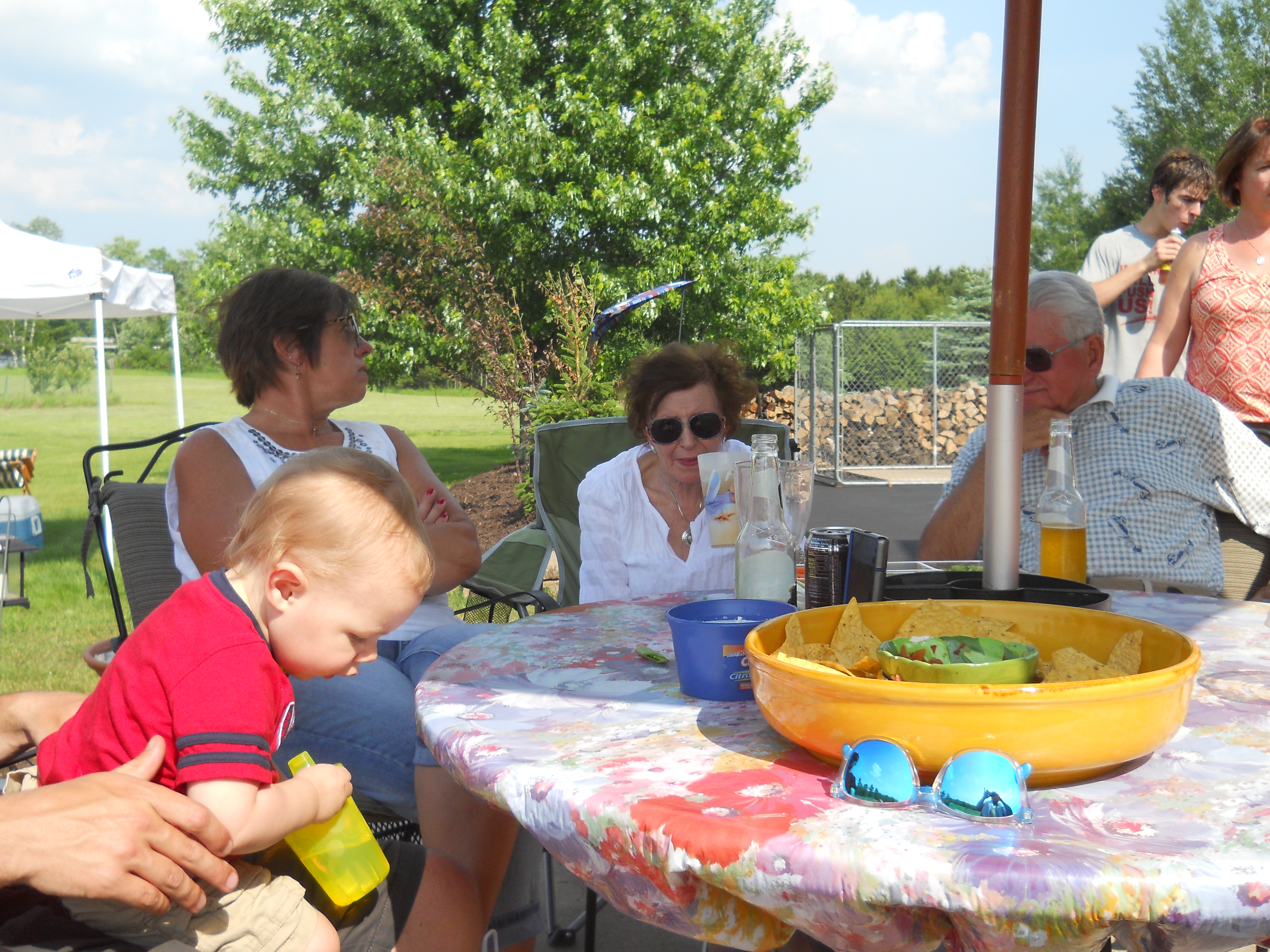
And of course, there was food. My mom, Barb Tourville, brought a mountain of potato salad. Others brought corn, cold salads, deserts, beans, and assorted side dishes. Rene’ slaved over a hot grill cooking brats and ‘dogs and burgers. There were coolers filled with soda and a variety of adult beverages. And there was conversation. Intelligent, respectful, polite (I’m not kidding!) discussions about politics, fracking, and family. Being a collection of Catholics, Lutherans, and Episcopalians, we didn’t talk religion. There wasn’t a hint of argument or upset. Not a hint. There also wasn’t much discussion of the reason we all had the day off: there was little recognition of the day our country declared that it was no longer a colony of a foreign power. Pretty important day to remember, if you’re an American. And yet, we all sort of took it for granted as we sipped cold Leinnies and chewed on our plates of vittles. Still, the importance of the day’s history was visible, I think, on the faces of everyone there. We all, down to little AJ, seemed to understand how damn lucky we are to live where we live: in a nation where we can love who we want without recrimination, work at the the job suited for our talents, and live where and how we choose. I’m not sure the collective herd of ten dogs that ran around the Munger farm this Independence Day thought much more than “Darn, what a great place to live”. But I’m sure that even little Kena, barely seven weeks old, the newest Munger dog, understood something special was happening.

Colleen and Alex Schostag


Al Schostag

Matt Munger


When the skies cleared of pyrotechnics and the night descended over the newly mown field around the house, the real celebration began. Thousands, perhaps millions, of lampyridae, fire flies, emerged from their hiding places. Soon, the field and the low sky were filled with blinking, winking, undulating flashes of green and yellow light. It’s as if God the artist had chosen to accent our farm with the tip of a luminescent paint brush putting Her emphasis on the importance of family being the foundation of this great land we call home.


Dawn, the day after.


Peace.

Mark


Posted in Blog Archive | Comments Off on Family and the 4th