Hiatus

Munger reading Miller


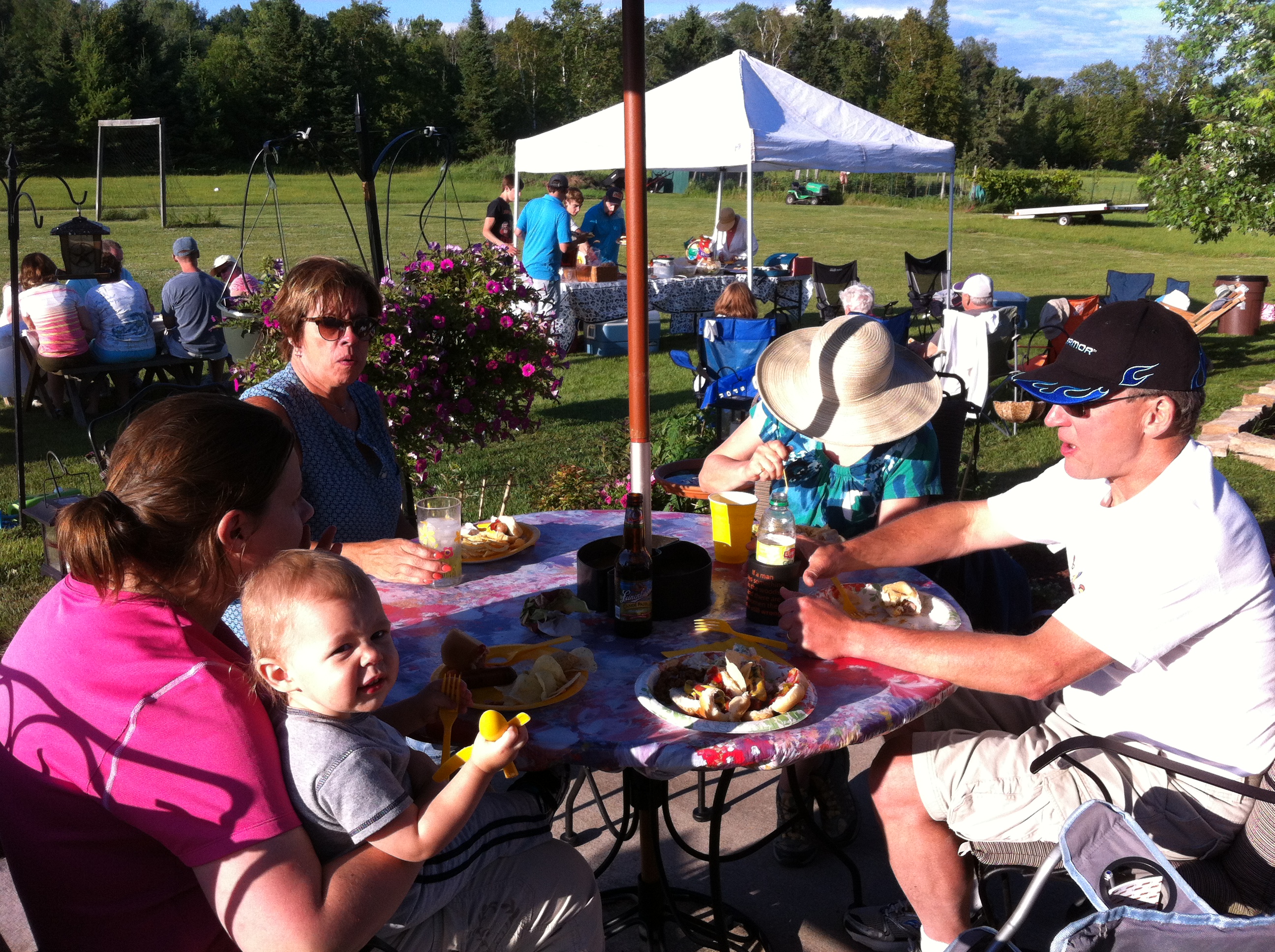
It’s been exhausting. Work has been demanding. School recently started up again and I’m spending Tuesday nights teaching Environmental Law to students at the University of Wisconsin-Superior. Monday night, Jack and I had our first Boy Scout meeting of the year. Sunday night was Confirmation Orientation at Grace Lutheran, the church we now call home. So when my wife told me our neighbors and close friends Ron and Nancy McVean wanted us to come up to Bear Head State Park between Tower and Ely and spend the night in their  new motor home, well, it seemed like just another item added to a very long check list. But as the week wore on and work became more and more difficult, the idea of spending a night, even in a very decked out and expensive contraption, in the woods of Northeastern Minnesota, loomed attractive.

We were supposed to be on the road by 4:30 and at the campground by 6. Didn’t happen. Work ran late and by the time I pulled into our house, dashed up the stairs to pack a ditty bag for the night, and throw some fresh deodorant under my arms, Rene’ was pretty much willing to simply hang out at home. But Chris, our third son, had signed up to keep an eye on our fifteen-year old and the dogs. So my wife and I tossed our meager belongings in the Pacifica, the car loaded with dry cleaning hanging from hooks over the rear seats, no time to carry the clean clothing into the house, pull it from the plastic bags protecting it, and hang it in my closet, and we roared down the driveway intent on making Bear Head before dark. We made it and had a wonderful evening trading stories with the Kaneskis, the Kuntzs, the Chesneys, and the McVeans; four couples who make a late-season trek to Bear Head every year, I guess, for the same reason I was willing to rush up Highway 4 to get there: They all crave the down time, the hiatus from the hustle and bustle of their daily lives. Dinner was lasanga and salad and hard rolls (we were supposed to bring the garlic bread but forgot!). I opened a bottle of Rene’s homemade wine and, before the night was over, the fire had faded to coals, and the couples had left to find their beds in their own respective campers, I’d pretty much killed the bottle with only scant help from my wife. With no clouds above the white and red pines surrounding the motor home, stars poked through the black cloth of evening above us. Soon it was time to claim the pull-out couch in the camper and crash. Which is exactly what I did.

Morning. The night had been cold in the camper with no heat. Rene’ and I snuggled on the pull-out but the night still touched the top of my head. When sunlight tickled my face, I scrambled out of bed, pulled on a fleece, picked up my overnight bag, and trundled off to the shower building a few hundred feet across the campground. Though it was after eight, a time when I am normally walking into the courthouse, the campground was quiet. I met one lady on the way to the facilities. Everyone else seemed to have the same idea: sleep in, we’re on vacation, maybe the last one before the snow flies. After a hot shower and a shave, I slipped into clean clothes and made my way back to the motor home. Everyone was up. Nancy whipped up egg pancakes (some call them Finnish or Swedish pancakes or crepes) and sausages. We sipped hot coffee and talked some more about kids, life, retirement (both the McVeans are retired and Rene’ and I grow more envious of their station in life with each passing day) and then, while Ron cleaned dishes, the girls went for a walk. Nature called and, when I headed down the road after doing my business, I couldn’t find the girls. So I took a walk of my own along the shoreline of Bear Head. There was only one boat out fishing on a cool, sunny Saturday morning. A ruffed grouse peeked out from the brush at the base of the majestic pines and scurried across the trail. I walked by its hiding place, fully expecting an explosion of wings and feathers. But the bird had apparently got the message as well and ambled off into the woods without too much excitement.

Ron was still cleaning dishes when I returned to the campsite. He didn’t need my help so I located my Kindle, a device I am still coming to terms with as a book lover, and claimed an empty lawn chair. In the relative quiet of beauty, with a chipmunk and a pine squirrel flitting about on the dusty ground, I found my page in Tropic of Capricorn and began to read.

Peace.

Mark

Posted in Blog Archive | Comments Off on Hiatus

Mentors

Scoutmaster Arne Erickson


I missed a funeral this week. I didn’t want to miss it but I didn’t have much choice.

The only thing you have to do is die and pay taxes…

That’s an over-used phrase that isn’t really true, at least with respect to the taxes part. You can choose not to pay taxes. The consequence is a meeting with the IRS and maybe some time in prison.

But on Tuesday morning, when they laid my former Boy Scout leader Arne Erickson to rest, I was thirty miles away from the Piedmont neighborhood in Duluth where I grew up and where Arne volunteered his time in scouting and raised his three kids. I had a calendar in the Lake County Courthouse in Two Harbors involving dozens of complicated criminal and juvenile delinquency matters, all of which are assigned to me. Most times, when there’s a funeral or other emergency that pops up during the work week, I can get a brother or sister judge to cover a calendar. But not on Tuesday. Because the cases were individually assigned, it meant I had to be there, which meant I missed Arne’s final send off.

But this blog isn’t about Arne Erickson per se. It’s about a topic I’ve danced around the edges in blogs, speeches, and casual conversation over the later portions of my life. This essay is about mentors: folks that make a difference in the lives of children by living and acting in exemplar fashion. Arne Erickson was one of my mentors. There have been many others, some of which I’ve spoken of before, some of which I have never mentioned in public. I take this public billboard to remember Arne and the other adults over the course of my growing up who made a difference, who helped form the fiber of my being. I’ll forget mentioning some folks but not by intention: I am simply an old man with an old memory.

Mentors come in all shapes, sizes, ethnicities, genders, ages, religions, and political leanings. Often times, children know very little about the person providing them with instruction and guidance. We only know that someone is spending time away from their own home, their own family, trying to help raise us. Hillary Clinton’s phrase “It takes a village to raise a child” applies in spades to adults who coach, teach, supervise Boy Scouts and Girl Scouts, lead confirmation and Sunday school, and the like. I experienced great role models, for that is essentially what a good mentor is,  in all those facets of my young life.

My parents of course, were my first and most thoroughly engaged mentors. My mom undertook reading to me at a very young age, instilled a sense of responsibility and order in me by assigning chores, and made sure I was grounded in faith by teaching Sunday school and leading the youth group of our tiny Episcopal congregation. When I was twelve and on the verge of puberty, Mom also made sure that our church participated in a Christian-based sex education class (which included Arne Erickson’s Baptist future son-in-law in the mix).  My dad took me fishing and hunting, taught me about politics and law, and, at least until he realized I stunk as an athlete, coached me in Little League. My mom’s cousin Lizette took over the church youth group when I was in high school. Despite the small number of teens in our congregation, she spent considerable time and energy making each monthly gathering, whether at a cabin on a distant lake for a weekend retreat or in the basement of the church, a spiritually fulfilling event. My mom’s sister, Susanne, put in her time with me as well, encouraging my fascination with the written word (turns out, she’s a writer too!) when I would stay with her during the summer at her home in tiny Benson, Minnesota. Susanne’s second husband, Paul, a former WWII aviator, a dead ringer for Clark Gable, and a staunch Republican, provided a counterpoint to my father’s Liberal view of the world. I sat in awe many nights at Paul and Susanne’s rambling house in Benson or at their tiny lakeside cabin listening to Dad and Paul go hammer and tongs about politics. My uncle Willard of course, both as a family member and as my boss when I worked for him at his West Duluth motel, gave me not only additional political mentoring; he was a man so handy with tools, his example filled a void in my practical education because Dad has no interest, and utterly no talent, when it comes to home maintenance or repair. Then there were my grandparents, all of whom, however briefly, I was blessed to know and learn from. Some of those lessons, like Grandma Munger’s loitering around the restaurant of the Willard Motel (she lived in an apartment next to the office) when I was a senior at Denfeld High School and my girlfriend at the time, a cute, smart kid named Karen, was hanging around while I watched the motel at night, were a bit over-the-top. But now I understand Grandma’s insistence in playing cards with us until, as the clock neared ten, Karen decided it was time to go. Grandma just wanted to make sure her grandson knew she was watching and that she knew what two teenagers were thinking.

Teachers and coaches. From Miss Ness, my kindergarten teacher at Piedmont Elementary who made the wise decision to put me and three of my hooligan cohorts in separate corners of her classroom nearly every day, to Marv Heikkenen, my high school football coach and one of my favorite teachers at Denfeld, who recognized in my scrawny determination something of value that he called to the attention of my teammates, to Dave Griffin and Jean Endrizzi and Miss Cohen and Judy Infelise and Gary Ames and Mr. Childs and Miss Hollingsworth and Mr. Merry and Mr. Nyquist, all of whom spent considerable time redirecting my enthusiasm to more productive pursuits; they all were instrumental in the formation of my character, as imperfect and flawed as it may be. There are many more I could name but one person in particular came to mind as I thought about Arne Erickson who has now joined my other departed Scoutmaster and mentor, Ed Salveson, in that great campground in the sky.

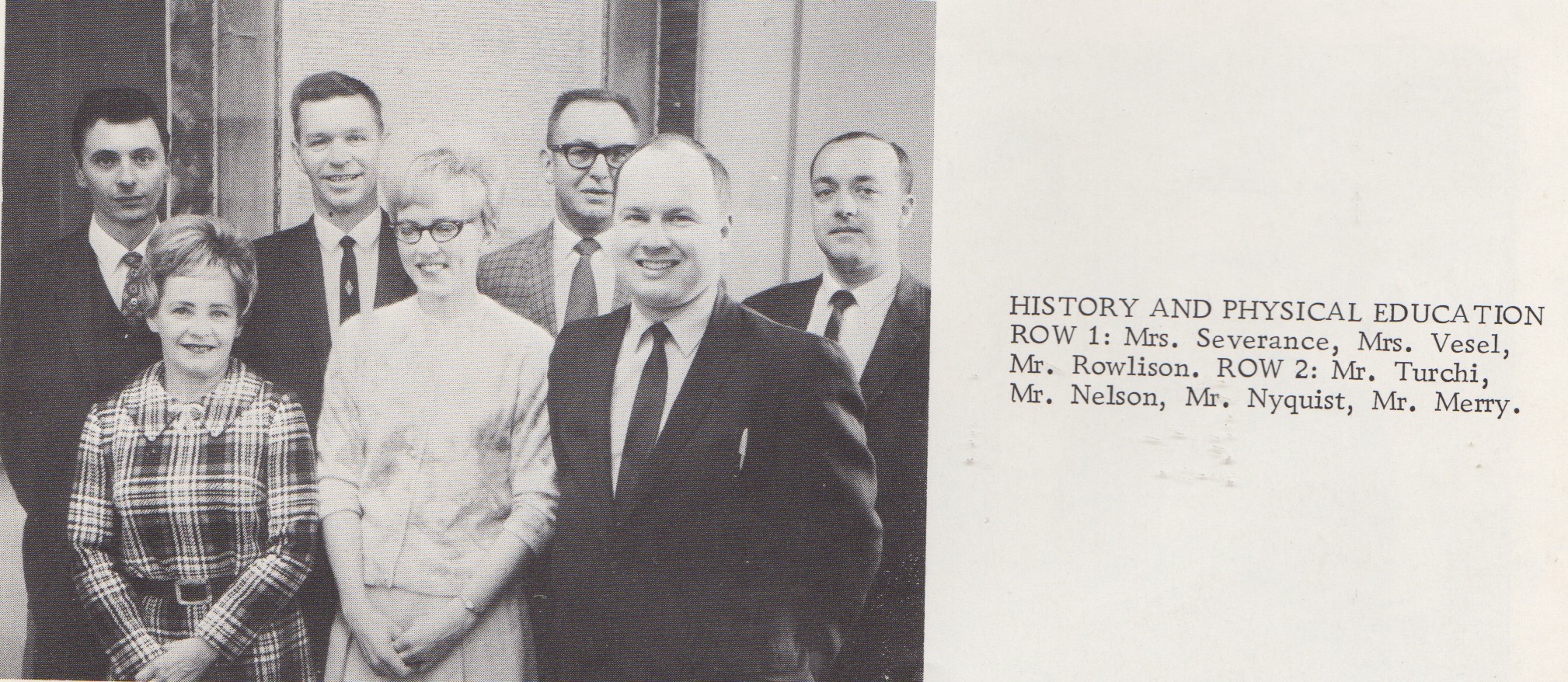
His name was Coach Nelson. That’s it. No first name. Honest. I even checked my Lincoln Junior High yearbooks to find his first name. It’s not listed. The caption under a group photo of teachers simply reads “Mr. Nelson”. Why am I mentioning a guy whose first name I don’t even know as an important impact on my growing up, especially when I’ve left out many, many fine folks, relatives and teachers and adult friends and religious leaders who had a hand in my formation? Here’s why.

1970 Lincoln Vikings 9th Grade Basketball Team


See the guy in the glasses and white shirt? No, that’s not me. That’s Roger Wedin, team manager. I’m the little guy to his right, the shortest guy in the photograph. If I was five feet tall the day this picture was taken, well, I must have been standing on a brick! Anyway, back to mentoring. I started playing ball in fourth grade because Eddie, that would be Ed Salveson’s son Dave, my best friend, wanted to play. We weren’t very good. Eddie couldn’t dribble but he could shoot. I couldn’t shoot but, with my head down and the ball in my hand, I could dribble like a whirling dervish. Not productively, you understand. Mostly in circles. Whatever. Anyway, we played together through Piedmont Elementary and into Lincoln Junior High. I’m not sure why Eddie’s missing from the 9th grade team photo. Maybe he was sick the day the picture was taken. Or maybe he didn’t play that year. I’ll ask him about that the next time we’re together. But here’s the point of the photograph: By the time 9th grade rolled around, and basketball tryouts were taking place, my meager abilities on the court hadn’t progressed, hadn’t kept pace with my contemporaries. When the dreaded day  for posting the team roster came and I walked into the locker room, found the listing, and saw I had been cut, I cried a river. Don’t know why. I knew then, as I know now that I wasn’t a ballplayer. But being cut still hurt. Damn it, it hurt. I managed to wipe away the tears, pull my gear out of my locker, and take the bus home to Piedmont without a major melt down in front of my classmates. My basketball days were over. It was time to move on.

But then an idea came to me.

Despite his Marine drill sergeant hair cut, deep voice, and scary demeanor, Coach Nelson is really a pretty fair guy. Maybe if I asked to simply practice with the team, he’ll let me.

I have no idea where the courage to knock on Coach’s office door came from but the very next day, I did just that. I stated my case. Coach Nelson, who had been a drill instructor in the Corps and maintained all the skills of intimidation that such a position requires, looked me up one side and down the other.

“Alright. You can practice. But you’re not on the roster and you don’t get a uniform.”

From the photograph it’s pretty obvious something changed. I showed up so determined to work my ass off, so dedicated to making an impression, that eventually Coach Nelson said “What the hell. You’re on the team. Here’s a uniform.” In fact, he actually put me in a crucial game against Stowe where I ended up guarding the team’s star, George Knezovich. In a packed Lincoln gymnasium, George knocked me down when I grabbed a rebound and tried for a layup. What the hell a four-foot-something guard was doing in the offensive paint, I have no idea. But somehow I got the ball and lobbed it towards the hoop just as George whalloped me. I got two free throws in front of the hysterical crowd. They all knew my story and were yelling my name, cheering me on. I missed both shots. But that’s not the point of this tale. Coach Nelson had no reason to let me practice with the team, less reason to put me on the roster, and absolutely no business having me guard the other team’s star. And yet, in a show of compassion to a scared little boy, Coach Nelson taught me the meaning of being a mentor.

It’s a lesson Arne and all the rest of his kind reinforced. And it’s a lesson and an example that I try to emulate every time I’m called upon to lend a hand on the playing field, in church, at home, or in Scouts.

Peace.

Mark


(That’s Coach, second from the left, second row.)

Posted in Blog Archive | Comments Off on Mentors

Writers Aren’t Always Authors

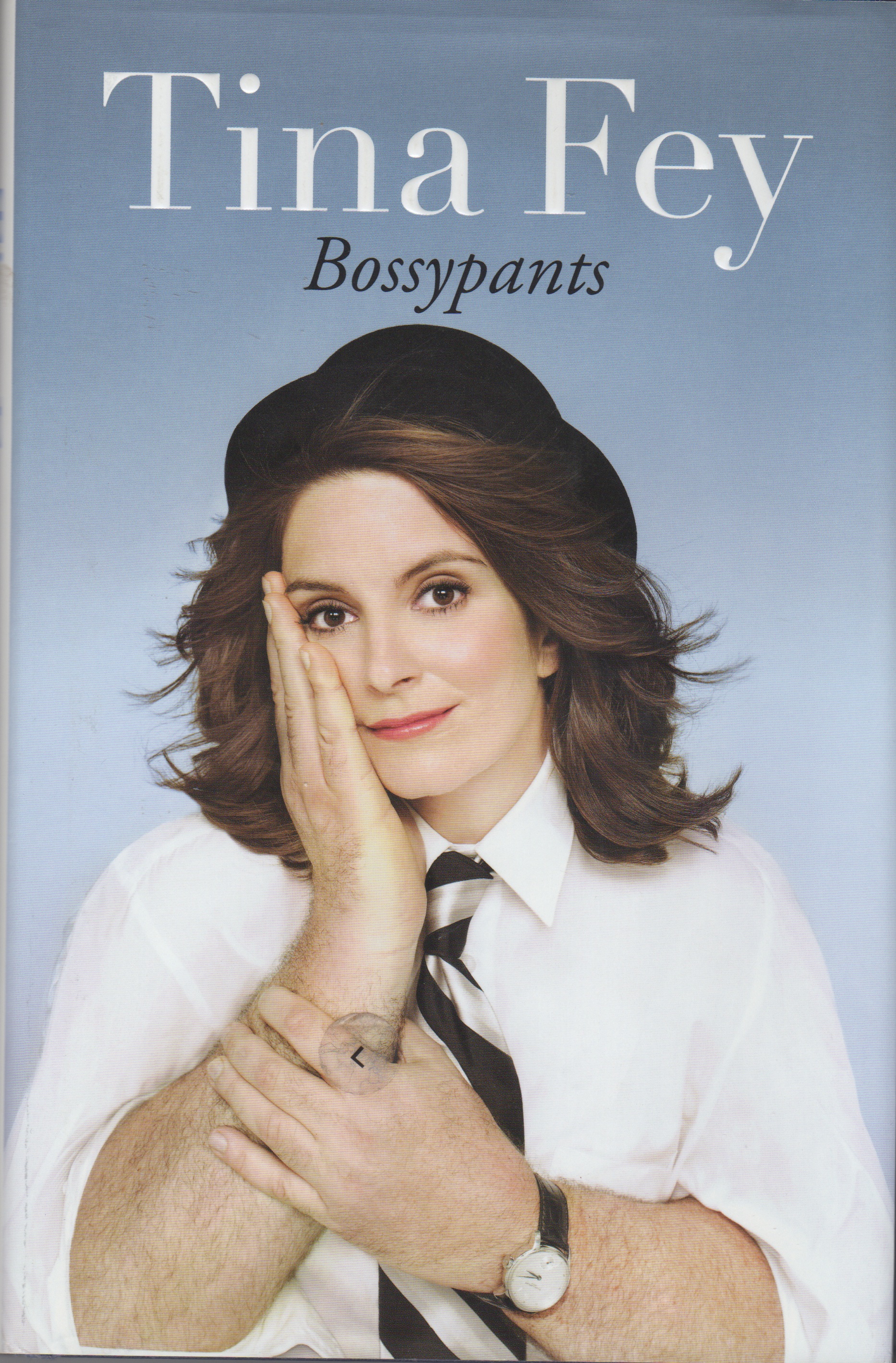
Bossypants by Tina Fey (2011. Little Brown. ISBN 978036056861)

Understand this: I love Tina Fey. She’s pretty, smart, has a great sense of humor, and, if all reports are accurate, a great mom and wife. Juggling being one of America’s premier female comedians, while producing and directing an award winning sit-com (30 Rock) along with parental and spousal duties and obligations is nothing to sneeze at. So when my wife received a copy of this book from our son and daughter-in-law, the memoir eventually made it to my reading stack. I don’t normally spend time with this sort of contemporary book but something about Fey’s intellect and career at Saturday Night Live as a writer and player intrigued me to dive in. I won’t say I was disappointed. I will say that, at the conclusion of the book, I really didn’t know Tina Fey much better than I did before cracking the cover.

First off, this really is a woman’s book. I know, I know. Right there all the feminists in my blogosphere are going to hit me with their purses. But Bossypants really isn’t what I thought it was; a tell-all retrospective look at Fey’s meteoric career in television. Rather, it’s a chronicle of her interactions with folks throughout her life, from gay pals during her adolescent summer stock years, to her rhetorical (not physical) love affair with the co-star of 30 Rock, Alec Baldwin. While post Neandrathal males like me can appreciate reading about womanly troubles and struggles in the contemporary entertainment world, the loosely chronological matter-of-fact structure of the book loses steam over time.

There are some funny and touching passages along the winding path Fey has constructed. Here’s a sampling of one such tidbit, where she talks about being Photoshopped for a magazine cover, that tickled my fancy:

But just be patient, for in a few weeks, the magazine will be out and you will have incontrovertible proof  that you are a young Catherine Deneuve. You casually check the newsstand on your way to buy Bengay heating pads. One day, there it is! Right between Jessica Simpson and those people from The Bachelor who murdered each other-it’s your face! It is your face, right? You can barely recognize yourself with the amount of digital correction. They’ve taken out your knuckles and given you baby hands. The muscular calves that you’re generally very proud of are slimmed to the bone. And what’s with the eyes? They always get it wrong under the eyes. In an effort to remove dark circles they take out any depth, and your face looks like it was drawn on a paper plate. You looked forward to them taking out your chicken pox scars and broken blood vessels, but how do you feel when they erase part of you that is perfectly good?…Do I worry about overly retouched photos giving women unrealistic expectations and body image issues? I do. I think that we will soon see a rise in anorexia in women over seventy. Because only people over seventy are fooled by Photoshop. Only your great-aunt forwards you an image of Sarah Palin holding a rifle and wearing an American flag bikini and thinks it’s real.

Fey loosely chronicles her life in this effort, even discussing the attack she survived as a young girl, when a maniac attempted to carve her face with a knife, leaving a prominent scar as a reminder of evil. But there’s very little revelation included in that tale, or any of the other vignettes reproduced for public conception. Now, to be fair, I don’t think the author was attempting a serious telling of her life story. Rather, the book appears to be an extension, a longer version if you will, of interviews, sketches, and jokes that Fey has already exposed to the world. The only real moment in Fey’s writing, the only time she lets down her guard and ponders her humanity to any degree, comes at the very end. In the last chapter, she debates with herself about having another child at forty. There’s no question, as I’ve written, that Tina Fey appears to be a loving and caring mother to her daughter Alice. And maybe, just maybe, her marriage to Jeff is one of those rare Hollywood unions that can survive stardom. So it’s not for lack of a solid familial unit that Fey laments motherhood: It’s the debate between career and home that so many working moms (including my own wife) have confronted since the end of WWII in America. This is the one chapter, the one place in Bossypants where one of our most brilliant comic minds lets her guard down. But it comes too late in the effort to make this a “must read”.

If you enjoy comedy and Saturday Night Live and 30 Rock there’s enough here to keep you reading to the end but don’t expect to come away from Bossypants with a deeper understanding of what makes Tina Fey tick.

3 stars out of 5.

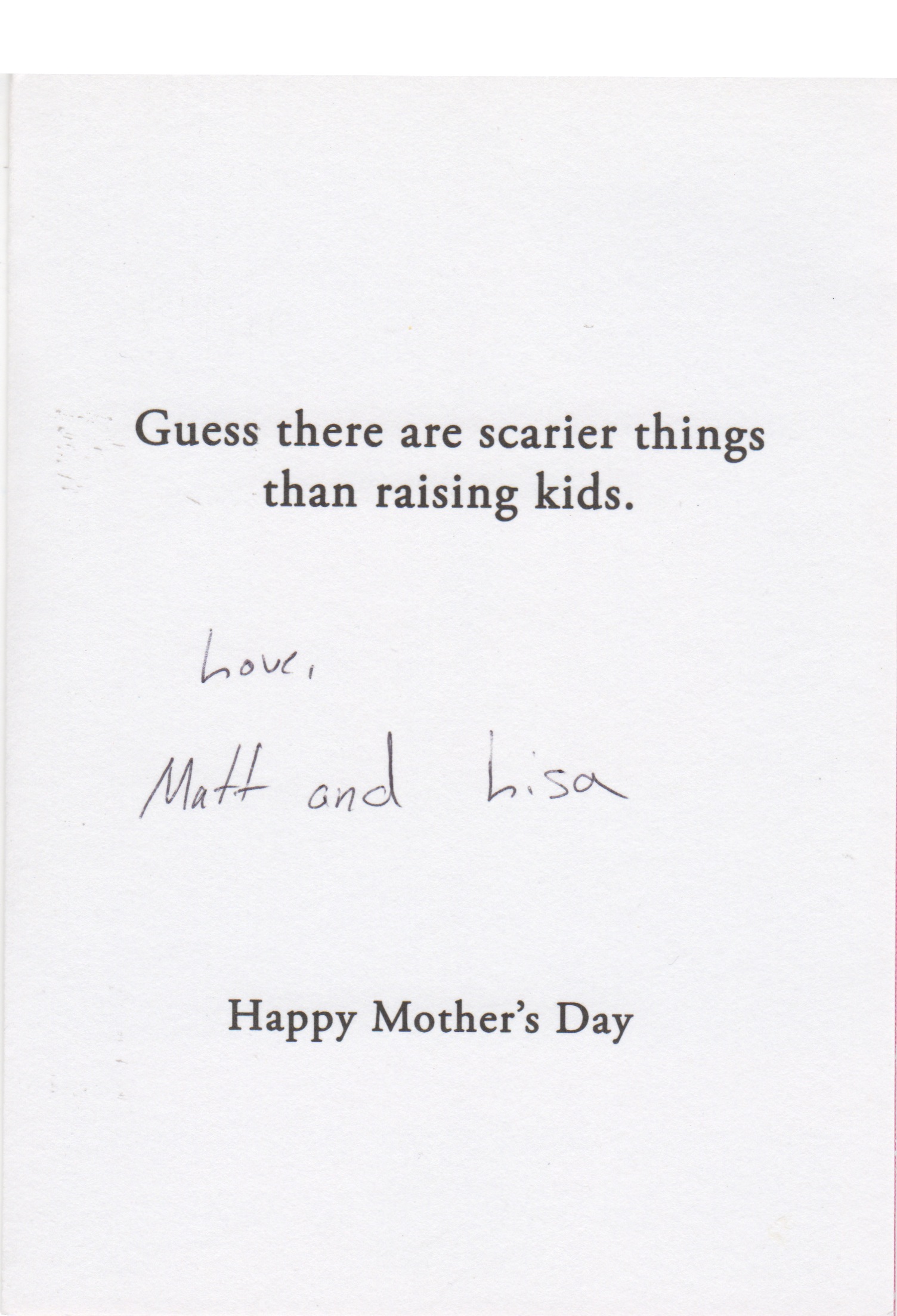
The card that came with the book. Maybe Tina should have written a faux biography of Sarah Palin instead!


Posted in Books | Comments Off on Writers Aren’t Always Authors

Surprise!


Yesterday. Rene’ scurried about the place cleaning bathrooms. I was busy manning our new Dyson Animal. With four dogs (only two of which frequent the inside of our home) and a wife who’s allergic to most everything, buying the Animal a few months’ back as a replacement for our tired Hoover was a good move. Anyway, it was clean the house day and my wife and I have divided that chore pretty much the same way ever since she returned to full time work about fifteen years ago. I do the vacuuming, the dusting, and mopping. She does the laundry and the bathrooms. Even the boys’ bathroom in the basement. Brave woman. I should have been out cutting the grass on my John Deere Sabre but the thing is on the fritz again (maybe time to invest in an up grade) so after push mowing the front lawn and trimming around the gardens and the house, I went back to cleaning.

As anyone who was awake yesterday knows, it was ungodly hot and humid as a rain forest; two conditions that make for considerable sweat when working. By the time I finished up my janitorial duties, Rene’ and Jack were gone, off to do some “back to school” clothes shopping with our grandson, AJ, at the Mall. I’d rather dust and vacuum and mop and sweat up a storm any day than shop at the Mall so I was perfectly fine with staying behind and finishing my chore list despite the heat.

When I was done with my work, I decided to wander out to the vegetable garden and score some raspberries. In normal summer, the raspberries and black raspberries we grow would be long gone. But this year, as I’ve written before, things are odd. Everything is about a month behind. The canes in the garden should be empty by now. They aren’t.

Cloquet River raspberries


See what I mean? Late August and I managed to gather two pints or more of fresh raspberries to douse in milk, spice up my corn flakes, or plop on a scoop of vanilla ice cream. When I was done berry picking, I cleaned the berries, put them in the fridge, and sidled up to our bedroom to change. Dressed in my swimming suit, towel jauntily tossed over a shoulder, I stepped onto the rear porch of our house to put on my water shoes. That’s where the title to this blog came from. When I stuck my right foot deep into my water shoe, I felt something very squishy blocking my toes.

“Kena,” I asked our new Lab puppy who was eagerly awaiting our walk to the river, “did you poop in my shoe?”

Undaunted by what I might find, I removed my foot from the rubber shoe, reached inside, and discovered the source of my surprise.

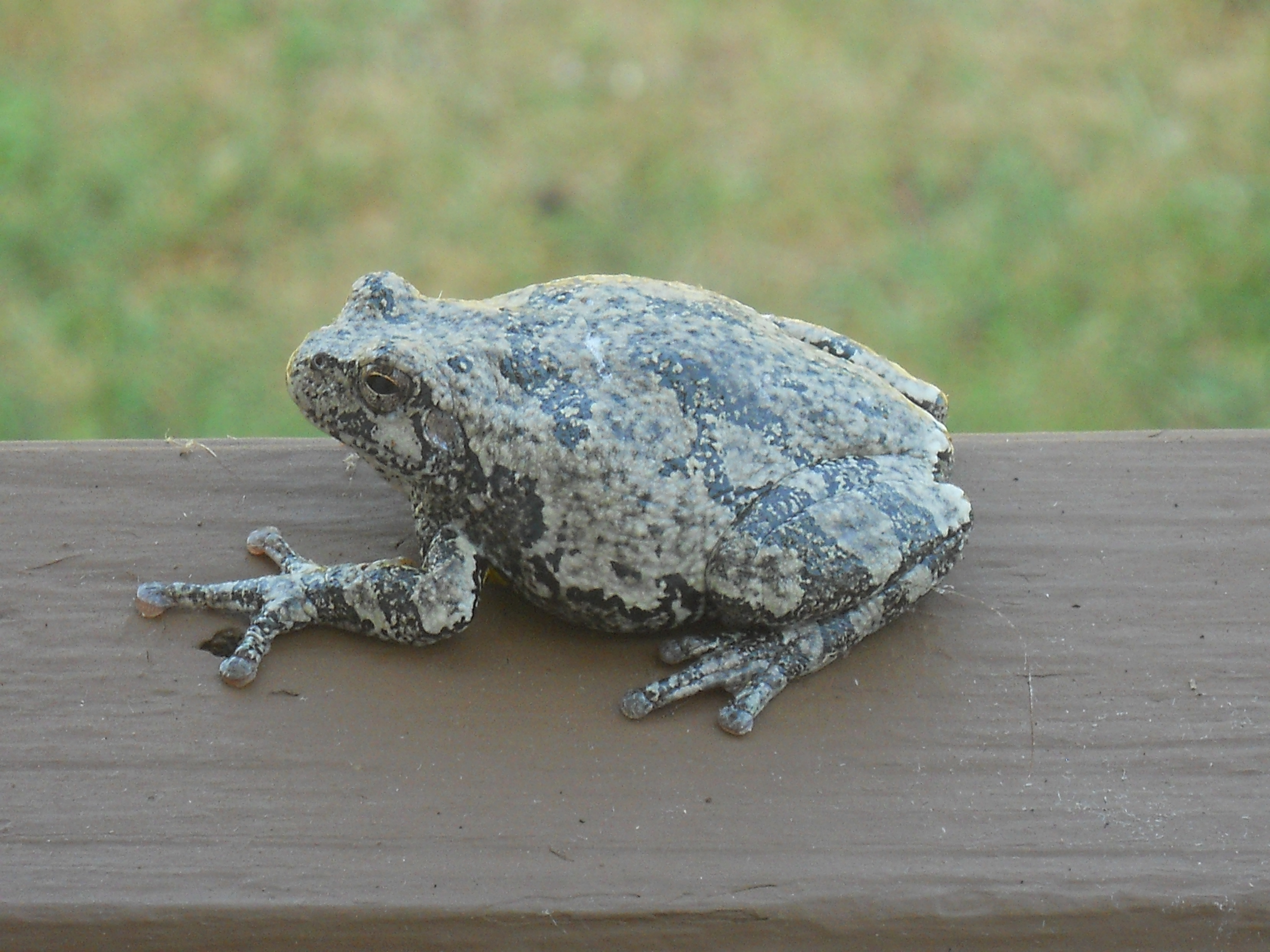
Eastern gray tree frog

We usually hear these little buggers as dusk settles in. Even out of mating season, they are loud callers. We often find them hiding amongst the logs stacked on our wood rack out on our covered front porch. This one apparently decided that my water shoe, moist and smelly, made a nice resting spot against the heat. Thankfully, it seemed unfazed by being nearly squished by my toes. I pulled the frog out of the shoe and placed it gently on the railing of our rear porch, noting the brilliant yellow splotches that run along its underside. I snapped a couple of photos and then, confident the frog would find another place to escape the unseasonable weather, descended the stairs with Kena in tow.

Peace.

Mark

You can learn more about this amphibian, and the rest of Minnesota’s frogs and toads, at http://www.herpnet.net/Minnesota-Herpetology/index.php?option=com_content&view=article&id=61:eastern-gray-treefrog-hyla-versicolor&catid=41:minnesota-frogs-toads-and-treefrogs&Itemid=63.


Posted in Blog Archive | Comments Off on Surprise!

I Miss This Guy

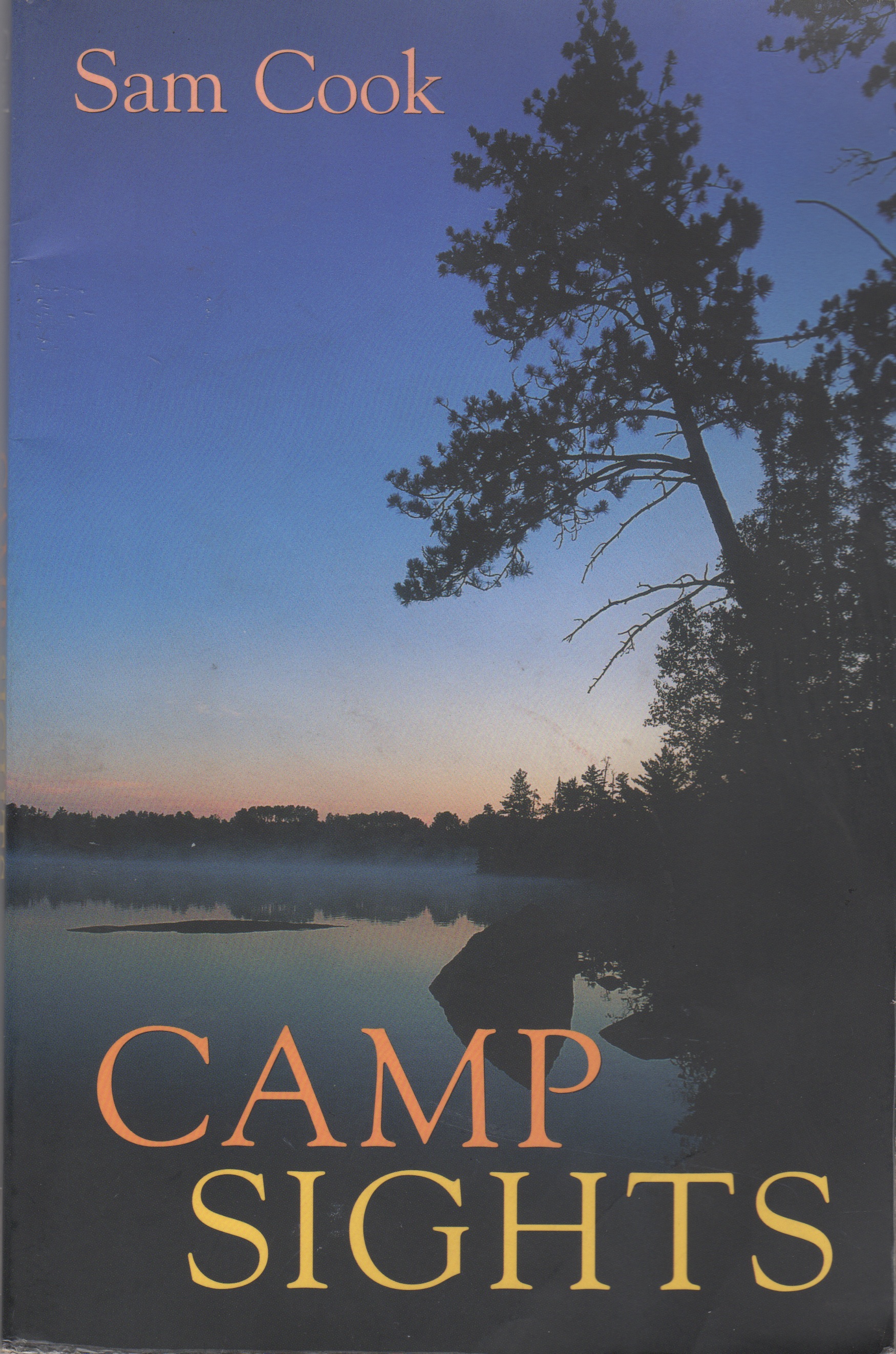
Camp Sights by Sam Cook (1992. University of Minnesota Press. ISBN 0-8166-4184-6)

While on my recent sojourn to Woodland Caribou Provincial Park in Ontario (see “Caribou” below for a full report on the trip), I cracked open Camp Sights by Duluth author and newspaper man, Sam Cook while sitting on granite staring at Secret Lake in midday, around the campfire at night, or in my tent as I shook off aches and pains and headed towards sleep. What I discovered in re-reading this old collection of Cook’s work culled from the pages of the Duluth News Tribune, where Cook has been the outdoor writer since 1976 (I was still in college so Sam’s got a few years on me!) is that Cook’s earlier writing emulates, to an extent, the essays of Sig Olson, one of America’s foremost outdoor writers. Not every story in this offering from the University of Minnesota Press attempts to be Olsonesque. But there are certainly echoes of the old conservationist in many of the stories, including “Well Worth It” (about not catching lake trout), “Thunderbolts” (replicating what it’s like to anticipate a storm while tenting in the wilderness) and “Whiteout” (a tale about being snowed in with dogs on a dog sledding expedition out of Great Slave Lake). Those are the stories, in my humble opinion, more so than the pure reportage Cook has leaned to in the later stages of his time at the DNT, that make a reader pick up a Duluth Pack, hoist a canoe onto his or her shoulders, and head north. Which, if you’ve ever read Sig Olson’s Listening Point or his other classics, is exactly the sensation you’re left with after reading Olson’s masterpieces. I miss the sense of wilderness magic Sam’s earlier pieces seemed to gravitate towards. I understand that, in this day of diminished resources at newspapers, outdoor reporters are being called upon to put aside their literary flourishes and simply tell us how to catch fish, where to hunt deer, and whether prairie potholes will produce ducks. I get the need for the newspaper to supply outdoor information as a viable means of selling its product to men. After all, most men read sparingly and, when they do read, they read for information not entertainment. So I get that, to sell papers, Sam needs to tone down the wistfulness of his pieces and hone in on data. And I need to be honest here: this change in tone within Cook’s writing is not universal. Sam still comes through with some dandy pieces of contemporary essay-style writing now and again. But if you want to read the best Cook, read his books where you’ll find passages like this, Cook’s description of a dream paddle in the Canadian wilderness:

No portage would be too tough, for there would be time, plenty of time. No perfect island campsite would have to be paddled by, for there would always be another night and another camp. No Indian rock paintings would be too far off the beaten path to inspect.

Ah, but in reality there were spouses and little people and jobs waiting, and there we were, paddling across Batchewaung toward the end of our trip.

The rain came down harder. Everything was wet. Warm rain poured down the backs of our necks and trickled down the valleys of our backbones.

(From “Batchewaung”)

Hopefully we’ll be treated to a few more gems like this one before Cook joins his contemporaries Pates and Stodghill in retirement from the newspaper game. And while we wait for the eventuality of there being no more Sam Cook in the DNT, there is a plethora of older Sam Cook essays waiting to be re-read in the form of his books. If I were you, I’d pick up Camp Sights, or any of Sam’s other collections to take along on your next outing.

4 1/2 stars out of 5.


Posted in Books | Comments Off on I Miss This Guy

Caribou

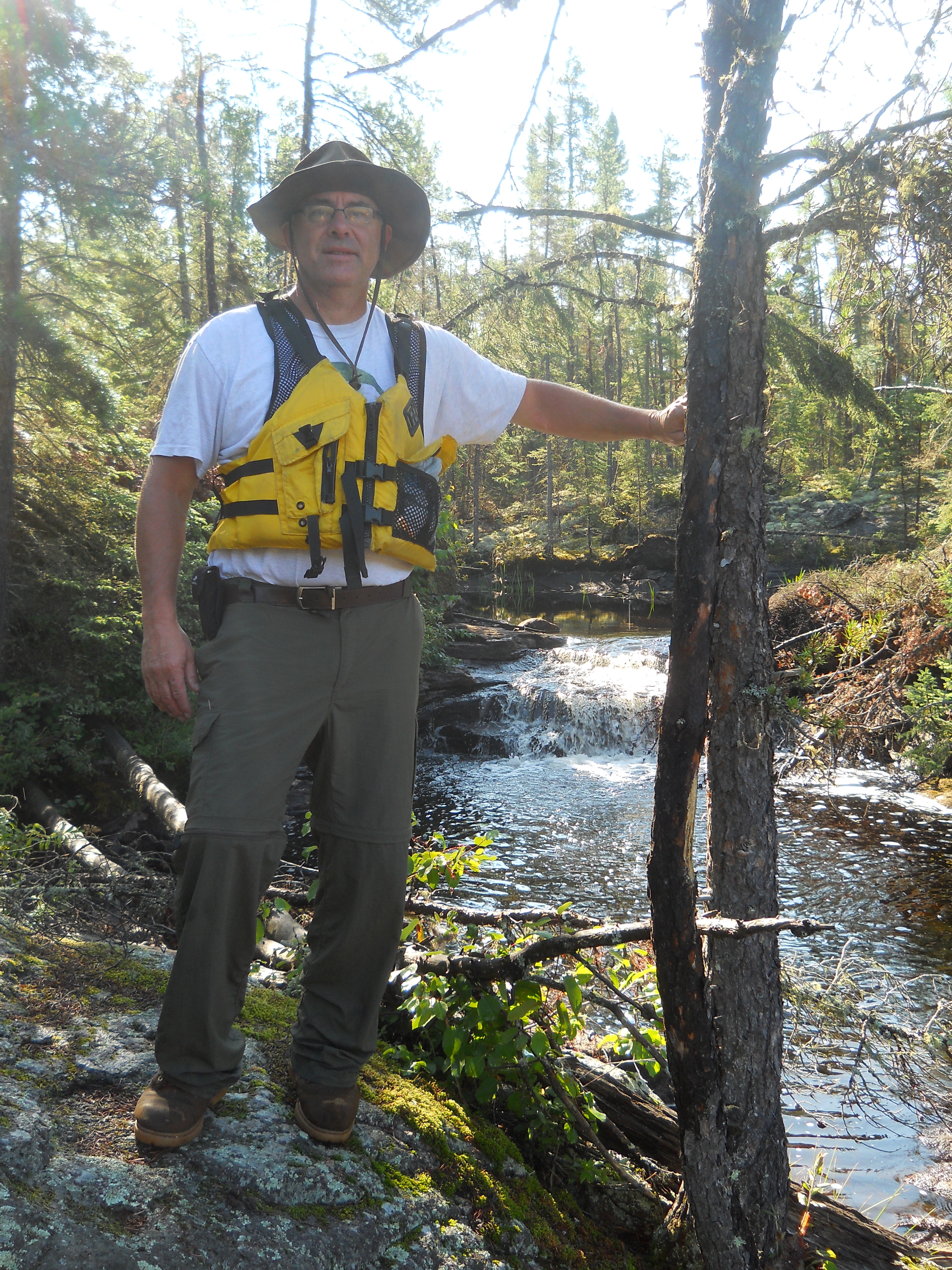
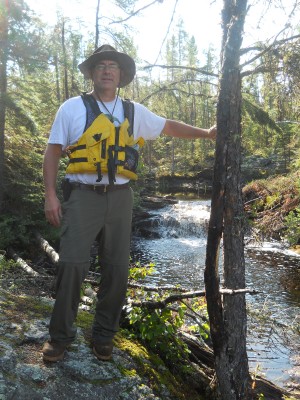
The author turned canoeist. Somewhere on a portage in Woodland Caribou Park, ON


800. Eighty-plus. Fifty-two. Sixteen. A dozen. Ten. Eight. Eight again. Six. Five. Two. Two more. Those are some of the numbers associated with last week’s trek into the hinter lands of the Ontario taiga. For you non-adventurous types, a definition is needed here:

taiga |ˈtīgə|
noun (often the taiga)
the sometimes swampy coniferous forest of high northern latitudes, esp. that between the tundra and steppes of Siberia and North America.
ORIGIN late 19th cent.: from Russian taĭga, from Mongolian.

(From The Apple Dictionary)

Having given you a short lesson in geography, let me explain the numbers. 800 is the longest “official” portage some members of Boy Scout Troop 106 of Hermantown, MN completed on our recent journey north to Woodland Caribou Provincial Park. I say “official” because one of the passages between two of the boreal lakes on our route marked as a shallow creek turned out to be virtually dry. Which necessitated nearly a mile of dragging canoes through saw grass, muck, Canadian Shield gray boulders and pink quartz. Understand; I didn’t go on this part of our collective journey but I sure heard about it from the six brave explorers who made the trek. More on that later.

Eighty-plus is the number of walleyes that my group, five pairs of canoeists, caught in two days of fishing on a lake which, because I’d like to go back and fish it again, shall remain nameless. Sixteen is the number of adults and young folks who made portions of the overall trip. I say portions because, as indicated, ten of us stayed on the fishing lake while six intrepid explorers made a large loop totaling over fifty miles of canoeing and portaging from start to finish. The explorers caught few fish but saw a bull moose resplendent in lily pads, water dripping off its rack as if staged for a Molson commercial. The six explorers also viewed pictographs drawn by long-forgotten First Peoples and touched the edge of true taiga where the spindly white spruce and jack pine that cover this part of the Canadian Shield give way to a virtually treeless landscape. And the explorers crossed over an old burn where the spindly conifers were charred to charcoal. Within the burn, Julie Belden, the only adult woman on the trip, found wild blueberries ripe and ready for the picking.

Another digression.  The number two is significant here for two reasons (cute, eh?): There were two females on the journey, including Julie and Heidi Hummell a teenager who defied the pouting, complaining version of young women seen on television sitcoms. Julie went with the explorers while Heidi and her father stayed with the fishing group.Two females. Two groups.
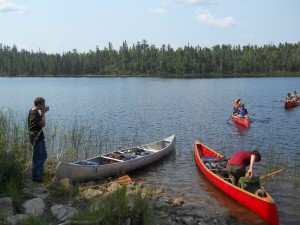
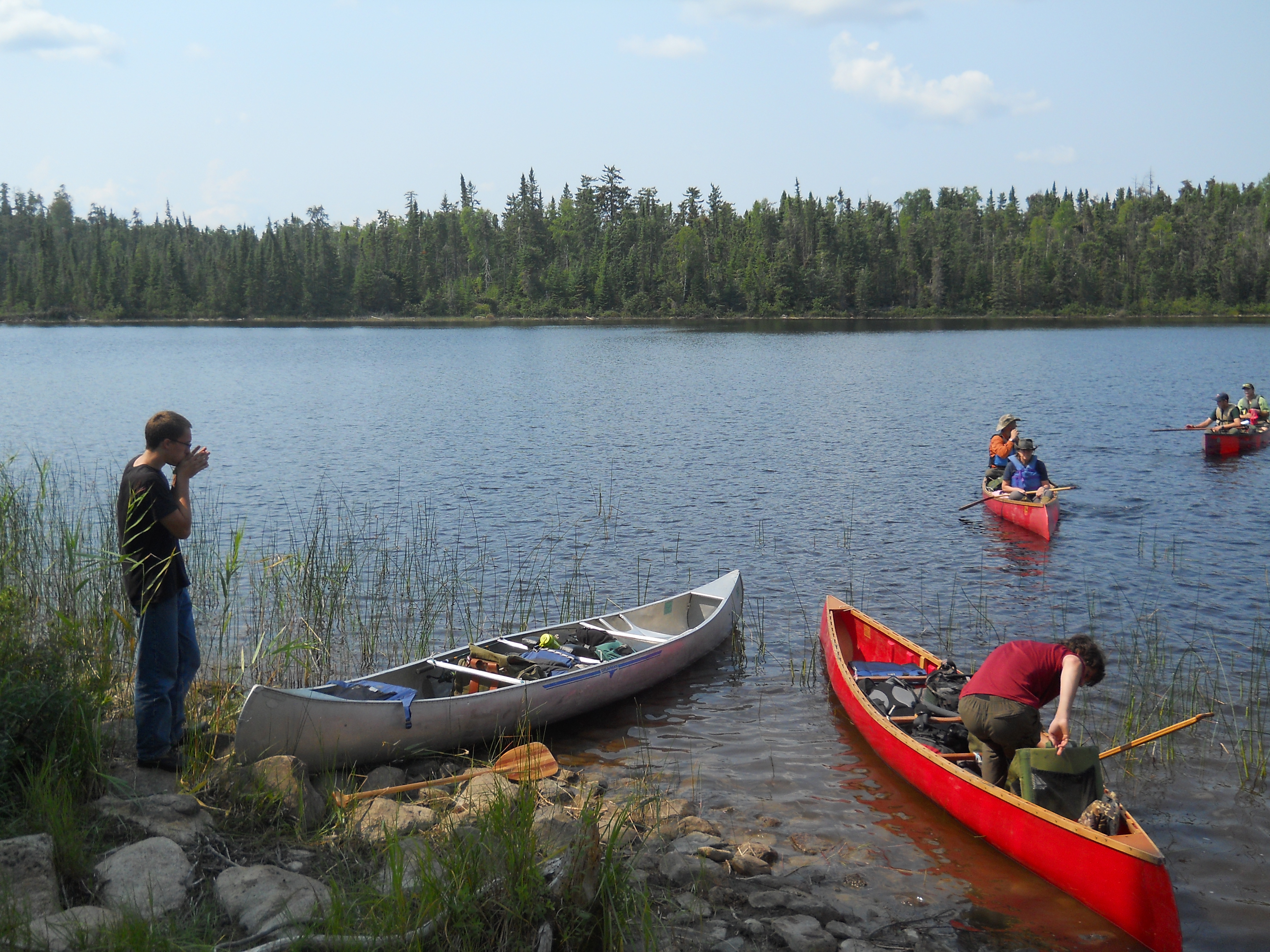
Launching the canoes.

Ten? That was the most portages done by the explorers group led by Jim Belden in one day. Eight? That’s the most portages completed by the fishing group led by Bryan Von Arb in one day. Eight was also supposed to be the number of fishermen staying behind to catch walleye on the secret lake I told you about but Mark and Heidi Hummell decided they’d rather catch walleye than wade loon shit. Go figure. So the second number eight in my computation became ten. A dozen represents my approximation of the snaky, voraciously hungry northern pike the group landed over the six days we were in Woodland Caribou. Since we were after walleye and lake trout, I don’t think anyone minded that we tossed every pike back into the tannin stained water of the park. Five represents the number of lake trout the group caught, beginning with my son Jack’s very first laker.
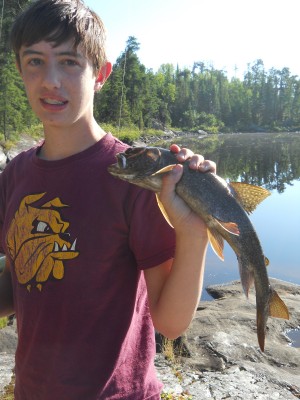
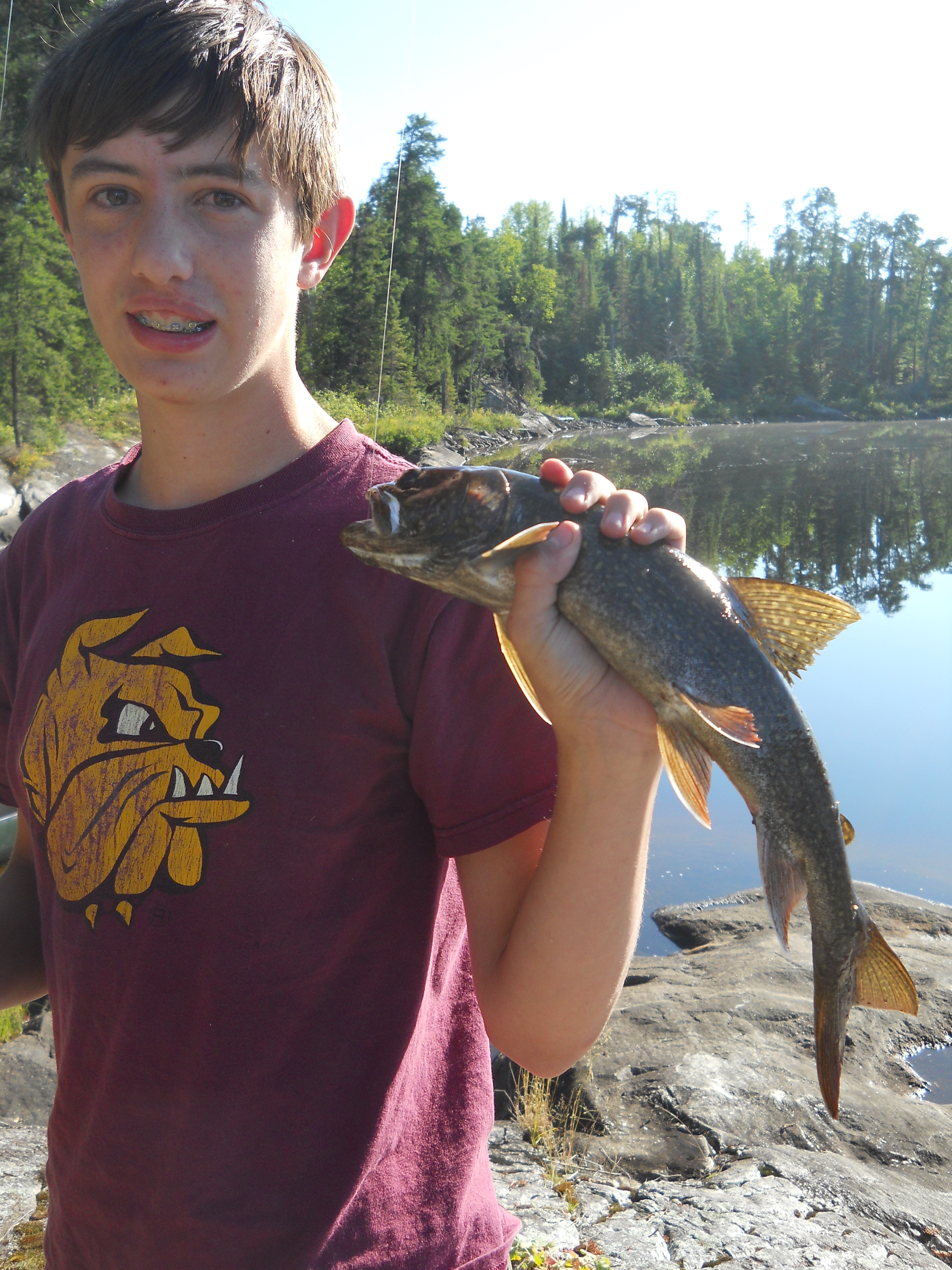
Jack’s first lake trout.

For those of you who are thinking, A week on the water in a park akin to the BWCA isn’t so tough, let me explain some facts about Woodland Caribou Provincial Park. First, the name. Yes, there are actual caribou in the park. We didn’t see any, not even the group that went further north. But, as indicated, the explorers did see a resplendent bull moose up close and personal and, the following scene will flesh out what the fishing crew experienced.

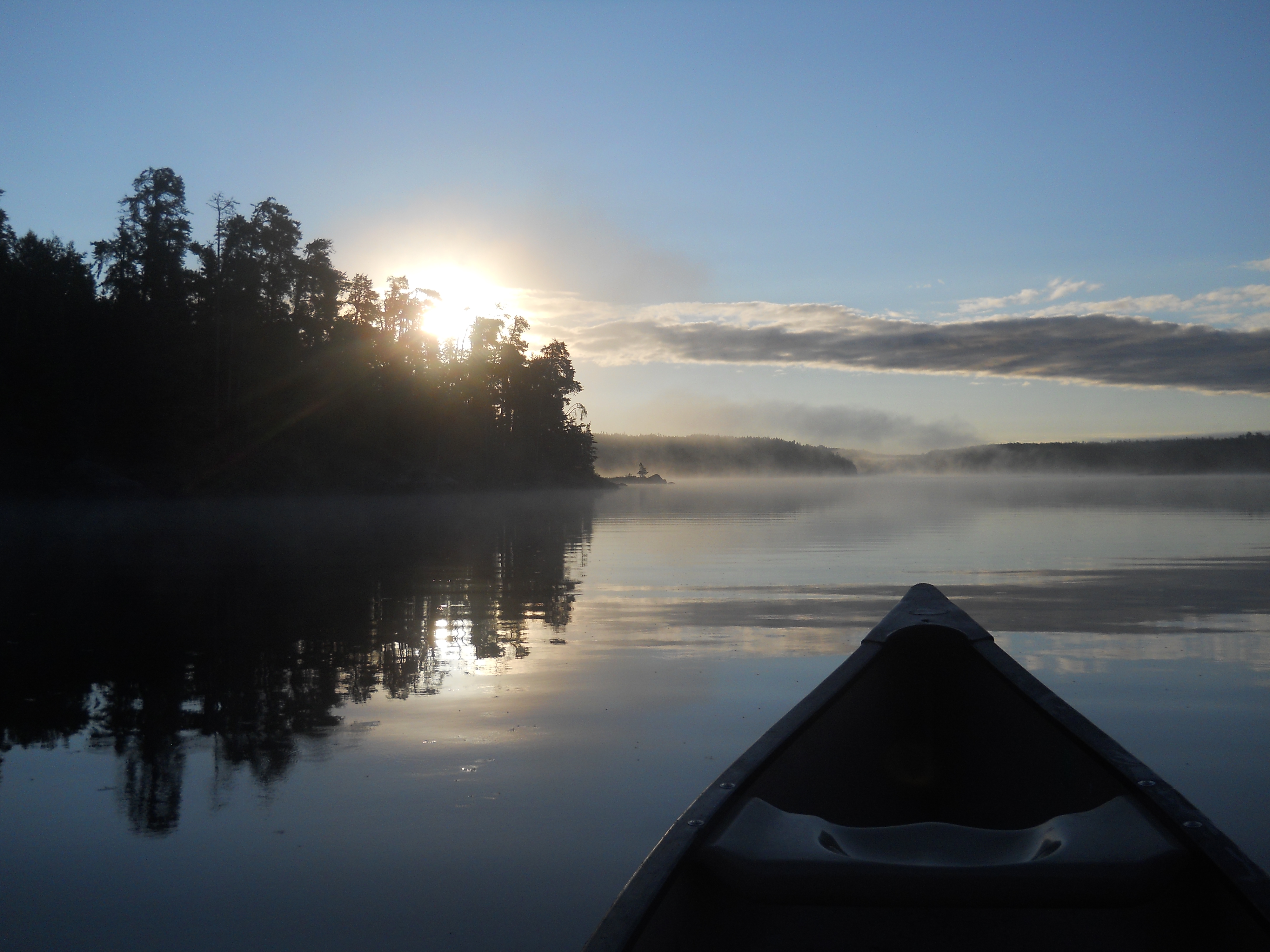
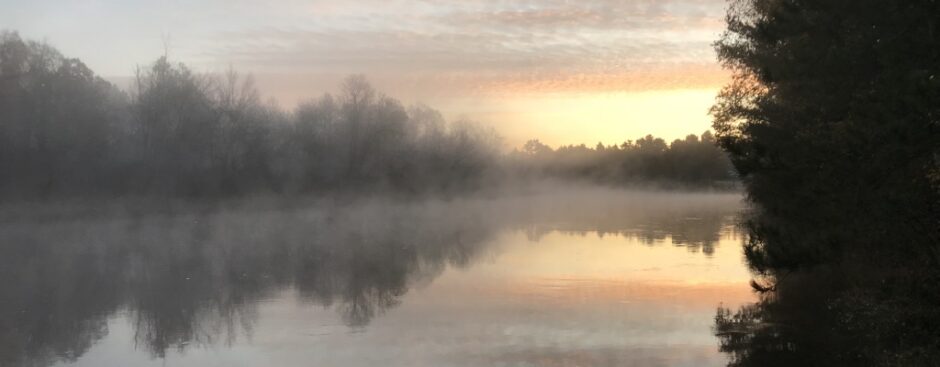
Morning. Before breakfast. The mist is clearing off Secret Lake.
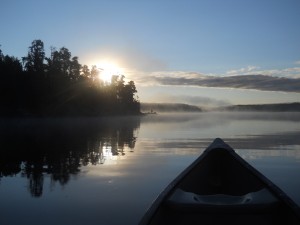
Sunrise on Secret Lake

I am sitting on the rock outcropping a few meters from our campsite, sipping hot morning coffee and marveling at my good fortune. Good fortune because I was able to convince my fifteen-year old son that this would be an unforgettable trip. Good fortune because, with the guiding abilities of Mr. Von Arb, we’ve found walleye. Good fortune because I am married to a beautiful and gracious woman who knows that, from time to time, I need to replenish my internal battery on wilderness.

Anyway, on Secret Lake there had been another group camping on a spit of rock a mile or so away. That group left with the onset of the sun. The lake is calm. There is no wind. And yet, as would hold true throughout the week, there are no bugs. No gnats. No accursed black flies. No mosquitoes. So I am sitting on granite, looking out over a quiet body of black water, listening to the cry of loons in the distance, when I see them.

At first, I’m not sure that what I am seeing are caribou. This is because the animals aren’t prancing along distant shoreline. They are swimming, making a beeline from the campsite the folks have just left for the far shore.

“Caribou!” I shout.

Nick Mallett, one of the Scouts, emerges from the trees.

“Where?”

“There, near the point. They’re swimming.”

“My dad has binoculars.”

“Get them. And tell the others.”

Very soon, Nick returns with the eight others in our party. We all stand on the stoney shoulders of the Shield, in a ragged line of expectancy, watching the animals swim. Each of us takes a turn with the field glasses. I’m last in line. I have the benefit of watching the animals emerge from the water onto solid ground at the mouth of a tiny creek Jack and I had fished the day before.

“They’re not caribou,” I finally say when I see the distinctive lanky legs and snout of North America’s largest ungulate. “It’s a cow moose and twin calves.”

So yes, if one counts moose as a commonality between Woodland Caribou and the BWCA, together with the omnipresent granite, thin soil, and coniferous forest, there are similarities between the provincial park and America’s most beloved canoeing retreat. But that’s about where the connections between the two places end.

First, the portages. The BWCA may have removed the wonderfully helpful portage signs (marked in rods) that announced each trail, along with the convenient portage rests on longer overland treks. But the portages one carries his or her canoe across in the BWCA (even the remotest of the remote) are generally maintained. Not so with even the most well used portages in Woodland Caribou. The trails are rugged, narrow, prone to have jack pine or white spruce blow downs blocking them, and are generally unmarked. You have to be a woodland detective to find the trail from one lake to the next.

Then there is the traffic. The two parks are about the same size. Woodland Caribou is 1.2 million acres of prime wilderness. The BWCA (without the adjacent Quetico across the border) is 1 million acres, give or take. But whereas the BWCA sees 200,000 visitors a year, Woodland Caribou has less than 1,000 visitors a season. That’s right. Less than 1,000. So while you may see fellow campers and canoeists on lakes that are known for their walleye fisheries (as our fishing group did), the more intrepid paddlers, like our explorers group, can pretty well be assured of seeing no other humans.

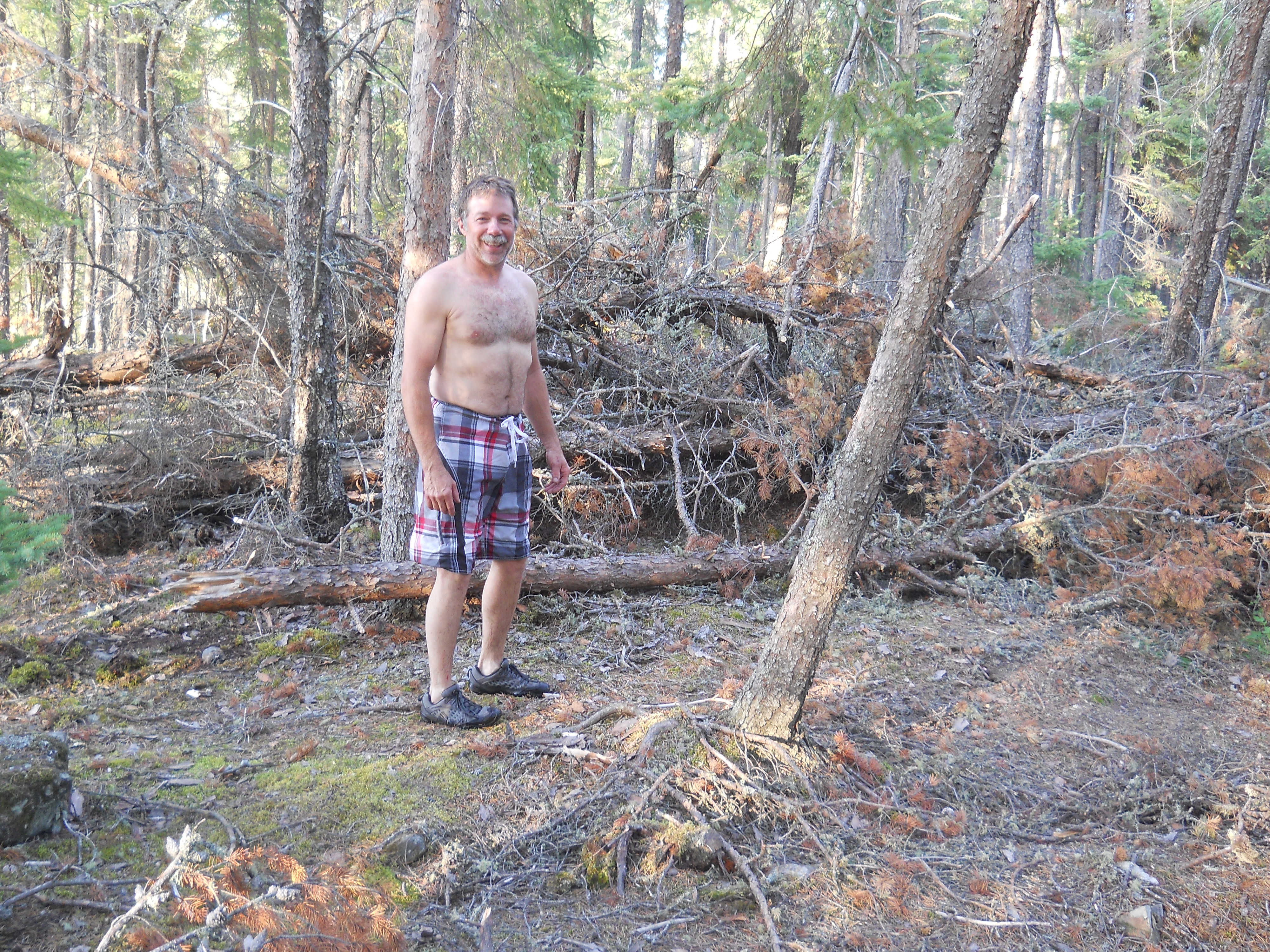
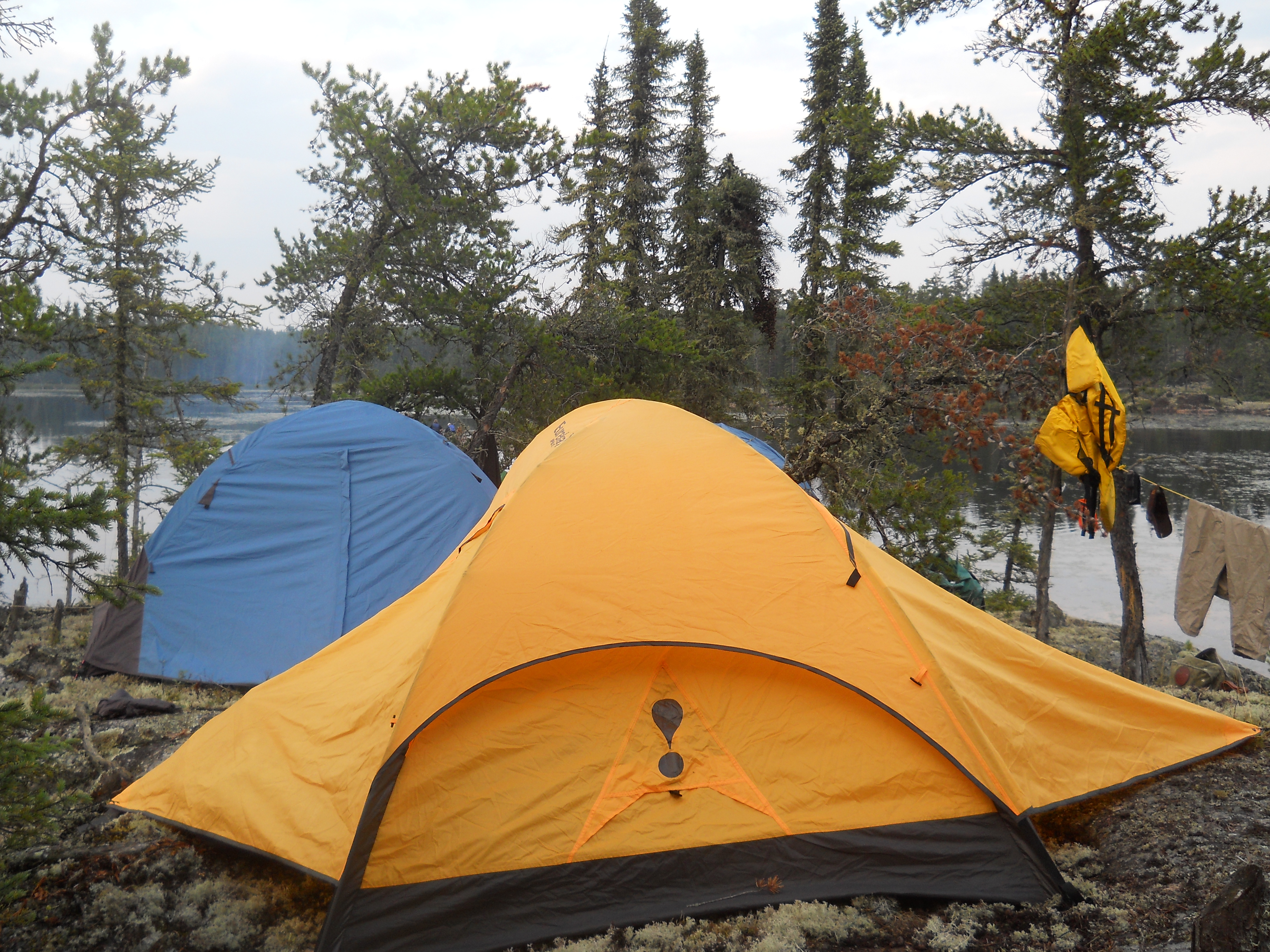
Then there are the campsites. On occasion, after massive straight line winds or fires, campsites in the BWCA become unusable. But the beaveresque crews of the US Forest Service usually have them cleared and in fine shape before too long. And all the approved campsites in the BWCA have fire grates and latrines, making camping, while certainly more primitive than your typical state park, doable for even the sissy pants in your group. Caribou has no fire grates. No latrines. And most of the campsites are prone to being rendered unusable without the aid of a hatchet and saw. Here’s what I mean.
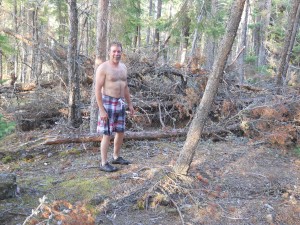
Bryan Von Arb ready for a swim after clearing our campsite of dead fall on Bunny Lake.


Notice how few of the standing trees in the photo are actually vertical? Every night, the creaking of white spruce and jack pines ready to tumble to the ground made for some interesting sleep given that our thinly skinned tents provided little shelter against the sudden descent of trees. This isn’t to say that some of the sites weren’t as picturesque or more so than their American counterparts.
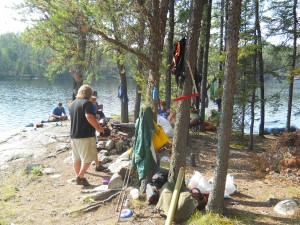
Jake Lake camp.

As the photo to the left depicts, our tenting spot on the crown of a rocky shoulder on Jake Lake was everything you’d want in a campsite: A clearing in the trees to let the breeze waft through. Plenty of firewood. Spots to use for your daily deposits (remember, there are no latrines and you really can’t dig into rock!). Fish (Jack caught a nice three pound laker we baked for breakfast on Jake). And even a sandy beach to clean off the dust and grime of the trail.
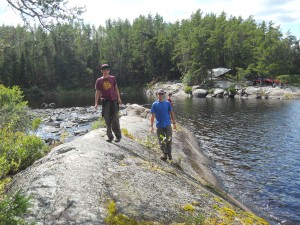
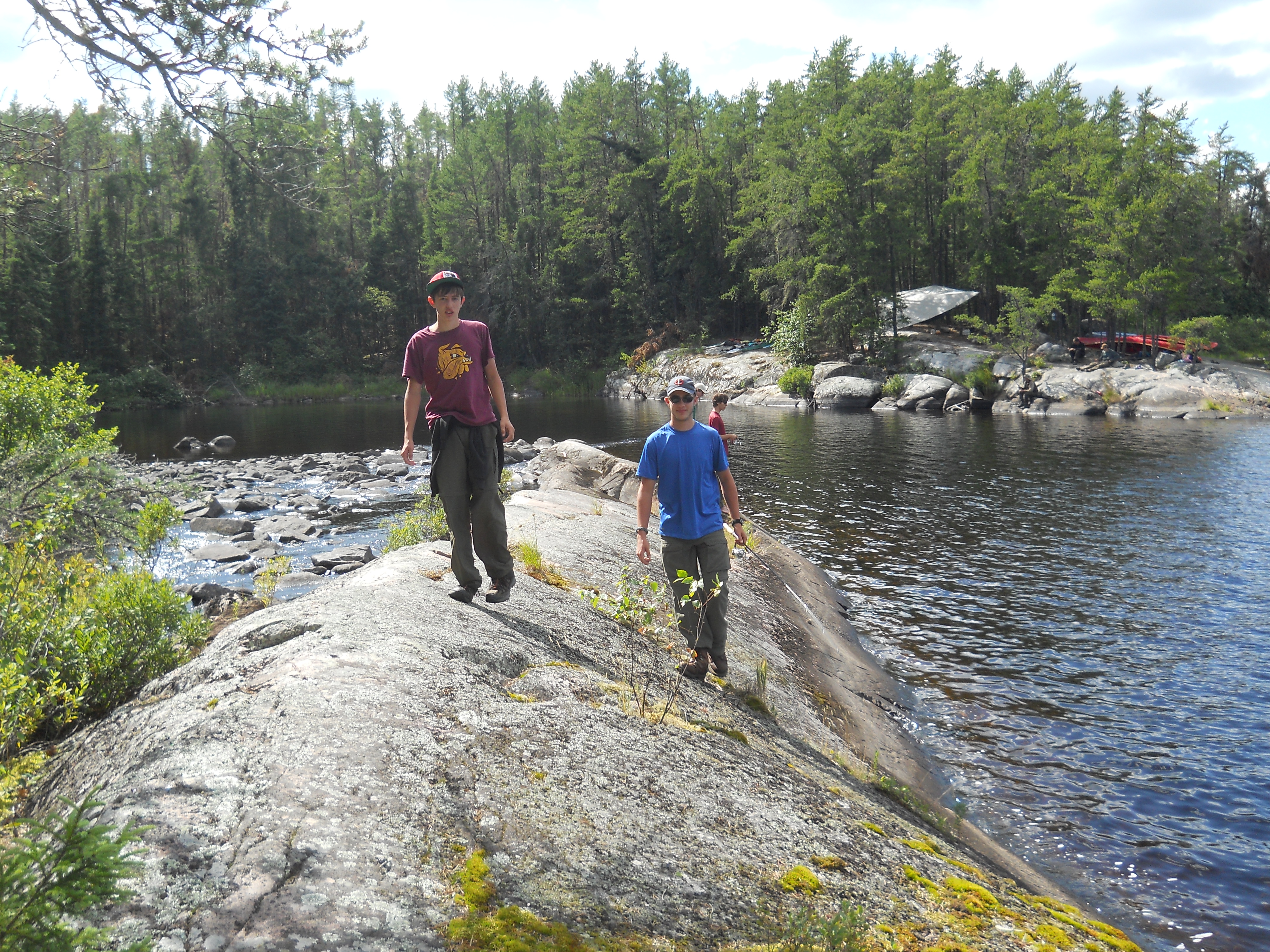
Zac Von Ab and Jack Munger, Secret Lake Falls. Note the campsite directly behind them where you can listen to the music of the falls entering the lake.


As depicted in the above photo, Secret Lake boasted not one, not two, but three BWCA-quality sites, two of which the separate squadrons of our group inhabited before splitting into the adventurers and the fishermen (and woman, sorry Heidi-you did your part too!). But then there were times when, as shown in the previous snapshot of Mr. Von Arb on Bunny Lake, or earlier in the trip, on East Lunch Lake, where the campsites designated on the map either didn’t exist or had been obliterated by storms.

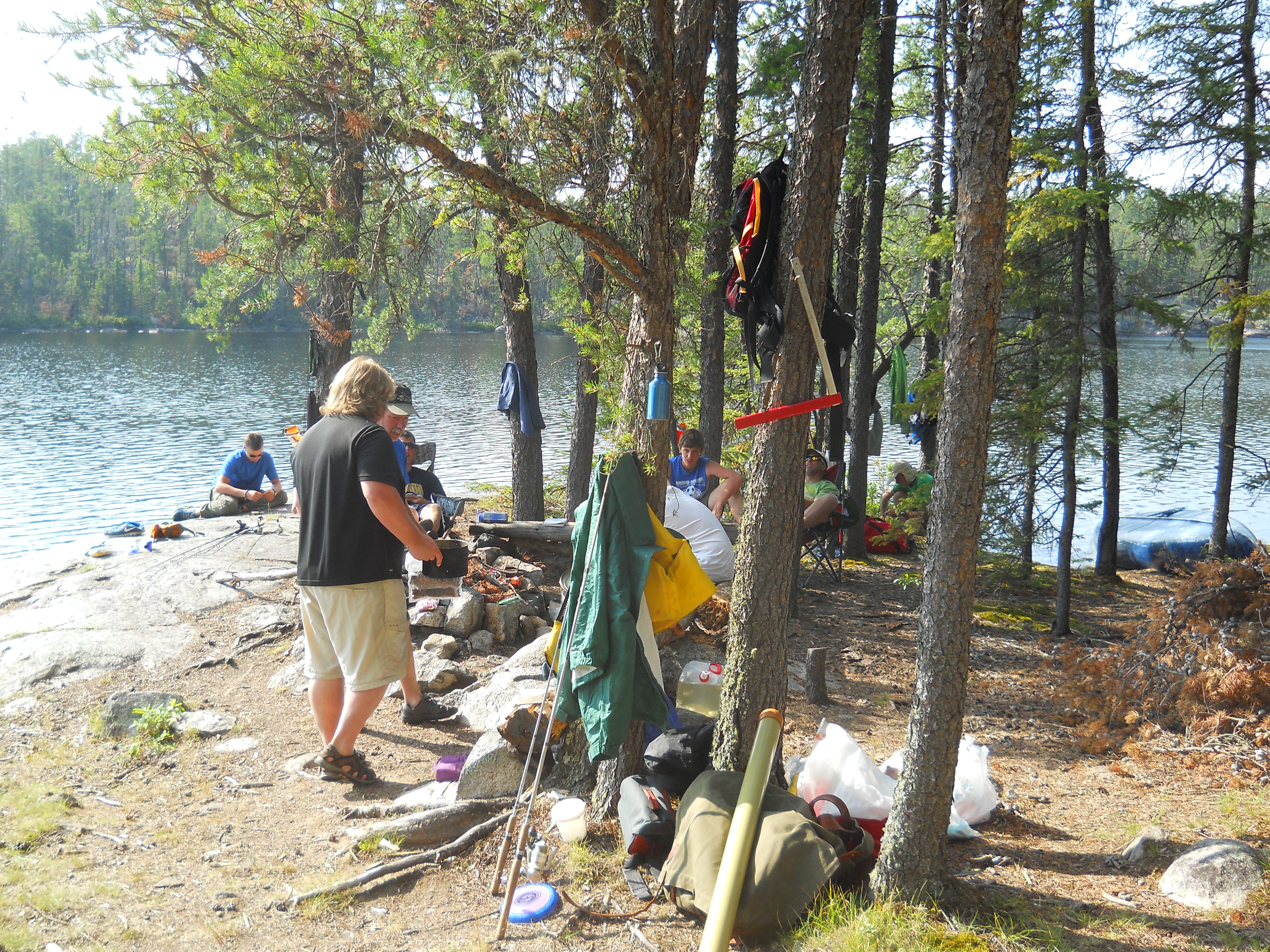
Our first night, which we spent on East Lunch Lake, was essentially an experience in sleeping on bedrock.
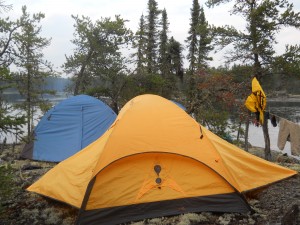
Site on East Lunch Lake


Thank God for the weather. Other than a rainstorm our first day on the water, which repeated itself as we slept on the rocky outcropping on East Lunch, we never encountered rain, or even wind until our time was done and we were back on Leano Lake searching for the invisible portage to the parking lot. Every day was sunny, warm, pleasant, and, though it’s repetitive to say so, bugless.
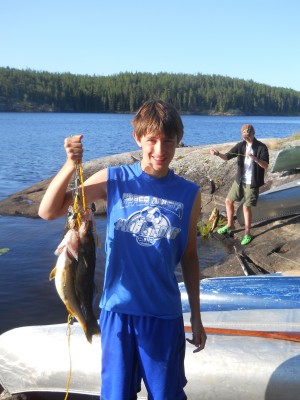
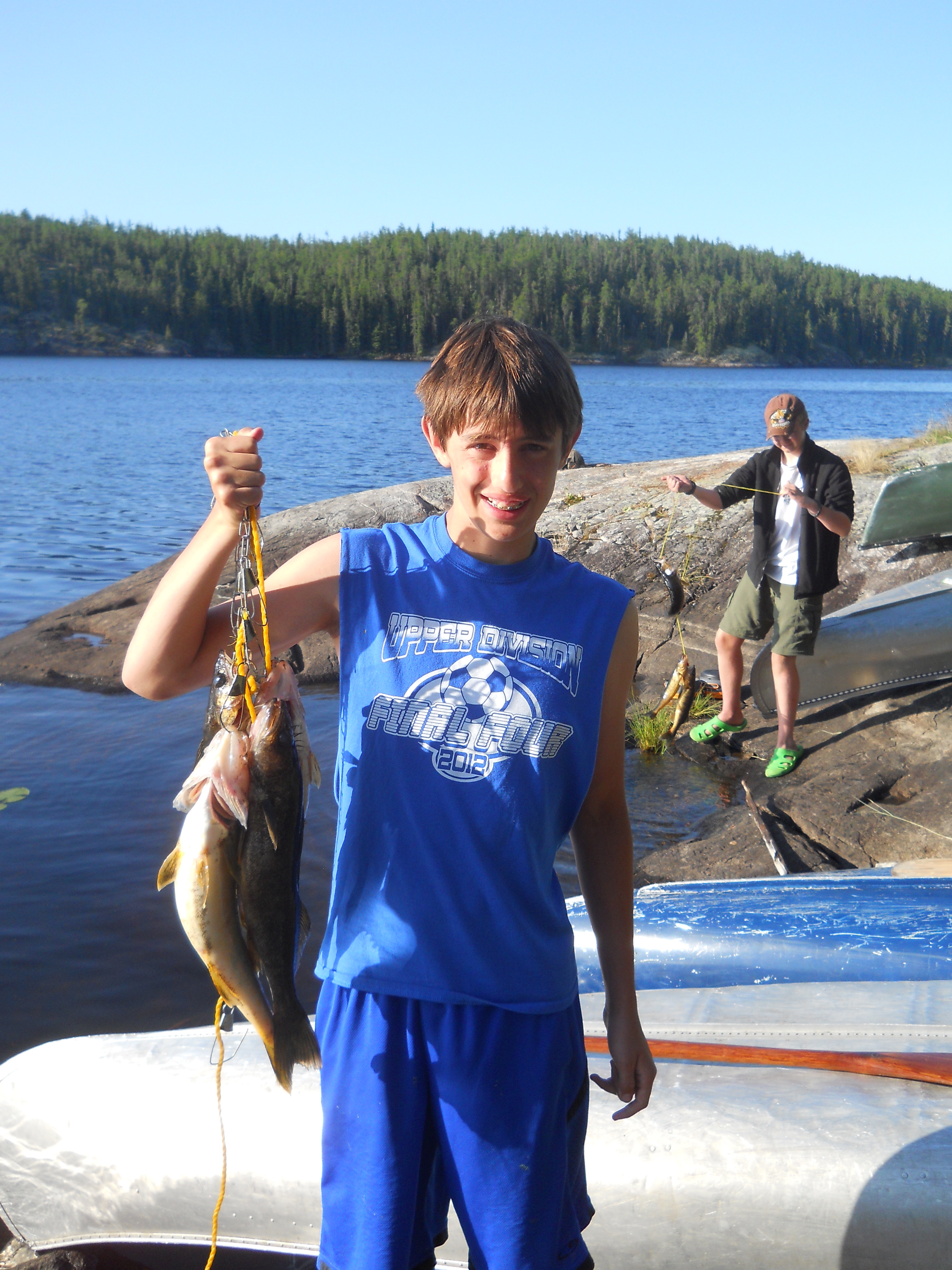
Jack and Nick Mallet holding some of the walleyes we cleaned for breakfast.

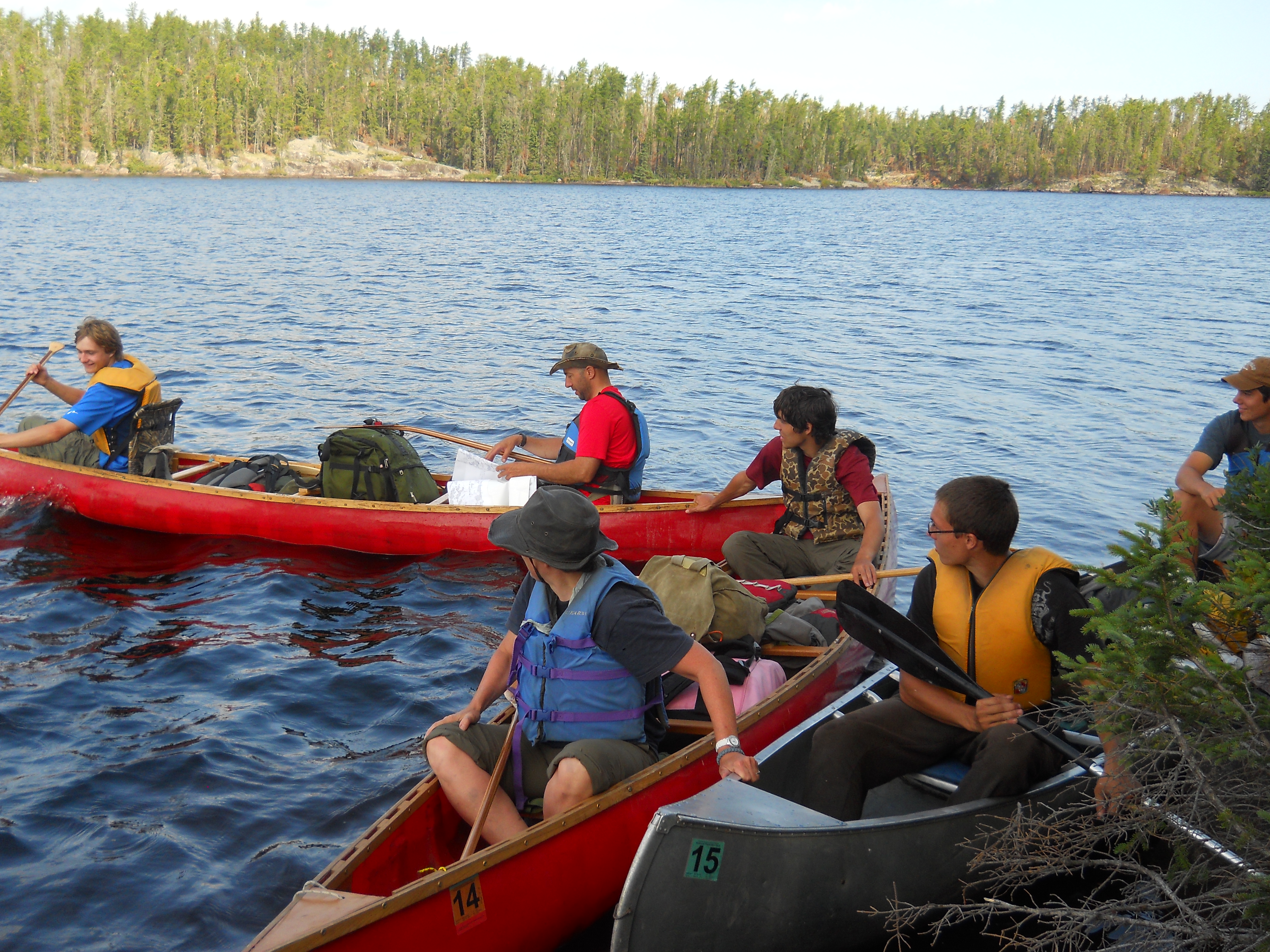
After being separated from the adventurers for two days, the fishermen reunited with the vision questers to paddle out as a group.
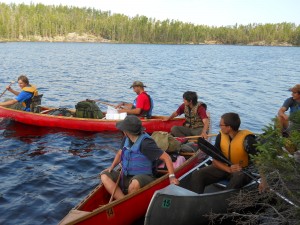
The adventurers return.


On the way to Leano Lake, I marveled at how tan and strong my adolescent son had become in one short week. Not that everything was always perfect in our canoe. Oh no, that would be a lie. We had our moments, like when Jack was grousing that I wasn’t paddling in the stern while he was trying to fish. He was frustrated, I think, because everyone else seemed to be catching walleye but us. His tone hinted disrespect. I splashed water at him with my paddle. We were in danger of getting into a row in the middle of the lake where everyone in the fishing group would have a ring side seat. But then, a walleye hit Jack’s jig. He set the hook like a pro. We began to catch fish and the storm passed. Funny how northerly bred walleyes, which fight so much deeper and stronger than their warm water cousins, can change a kid’s perspective on life.
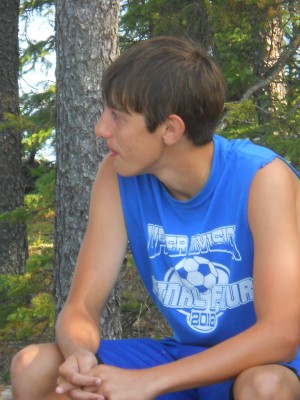
Jack Munger


Once the two groups made the parking lot at Leano Lake, all that was left to do was secure our gear, tie down the canoes on the four vehicles in our caravan, and make the long, dusty trek back to Red Lake where pizza awaited.
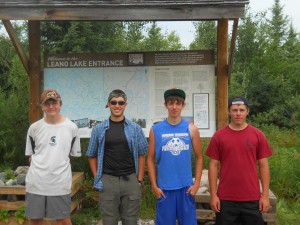
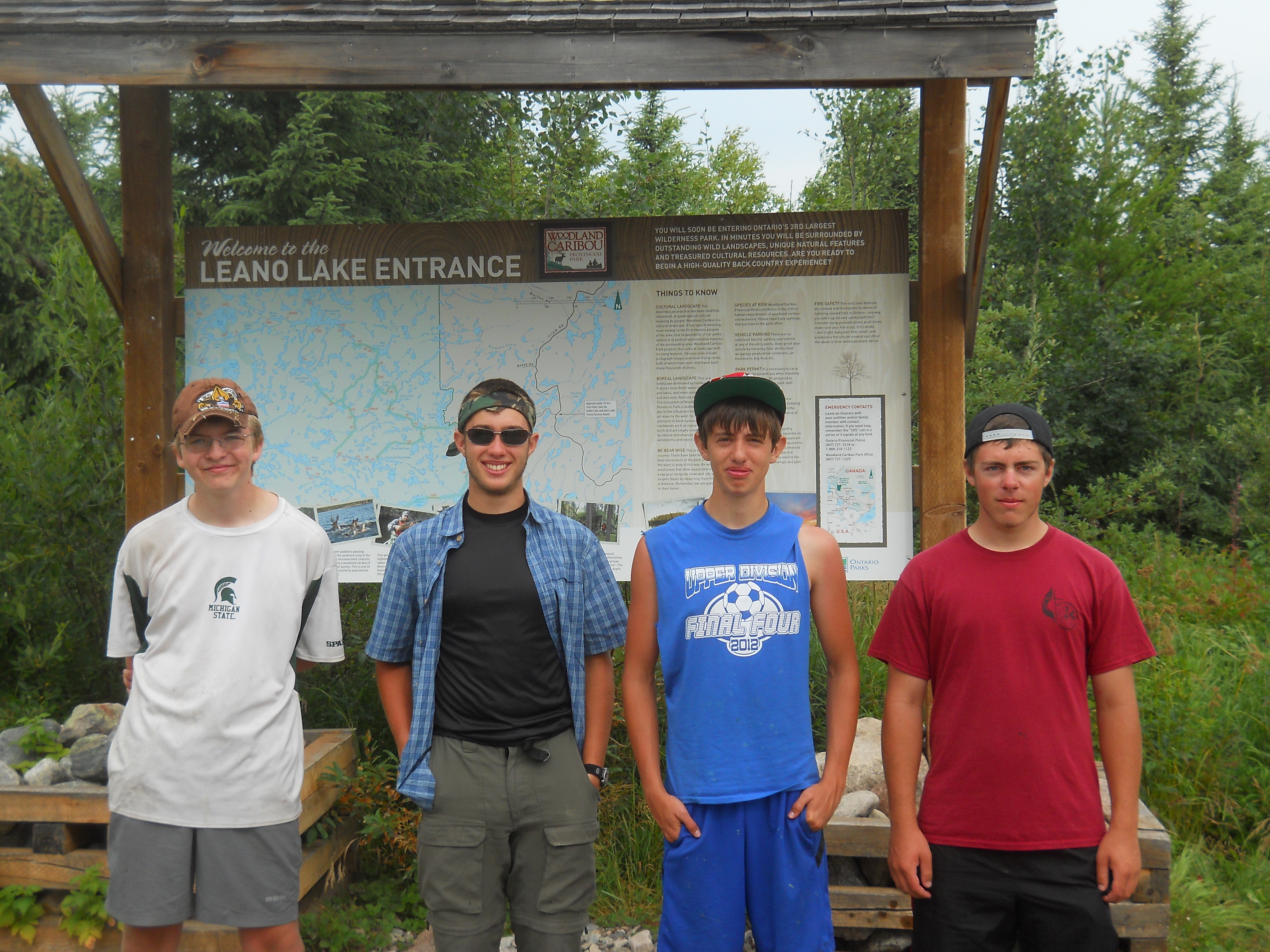
The four amigos (Nick Mallet, Zac Von Arb, Jack Munger, and Josh Hendrickson) at Leano Lake.
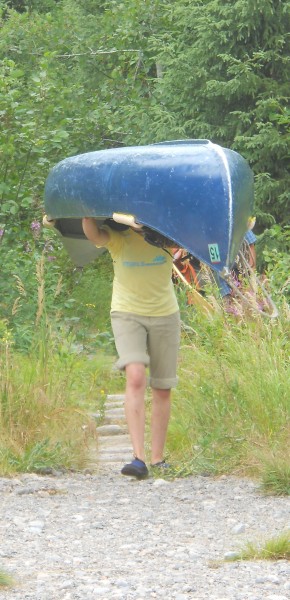


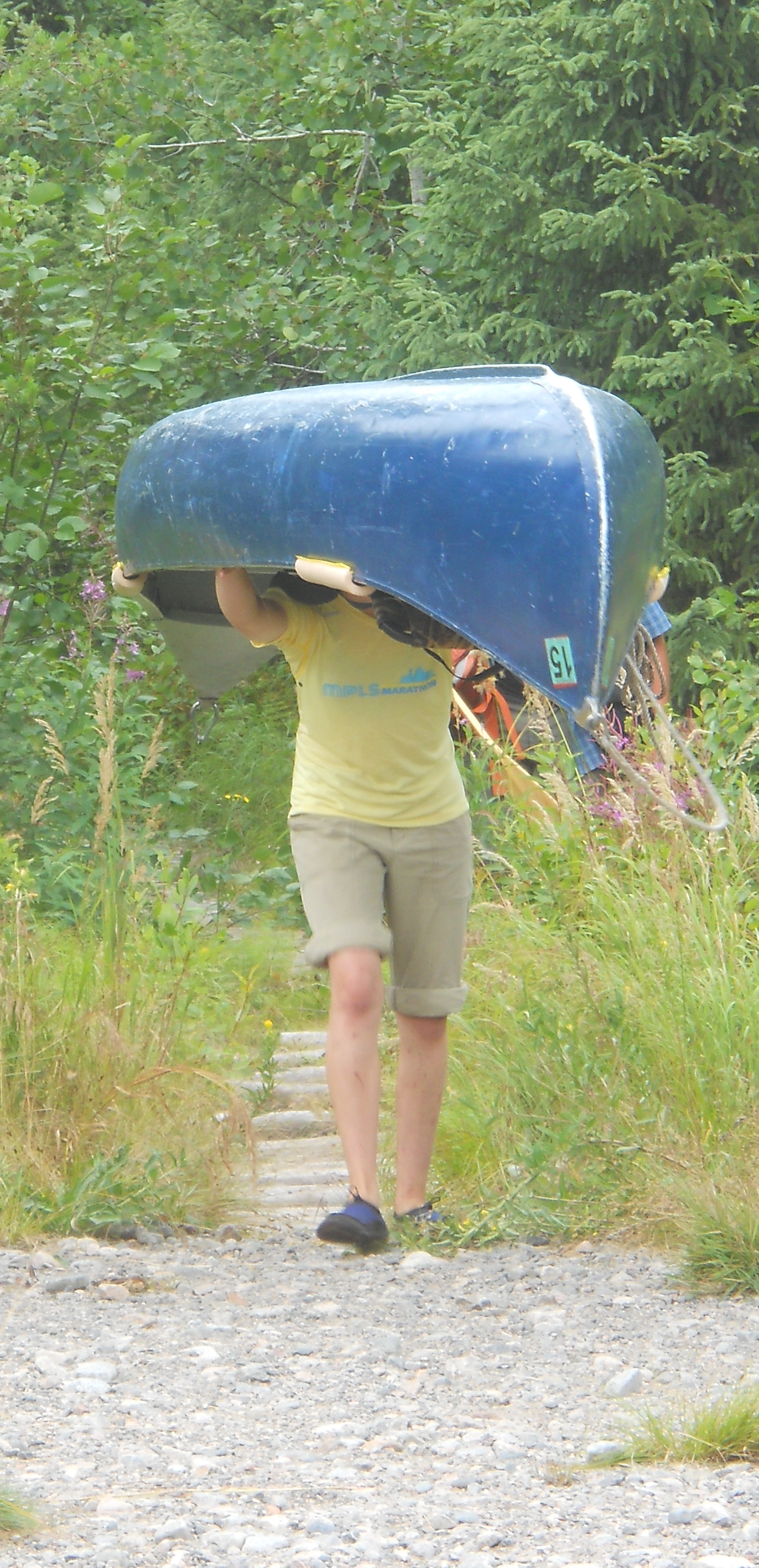
Heidi  on the final portage

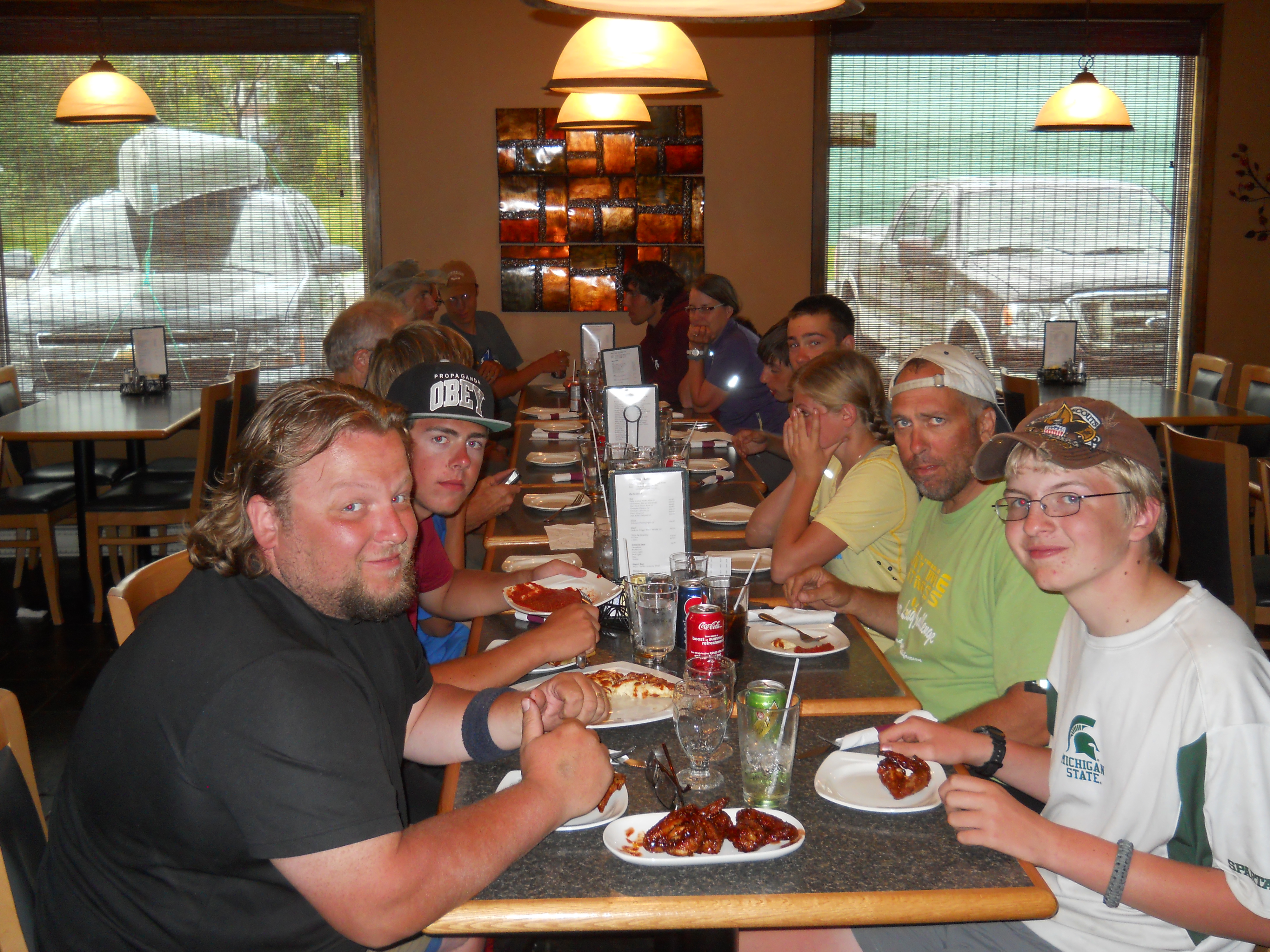
Rumors of a Pizza Hut proved false. But we lucked out. Antonio’s, it turns out, a place that, from the outside, looks like a hole in the wall, but on the inside, rivals the finest Olive Garden, had big pizzas, hand-made, cooked to perfection, and at a price far less than one would pay at a chain. It seems Troop 106’s good fortune held even in town.
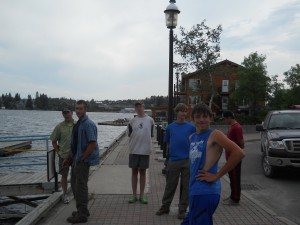
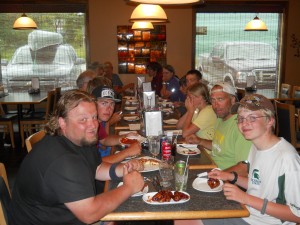
John & Nick Mallet and crew at Antonio’s


Then it was off to Pakwash Provinicial Park for our last night of camping before the eight hour drive home. Pakwash is akin to the Minnesota state parks you may be familiar with. It has spots for tenters (like us) and RVs, pop-up campers, and everything in-between all snugged along the shoreline of beautiful Pakwash Lake. I put on my swimming suit, gathered up my toothpaste and soap, and headed for the sand beach, foregoing the hot showers that Jack and everyone else went off to enjoy. I think I chose the lake over the showers because, well, I just didn’t want the magic of the trip to end. After scrubbing my near-naked body with a bar of Dove and cleaning a week’s worth of gunk from my gums over a cold water tap, I wandered down a gravel lane to the beach. The shoreline was deserted. Alone, my aching back, hips, knees, and shoulders finally at ease, I waded into Pakwash and let the cold waters of Northwestern Ontario surround me. Threatening skies sped to the east after lobbing a few splats of rain on my newly muscled shoulders and arms. There would be no rain to ruin the evening.
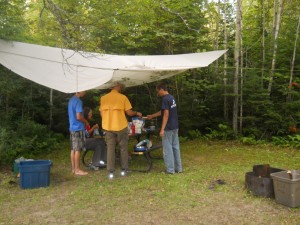
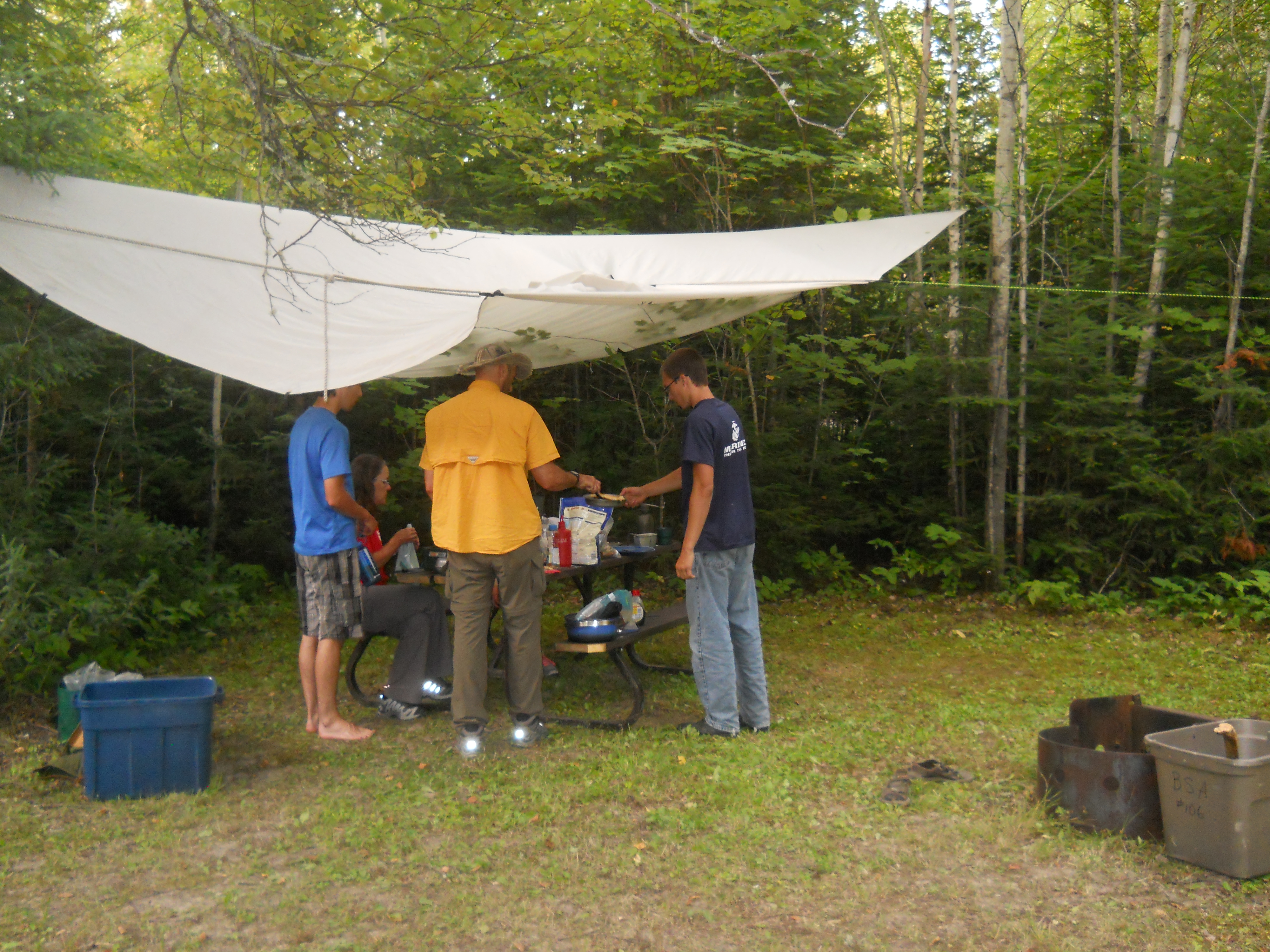
Final camp @ Pakwash Provincial Park, ON.


Peace.

Mark
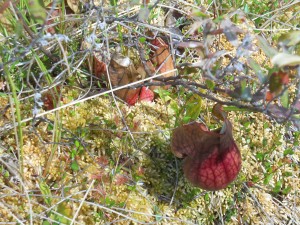
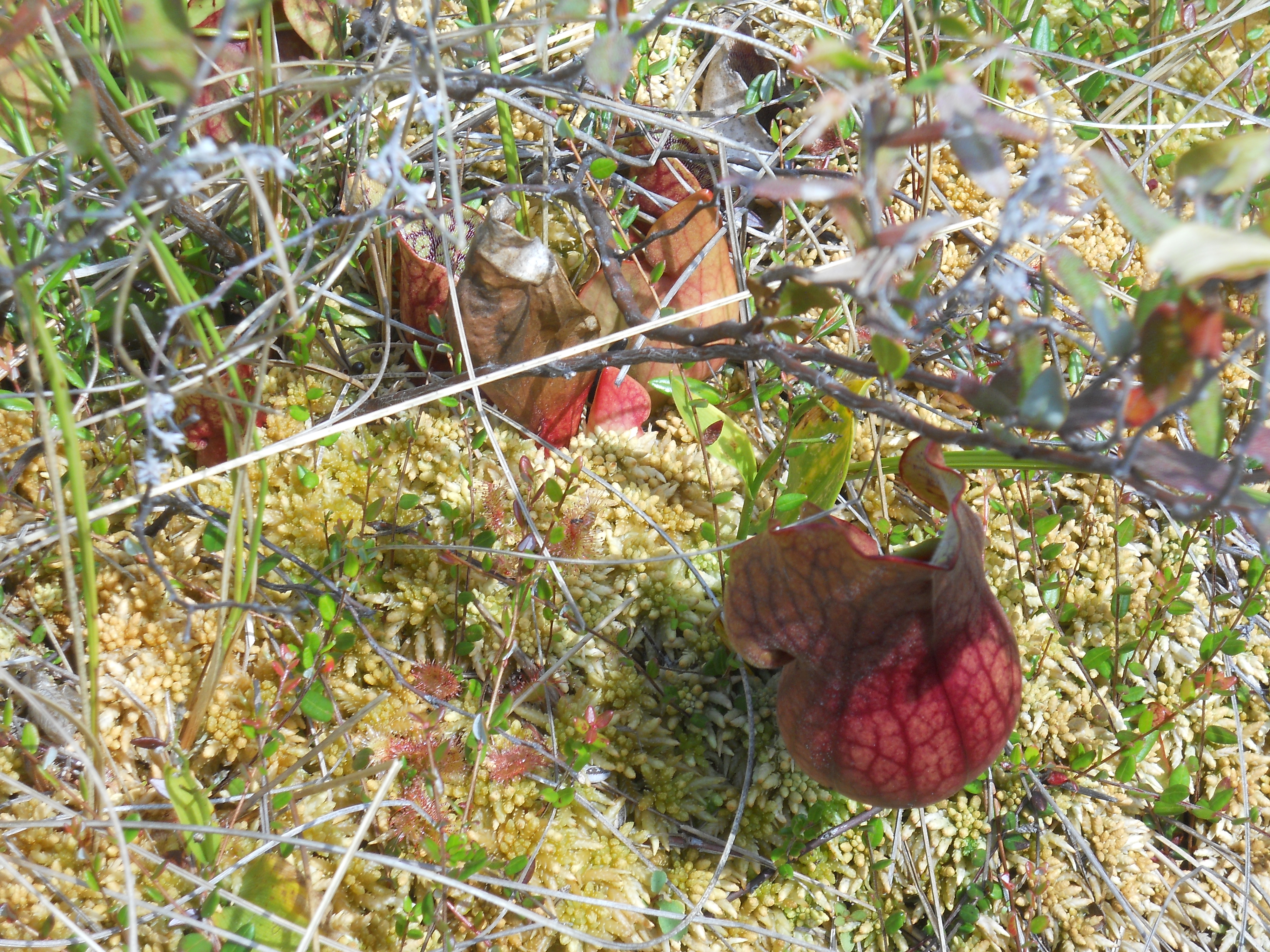
Pitcher plants, Woodland Caribou Provincial Park, ON

A special thanks to Jim Belden, former Scoutmaster of Troop 106 for all his work in making this indeed a trip of a lifetime.


Posted in Blog Archive | Comments Off on Caribou

Floggin’ in the Deep Grass

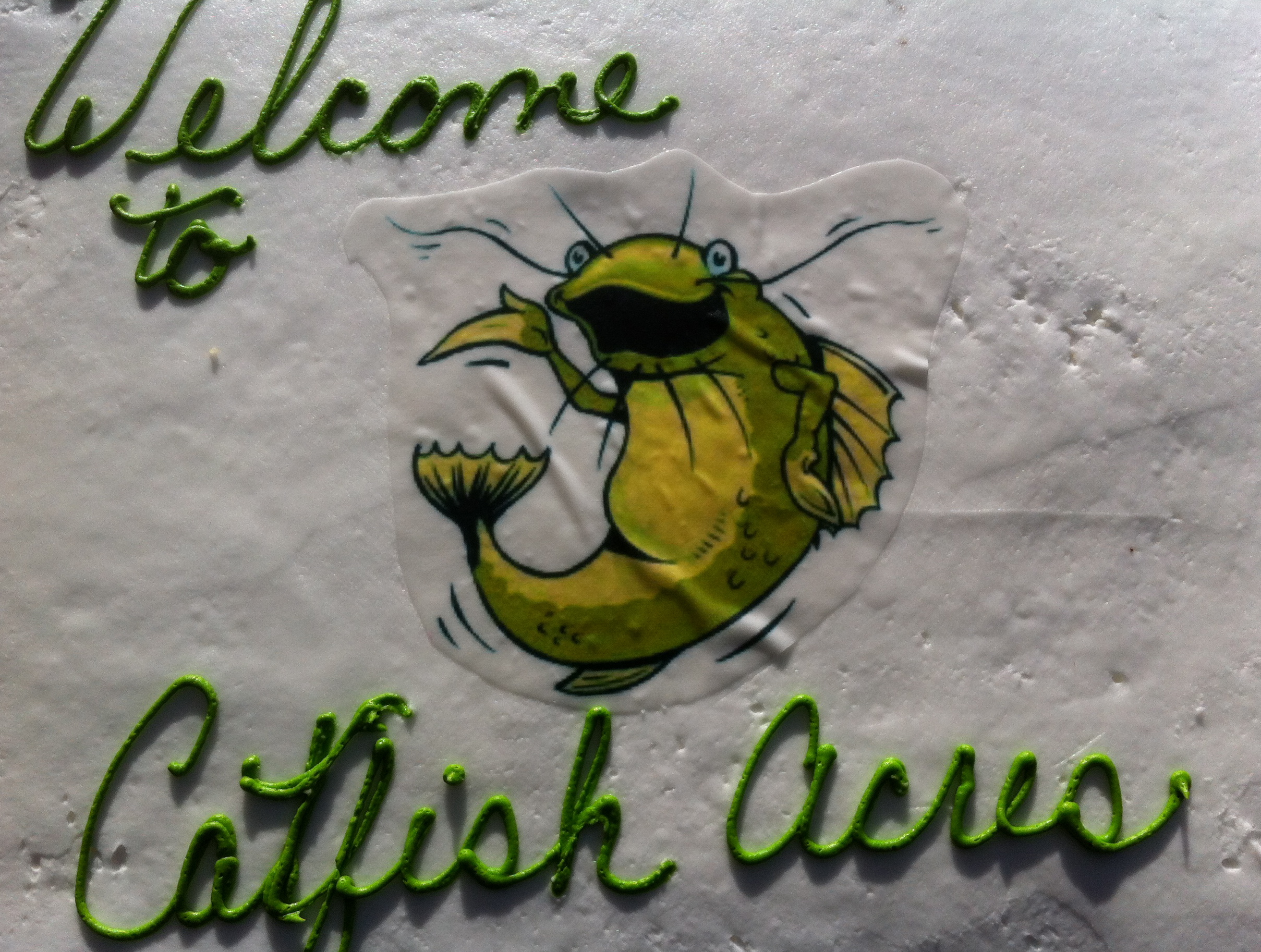
Cake courtesy of Mary and Dave Larsen

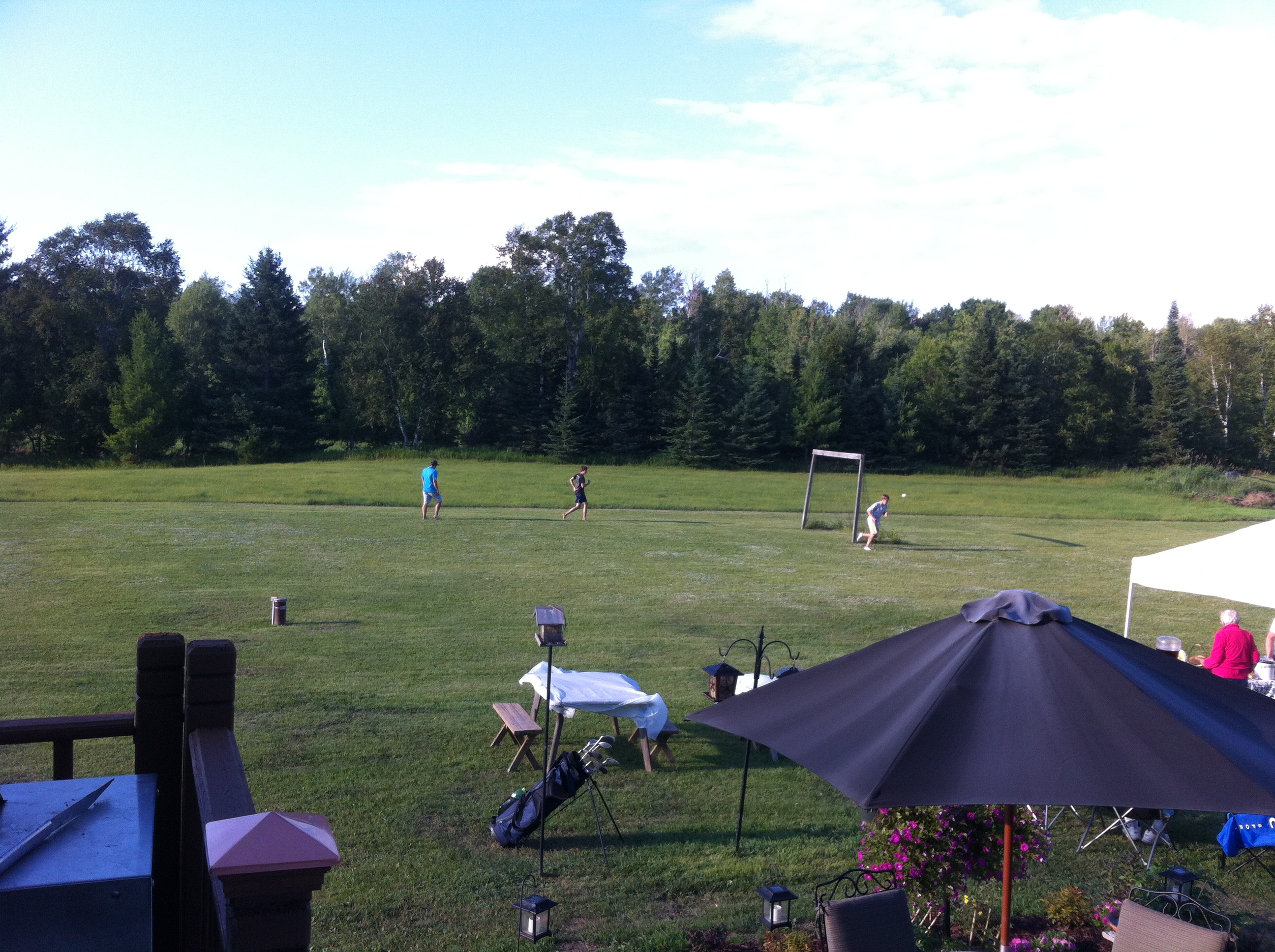
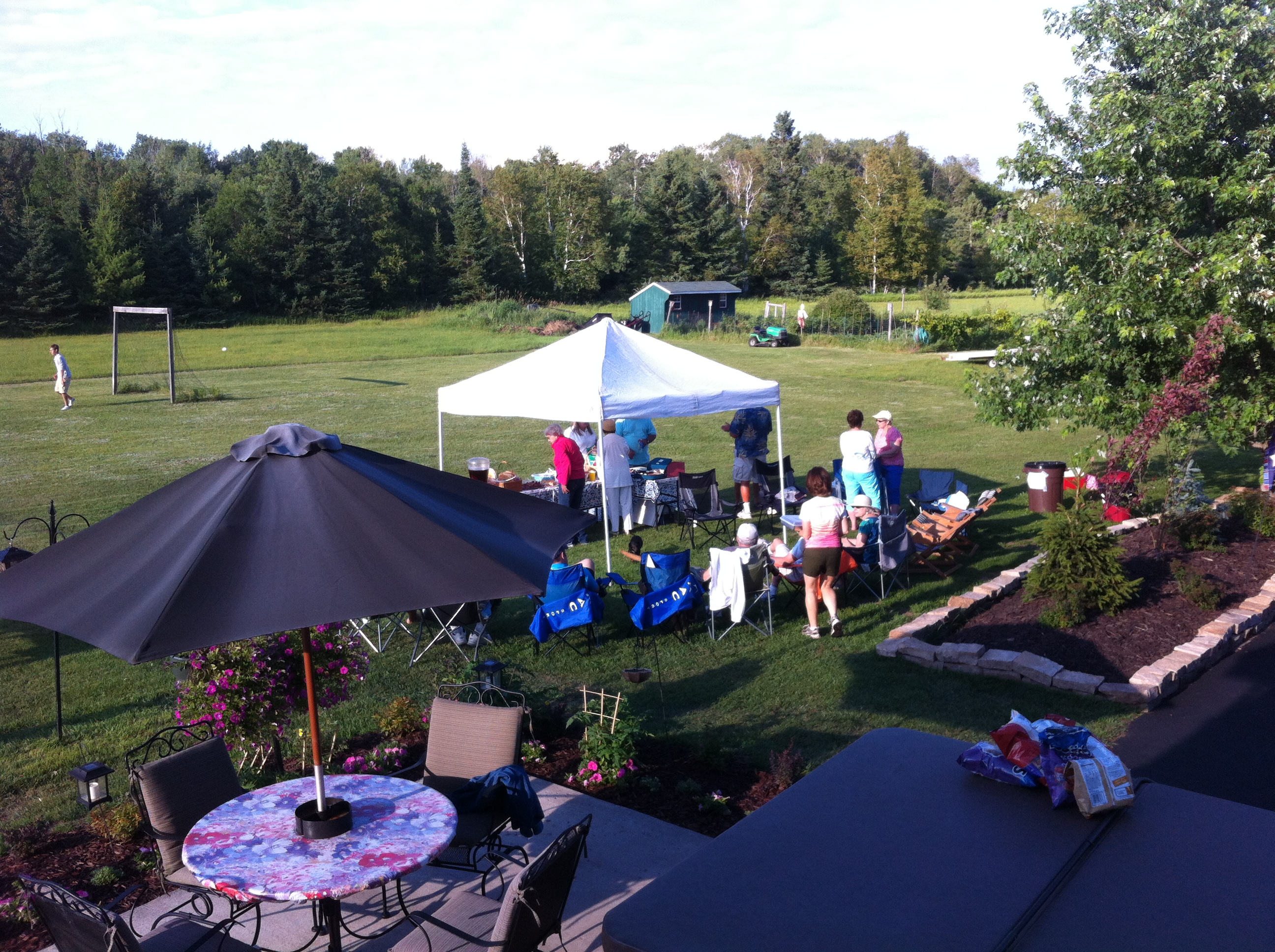
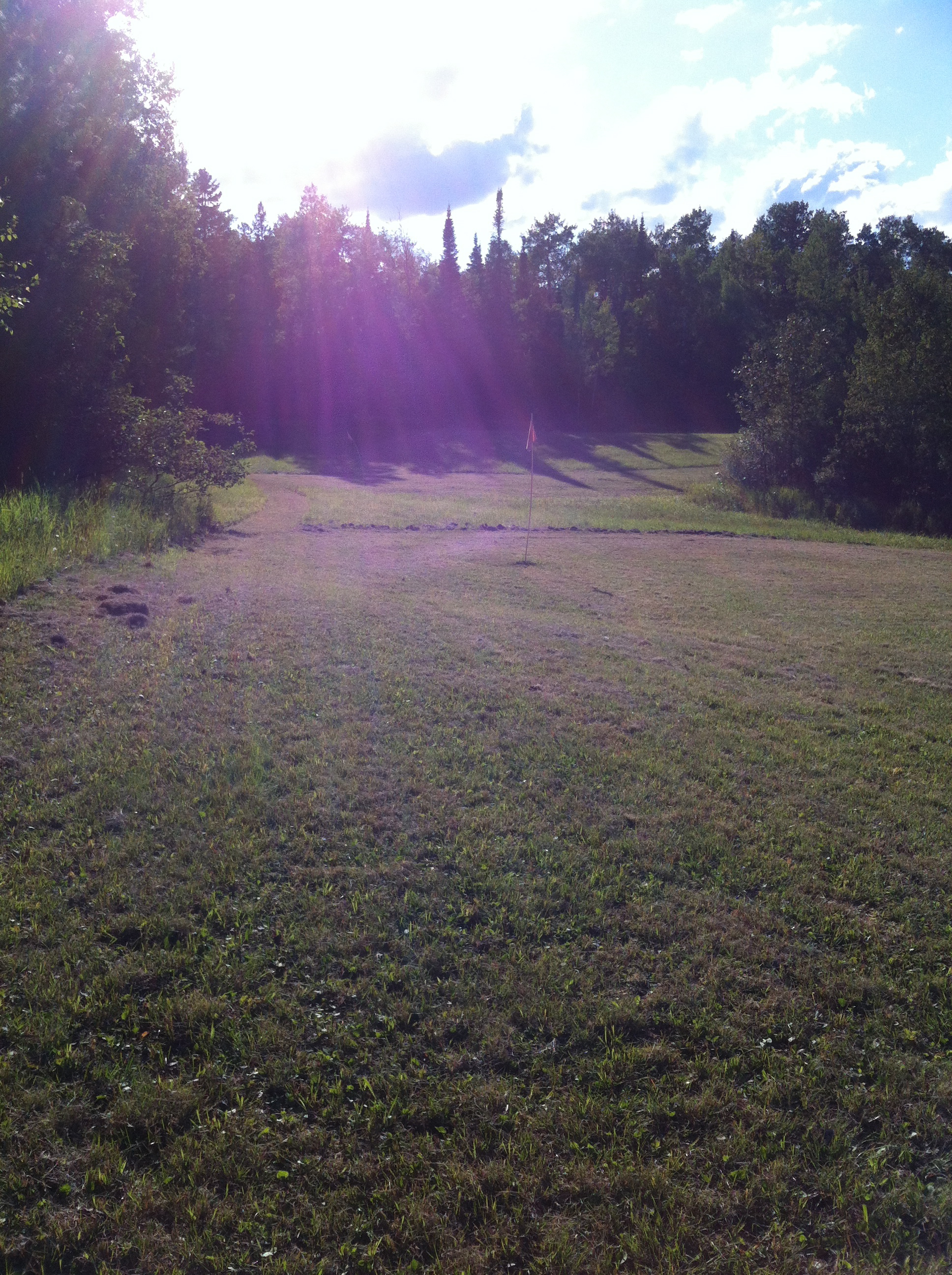
Seventeen intrepid floggers (that’s what golfers on our pasture-based course have come to be known) and a handful of walkers, gawkers, and spiritual advisers managed to find their way to the Munger Farm on the banks of the Cloquet River Saturday for the not-so-annual, whenever-Mark-feels-like-holding-it, Catfish Open. This is the third time in a decade that, after the Larson boys have hayed our field, I’ve mowed fairways and greens and put in flags and cups to denote something close to a Scottish Highlands golf course. This year, the weather couldn’t have been better: sunny, mild, a high in the low 70s, and just enough breeze to keep off the flies. The mosquitoes, on the other hand, seemed content to lurk under the foliage and, whenever the course drew players to tee boxes or greens in the shadows, the skeeters swarmed like Japanese pilots bent on crashing into air craft carriers. DEET didn’t deter the littler buggers ardor for human blood. Only moving into sunlight seemed effective. But despite the bugs, it was a grand day for a floggin’ tournament, one that featured shots of amazing quality and skill.

The event featured four teams of 4-5 floggers per group, all staggered around the course for the shotgun start. Because of heather-like rough (deep enough to swallow a man) and very tight, tree-lined fairways capable of consuming even the prettiest drives, I placed complimentary jugs of used golf balls on the 1st and 5th tees, Lose a ball? Take another. Seems fair to me. Since folks drove all the way from town to join my cavalcade of fun, the least I can do is supply used balls to whack into the pines. As reported in a previous blog, my first tour around the course this year, I lost five balls on nine holes. Oh, it got better. By the third time around, I only lost one. Saturday, I also positioned four of our picnic table benches around the course so oldsters like myself (and my eighty-year-old-plus father and step-father) could, you know, take a load off. Nothin’ fancy. Just a place to rest your keister while waiting to flog.
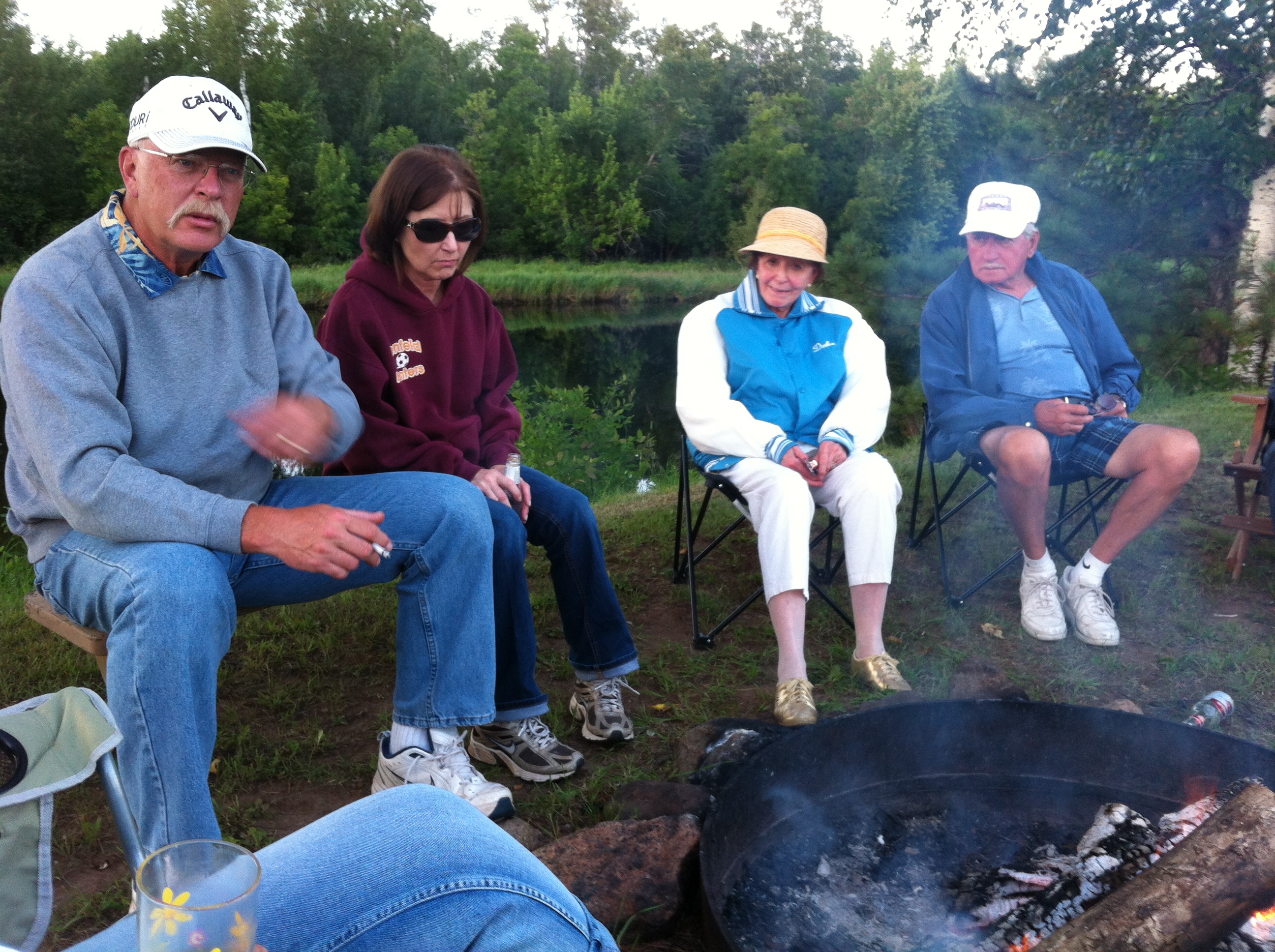
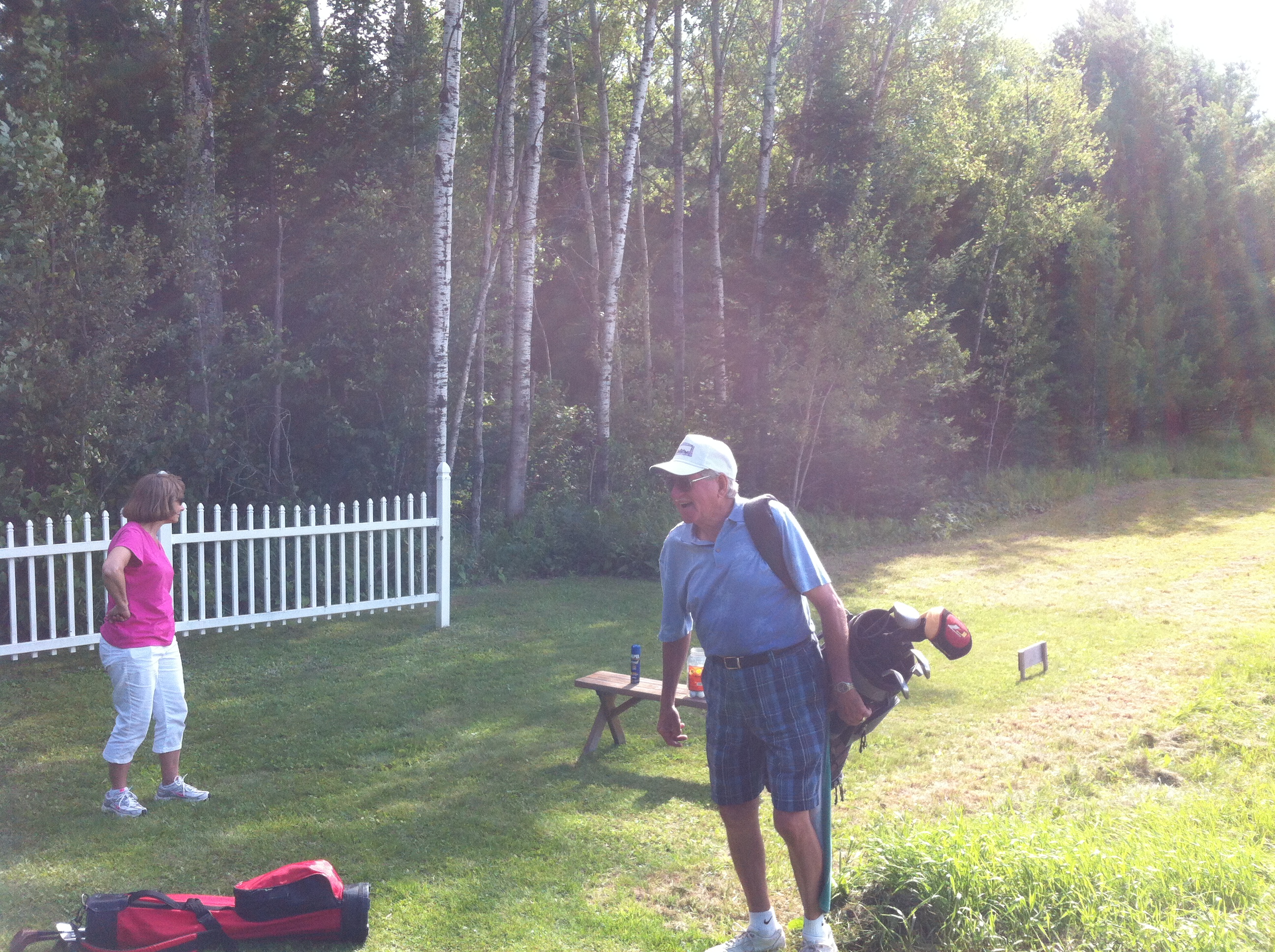
Judy Streefland and Duke Tourville, 1st Tee

Keeping up a regulation floggin’ course is no easy chore, what with familial duties, work, and other chores getting in the way. As the week approaching the great Open sped by, I knew I was in trouble. The fairways and greens were reverting to pasture, and the holes (really just those little plastic containers you buy plants in) needed re-situating. Our fifteen-year-old son Jack offered to help mow. But our rider is slow and it would have taken Jack eight hours to mow the course on his own. I didn’t want to have to cart Eddie Salveson’s riding lawn mower from town again. Remember, he’d come out two weeks earlier to help me give the fairways and the greens their first cutting. With time running short, I hit on the idea of asking Ron McVean (a neighbor and close friend who wasn’t able to attend the event) to loan me his riding John Deere. But Ron did me one better. He showed up Friday, the day before the Catfish Open, with his mower. In the blink of an eye, Ron had his rider off the trailer, fired up, and cutting grass. Between Ron and Jack, they had the entire course and the lawn done before noon. It’s a good thing to know retired guys with riding lawn mowers.Thanks, Ron, for pitching in.

Saturday. The four groups assembled around the course. Duke Tourville was the captain of my team. Eddie, the odds-on favorite to win the title and fabulous prizes (there were no prizes, not even a trophy) headed up another group. “Honest” Bruce Larson, CFO of Best Oil, Co. in Cloquet, captained Team No. 3. And Colonel Dave Larsen (US Army, Ret’d.) was the leader of the fourth and final bunch of floggers. The event called for 18 holes but, due to a late start and Suzie Salveson’s aching knees, the girls pulled the plug on the contest after everyone had completed nine. It was likely a good thing. With all the balls sailing around, my liability insurer breathed a sigh of relief when we ended the contest early. Plus, the mosquitoes hiding beneath the tree canopy continued their assault without mercy. My grandson AJ ended up looking like he had chicken pox due to all the bug bites on his face and neck. No, it was a wise decision by the women folk to override my zeal. I’m a pretty good ideas man but, when it comes to executing events ( including family canoe trips) sometimes my mind wanders into fantasy land. Nine holes was, at the end of the day, plenty for all concerned, including the author and golf course operator.

As foursomes were finishing, I fired up the grill. Once my wife (and assistant course manager) made it safely in from the field of play, the women assembled a feast of Arthurian proportions under a white EZ-Up tent that once served as my mobile bookstore. Brats and dogs sizzled. Our son Jack, his pal Nathan,and our older sons Chris and Matt played an impromptu game of football (we Americans like to call it “soccer”) on the back lawn. Beer tops were popped. Cocktails were poured. I tabulated the scores.


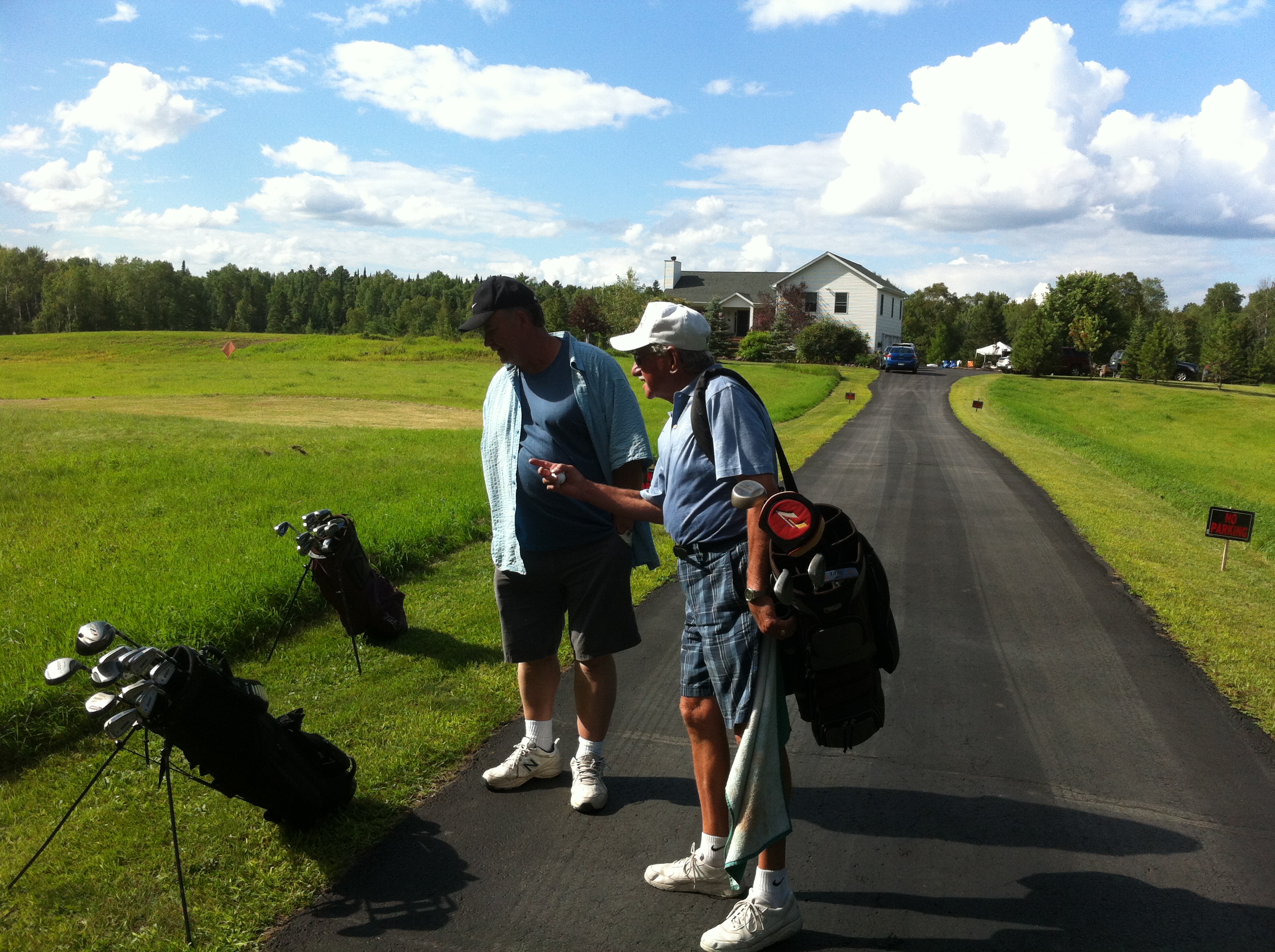
Paul Lund and Duke Tourville

The soccer game


As expected, my retired fire fighting pal Eddie squeaked his team to a one stroke victory. Duke Tourville and Colonel Dave’s teams tied for second place, though, in a moment of executive decision making, I declared Duke’s team to be second and the Colonel’s misbegotten clan to be third. Since I was on Duke’s team, a protest was lodged with the executive committee. But since I am the executive committee, redress was denied. “Honest” Bruce Larson, who, as a CPA, never met a number he didn’t like, computed his group into last place, apparently oblivious to the “new” math that most floggers rely upon when reporting their scores.


Gathering for dinner

Col. Dave, Roni Town, Mary Larsen, and Jan Larson


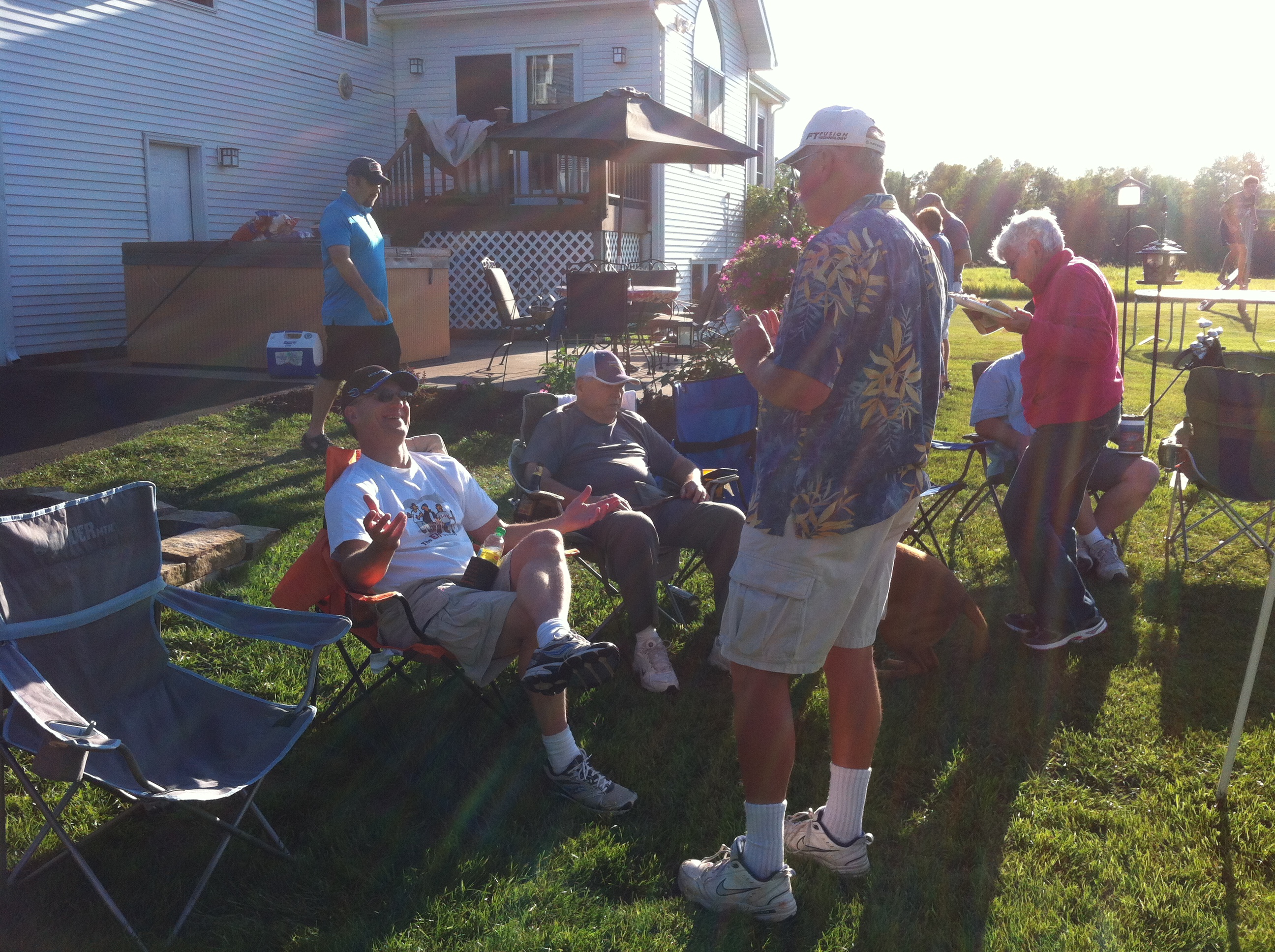
Eddie Salveson explains politics to “Honest” Bruce Larson and Harry Munger

The Mungers and the Larsons dine on the patio


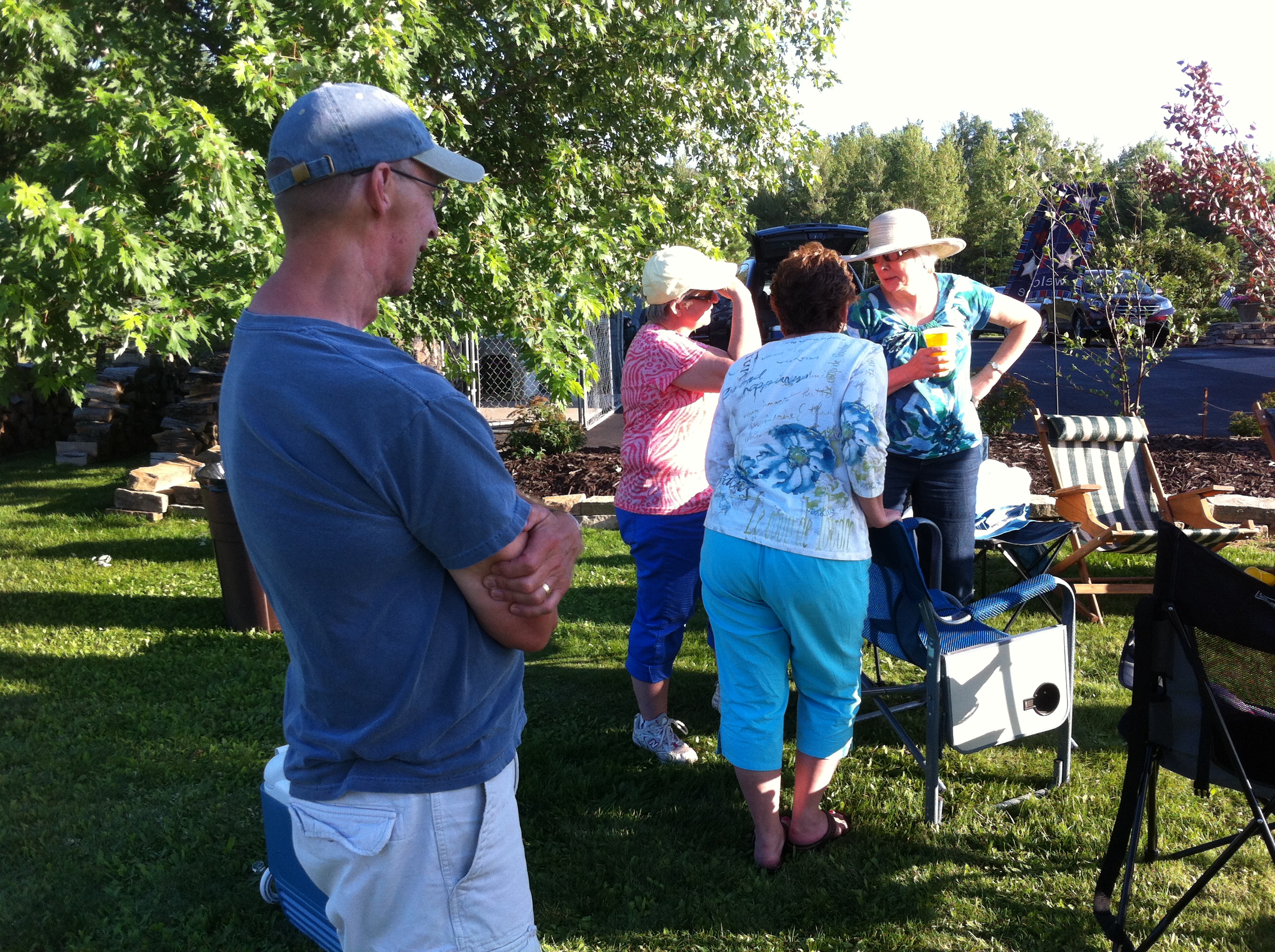
After dinner, conversation, and an adult beverage or two, I toddled off to start a bonfire down by the river’s edge. One by one, the couples who’d shared Catfish Acres with us said their goodbyes. As dusk closed in around the field and the fire crackled, Roni Town, Rene’ and I, my mom and Duke, and the Salvesons claimed seats around the fire and talked a bit more, relishing memories of soaring white balls and flailing clubs.

The Salvesons and Tourvilles around the campfire

No. 1 green, Catfish Acres Country Club


Thanks to everyone for coming out to share a glorious day on the River with Rene’ and I. Hopefully, we don’t wait four years to do it again…

Peace.

Mark


Posted in Blog Archive | Comments Off on Floggin’ in the Deep Grass

An Anniversary

Today I celebrate the day my wife Rene’ trusted her instincts and said “I do.” Understand; it wasn’t really a reciprocal deal. She was the one who had to take the leap of faith in saying “yes” to my proposal. I was a flighty, weird, nerdy, day-dreaming sort of mystic who thought he knew something about life but had not clue about how to be an adult. Not that Rene’ was a saint or anything. No, she wasn’t that. But I think she had a clearer view of the days ahead for us than I did. The amazing thing, is, despite whatever clarity she was able to assign to our future, she took a flyer and plunged ahead. That’s damn trusting, as anyone who knew me back in the day will attest.

Tonight, while I am busy talking to my fellow judge Eric Hylden’s book club about my latest novel, Laman’s River, the wife of my four children, my girlfriend, the love of my life, and the best cook a man could ever hope for, will be, as she has for over three decades, cooling her heels at home after a tough day of work. She’ll be trying to keep our new Lab puppy from peeing on the carpet. She’ll be trying to have a heart-to-heart conversation with Jack, our fifteen-year-old-going-on-forty son, the last of the Munger boys left at home. And she’ll be there to snuggle with when I return from chasing the very same dreams that have eluded me for the better part of our life together.

I love you.

Peace.

Mark


Posted in Blog Archive | Comments Off on An Anniversary

One of the Good Ones

Today marks the retirement of a fine journalist. Mark Stodghill, a fixture around the Duluth News Tribune for as long as I have been a lawyer and judge (over thirty years), is putting the old dust cover on the Underwood, placing his No. 2’s in an old “Grandma’s Marathon” coffee cup, ripping off the last pages of his last notepad, and turning in his final story. Those of us that have known Mark as the guy who covers crime and the criminal justice system will miss him. Why? Because Mark could always be trusted to write a fair, balanced, and thorough version of any particular investigation or trial no matter how sensational or scintillating or sordid the facts might be.

I first met Mark when, after having my head shaved bald and fresh from twelve weeks of basic training at Fort Dix, New Jersey as an enlisted man (I joined the Army Reserve at 26 to pay off my student loan debt from law school), I joined a host of other young and not so young professionals playing basketball over the noon hour at the Duluth YMCA. I was never much of a ballplayer as a kid and certainly didn’t improve with age. But to keep up my “fighting weight” (I lost not only my hair but 30# in boot camp), I decided to join the noon-time games for exercise.

There were some mighty good ballplayers in the mix; former Duluth high school legends Rodger Hanson, Lew Rickert, and Thor Sorenson (now Pastor Thor) were always involved in the “A” game, a serious never-ending battle featuring the top players in the gym. Chief County Prosecutor Gary Bjorklund, private investigator Dan Olson, and Dr. Chris Chapman  played in the “A” games as well and Stodghill was right there with them, a talented ex-college ball hawk and shooter. Some of the guys who took the court for those contests (none that I’ve named here) behaved as if those games were preludes to future greatness. Those guys made it tough on novices like me and my fellow Denfeld alum, Chief Public Defender Fred Friedman, and neurosurgeon and former college football star, Dr. Bob Donley. It’s not that the three of us were unathletic. We simply weren’t ex-college or high school basketball stars. We could run the court. On occasion, we could put the ball through the hoop. And Donley and Friedman in particular could certainly occupy the paint and rebound. But we weren’t in the same class as the real “A” players and when, on occasion, the top game needed additional bodies and we were allowed into the inner sanctum, well, we didn’t exactly measure up.

But as intense as Stodghill was on the court during those tilts, he never once demeaned or talked down to the “B” level guys who were pulled in as extras. I stand by this observation: You can learn everything you need to know about a man or woman’s character on the playing field or the ball court. And what I learned about Mark’s character during those games is that he’s a class act, not one to rest upon his past glory or place himself above folks who might not share his athleticism.

After tearing my left ankle pulling down a rebound during one of the “B” level noon games (Donley tended to it, thought it was broken, and made me go to the ER), I hung up my game and, once the cast was off, went back to running at noon. My acquaintanceship with Mark was put on hold until I filed for election for an open judicial seat in 1998. Mark covered that election and was the first person to call me from the press after the polls closed.

“How does it feel, Judge Munger?” he asked.

My family and friends and supporters were gathered at Blackwoods in Proctor waiting for the election results on television. Given that it was the same year Jesse “The Body” became governor and that there were more interesting contests for the news to cover than a bland judicial race, those gathered at Blackwoods had no idea where I stood in the polls before Mark called. His question confirmed that I’d made it, that seven months’ of hard work had paid off.

“I think you’re telling me I won.”

“Correct. Would you like to comment?’

After that night, our professional paths crossed regarding many cases, notorious and otherwise. Having started my collegiate education as a journalism major, I always appreciated Mark’s candor, his honesty when asking questions. With Mark, “Off the record” meant that what I was telling him would never appear in print and never be used to embarrass me. “On background”: same thing. And if Mark needed information about a case that wasn’t confidential or otherwise protected from the press, but couldn’t be gleaned from the court file, I never hesitated to return his call and provide what he needed because I knew Mark Stodghill was journalistic integrity personified. Mark played the news writing game just like he played hoops: with passion and grit but always within the bounds of the rules. Not many athletes or newspaper men or women can make that claim.

Here’s to one of the good ones. Now, from one writer to another: Mark, it’s time to get started on that memoir…

Peace.

Mark


Posted in Blog Archive | Comments Off on One of the Good Ones

Not Quite Colcorton

River in the Wind by Edith Pope (1954. Scribners.)

My review of Pope’s seminal novel about race, which I liken to To Kill a Mockingbird in its tenor and complexity, appears elsewhere on this site. After being provided a copy of Pope’s best known work to review for the Rural Lit R.A.L.L.Y. website, I explored Pope’s career and bibliography to learn more about this forgotten literary figure. I came across a used copy of River in the Wind on Amazon and decided to give it a read. Despite the title to this review, the book didn’t disappoint me.

River in the Wind was billed, when it debuted in 1954 (the year of my birth!) as historical fiction. That label is only partly true. In many ways, the story is also a literary romance, chronicling the relationship between Thad Renfro, the son of an orange grove manager and his wife, and Medora King, daughter of federal territorial judge William King and his wealthy wife, Georgiana. Medora, only sixteen when the story begins, is placed in an arranged marriage with Moncure Lauren, a bland, uninviting bank speculator more than a decade Medora’s senior. Much of the plot involves exploring the loathing Medora feels for her husband and the love she retains for Thad, a boy approximately her own age. There is also the domestic drama of the Judge’s sexual relationship with a household slave, Delphie, to spice things about a bit in the King household. But beyond the domestic complexities of early 19th century frontier Florida, the story also involves history. In a markedly personal and detailed manner, Pope reveals the suffering on both sides of the Seminole Indian War that plagued much of the territory of Florida during the mid 1800s. Thad’s service in the United States Army, alongside veteran scout Jeff Orcutt and historic figures such as General Winfield Scott, is chronicled and brought to reality without little sentimentality or exaggeration. And was true in Colcorton, the author uses finely tuned descriptions of her native state as an adjunct to the human characters in the tale:

The scallops in the sand were etched in indigo as they walked homeward. Along the inlet and the air was a great traffic of sanderlings and dowitchers, godwits, and terns. Around the horizon the air looked thin, a colorless rim that merged into the blue. The sky about deepened to cerulean and overhead to cobalt. Medora and Thad passed the point and started up the river. The east bank was lit with a pink glow that, as daylight began its ebb, seemed less to be washed over than suddenly to gleam forth from grasses and trees. The western shore stood in its shadow, unadorned. Looking upward, Medora spoke as if bemused. “You’re wonderful and I thought you were just Thad.”

At times, as demonstrated by the line of dialogue quoted above, Pope’s writing deteriorates a bit as she attempts to render an accurate portrayal of two adolescents negotiating love and adulthood. And the romance, while fuel for the longings that drive Thad back to the King house in St. Augustine time and time again, thus propelling the plot towards its conclusion, does become a bit tiresome towards the end of the book. But the writing is, in most other areas, top notch and complex with more than enough spice, war, social justice, and intrigue to keep readers interested nearly sixty years after the book was penned.

All in all, a neatly crafted story regarding an area of the country that doesn’t get enough attention in historical fiction.

4 stars out of 5.

Posted in Books | Comments Off on Not Quite Colcorton