The Boogie Man Comes Back


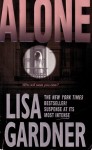
Alone by Lisa Gardner (2006. Bantam. ISBN 0-553-58453-7)

Bobby Dodge takes the shot. He’s a SWAT sniper and he needs to take a life to save two lives. He does. His world starts spinning out of control, manipulated by Catherine Gagnon, a woman whose entire life (since being abducted and molested by a brutal rapist/murderer) has been a cardboard cutout of the American Dream. For it’s Catherine and her perpetually sickly son whom Bobby saves with the shot of a lifetime, the lives of the shooter and the saved becoming inexorably linked.

Tautly drawn. Fast paced. Gardner knows her genre and this book will not disappoint her fans or those readers who love hard boiled crime novels. But, having said that, I’m always a bit disappointed when I get done with a book like Alone, one often called a “beach” or a “summer” read. There’s plenty of characterization here. That’s not the issue (with maybe the exception of the main bad guy, a hulking, brutal stereotypical boogie man (child abductor) who is really scary but not very interesting). Setting? A bit on the perfunctory side. Dialogue? Exactly what you’d expect and demand out of a crime novel set in modern-day Boston. Plot? A tad predictable. (Spoiler alert: I figured out that the kid’s mysterious illness wasn’t Catherine’s fault pretty early on in the game.) Gardner even beat me to the punch by having a misbehaving judge as one of her central characters (as will be true in my own forthcoming crime novel, Laman’s River. See “Other Writings” and click on the title for an excerpt). My wife liked this book immensely. I won’t use that same adjective but I will agree it was first class entertainment and a good choice to break away from watching another “Law and Order” rerun on satellite.

The book promises much more depth and nuance than it ultimately delivers and that, in the end, is a bit disappointing. But take this review for what it is: A critique written by a writer whose usual fare runs to Chekov and Hemingway and only occasionally wanders into the realm of genre fiction.

3 and 1/2 stars out of 5.

Posted in Books | Comments Off on The Boogie Man Comes Back

Mom’s Hometown

The trains are relentless in Wadena. Every twenty minutes or so, another diesel-locomotive-pulled assembly of open hopper cars full of coal or tank cars  full of volatile chemicals or box cars full of goods rumbles through the center of town, whistle shrieking, wheels clacking. If there’s a customer at my table in the Author’s Tent of the Affaire de Arts in the little grassy park and a train is coming through, we stop conversation until the train has passed. There’s no point, as my mother would say, in shouting.

The drive over from Duluth was glorious. After days and days of mist and cold and fog and rain, the sun has broken through. Between McGregor and Aitkin, a solitary sharptail grouse set its wings and glides across Highway 210 in a wash of brilliant white light. It’s rare for me to see a sharptail: In my “neck of the woods” we have spruce and ruffed grouse but sharptails, inhabitants of grasslands, don’t live in the Cloquet River Valley. I’ve never been privy to the elegant dance the male birds do; puffing up their red cheek sacks and strutting and weaving like teenagers at their first school dance. I don’t get to see the dance today: Just one lone bird sails off to wherever it is sharptails sail.

There were no clouds at 6:30am when I began my drive west, my Pacifica loaded with books, a small exhibit table, and bin of promotional supplies. Traffic was sparse. Even the blue hairs at the Black Bear Casino in Carlton were in short supply. There were only a few tentative white tail deer standing alongside the road. None chose to commit suicide by car. I passed through Brainerd. Motley. Staples. And finally, Verndale before arriving in Wadena, county seat of Todd County.

I had emailed one of my sister judges, Judge Sally Robertson, about my coming to her town. Never received an email back so I figured she was on vacation. I know her a bit, from committees and gatherings and her singing along with my departed friend’s (Judge Jeff Rantala’s) sweet guitar licks. Woody Guthrie tunes. Beatles’ tunes. Steve Goodman tunes. Jim Croce tunes. You get the picture. Other than Sally, I don’t know anyone in Wadena. My mom was reportedly born here, back in 1928, when her father, my grandfather, was traveling through with his pregnant wife and nature decided my mom should make her debut. But Mom never, to my knowledge, actually lived here. So I don’t expect an adoring crowd of her long-lost friends to show up.

The park we’re in is right next to the old railroad depot. The depot’s no longer active as a passenger station. If you want to board the Empire Builder bound for Seattle you’ll need to do it a few miles to the southeast, in Staples. After setting up my table and books, I had wandered into the old depot to use the restroom. The place was spotless, as if, should Barack Obama’s vision of restored passenger train service ever come to fruition, tickets could be sold, loved ones could be hugged, and passengers could board trains pulling east and west from central Minnesota.

Not in my lifetime.

I have pleasant discussions with my fellow booksellers. The fellow next to me, a nice man who has written a couple of slender regional novels, talks optimistically about selling “50,000 copies” of his books. I don’t have the heart to tell him I’ve been at this self-publishing game for the better part of twelve years and that 5,000 copies of one novel still remains a vision, a distant jewel suspended just outside my grasp.

Maybe it will happen for him.

I’ve read enough in Poets and Writers, on the Internet, and in other writerly magazines about publishing and selling fiction to know that the man’s optimism, while charming, is fatally flawed. Still, you can’t blame a guy or a gal for believing in himself or herself.

All of us here, from the eighty year old lady selling history to the judge pawning his novels (and a thick biography of a politician few folks outside Duluth have ever heard of) are filled with hopes and dreams. And that’s not a bad thing for a writer, for any creative person, to hold on to.

Traffic in the park is sparse. What I thought would be a sweltering day turns out to be pleasantly cool, a wind blowing in from the northwest keeps the air fresh and the need for a fleece pullover omnipresent. I sell a few books. I meet up with Judge Robertson and we engage in small talk. I sell books to an attorny/city councilor and his wife. The judge promises to stop by with her husband to continue our discussion. A female potter, a fellow vendor at the show, leaves her booth and stops in front of my table.

“I read this one,” she says, pointing to Suomalaiset. “There was something about it I didn’t like.”

Oh oh.

“You’re not Finn, are you?” she asks.

“No.”

“That’s apparent from the book.”

I marshal my artistic defenses.

“But that’s a book that’s universally loved by the Finns…”

“It would be.”

I can’t tell from her comment whether she’s a Finn who disagrees with my portrayal of the Red Finns (socialists, communists involved in the workers’ movement) or she’s a non-Finn who isn’t impressed with the Finns. But before I can respond, she startles me.

“Oh, I guess I’ll take this one (Esther’s Race) and this one (The Legacy) and this one (Pigs),” she says blandly.

I’m stunned. I accept her money, sign the books, place them in a plastic bag, and watch in amazement as she wanders back to her booth.

“That’s a first,” I say to a female mystery author in the “Minnesota Crime Wave” booth next to me.

“How’s that?”

“I’ve never had someone complain about a book and then buy three more.”

The woman simply shakes her head.

Judge Robertson stops by with her husband and some friends. She buys a copy of Esther’s Race. Her husband, who I learn is the director of the New York Mills Cultural Center, asks if I’d consider giving him five copies of Suomalaiset to sell at the Center on consignment. I was at the Center a few years back. I’d driven from Duluth on a below zero February day to give a talk about the Finns and the book. A prairie wind was whipping that day; snow was blowing and the mercury was falling. But I knew, since my audience would be primarily tough Finns, that if I made the trip, I’d have an audience. I made it and had a wonderful discussion with a dozen folks.

“Sure, no problem.”

I package up the books. Jamie (the judge’s husband) and I shake hands and they depart. It’s not long until the crowd thins from sparse to nothing and I pack it all in and head for home.

Peace.

Mark

Posted in Blog Archive | 2 Comments

Making Memories on Memorial Day Weekend


Eight paddlers. Four canoes. Eighteen miles of mostly gentle river. What could go wrong? My wife and I are not avid wilderness buffs but, over the course of our relationship (going on 35 years this summer; married for 33) we’ve enjoyed the occasional foray into the Boundary Waters Canoe Area Wilderness with friends or family. Last year (see “Low Water” in the Blog Archives of this site), our eldest son Matt, his wife Lisa (who had never been in a canoe), Rene’, our youngest son Jack, and I paddled Hog Creek into Perent Lake for a fairly uneventful and bucolic stay. This year, looking at looming book selling events, grad parties, baseball and soccer games, it didn’t look plausible to do another BWCA trip over Memorial Day weekend.

Why not take the canoes from our place down to Independence? That’s only a six hour paddle on very easy water.

When I broached the topic with my wife, she was all for it. When I emailed our three oldest sons, the response was negligible. It took some doing to corral their agreement. We set Sunday of Memorial Day weekend as the day for the big trip. Rene’ and  I would supply the pop, beer, chips, candy bars, canoes, paddles, life jackets and such. The boys and their significant others (Dylan’s girlfriend Shelly and Matt’s wife Lisa) would supply the memories. As the weekend approached, I kept a close eye on the weather. Saturday night, it still looked “iffy” to launch the canoes on Sunday. But Weather Underground predicted partly sunny skies and no rain until late in the evening.

It’s only a six hour trip, I thought to myself. If we get started by ten, we’ll be off the river long before the storm.

Logistics were completed by driving three cars, including my Pacifica towing a snowmobile trailer, to the parking lot at Independence. Matt drove his Outlander. Dylan drove Rene’s Matrix. We left the Pacifica and Matrix at the take out point to haul eight canoeists, four canoes, and all our gear back up river.

“Dylan, did you take the keys to Mom’s car?

“Right here in my pocket, Dad,” my second son said, patting his jeans.

The canoes hit water around noon. Trying to round up eight people and get them motivated to spend six hours in canoes on a day where the sky, though not raining, threatened to do so, wasn’t as easy as I’d thought. Still, once we were all seated and on the water, paddles dipping silver and the poetry of flowing water beneath us, I, at least was in heaven.

This is what I live for.

Chris, my third son (who had nearly backed out of the trip) fishes the river every week. He was hard at it as our canoes moved slowly to the west, a pewter gray sky, an ominous sky, overhead. He cast and cast and cast from our place to the first stopping point, Hunter Lake, where two loons dove beneath our canoes, appearing as black and white torpedoes in shallow water.

“I’ve never seen them up close like that,” Lisa said. snapping photos. “They’re beautiful.”

Earlier, as if on cue, a mature bald eagle had alighted at the very top of a white pine and taken notice of our presence. The newcomers to the river, Shelly and Lisa, were suitably impressed. The majestic bird led us down river for a bit until it found something else of interest and soared off.

Sometime later, we pulled up on the river bank and ate sandwiches. Dylan yanked wood ticks off him like fleas off an old dog. Speaking of old dogs, Shelly and Dylan had a duffer in their canoe: Layla, a black lab/shepherd mix who spent most of the journey patiently observing the antics of the humans around her from a bed in the bottom of a canoe. About the only excitement the dog was able to conjure up for herself was playing with the rotting carcass of a dead snapping turtle that Dylan took away from the dog and tossed into deep water.

At Bowman Lake, Chris caught a walleye, which prompted Jack and Chris to lag behind. Chris caught another walleye but a fool with a high powered outboard (better suited for Lake Vermilion than the tiny ox bow off the Cloquet River) kept roaring and revving the big motor, disturbing the tranquility and the fish.

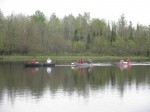
Just past Bowman, we ran into some old friends, Mary and Pete Bauman, whose sons had played sports with Chris and Dylan. The couple was enjoying the river in two small kayaks, fishing occasionally and paddling easily. Mary snapped the picture for this article sometime during our drift down to a new boat launch below Bowman Lake.

Between the lake and the landing, we were blessed to see a pair of osprey guarding their gigantic nest of sticks and twigs set high atop a power pole. The birds circled us, chirping alarm, as we floated on by and marveled at their wing span and their grace.

“A porta potty”, someone in our group said excitedly as we followed the Bauman’s to the new launch. Those of us who needed to use the facilities did so. The rest of our group exited canoes and stretched weary limbs.

The shoulders don’t move quite the way they used to.

“How far you going?” Pete asked us as we clambered back into our canoes.

“Independence.”

Pete paused for a moment and then said, somewhat mysteriously:

“Good luck with the rapids.”

I had done this trip before. Maybe fifteen years ago. I recalled one set of rapids, a fairly modest riffle, that we waded through in low water. Pete’s admonition didn’t seem to square with my memory.

“We’ll be fine,” I expressed with confidence.

The little rapids below where the Cloquet River Inn used to sit  (a quaint old burger and beer joint that was once a primary destination for canoeists but has since closed) didn’t cause any of the three canoes in our reduced group problems.

“I wonder if Chris and Jack will just go over to Dave’s and call us for a ride?” I thought aloud, knowing that the lure of walleyes at the junction of Bowman Lake  (where my friend Dave lives) and the river likely held sway over my third son.

Matt tried to reach Chris via his cell phone as we left the landing.

“Why do you have a cell phone with you on a canoe trip?”

“Never know when you’ll need it.”

“Electronic devices are forbidden on Munger canoe trips,” I said, pointing to the portable radio he had stowed in the bottom of his canoe so he could keep tabs on the Minnesota Twins.

There was no response from Matt.

Below the Highway 48 bridge, we started catching smallmouth bass. Chris, who had caught up to his lolly gagging parents and siblings,  was the first to pull one in. Then Matt landed a nice fish. Finally, Rene’ (who essentially duffed the entire trip so she could fish) landed one.

“How far to the cars?” Matt asked.

“About an hour,” I said.

Chris chuckled.

“Try about two.”

“No way. We’ll be there by six.”

“Try seven thirty.”

The sky doused us with modest rain.

We ran the first sets of rapids near Lost Lake without incident.

“I’m not running the rapids by the highway,” my wife announced after we cleared the last of the boulders.

“Oh yes you are.”

“Oh no I’m not.”

She returned to fishing. She caught a half dozen more bass and two nice walleye which we released. The day was about over when I finally got the message: The trip is not a six hour trip when everyone is fishing. It’s more like an eight hour trip. We’d be lucky to make the cars by dark.

“How far to the landing again?” Matt asked.

I didn’t respond. Chris chuckled.

As we entered the third set of rapids above the highway, Dylan and Shelly found their 18′ Grumman square stern  (a beast of a canoe for running white water) caught sideways. Layla, sensing a lost cause, lept from the canoe, flipping the vessel and sending the two young folks into the froth. Luckily, the water was only waist deep and wasn’t cold. The kids were fine but their gear and the canoe were another matter. Absent the weight of the paddlers, the canoe broke free of the rocks and sped downstream. Matt and Lisa caught the Grumman and brought it to shore. Rene’ and I retrieved gear further downstream and waited for everyone to catch up. Then we plunged through another set of rapids as a group without incident.

“I lost my cell phone,” Matt lamented.

“In the water?”

“No, I left it in the woods when I was going potty.”

Hence the prohibition against electronic devices.

Rene’, true to her word, exited the canoe at the next big riffle and made me pilot the craft solo through the rocks. I was nearly free of the turbulence when, to answer a question about the route from Dylan (who was a few yards upstream from the rapids waiting to descend) I turned in my seat and promptly found myself waist deep in the Cloquet. The canoe was fine: I maintained a grip on the stern and eased myself back in. But my pride was mortally wounded. I picked Rene’ up on the bank and proceeded downstream. Matt and Lisa were on shore, emptying water from their canoe. They had flipped their canoe in the rapids and had managed to fill the thing to the gunwales. It was a slow process emptying the Old Town by using a cooler as a bailing bucket.

Of the canoe captains, only  Chris escaped a dunking. Rene’ and Jack stayed dry by leaving the rapids to others and walking. Despite her protests, Rene’ and I ran the final set of rapids without difficulty.

At the landing next to Highway 53, I emptied our red plastic Coleman, a perfect canoe for a rocky, shallow river like the Cloquet, and portaged it to the waiting trailer. By the time I got back to the landing, evening’s gloam falling, my teeth chattering, we had a new problem.

“I can’t find Mom’s keys,” Dylan said as he checked the pockets of his soggy jeans.

“Did you lose them in the river?” Rene’ asked.

Our son paused.

“I think I left them in Matt’s car. On the console. I spaced out that we needed them.”

I took a deep breath. I’d miscalculated the length and difficulty of the paddle. The DNR map said the rapids we encountered are Class I, doable if you’re a novice. Well, maybe in an empty canoe with good water. In modest flow, with dogs and coolers and fishing gear, not so much.

“I messed up too,” I admitted. “We’ll work it out.”

The ride back was agonizingly slow. With four canoes strapped to the trailer, the load wanted to buck and pitch as soon as we left Highway 53. I drove 20-30 miles an hour all the way home. During that long drive, the title for this piece came to me.

“You know what we did today, kids?” I asked the three women and Jack.

“Got wet?” Shelly offered.

“Caught fish?” Rene’ asked.

“No, we made memories.”

“You got that right,” Lisa chimed in.

“That’s what I’m all about; making memories.”

The keys to Rene’s car were right where Dylan left them. Sopping wet, I drove Matt’s Outlander back to Independence. My three oldest sons and I loaded soggy equipment and clothing into the vehicles. I drove the Matrix. Matt drove his Outlander. It was after ten and quite dark by the time our journey ended. But there was no doubt: We  had made some memories.

Peace.

Mark


Posted in Blog Archive | 2 Comments

Only Half a Book


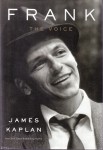
Frank, the Voice by James Kaplan (Doubleday, 2010. ISBN 978-0-385-51804-8)

I’m not a fan of serials. Oh sure, I own a collection of old Buck Rogers episodes from the 1930s and ’40s. And those bits and pieces of entertainment do, when watched sequentially, form a serial. But I can also, if I desire, watch DVD after DVD and, in the end, see the entire story. I thought, when I began reading Frank, the Voice I was beginning a biography of Mr. Sinatra’s entire life. I was wrong: It’s only half a book.

Kaplan does a thorough job of painting a mostly unflattering half-portrait of one of the most controversial and influential singers of the 20th century. Primarily a story of Frank’s early years and a chronicle of his first two marriages (the first to Nancy Barbato, the mother of his three children (though he was married four times, he only fathered children with Nancy), and the second, to film star Ava Gardner) the book ends the year I was born, 1954 though Sinatra’s life and long career in music (and film) was just beginning. I didn’t realize I was reading a truncated  biography until somewhere in the Gardner years, which seemed to drag on a bit despite the titillating details of their love life and the near-constant battles between the two stars.

At times, the writing is poignant and original: at times, Kaplan’s prose reverts to a Kitty Kelly-like lowbrow effort, using slang or street terms to flesh out the tale. Such linguistics might work in a tabloid newspaper article but just don’t seem appropriate in a book labeled “a biography worthy of the man” as declared by one blurb on the back cover. Still, it’s hard to keep your eyes off a train wreck and that’s where Kaplan’s story, at its best, places readers: In an armchair across from The Voice as he and Ava (and to a lesser extent, Nancy) love and hate each other until they’re exhausted.

In the end, the author paints Sinatra as a brilliant vocalist with a complicated set of wants and needs: A  man very clearly, despite flashes of decency and empathy, bent on creating his own place in the world come hell or high water. The passages dealing with Sinatra’s relationship with Gene Kelly, Montgomery Clift, and Lauren Bacall are classic and open the reader’s eyes to the person Frank Sinatra could have been had he been given a different childhood and upbringing. Facinating and, for the most part, well written, I still feel a bit cheated at only getting half the story from this book. If Kaplan’s at work on the concluding years of the singer’s life, I’m not sure I’m willing to invest another twenty bucks on the sequel.

OK. That’s not true. I love a train wreck as much as the next guy and Kaplan, despite the book’s flaws, has got me hooked.

4 stars out of 5.


Posted in Books | Comments Off on Only Half a Book

The Gloaming


Wake to the alarm at 6:00am. Make coffee. Exercise to “Body Electric” at 6:30am. Make the bed. Shower. Shave. Dress. Get Jack ready for school. Drive Jack to school. Get my ass to work. Deal with children in need of protection or services. Eat lunch at my desk. Set the alarm clock. Take a nap at my desk. Wake to the alarm. Deal with criminals. Drive home. Toss the baseball with Jack (still in my dress clothes, my tie flapping as I throw the ball). Change into casual clothes. Drive Jack to Boy Scouts. Take a trip to Office Max to pick up paper for the printer. Drive back to Boy Scouts. Chat with some other dads. Pick Jack up. Drive home. Try to get Jack to help carry the canoes down to the racks next to the river. Fail at that. Portage all three canoes (including the 18′ Grumman square stern) by myself. Feel my low back, where the fusion holds things together, cry out in protest.

And then the best part of my day happens.

The gloaming: that time of dusk or twilight when the sun settles below the ridges and trees along the river to the west, and the light begins to fade over the silver black water. I sit on steep wooden stairs leading to the Cloquet River. Mallards quack and fly against blue turning black. A pair of wood ducks races towards the Island Lake dam. A buck snorts across the hollow across the river. Daisey (our black lab mix) ambles down the stairs on arthritic hips and sits with me as the sun descends. The dog is needy. Her warm nose nuzzles my calloused hand for attention. I scratch her ears. She yawns, leaps an old dog’s leap from stairs onto the riverbank and slurps cold water with greedy delight. I hear no Canada geese bugling overhead. I hear no ruffed grouse drumming in the forest surrounding my place of contemplation. I hear only the occasional lament of a lone male mallard in search of love and the whine of tires against asphalt as cars and trucks speed over the bridge upstream from my sanctuary.

“Look,” I say to Jack, who’s now standing on the broad back lawn of our place.

Jack’s view of what I see to the east is blocked by trees. He moves. He still can’t see the miracle. He walks towards me.

“What is it?”

I simply point.

He walks a bit more. His eyes scan the treetops marking the edge of our field.

“Wow. I thought tomorrow was the full moon.”

Big, yellow and pockmarked, a nearly complete moon stands just above the crowns of a line of mature Norway pines.

Later, Jack and I take a hot tub under the yellow glow of Earth’s only natural satellite and talk about our day and what tomorrow will bring.

There is quiet in the valley as we close the cover to the spa and head into the house.

Peace.

Mark

Posted in Blog Archive | 1 Comment

Mostly, I Fell Asleep


Wake Up, Sir! by Jonathan Ames (2004. Simon and Schuster. ISBN 978-0-7434-4907-6)

OK. My title for this review is a bit harsh. To be fair, I don’t ordinarily choose humor as my choice of fiction: I lean to the dark, the serious, the literary. So I’m not the best choice to review this novel, a book proclaimed by The New York Times Book Review as a notable book for 2004. I’m not sure what the undaunted arbiter of good taste (The Times) saw in this novel. But then, who the hell am I?  What the hell do I know anyway? But, since I started to try to give you, kind readers, an “Average Joe’s” view of Mr. Ames’s book, here goes.

The premise of this tale is that Alan Blair, a once published, now writer’s-block-plagued Jewish novelist hits the road with his man Friday, Jeeves, a personal attendant right out of an old British sit com. Alan sets out to rekindle the flickering light of creativity by escaping to the New York State countryside. But, after a false start (involving a slight error in judgment by Alan) the protagonist is invited to a writer’s retreat in Sarasota Springs. Surrounded by kooks, nuts, and depraved artists and writers, Alan falls into debauchery and shenanigans involving crabs (the genital kind), a beautiful blond with a Jimmy Durante nose, too much booze, too much pot, and very little writing. I have to admit: While reading the book in my booth during the recent Living Green Expo in St. Paul, I laughed real belly laughs as I read some of the scenes. At its best, the plot moves along like a Seth Rogen movie: Smart and mature in its humor and distinctly more compelling than Will Farrell’s increasingly stupid movie plots and characters. (Note to readers: Avoid Farrell’s “Semi-Pro” like the plague. It is the worst movie I’ve ever seen.) But, despite the guffaws the story drew from me as I sat in the cavernous exhibition hall of the Minnesota State Fair grounds (strangers likely avoiding my booth due to my inappropriately loud laughter)  the book just didn’t do it for me.

Why? The plot is more screenplay than novel. Maybe, for some readers that relationship, that dissonant chord makes for a good read. But not for me: I want meat on the bones of a story’s skeleton. I want to experience compassion, passion, empathy, conflict, lust, revenge, redemption, and any number of other adjectives that make a story compelling as I dig in. Wake Up, Sir! doesn’t display such attributes. And even though the absurdity of having Alan traipse around New York State with his butler is the focal point of the satire; I think Jeeves  should have found a good English cozy mystery to inhabit. That career choice would have spared him the embarrassment of playing second fiddle is this thinly orchestrated comedy.

3 stars out of 5.


Posted in Books | Comments Off on Mostly, I Fell Asleep

Surrounded by Sustainability

My booth at Living Green

Rene’, Jack and I drive I-35 in my Pacifica loaded with books and the trappings of book selling. It’s Friday night after work and we’re headed to the Twin Cities to stay with the Schostags, Rene’s sister and brother-in-law and their two kids. Free lodging. Good company. Maybe a meal or two: The elegant life of a semi-famous novelist. The weather is clear and cool. We stop for a bite to eat at a little ma and pa in Barnum. It’s nearly nine-thirty at night when we pull into the Schostags.

Saturday morning. 5:00am comes early. I’m a bit behind the eight ball because I haven’t set up my booth in the Education Building at the Minnesota State Fairgrounds in St. Paul. It’s been a long two weeks at my “real” job: Back-to-back jury trials. First a complex civil case and now an ugly intrafamilial criminal matter involving allegations between brothers. I’m wore out; done in. But I get up from the couch I’m sleeping on and wander upstairs to take a shower. Restorative hot water cascades over my tired bones. A quick stop at McDonald’s for an egg McMuffin, coffee, and a small O.J. and I’m on the road to St. Paul. It’s nearly an hour drive from Lakeville, where we’re staying, to the fairgrounds. But there’s no traffic. The sun is rising. Life is good.

The event I’m headed to, the Living Green Expo, is a big deal: Minnesota’s largest environmental fair. There are hundreds of booths, both commercial vendors who promote their “green” products and services; and conservation organizations, like Defenders of Wildlife and the Audubon Society. I find my building, park my car, and hustle inside. There’s no one around. The cold, cavernous space is crammed with booths and exhibits. I find my spot, B-25 (sounds like a bingo call), grab an empty, low slung wooden dolly, and unload the Pacifica in one trip. The first order of business is putting up my Cloquet River Press sign and the posters of three of my books; Mr. Environment (the reason I am here), Pigs, and Suomalaiset. I climb a metal step stool I brought with, ball of twine and knife in hand, and go to work. After an hour of hustle, the booth is up and ready for business.

Traffic is slow but steady. I chat with my neighbors on either side between customers. To my right, there are two ladies who own a construction/design company specializing in green buildings. They buy one copy of every book I have for sale. To my left, there are a husband and wife couple selling prefabricated wall and roof panels. They buy three or four books from me as well. I’m lucky. Both sets of neighbors share my politics and my view of the world. Of course, this is an environmental expo: I didn’t expect Dick Cheney to show up here.

I grab some wood-fired pizza for lunch, pizza made from scratch just outside the doors to the Education building by a vendor with a portable pizza oven. The food is excellent: better than many pizzas I’ve had in pizzarias. During slack times, I read a novel my son Chris bought me for Christmas, Wake Up, Sir! (a review should be up tomorrow on this site) and talk to my neighbors. As I struggle to hand sell my books to the folks walking by, I come to a stark realization:

All the folks who stop and tell me what a great guy my Uncle Willard was, all the environmental types that urged me to write his story, not a single one of them has bought a copy of his biography.

It’s the gospel truth: I have probably ten people who stop, look at the book, and claim to be FOW (Friends of Willard) who either knew him, knew of him, or worked with him on environmental matters. Not a one of them opens their wallet and buys a book. Not a one!

Still, I entice enough non-FOWs into my clutches so that I sell a few copies of this and that, and, by the end of the day, my back sore from standing on concrete, my knees and hips aching, it’s been worthwhile.

Saturday night my brother-in-law Allen grills burgers and dogs the old fashioned way: over charcoal. The adults and my niece Claire settle in to watch Winter’s Bone, one of then ten nominees for “Best Picture” this year. My eyes are heavy as the spooky, well-crafted indie flick fades to black, and the Schostags head up to bed, leaving the two couches to Rene’ and I.

Sunday morning. The sky is gray and threatening.

I wonder if rain will make attendance better or worse?

I haven’t a clue. This is only my second year doing this expo. Last year all the vendors were in one building on the fairgrounds, in the grandstand. This year, we’re scattered between four smaller buildings with outdoor activities spread throughout the venue. I heard some vendors in my building (not my immediate neighbors) grousing about the new set-up. I really don’t have a dog in this fight: My sales are modest but acceptable. About what I did last year in the grandstand, give or take. I’m not getting rich, selling books to the Greens. But then, I didn’t expect to.

The day starts slowly but by the time Rene’, her sister Colleen, and Jack and his cousin Alex show up, I’ve made my goal in terms of sales. I’ve finished the novel I was reading, made a few new friends, had some return customers stroke my ego, and stayed warm and dry in the exhibition hall despite the rain pouring down outside. My question is answered: The rain neither helped nor hurt. The traffic was about as I had expected.

Quarter to four. I remove signage and pull cartons and bins out from under my table. By four o’clock, my display and stock are packed away. I haul heavy boxes and plastic bins out to the Pacifica on the adjacent street. In my mind, I calculate sales: Mr. Environment was the best seller of the show by a book or two.

It’s gonna take a long time to empty that storage building, I think as I drive my sister-in-law and her son to their car through drizzle. 2,000 books, one at a time is gonna take a long, long time.

Peace.

Mark

Posted in Blog Archive | Comments Off on Surrounded by Sustainability

Three Minutes

Photo by Amanda Hansmeyer


Monday night. I have plenty of time to exit my chambers at the courthouse, take the stairs to the third floor, wander out to my Pacifica in the parking ramp, grab my “author” clothes from hangers suspended in the cargo space of the van, and return to the privacy of my chambers to change.

3 minutes. They’re only giving me 3 minutes and I’m the freakin’ winner.

I’ve been practicing. For tonight and my three minutes of fame. You see, on a whim, and over the course of one Saturday morning about a month or so ago, I sat at this very keyboard, fired up my iMac, and wrote a short story entry to the Lake Superior Writer’s 2011 Open Genre Writing Contest. Poets, essayists, and short fiction writers were all welcome to submit a piece to LSW in hopes of winning recognition, a bit of cash, or both. So I wrote “Threshold”, a short story in response to Amanda Hansmeyer’s photograph (see above), which all the applicants used as a prompt.

Now, over the years, I’ve submitted many short stories and essays to literary magazines and journals and writing contests. The closest I ever came to winning the brass ring (a national level prize) was back in 2000, when my essay, “Leaving Mayo” was a finalist in the Faulkner-Pirate’s Alley writing contest in New Orleans. But that’s as close as I got to winning anything until recently, when my essay “Katherine Lake” was selected by 1,000 Friends of Minnesota, and my postcard story, “Missing” was named a winner by the Northwestern Ontario Writers Workshop. Granted, neither of those were as prestigious as winning the Faulkner but any recognition in the lonely pursuit of writing is a good thing, in my humble view of the world.

Sometimes knocking your forehead against the wall (metaphorically only; I need my brain cells) and submitting your work to a contest only to receive yet another rejection is the last thing a writer needs. With every word that’s typed, every plot that gets twisted, every comma that gets placed, I have doubt: doubt that what I write, what I create means anything, is anything. So, over time, I’ve lost my enthusiasm for submitting. That’s changed a bit with my recent modest success. And when I saw Amanda’s photograph in the Duluth News Tribune and LSW’s call for entries, well, I just had to give it a shot. And darn it if I didn’t win, which meant I was going to read from “Threshold”. For three minutes. To what likely would be a small audience of LSW Board members at the annual LSW meeting at Teatro Zuccone, the trendy little theater attached to the Zinema and Zeitgeist Arts Cafe in Old Downtown Duluth.

I sit at a small wooden table in the basement of the DeWitt Seitz Building, in the Amazing Grace, eating a sandwich, slurping corn chowder, and marveling at the energy of the young women working in the place. They remind me of days gone by, of when I was  a college kid chasing my wife to be. Every now and then, I pretend to read from an essay in The Sun, one of my favorite literary magazines (and a publication which has rejected my work). For a while, bitter loser that I am, I stopped subscribing to The Sun after receiving yet another rejection from it. But I’ve grown some as a writer: I don’t take it personally anymore. Much. I write that I am pretending to read the Sun because my eyes can’t seem to stop following the women of Amazing Grace. There’s a short, well configured young lass with slashed auburn hair and an intriguing array of tattoos displayed against her dark skin. There’s a tall, angular red head whose eyes sparkle and mouth purses. There’s a lanky blond working at her MacBook, papers strewn all over the table top, obviously cramming for a college exam.

Youth. Wondrous, beautiful youth.

I shove trash into the garbage can, recycle a glass juice bottle, and stack my plates and utensils before leaving the funky old bakery. I don’t turn any heads: None of the young women notice the old man leaving. I’m just another semi-famous local author on his way to his 3 minutes of fame.

“I think I’m supposed to read tonight,” I say, standing in front of Kyle, a poised young social worker-poetess who often appears in front of me when I am working my “real” gig as a judge.

I can tell that, because we’re both out of our element (no black robe, no big oak bench as a buffer) I’ve caught the young lady off-guard.

“Excuse me?”

“Mark…Judge Munger.”

“Oh, I didn’t recognize you. Yes, as the first prize winner, you’re actually going to read first, before the poets.”

We talk a bit more.  I understand my role in the evening’s course of events: Short LSW meeting. An introduction from Kyle. Accept the check. Read for three minutes. Sit down. Go pick up Jack from Boy Scouts.

That last item, of course, no one else at the theater knows about. I’m doing double duty tonight, as I have for thirty-one years: I’m not only the writer guy; I’m Dad.

Patty, an old friend from law school, someone I haven’t seen in three decades, shows up to hear me read. We exchange pleasantries. She sits next to me in the front row of the darkly lighted theater. The place begins to fill up. Soon, every seat in the house is taken. There are a couple dozen folks of all ages, shapes, and sizes standing in the spooky recesses of the entry way.

Standing room only.

Then it’s my turn. I take the stage to join the young woman.We follow our prearranged ritual: Kyle introduces me,  hands me an envelope containing my check and reclaims her seat. I take a deep breath.

“It’s dangerous to give a lawyer a microphone and tell him he’s only got three minutes to talk,” I say.

Laughter. I read. I don’t screw up (much). I sit down. I am amazed by the talented poets, young and old, who follow me.

It’s a remarkable night.

Peace.

Mark

Thanks to LSW for making the night one to remember. You can read the entire story, “Threshold” filed under the tab “Other Writings” on the dashboard of this blog site. If you live in the Lake Superior Basin and want to become part of a vibrant writing community for support, socialization, or just to hang out with cool folks, contact LSW for a membership application at http://lakesuperiorwriters.wordpress.com/membership/. You can see more of Amanda’s remarkable photography at http://amandahansmeyer.photoshelter.com/.


Posted in Blog Archive | Comments Off on Three Minutes

A Titanic Discovery

Oh oh. The situation all authors of historical fiction dread: Someone points out you got it wrong. Dead wrong, in this case, as I will explain.

In my well received and widely read novel of Finnish immigrants to NE Minnesota, Suomalaiset: People of the Marsh, I start the book with a short novella about Finnish immigrants traveling aboard an unnamed vessel which turns out to be…(drum roll, please)… the Titanic. Why is the pre-story part of the story? Simple: I thought I’d learned something about Finns and the Titanic which was so interesting and compelling that I wanted to include it in the book. When it became clear that the story of Finns on the Titanic wouldn’t really fit with the main plot of the novel, the Titanic piece  became a separate but related prequel so to speak. The story of Juha Stranden and his survival forms a suitable beginning, in my humble view, for the larger drama. So what’s the problem, you ask?

Well, part of the Titanic story as it relates to the Finns on board that ill fated ship involves the drowning of an entire Finnish family, the Panulas.  It also includes the remarkable tale of forensic geneticists at Lakehead University in Thunder Bay, Ontario who link the remains of an infant boy retrieved from the sea a week after the ocean liner’s sinking to Eino Panula, the youngest of the five boys who died. That revelation, which was announced as fact in the late 1990s, is no longer valid history.

Though the remarkable work of putting Eino Panula’s name to the unknown body entombed at the foot of the Titanic memorial in Nova Scotia is compelling, recent investigation by the same laboratory at Lakehead University confirms that the body entombed in Halifax is not Eino Panula’s  but that of an English child, Sidney Goodwin.

It’s very easy to say you got this wrong, but nevertheless, that is how science works, and you do change your ideas and you do change your theories,” said Ryan Parr, the case’s lead researcher at Lakehead University.

(The Telegraph, 02 August 2007)

Did this author “miss the boat”? (Sorry.) Not really. I began the research for Suomalaiset in 2001. The book was published in 2004. At the time of publication, and indeed, for three years thereafter, the consensus was that “Our Babe” (the inscription on the unknown child’s coffin) was Eino Panula. And I, of course, was happy that such was the case since I’d used that bit of trivia to launch my most successful novel. But hey: I don’t want to be linked by factual inaccuracies (even in a fictional novel) to the likes of James Fry or Greg Mortenson. Not gonna happen. So when I came across the article about Sidney Goodwin in Yahoo News, I had to come clean.

So now what should I do? Here’s what I suggest, loyal readers of Munger books: You tell me.

There’s a poll on the right hand side of this blog that asks the question “What Should Mark do about the new information regarding “Our Babe”, Sidney Goodwin?”. You have four choices. Pick one. The poll will be open for a month. No promises as to what I’ll do after you all vote. But it should be interesting to find out how you think I should handle this discovery.

Peace.

Mark

Posted in Blog Archive | Comments Off on A Titanic Discovery

The Winter War


The Winter War by Elise Engle and Lauri Pannanen (1973. Stackpole Books. ISBN 978-0-8117-2433-3)

In the process of researching and writing my new novel about Finland, Karelia, Estonia, and the United States between the Great Depression and the Second World War, I have been reading quite a few very well written books from foreign authors on these topics (all translated into English, of course!). This slender non-fiction account of the Soviet Union’s unprovoked attack on neutral Finland (the country had allied itself with Sweden and Norway and did not want to be dragged into the war) in November of 1939, is a great place to begin your understanding of the Winter War and what the Finns were able to accomplish against a much larger and better equipped aggressor. I had the misunderstanding (as I am sure most non-Finns do) that the Winter War, a defensive struggle that preserved Finland’s independence, was cheered as a victory by the Finns. I was wrong in my perception: The authors of this exhaustively detailed account of the causes for the war, the battles, the personages, the tactics, and the end result make it clear that Finns of the time did not consider the Winter War to be a success. By the time of armistice, nearly 450,000 Finns in Karelia were given this unattractive choice: Stay in your homes and on your farms and become Soviet citizens or leave everything behind and move to Finland. Unanimously, the Finns of Karelia moved, a circumstance which, along with the territory, resources, reparations, and infrastructure Finland  handed over to Stalin left a bitter, bitter taste in the nation’s mouth.

At times, the writing in the book seems to migrate towards memoir or even fiction by bringing first-person and third-person narratives into an otherwise fairly clinical and scholarly work. It’s as if the authors couldn’t decide whether to write a more detailed and less poetic version of Antiti Turri’s novel of the same name (The Winter War. 2003. Aspasia Books. ISBN 978-0-973-1-5339) or stick to the facts. Such diversions can be, when an author is looking to the volume in front of him or her as a reference, a bit disconcerting. What is truth? What is embellishment? But, in this book, this problem is minimally distracting and doesn’t impact, in my view, the overall veracity of the work.

Of great help to me in understanding the conflict were the battle maps and photos.

A very fine resource regarding a fairly obscure topic.

4 stars out of 5.


Posted in Books | Comments Off on The Winter War