A Big Book…A Big Deal


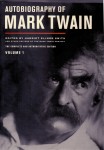
Autobiography of Mark Twain Edited by Harriet Elinor Smith (2010. University of California Press. ISBN 978-0-520-26719-0).

Wow. This is a ginormous work. The introduction is 58 pages alone. The main text runs 469 pages of very small font in its present hard cover, textbook size format. The Explanatory Notes begin at page 469 and end at page 650; which are then followed by the Appendices. All in all, the book runs well over 700 pages. But here’s the thing: It is the 469 pages of Samuel L. Clemens’s fits and starts, his attempts to chronicle his life both in and out of letters, that make this work sing. In many ways, I wish the scholars who are charged with preserving Clemens’s life story, a story he forbid publication of until 100 years after his demise (he died in 1910 at the age of 74; hence the publication of the book in 2010) had chosen to honor one of America’s greatest humorists and storytellers by putting his words in a format we commoners would appreciate. This effort, as brilliant as it may be in terms of documentation and scholarship, is anything but reader friendly.

First off, have you ever tried to sit in bed, or in a chair, or on a sofa, or in a hammock (likely the place ol’ Mark himself would prefer on a sunny Missouri afternoon) with a book having the heft of a small pig and the girth of a fat woman? Can’t be done, at least not in comfort. For a life story about a man of the people, a guy whose humor was revered by the unwashed masses, this book leaves those folks in the dust: It’s a friggin dictionary, for Pete’s sake. It is cumbersome and unwieldy. It’s heavy and can cause the reader who deigns to pick the volume up without  proper precautions (think stretching exercises) a hernia. No, friends, this is not what Mr. Clemens envisioned when he left his life story behind for posterity.

Then there is the structure of the book itself. Broken up as it is into a faux doctoral thesis, the magic of Twain gets lost in the egg headed highbrowness of someone’s vision of what posterity demands of Clemens’s life story. Why not, good editors, create two versions of the book and release them simultaneously: The thick thighed monolith of prose that I am now staring at and trying to describe (perfect for Twain aficionados and scholars) and a slimmer, more robustly entertaining volume for dullards like me? You know, folks that actually want to read Clemens purely for entertainment and enjoyment? With digital technology, there’s no cost involved in creating two manuscripts from the same wealth of material. And guess what? You’d have a book, in the smaller, less ostentatious version, a guy like Munger could bring with him to the beach. Fancy that.

Enough complaining. So how is Clemens’s autobiography as story? Riveting. It takes a bit to get used to the fact that Clemens was trying to break ground here with the format he chose (dictated recollections which don’t necessarily proceed in chronological order). But once you’re able to forget your initial skepticism as to the book’s non-sequential arrangement, hold on to your hats! The stories are first rate. The humor, vintage Mark Twain. Here’s a sample which purports to recount the author’s first visit with Governor (later President) Grover Cleveland:

So Cable and I went to that majestic Capitol building and stated our errand. We were shown into the Governor’s private office, and I saw Mr. Cleveland for the first time. We three stood chatting together. I was born lazy, and I comforted myself by turning over the corner of a table into a sort of seat. Presently the Governor said:

“Mr. Clemens, I was a fellow citizen of yours in Buffalo a good many months, a good while ago, and during those months you burst suddenly into a mighty fame, out of a previous long continued and no doubt proper obscurity– but I was a nobody and you wouldn’t notice me nor have anything to do with me. But now that I have become somebody, you have changed your style, and you come here to shake hands with me and be sociable. How do you explain this kind of conduct?”

“Oh,”I said, “it is very simple…In Buffalo, you were nothing but a sheriff. I was in society. I couldn’t afford to associate with sheriffs. But you are a Governor, now, and you are on your way to the Presidency. It is a great difference, and it makes you worth while.”

Splendid writing, that.

Feast on this little snippet of a scene from a more serious topic: Twain’s recollection of his first meeting with Helen Keller who was born blind, deaf, and dumb:

I remember the first time I had the privilege of seeing her. She was fourteen years old then. She was to be at Laurence Hutton’s house on a Sunday afternoon, and twelve or fifteen men and women had been invited to come and see her…The company had all assembled and had been waiting a while. The wonderful child arrived now, with her equally wonderful teacher, Miss Sullivan…The guests were brought one after another and introduced to her. As she shook hands with each she took her hand away and laid her fingers lightly against Miss Sullivan’s lips, who spoke against them the person’s name. When a name was difficult, Miss Sullivan not only spoke it against Helen’s fingers, but spelled it in upon Helen’s hand…Then I told her a long story, which she interrupted all along and in the right places, with cackles, chuckles, and care-free bursts of laughter. Then Miss Sullivan put one of Helen’s hands against her lips and spoke against it the question: “What is Mr. Clemens distinguished for?” Helen answered, in her crippled speech, “For his humor”. I spoke up modestly and said, “And for his wisdom.” Helen said the same words instantly–“And for his wisdom.” I suppose it was a case of mental telegraphy, since there was no way for her to know what it was I had said.

For those readers, like myself, who’ve attended one or more of actor Hal Holbrook’s legendary performances, where, through magical metamorphosis, the actor becomes Mark Twain, the gems of observation in this book bring to mind Holbrook’s absolutely dead-on portrayal. This book could have been one of those raggedy epistles every writer carries around in his or her backpack when he or she wanders off to think big thoughts. Sadly, you’d need a truck to cart this book with you in its ill-conceived present configuration. But here’s hoping a more pedestrian, less high-brow version of this excellent work comes out soon.

5 stars out of 5 for Clemens’s original content; 3 and 1/2 stars out of 5 in its present format.


Posted in Books | Comments Off on A Big Book…A Big Deal

The Pondering Man

Ponder (pon’ der) v.i. 1. to consider something deeply and thoroughly; meditate…

In hindsight, maybe the title of this piece should be “the ponderer” (n., one who ponders)

It’s 6:00pm. Wedndesday evening. My belly is full of Vietnamese food from A Taste of Saigon. I’m alone, killing time before I drive over to UWS to teach environmental law to young men and women, mostly seniors on the verge of graduation and stepping out into an economy to look for their first “real” job. Things don’t look good for the kids at this point, what with the economy in slow gear as it climbs a hill created by graft, corruption, and greed. Not their fault. Not my fault either. But it is what it is and only the strong survive. That’s America, right? From kids’ Little League and softball to the majors; America is all about competition. Welcome to the Big Leagues is what my students will get come commencement. I hope they can at least hit for average.

I head over the Lift Bridge, Duluth’s iconic landmark of steel spanning the ship canal. I may or may not stop at the Park Point Community Center, park the car, and walk down to the beach. I did that the last time I was pondering.

Might be bad karma to do it again.

I listen to rubber whine over the steel mesh deck of the old bridge as I cross from city to point. A big laker rides low on Lake Superior, her belly full of coal or grain or limestone. The boat has just passed under the raised span of the bridge and is chugging north, towards the locks at Sault Ste. Marie. It’s too early in the year for pleasure boats to be out and about. I drive by powerboats and sailboats in Tranquilty Cove and Lakehead Boat Basin. The boats sit in wooden cradles awaiting the application of copper bottom paint to their hulls and whatever mechanical adjustments the long winter requires. I stop at the stop sign by the vacant Bayside Market and ruminate (something akin to pondering) what I would do with the building if I had money and time. I have neither but, what the hell. A guy’s gotta dream, right? With visions of a great little convenience store-coffee shop-bookstore-bakery-law office-art gallery in my head, my Pacifica pulls away from the silent building. I mosey down Minnesota Avenue (the only real road on Park Point, a spit of sand that juts out into Lake Superior). “The Point” (as we Duluthians affectionately call it) ends in sand and red pine forest and poison ivy near the only natural break in the dunes: The Superior Entry. I say mosey because the speed of my car, as is so often the case, is in tune to the music on my CD changer. No Springsteen or Pearl Jam spins tonight. It’s Duluth’s own Low, the band’s new CD, “C’mon”, and the lush, slow sounds of orchestral rock done right that plays behind my pondering. I drive slow, at a crawl, in tune with the tunes so to speak. And because there is no traffic, no pissed off Pointers rushing to get home after work, no one cares.

I pass the community center without stopping.

My last visit to The Point, I stopped at the community center and walked down to the beach to watch waves stirred up by gale force winds. I picked sand out of my scalp  for a week after that bit of pondering.

I pass the little Episcopal church, the Catholic chapel, the nursing home, and the rowing club before coming to the parking lot near the end of Park Point. The lot isn’t the true end of Minnesota Avenue: you can drive a bit further, into Sky Harbor Airport, but I have no reason to go there. So I turn into the cul-de-sac (the program I am using hates this word, with or without the hyphens) near the boat landing, find a spot (I have absolute freedom of choice as it seems no one else is out pondering today), park the Pacifica, turn off the ignition, and listen to Low.

What does this place sound like?

I turn off the music. A nearby sandbar is crammed with herring gulls: Their high pitched calls (likely love songs of the birded kind) pierce the still, spring air. The ice is completely gone from the harbor. Nothing moves on the water. Across the bay, on the Wisconsin side, I hear locomotives pulling rolling stock over tracks and the occasional train whistle.

This exercise, my searching for a place to ponder between the hustle and bustle of the courtroom and the vigor of a university class, doesn’t come easily to me.

Hell, I’m up at 4:30am typing this piece because I’m not the sort of person to sit idle, to simply think.

But I am learning. After fifty-six years of living, I am learning that a man needs to do more than simply act. He needs to think. He needs to ponder.

I think no great thoughts while I listen to the gulls. I endure no epiphanies or moments of inspiration from the heavens during my few minutes of contemplation on the shore of the river that separates two northern towns. I simply ponder. And that seems to be enough.

Peace.

Mark


Posted in Blog Archive | Comments Off on The Pondering Man

Thinking and Walking (April, 2011)

I finished my court docket just before noon. Even though it was a crappy day (wind, cold, snow on the way only a day after the temp hit seventy degrees) I needed a walk. To clear my head. To feel the fresh breeze. I was in one of those moods that only putting your feet on the ground and moving forward can cure.

I’d heard about a new CD released this week by Duluth’s quintessential slow rock group, Low. I saw the band once, years ago, before they became like me (the writer): semi-famous. My kid’s gave me that label in Winnipeg when the A-Channel up there interviewed me and put my mug on Canadian television after the publication of my first book. In hindsight, “semi-famous” isn’t the right adjective for Low. “Mostly famous” is likely a better fit.

Anyway, my original intent was to walk to the Last Place on Earth in downtown Duluth and buy the new Low CD. I’m the kind of guy who shops at a very limited range of stores: places with music; places with words; places with shovels; and places with electronics. That’s about it. I rely on my good wife Rene’ for toothpaste, underwear, the occasional Christmas gift tie, food, and shoes. Everything else, in my view, is extraneous and not worth wasting my precious time on.

Of course, any meander on a city street usually includes a diversion or two. My walk today had one: A stop and a period of reflection at the Clayton Jackson McGhie memorial at the corner of 1st Street and 2nd Avenue East. I hadn’t planned on walking east on First Street but something prompted me to do just that and once I headed east, it became clear that the memorial (dedicated to three young black men wrongfully accused of the rape of a white woman and lynched from a light pole by a mob of Duluth working men) was not going to allow me to walk past history. So I stopped. Not for hours: just for a few minutes. As long as it took to read the quotations from Rumi, Dr. King, and the others inscribed into stone. As long as it took to read the description of that terrible event. As long as it took to pay my respects, silently stare at the busts of the three victims, and wonder whether we’ve learned anything at all in the two hundred plus years of our country’s existence. I didn’t cry. I didn’t pray. I simply stopped, read, and pondered. And only then was I able to walk on.

As I picked out the Low CD (and the latest by guitarist Charlie Parr) at the Fetus, the bronze likenesses of the three black men overwhelmed my thoughts. I’m certain that the clerk at the music shop wondered why an old guy with graying hair and scratched glasses was buying music meant for her generation. But I doubt she understood that my blank stare was due to a hauntingly real vision of me (or someone like me) standing in a crowd of angry white men, screaming for the blood of three innocent black circus workers.

I was there that day. So were you, is what I was thinking as I paid the young lady and left the store with my music. The walk back to the courthouse was slow: I labored against the wind carrying my city’s guilt as if it was my own.

As I approached the Priley Fountain, the water shut off and drained, members of the “Tea Party Express”, maybe fifty or so, stood in front of Duluth’s memorial to the Civil War, beneath a gigantic, fluttering American flag. One of the Tea Party leaders was screaming something over a bullhorn to loud applause. I didn’t hang around to hear what was being said: I doubted whether more than a handful of the self-proclaimed “patriots” standing in the civic center had ever visited the Clayton Jackson McGhie memorial or knew what had happened in Duluth on June 15th, 1920. As I passed them, I looked into the faces of the protesters: There were no folks of color in attendance. I left the rally without comment. I followed my old man’s advice “Never to get into a pissing contest with a skunk” and I wandered back to my office.

I’m typing this piece during the remainder of my lunch hour. I’m listening to the gorgeously arranged song, “Nothing but Heart” from the Low CD, “C’mon”. The music is playing on my computer. Low is on loud enough to drown out the protesters outside my window. With the song as background, I piece together what I’ve learned this lunch hour and I come to this:

Despite the wind, the gray sky, the cold, our city’s past, ignorance, and anger, there is beauty in the world. Take a walk. Go out and find it.

Peace

Mark

Posted in Blog Archive | Comments Off on Thinking and Walking (April, 2011)

The Big Sky – Review


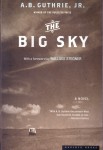
The Big Sky by A.B. Guthrie, Jr. (Mariner. 1947. ISBN 978-0-618-15463-0)

Dark. Foreboding. Tense. Intense. Unapologetic. Testosterone-driven fiction. These are the adjectives I’d use to describe Guthrie’s classic western novel depicting the travels and life of Boone Caudill, a Kentucky boy who, after getting the better of his abusive Pa, steals his father’s long gun and sets out for the American West. There is little light or redemption in this tale. Think Clint Eastwood with no remorse, no slight grin, and a whole lot of anger. That’s, in my mind’s eye, Boone Caudill.

The landscapes painted by Guthrie fairly sing under his pen. The long, disastrous raft trip up the Missouri from St. Louis to Fort Union, Montana, is so well done, you’re wiping your brow free of sweat as you pole along with the ill-fated crew of the Mandan as you read. Teal Eye, the Blackfoot girl Boone meets, falls in love with, and later (as she reaches adulthood) takes as his own, is the only female character other than Boone’s long-suffering Ma who appears in the book. This is a man’s journey, a man’s book. but one that readers of both genders will understand and appreciate.

I have to believe that Larry McMurtry read this book long before he sat down to pen Lonesome Dove, one of my favorite novels of all time. There’s an element of Boone in Captain Call (the character played by Tommy Lee Jones in the miniseries) a strong resemblance between the characters that can’t simply be chalked up to coincidence.

In the end,this book stands, like its protagonist, tall and brutal. It is a “must read” for anyone interested in Montana, the early days of the Mountain Men, and the American West.

5 stars out of 5.

Posted in Books | Comments Off on The Big Sky – Review

A Moveable Feast – Review


A Moveable Feast by Ernest Hemingway (1964 (Restored Edition, 2010). Scribner. ISBN 1-4391-8271-0)

So what’s not to like? Reading Hemingway’s memoir of the time he and his first wife Hadley spent in Paris in the 1920s in the company of Gertrude Stein, F.Scott and Zelda Fitzgerald, and a host of other poets, writers, and artists is like descending into a time machine and turning back the clock. The writing, done at the end of Hemingway’s long career, is some of his best, if a bit abbreviated. We will never know exactly how the book should read in its final edit because Hemingway killed himself before the memoir was completed. Still, with this edition’s added excerpts and snippets, the book contains some of Papa’s best prose: succinct, declarative, bald, and honest. There is absolutely none of the blatant misogyny that mars Hemingway’s other works. In fact, his portrayal of his betrayal of Hadley (through his affair with her best friend, who became Hemingway’s second wife) is an apology that Hemingway likely never made in public before his death.

It’s also the kind of writing that begs for more:

Scott Fitzgerald

His talent was as natural as the pattern that was made by the dust on butterfly’s wings. At one time he understood it no more than a butterfly did and he did not know when it was brushed or marred. Later he became conscious of his damaged wings and of their construction and he learned to think. He was flying again and I was lucky to meet him just after a good time in his writing if not a good one in his life.

Though others have written that F. Scott Fitzgerald’s jealousy of his wife’s writing talent assisted in driving her mad, Hemingway doesn’t see it that way. Which is the correct view, I’ll leave to you and history. However, one does get the sense that Hemingway tends to overlook the faults of those he respects, and inflate the faults of those he considers inferior: Just a caution to the reader to look at other sources before deciding whether to accept Hemingway’s version of truth as true.

This, and the fact the book left me wanting more (which is what a good book should do) are my only criticisms of the restored version of this great look into the life of one of America’s greatest writers.

4 and 1/2 stars out of 5.

Posted in Books | Comments Off on A Moveable Feast – Review

Red Moon over White Sea – Review


Red Moon over White Sea by Laila Hietamies (1992 (English Translation: 2000). Aspasia Books. ISBN 0-9685881-4-x)

My pal Gerry Henkel, editor of The New World Finn, handed me a copy of this novel a few months back when we were talking about Sukulaiset: The Kindred, my latest work in progress. Set in Karelia, the U.S., Estonia, and Finland, Sukalaiset is a massive undertaking; my attempt to chronicle the events in Finland-Karelia-Estonia from 1918 to the present through fiction. Because Red Moon takes place in Viena, a Finnish speaking enclave of Russian Karelia just before the fall of Czar Nicholas II, Gerry thought it would give me some insight into the region, its people, and its history. He was right. But more than that, Red Moon is a whale of a good yarn as well.

Well-written, with believable characters and dialogue, the real beauty of Ms. Hietamie’s prose is the landscape. It has been said by others that one of the hallmarks of my own writing is my ability to call upon various settings as if the forests, lakes, farms, and rivers are characters in my tales. As the writer being referenced, I don’t have sufficient distance from my own work to comment upon that observation. But I can heap similar praise upon Red Moon: I felt as if I was riding, walking, and rowing the paths, roads, and lakes of early 20th century Karelia as the story of Anna Lisa Huotari and her grandfather, Ilja, unfolds and as they negotiate the dangerous politics and intrigue of pre-Soviet Karelia. The plot has a predictability to it but, given the quality of the overall story and Hietamie’s prose, that is but a minor distraction in this very fine read.

4 stars out of 5.

Posted in Books | Comments Off on Red Moon over White Sea – Review

Another Close Encounter

Remember the fisher who dodged traffic? Well, this morning on the way in to work, the following scene unfolded as we slid our way down Lavaque Road past the Blue Max and Eagle’s Nest resorts on Fish Lake.

The snow was still falling. Wet. Thick. Like a mangy dog’s coat. The roadway was slippery and treacherous. I had all I could do to keep the Pacifica on track, even with all wheel drive. As we passed the Eagle’s Nest, Jack’s head rotated. The boy’s eyes were fixed on the growing piece of open water next to the Fish Lake bridge.

“Dad, there’s a dog trying to get back up on the ice. From the water. He’s barking and can’t get back up.”

I pondered the information.

Maybe Dave at the resort has a boat handy and can slip it out to the open water and drag the dog to safety.

I turned into a driveway, waited for a school bus to pass, and then retraced our route.

“What are you doing?”

“Going to save the dog.”

Jack thought a moment.

“You can’t walk out on the ice. It’s too thin.”

“I know. We’ll see if anyone is at the resort. If not, I’ll dial 911.”

As the open water came back into view, my lips began to curl upward in a grin. The grin turned into a smile. The smile turned into a chuckle as we stopped in the parking lot next to decaying ice.

“That, son,” I said watching the small mammal cavort from open water onto thin ice and slide back to water,” is what is known as an otter.”

And to think the kid’s about to get his Star badge from the Boy Scouts.

Peace.

Mark

Posted in Blog Archive | Comments Off on Another Close Encounter

What Wannabe Authors Do on Vacation

Nothin' better than Hemingway in the Florida sun.

Seven days in the sun (and much rain) of central Florida. Orlando. St. Petersburg. Cocoa Beach. Kennedy Space Center. Sea World. Universal Studios. Tampa. The Salvador Dali Museum. Hydroplaning tires in a 6 and 1/2 inch rainfall (in twelve hours) at sixty-five mph. Slight sunburn. Standing in the pouring rain at Universal to get on the Simpson’s virtual ride (Krustyland Amusement Park). Manatees (both in the wild and at Sea World). Shamu (back after having killed a trainer by drowning her). Sharks. Walrus. Seals. Sea lions. Otters. Jelly fish (thankfully, only in the tank and not at St. Pete or Cocoa Beach). Sam Adams. Wine. Good food. My wife’s fingernails digging into the skin of my right arm as the rental car slips and slides through the heart of a storm that brought 70-100mph winds. Thirteen year old Jack joining in, criticizing the fact that we’re on the road (could have been in the ditch). Great food. Terrible atmosphere (Joe’s Crab Shack…we booked before the waiter arrived). Bikinis. Muscle bound guys who could bench press me one handed (that’s a bone to Rene’). And reading:

The Big Sky by A.B. Guthrie, Jr. (See Mark’s Reviews on the dashboard in a day or so for my review.)

The Writer Magazine (April, 2011: No review; just great practical tips for the guys and gals like me who want to write and sell their words.)

The Paris Review (Winter, 2010: Again, no review but if you can find a copy, Wow! The interviews with Jonathan Franzen and Minnesota author, Louise Erdrich are worth the price of the issue, not to mention several terrific works of short fiction and some outstanding poetry.)

Minnetonka Review (Spring, 2011: They rejected my stuff but hey, who hasn’t. Won’t hold that against them. A nice collection of fiction and poetry, though a bit disappointing that they don’t have but a couple locals contributing. Must be we hicks can’t write. Oh, shit. I said I wouldn’t do that!)

Glimmer Train (Winter, 2011: Like I said, this magazine and The Sun are my two favorite periodicals after The New World Finn.)

A Moveable Feast by Ernest Hemingway (Restored Edition. Again, watch for a review in a few days or so up on the “Mark’s Reviews” portion of the dashboard.)

Red Moon over White Sea by Laila Hietamies (Given to me by my buddy Henkel to inspire me to complete Sukalaiset: The Kindred, the sequel to Suomalaiset I’m working on right now. Again, watch “Mark’s Reviews” for my thoughts on this Finnish novel.

Reading Glimmer Train on St. Pete Beach, FL.

To be honest, I’d started Red Moon, The Writer, The Paris Review (sadly, sans Plimpton), and Glimmer Train before I left Duluth for the sun. But I pretty much ate up other writers’ stuff while the sea crashed, my kid chased waves, my wife lounged, and spring breakers cavorted around us. I was so engrossed in Glimmer Train while basking in the 90 degree day on the coral sands of St. Pete that I missed the manatee that came into a crowd of kids in thigh deep water and scared them shitless.

“He bumped up against my leg,” one of the little suntanned girls said to her mom as she ran shrieking from the water, likely having confused the curious mammal considerably. “I thought it was a shark.”

Jack saw the manatee. It likely made his trip.

I guess that’s all that really matters.

Peace

Mark

P.S.

Yes, the title of the Hemingway memoir is spelled “MovEable”. One of Hem’s habits, I guess, adding  “e’s” where they aren’t needed. Seems odd for the guy who invented sparse writing to toss in surplus vowels. But that’s the way it is.

Posted in Blog Archive | Comments Off on What Wannabe Authors Do on Vacation

Big Russ and Me – Review

Tim

Big Russ and Me by Tim Russert (Hyperion, 2004. ISBN 978-1-4013-5965-2)

As an unabashed Liberal (note the large “L”) from a long line of unabashed Liberals (see the “books” tab in the dashboard and read the excerpt from my latest book, Mr. Environment), I of course loved Tim Russert’s political commentary. Not because he revealed his love and passion for all things left when he hosted “Meet the Press” but because he was one of the few commentators who refused to cow-tow to the thugs running Washington during the run-up to the Iraq War and thereafter. In this book, really a memoir of Tim’s life constructed around his roots and upbringing in South Buffalo, New York in the shadow of “Big Russ”, his father, we learn why Russert was not one to back down from a fight when interviewing the most powerful men and women in the world.

As a Protestant, I sometimes loathe, and oftentimes lament, the ritual and structure of the Catholic Church. Russert’s life story, growing up in an Irish Catholic working class family (his father worked two jobs to support Tim and his siblings) puts Catholicism in perspective and gave me a new appreciation for the depth and power of traditional faith in the formation of morals, family values and ethics. The snippets of life lived in parochial schools, from elementary school to law school, are priceless treasures and give perspective to the story of two ordinary men; a father and his son, who strove for, and at least, in terms of the the son’s short life, achieved the American dream. Russert’s depiction of meeting the Pope in Rome when he was working on the “Today Show”, left me in tears.

We miss you Tim. I have to give the book 5 of 5 stars. Even though it may not be Germinal or Lonesome Dove in terms of literary merit, it’s a great read about two extraordinary ordinary Irish Catholic Americans.

Posted in Books | Comments Off on Big Russ and Me – Review

Under the Banner of Heaven: A story of a Violent Faith – Review

Mormons

Under the Banner of Heaven: A story of a Violent Faith by Jon Krakauer (Anchor, 2004. ISBN 978-1-4000-3280-8)

OK, I’ll admit to my prejudice. As an historian, I have a hard time buying Joseph Smith’s story regarding the discovery of the golden plates near the Hill Cumorah in the early 19th century. There are many arguments that I could advance here to illustrate why I am a skeptic when it comes to Smith’s claim that divinity led him to the Mormon faith and to the founding of the Church of Jesus Christ of Latter-day Saints (LDS) a few years later. This review isn’t the place for such a debate. And even in my fightingest mood as an Episcopalian, I must admit: the Mormons, as the fastest growing faith in the world, are on to something.

Jon Krakauer explores what that something is not by examining the brutal murder of a woman and her infant daughter at the hands of the woman’s brothers-in-law (the child’s paternal uncles). Krakauer’s work unravels the dedication and call to duty that permeates the LDS faith, and in the case of LDS Fundamentalism, rises to the level of murder.

There is no question that the issue of polygamy remains the central principle of the tens of thousands of Fundamentalist Mormons who cannot reconcile the teachings of Joseph Smith (and the leadership of Brigham Young) with the modern LDS stand against plural marriage. Krakauer explores these fissures in the only American-born religion in great detail, and paints a picture that the LDS hierarchy would rather went unnoticed.

Krakauer interviews one of the brothers involved in the murders which form the centerpiece of the book. And as Krakauer questions the faith, the motives, and the ideas contained in the seemingly innocent and benevolent mind of Dan Lafferty (the brother who wielded the knife that slashed the throats of his sister-in-law and niece) one gets the sense that religious zealotry is not only found in third-world countries. Just like Timothy McVie, who evinced no remorse for killing dozens of children as part of his attack on the federal building in Oklahoma City, Dan Lafferty seems content with what he has done. After all, God spoke to his brother Allen and Allen relayed the plan to Dan. Isn’t that how it was done in the Old Testament?

Krakauer never loses sight of the fact that, as cynical as outsiders might be regarding the historic accuracy of Joseph Smith’s discovery, no one within the mainstream LDS church, the church that raised the Laffery brothers, supports their theology or their crimes. But, even though the modern church has distanced itself from the fringes, the Laffertys’ brand of Mormonism shares a common history with the mainstream church.

The Lafferts’ brutality isn’t far removed from the legendary Mormon trek west; a journey which reached the height of paranoid depravity with the massacre of over one hundred men, women and children. Surrounded by Mormon militia and their Native American allies at a place called Mountain Meadows in August of 1857, members of an Arkansan wagon train were assured safe passage through Utah by the Mormon commander if they surrendered their weapons. The travelers did so, with nary a hint of fear, only to be slaughtered.

According to the author, the religious fervor that caused sane men to commit such an atrocity still lurks in the dark fringes of Mormonism. There has been no recognition by the LDS church of the church’s involvement in the massacre.  Even today, the official line remains: “It was the Indians.” And this failure, Krakauer convincingly asserts, is why folks like Allen and Dan Lafferty persist at the far edges of Joseph Smith’s religion nearly 200 years later.

A great non-fiction book on a misunderstood and under appreciated religion, Under the Banner of Heaven is also a solid “true crime” story. 4 stars out of 5.

Posted in Books | Comments Off on Under the Banner of Heaven: A story of a Violent Faith – Review