The Dance Boots – Review

The Dance Boots by Linda LeGarde Grover (2010: University of Georgia Press. ISBN 978-0-8203-3580-3)

A Duluth author wins the Flannery O’Connor Award for Short Fiction. There’s some immediate hubbub in the local newspaper. Some book signings around town (we only have three, soon to be two, bookstores in this town so the signing tour will be short). Maybe an appearance at the Duluth public library. A lecture at the local tribal college. A reception at the university where Linda teaches. And what then? Is it likely that this fine collection of prose will morph into the next Cohen brothers movie? Doubtful. It’s not that kind of collection. More likely, the renowned author will return (like the judge writing this review) to her “real” job; teaching American Indian Studies at the University of Minnesota-Duluth. Linda will likely, despite her success, continue to work on her fiction, essays, and poems in her “spare” time. That’s the reality of a writer’s life in 21st century America. As prestigious as it may be, winning an award given in honor of one of America’s premier storytellers won’t likely change how Professor Grover goes about her life. And you know what? I bet she’s fine with that.

To the book.

Lyrical.

That’s the singular word that kept spinning over and over in my mind as I read this very compact collection of linked short stories. Set in and around Duluth and a mythical Indian Reservation in northern Minnesota, Grover weaves these tales in print as if she is standing before her Ojibwe kin and rendering stories (as the indigenous people have done for millennia)  aloud; in the oral tradition of the ancient Greeks and other extinct cultures. The author’s command of language is indeed stellar and her talent is amazing. Whereas I am a very linear writer (perhaps my greatest flaw as an author) Grover writes in a graceful story arc. Her stories do not necessarily have a beginning, an end, or even a moral. Storytellers such as Grover, whose fiction style approaches prose poetry in pattern and texture, are rare. Treasure this book. Your only disappointment will be that the book ends too quickly.

My one major beef? Linda, as great a writer as you are, you should have come to me for details concerning hunting rats at the grain elevators: Shovels are far too slow; hockey sticks are much more effective. This I know. Just don’t ask me how.

A wonderful gathering of tales, this collection truly deserves every fiction reader’s attention. 5 Stars out of 5.

Posted in Books | Comments Off on The Dance Boots – Review

They Took My Father – Review

They Took My Father by Mayme Sevander with Laurie Hertzel (1992: University of Minnesota Press. IDBN 978-0-8166-4336-3)

One great thing about working on a new historical novel (my manuscript of the ties between Karelia, Finland, and Estonia tentatively entitled Sukulaiset: The Kindred) is that I get to read all sorts of background material. I am dedicated, as a fiction writer, to telling the truth despite the fact that the genre I write in seems contradictory to that goal. But in crafting an imaginary world from real events, detail is important. Consistency is required. And so, I do the dog-tiring research necessary to a book. Even when working out of my genre (as I recently did in completing Laman’s River, a contemporary crime novel about fundamental Mormonism) I spend as much time on background and research as I do writing and editing a book. That’s my work ethic: Try and make the tale ring true no matter the genre, no matter the setting, no matter the time frame of the story.

Sukulaiset is being molded out of images and words from the period of Karelian Fever: The early 1930s when Finnish Canadians and Finnish Americans left North America to seek Communist utopia in the U.S.S.R. My research has included reading (twice) Karelia: A Finnish-American Couple in Stalin’s Russia (see below for a review) as well as hundreds of pages of web material. Before beginning the book, I knew that Mayme Sevander (born in NW Wisconsin and the daughter of Communist organizer and newspaper editor, Oscar Corgan) had written a memoir about her experiences in the U.S.S.R. She was a child immigrant during Karelian Fever who stayed in Karelia, paying, as the book describes, a terrible price for her faith (and her parents’ faith) in Marxism. I also was aware of some tension between the Finnish American community and noted Professor of Russian History (and a specialist in Karelian Fever) Dr. Alexis Pogorelskin as to the accuracy and tone of Ms. Sevander’s description of her father’s role in the mass exodus of Finns from North America. I don’t know the details of the rift; only that, in putting together a DVD regarding the episode, Dr. Pogorelskin didn’t necessarily agree with Ms. Sevander as to the details of the Karelian Fever story. Despite this conflict (and my respect for Dr. Pogorelskin) I picked up a copy of They Took My Father from Barnes and Noble. Here’s what I think.

The book is fascinating memoir: A top notch effort in terms of pace, tone, detail, editing and writing. While there may be differences of opinion amongst academics and serious students of Karelian Fever as to each principal’s role in the debacle (for that is what it turned out to be) Ms. Sevander’s eyewitness recounting of what she and her family endured at the hands of Stalin is a remarkable addition to this category of non-fiction. Ms. Hertzel crafted Ms. Sevander’s story into a readable, organized rendition of hope, fear, and ultimately, anguish that bears reading if you have any interest in the Finns, Karelia, Soviet history, or the like. My only criticism is that the book could have spent the same detail recounting Ms. Sevander’s life after World War II as it devoted to the family’s early years in Karelia. Folks picking up the book would likely be eager to learn about the day-to-day struggles, hardships, and intrigues that made life under Soviet rule really a game of human chess: Knowing when and not to telegraph ones intentions and moves.

All in all, a valuable asset in my attempt to understand a little known piece of Finnish American history. 4 and 1/2 stars out of 5.

Posted in Books | Comments Off on They Took My Father – Review

The Good Fight: A Life in Liberal Politics – Review

The Good Fight: A Life in Liberal Politics by Walter F. Mondale with David Hage (2010; Scribner. ISBN 978-1-4391-5866-1)

Attorney General of the State of Minnesota. United States Senator. Vice-President of the United States. Ambassador to Japan. Father. Husband. Native son of Minnesota. Lawyer. And yes, friend and political mentor to the author of this review. I, along with my father, mother, brother, and sister, know him as “Fritz”. He and my father have been friends for fifty years. Fritz was a friend of my Uncle Willard (Minnesota’s famed environmental legislator and an original Farmer-Laborite) from the late 1950s until Willard’s death in 1999. Despite his busy schedule, Fritz Mondale made sure he attended Willard’s funeral  (an event bringing together politicians of every persuasion) and he took time to write the foreword to Mr. Environment: The Willard Munger Story (see “Books” tab above on the dashboard of this website to purchase your copy), my biography of Willard’s remarkable life.

When I learned that Fritz’s political memoir was being released (my dad got an early copy), I knew I had to read it and review it for this website. But of course, there’s a problem with doing that, isn’t there?

What if I don’t like the book?

Of course, if that was the case, I could simply refrain from penning a review. But how would that look? I mean, I bought all four of my sons personally inscribed copies of the thing. If I didn’t review it here, they, if no one else, would know something was amiss: My boys know I read the books that I buy within a few days of purchase. So I couldn’t throw out the excuse, “I haven’t got to it yet.” Pleading the fifth wasn’t going to be an option.

Damn. I guess I’ll just have to read it and give my honest appraisal of the book.

Here goes. Like Teddy Kennedy’s memoir (reviewed below) True Compass, The Good Fight chronicles the ideals, political career, and personal life of a true 20th century Liberal. With the plethora of “memoirs” being thrust into the public square by folks on the right (including two by a person who didn’t even finish her one term as Governor of Alaska!), it seems only fitting that the left should have some reading material. And Mondale’s book is a good one; not just for Liberals, but for anyone interested in the politics of our great nation. You get the history of the Senate, the politics of the past forty years, the anecdotes and stories; all the things you’d expect from political memoir. But you also get something far more important: An understanding, a belief, that a fundamentally understated and decent man can make a difference in the shark-filled waters of national politics.

The book’s depiction of Mondale’s civil rights involvement, his work on behalf of the environment, and his time spent as President Jimmy Carter’s understudy is well written, insightful, and a must read for anyone interested in world affairs, national politics, or Minnesota history.

Near the end of the memoir, as Mondale describes his hectic six day campaign for the late Paul Wellstone’s United States Senate seat (at the behest of both the DFL Party and the Wellstone family) you understand that, unlike the vast majority of politicians today, Walter Mondale was in the “Good Fight” not for personal gain, or glory, or ego: He was in politics to represent those Americans, who because of race, gender, religion, or economic status, couldn’t fight for themselves. 5 stars out of 5.

Posted in Books | Comments Off on The Good Fight: A Life in Liberal Politics – Review

Whitney: From Farm Kid to Flying Tiger to Attorney – Review

Whitey: From Farm Kid to Flying Tiger to Attorney; A Memoir by Wayne G. Johnson (2011: Langdon Street Press. ISBN 978-1-936183-93-7)

Spoiler alert. I had the privilege of reading the first one hundred or so pages of the unfinished manuscript that became this memoir about two years ago. Wayne Johnson, the author, is a friend, mentor, and attorney from “my neck of the woods”. He has been incredibly supportive of my writing. It was a great pleasure to be asked to take a gander at Wayne’s work-in-progress. Many of the suggestions that I gave the author were followed in the final draft of Whitey. Some were not. Now, don’t get me wrong. I don’t pretend to be an editor. Nor a successful author. I’m just a guy who knocks words in some kind of order to tell a cogent story. But I think I know a good yarn when I read it. With the changes, this memoir is two-thirds there. Here’s why.

I found myself falling off my recliner with laughter at some of the anecdotes from Wayne’s childhood. He grew up on a succession of farms, part of a large Norwegian immigrant family, in southwestern Minnesota. Here’s a snippet from that section of the book that any country boy or girl can relate to:

Another incident I recall from this time frame involved the linoleum in our kitchen. New linoleum had just been laid and Mother was very proud of the imprint. When Mother and Dad went to town, my brother Clarence got the bright idea to bring one of our favorite horses into the house…it left hoof prints on the new linoleum. Mother didn’t notice the marks on the floor when she an Dad came home…

The next day she was mopping the floor….and she noticed the marks…She was really puzzled. She returned to town a few days later and complained to the owner of the hardware store who had sold her the linoleum about the strange indentations on the kitchen floor. The hardware man…was equally puzzled. Being a fair shopkeeper, he replaced the linoleum at no cost, although he did send a sample of the damaged linoleum to the manufacturer…(T)hey were unable to solve the riddle as to how the marks had occurred. They had never seen their product experience a similar deterioration, and I thought they probably would never see it again…Many years later, we revealed to Mother the cause of the strange marks.

The farm section has more pure fun in it than the other two sections of the book; more than likely due to the fact that childhood, despite the skinned knees and the teasing, is generally a blast. This is not to say that the middle section of the book, which deals with Wayne’s service as a fighter pilot in the Flying Tigers during WWII, doesn’t have its humorous moments. It’s too long to repeat here, but the story of Wayne stealing a general’s Jeep after a high-brow cocktail party in India, caused deep belly laughs from this reviewer. Again, the war years in the story hold a plethora of wonderful anecdotes, cultural observations, action, humor, and wisdom.

Though the last section of the book includes tales from Wayne’s nearly sixty years at the bar (including references to his work on the Reserve Mining case), unfortunately the legal “war stories” are not prevalent enough to save the last section of the book from a feeling of malaise. In addition, a minor flaw noted in the book’s earlier sections becomes manifest. Granted, this memoir is self-published. And because I have made similar errors in my own self-published books, I can forgive some repetition in a book as lengthy as this. But when passages or themes repeated in the book’s earlier chapters re-appear in the book’s final chapters, the mildly distracting turns annoying. Then too the long, winding passages relating to the Flying Tigers’ post-war conventions bog things down further. The tight, demonstrative writing of Wayne’s wartime journal (describing Casablanca, India, and other places far distant) was succinct. It’s as if, when pressed for time, the author was able to cut to the chase. His travelogues regarding trips to the Far East on behalf of the Flying Tigers  after the war don’t have the same crispness.

In addition, while the author describes his recent health problems, I think he missed an opportunity to stretch himself as a writer. What goes through an eighty-even year old former fighter pilot’s mind when he wakes up after a routine heart operation and finds he is now a double-amputee? Rage? That’s the one emotion the author does describe. But surely there are other states of mind that Mr. Johnson has encountered post-surgery. Curiously, he spared no detail and took no prisoners when revealing past loves and forgotten transgressions: I wish he would have used the same level of abandon to craft the last third of the book.

All in all, this memoir is a solid read for two-thirds of its heft. Had the same fast-paced style been carried through the final section of text, there is every chance Whitey’s story would be coming to a big screen near you. Despite its flaws, Whitey is a book worth spending time over a succession of cold winter evenings (preferably in front of a roaring fire) while marveling at a life well-lived. 3 and 1/2 stars out of 5.

Posted in Books | Comments Off on Whitney: From Farm Kid to Flying Tiger to Attorney – Review

A Grave in Karelia – Review


A Grave in Karelia by Ernesti J. Komulainen (1995. Self-Published. No ISBN. Available through the New World Finn Bookstore. http://www.newworldfinn.com/.)

Thanks to my pal, Gerry Henkel, editor of the New World Finn (http://www.newworldfinn.com/) a fine periodical chronicling the culture, history, and attitudes of the Finns, I recently read this fine little novella (it’s only 128 pages but that’s deceptive; it likely doesn’t exceed 30,000 words). The book depicts the death of Nikolai Kivola, a middle-aged American Finn who, along with his wife and two children, returns to Karlelia in the U.S.S.R. during Stalin’s reign to help build a Socialist paradise. Selling all his worldly possessions to return to a land geographically similar and near in proximity to his native Finland, Nikolai becomes separated by his work from his family and falls ill. More than simply a short tragedy of one man’s demise, the novella packs, in its tiny frame, all the essential elements of the debate that has raged about the why and the wisdom of Karelian Fever. What prompted men and women who had left Finland to escape economic claustrophobia for the greater opportunities available to them in the United States and Canada to, a decade or so after making that perilous journey, jump on another ship and return to a place, a land, devoid of the comforts and freedoms they had at their fingertips in North America?

What sets the book apart from other fiction written about Karelian fever is that Ernesti Komulainen (aka, Ernest Laine) writes from personal experience; as a survivor of the Stalinist purges that killed hundreds, if not thousands, of the immigrants to Karelia out of paranoid fear that the new arrivals were disloyal.

A slender, well-written story that echoes, in its tone and its deliberate pace, Alexis Kivi’s Seven Brothers (http://www.kirjasto.sci.fi/akivi.htm), this little book is a fine introduction to the complex debate that still rages in the Finnish American and Finnish Canadian communities regarding the motivations of those who left. Nicely translated by noted Finnish American translator, Richard Impola.

4 stars out of 5.

Posted in Books | Comments Off on A Grave in Karelia – Review

Finns Still Value Their Bookstores…What’s Wrong with Us?

(Posted March 20, 2011)

OK. Those of you who know me, know I’m a “wannbe”. I grew up surrounded by Finns. Consequently, I find myself writing stories about Finnish Americans, Finnish Canadians, and real honest-to-goodness Finnish Finns. Heck, my novel, Suomalaiset is even being sold in the Academic Bookstore in downtown Helsinki. Stockmann’s (a major department store) owns the place and has a few copies of my weighty novel on hand for Finns (or tourists) who are interested in what a Slovenian/Welch/Dutch/German/English/Irish/French American mutt thinks about all things Finnish.

Anyway, the most recent edition of The New World Finn (http://www.kantele.com/nwfwebsite/index.html) has a well-written article by Sargit Warriner (Spring, 2011; p. 22)  which details a conversation the author had with strangers about books, publishing, and Helsinki’s Academic Bookstore during the intermission of a symphony concert. Sargit makes a great point about the value of printed books versus the new wave of e-reading technology that’s being unleashed into the world. In the article, she describes confronting an impulse to buy her husband a new e-reader (as a gift) but opts instead for a hardcover version of a new book by his favorite writer. She concludes (and her view is supported by the folks she’s talking to at the symphony) that a bound book makes a more lasting, personal gift. She then goes on to discuss the history of the Academic Bookstore and its remarkable building. It seems that in Helsinki (and all over Finland) reading is still very much alive, though whether small independent bookstores (or even large bookstores affiliated with major department stores) can co-exist with technology remains, I think, an open question,whether the store is in Helsinki or Duluth.

In contrast to the vibrant literary culture Ms. Warriner describes in her article, Duluth’s authors and readers recently lost a beloved institution: Northern Lights Books and Gifts. So, before I continue, I’d like to make this pitch: When you’re considering buying books, please visit Sally and her staff at the Bookstore at Fitger’s (the city’s last independent bookstore) before going online or elsewhere to make your purchases. I’d hate for Duluth to lose the last vestige of commercial freedom we have in this town when it comes to the written word.

Now, I understand: The digital revolution is here to stay. In fact, you can find my books on Kindle (if you’re of that ilk). Despite this modest digital presence, I’m struggling  (as a self-published author) to figure out how to make my little press viable. One of the things I may be forced to do is sell the Kindle versions of my subsequent books at “fire sale” prices to find a broader audience for my work. I know I’m not alone. Other writers doing what I do are facing this same decision: To digitize or not to digitize. But going digital doesn’t mean I’ll abandon the old ways of putting a book together. Paper and ink are for me, still the preferred vehicles to convey my ideas, thoughts, and stories unto the world. But, as times change, so must I. Today, publish or perish means more than simply creating a great read in print: It means putting your book out in formats that young folks raised in a digital age will buy.

That having been said (and as the NWF article points out) brick and mortar bookstores provide a physical (versus a theoretical or an atmospherical) space where authors and readers can come together for readings, signings, and discussions. Ms. Warriner points out very clearly that interactions between readers and authors at the Academic Bookstore are major cultural events that draw folks to downtown Helsinki. So, even in a world organized in neat rows of 1’s and 0’s there exists a place for me, for you, to come together and talk about the message I, the writer, thought I was conveying to you and the message you, the reader, thought you received. In the end, I hope, despite the significant changes being experienced in the world of books and bookstores, you and I can keep meeting and talking and enjoying each others’ company whether I’m ever named an honorary citizen of Finland or not!

Peace.

Mark

Posted in Blog Archive | Comments Off on Finns Still Value Their Bookstores…What’s Wrong with Us?

Gravity an Other “G” Words

(Posted March 6, 2011)

Yesterday I finally got off my duff and went outside to clean up the snow in our driveway. Usually, Barney the plow guy takes care of all of our plowing needs. But we’ve been away from home for awhile skiing in Montana and though it didn’t snow much while we were gone (much to Barney’s dismay, I’m sure) the wind has whipped a fair amount of powder into the driveway: Enough so that my Pacifica ground to a halt a couple of days back, when I was racing out the door, the clock against me, to get Jack to school.

“You don’t have to swear, Dad,” my thirteen year old reminded me as I muttered and cursed and rocked the van until it was buried.

More bad words.

I retreated to the garage, grabbed the first snow shovel I could find, and trudged back to the drift-encased Chrysler. It wasn’t a big deal. I got the car out after a few minutes of shoveling. But it took a while for my blood pressure (more from the anger than from the shoveling) to return to baseline.

“Sorry about the bad words.”

“No problem. I’ve heard them before.”

Indeed he has. From me. From his buddies. From his brothers. But Jack knows better than to curse in any argument between us. Though he’s too old for it now, he’s benefited from my mom’s time-honored remedy for cursing: the dreaded bar of soap. Happened with each son only once. Mom was right: that’s all it takes.

Anyway, yesterday. A bright, open, late winter’s sky stood above me. My list of chores loomed over me like Lone Peak, the mountain that defines Big Sky in all its craggy glory.

Bring in the recycling. Snowblow the driveway. Clean the garage. Stack the wood pile. Vacuum, dust, and wash the hardwood floors in the house.

These tasks awaited me as I wandered into our crowded garage and looked at our own little Lone Peak of recyclables that had accumulated.

Better than sending it to a landfill.

The run to the township recycling shed went smoothly. I was back at the house, behind the purring engine of a snowblower, in an hour. But the snowblowing wasn’t as easy as it looked at first glance.

Gravity.

What I thought as I labored to force the snowblower through defiant snowdrifts was how, as we age, Mother Earth’s hold on us seems to grow. You know, how your legs, legs that once carried you across the finish line of marathons or allowed you to avoid tacklers on the football field seem as dead as logs. And how your shoulders and back and thighs and hips-parts of your body you once relied upon for steady strength and endurance-now seem ready to allow your skeleton to collapse into goo. I came to the conclusion, as I waddled (twenty pounds over my “fighting” weight) behind the snowblower, that despite my successful conquest of three Montana ski resorts (no major falls, no broken bones) that gravity was a force I could not, and will not, outdistance.

This morbid thought stayed with me as I swept winter leavings on the garage floor into piles and sucked them into oblivion with my shop vac. The weight of the world pronounced itself to an even greater degree as I pulled plastic slider after plastic slider filled with dry, split maple (for our great room fireplace) through melting snow, revealed dog shit, and decaying ice. Gravity’s embrace clung to me like a fat lover as I filled my arms with firewood and climbed the steep stairs to our covered front porch to fill the wood bin.

Gravity. Grave. God.

The sun stood high as this succession of “G” words came into my head. I sat on the top stairs, exhausted, having done as much of my chore list as my body would allow a fifty-seven year old man to do in one day. Daisy, our aging black Labrador-something-else-mix, nuzzled my gloved hand with her wet nose. I removed my glove and scratched her black belly.

She so loves the sun.

Kramer,the other geriatric Labrador patrolling our acreage, stood at the bottom of the stairs, gravity having robbed him of  his ability to climb. I stood up and descended the stairs to give Kramer his due. One scratch on the belly didn’t satisfy the old moocher. As I wandered down the now-cleared driveway to retrieve the day’s mail, Kramer followed by my side, occasionally nudging my bare hand for attention. Daisy, gravity thick in her hips, rose slowly from her sunny repose and joined our walk down the lane.

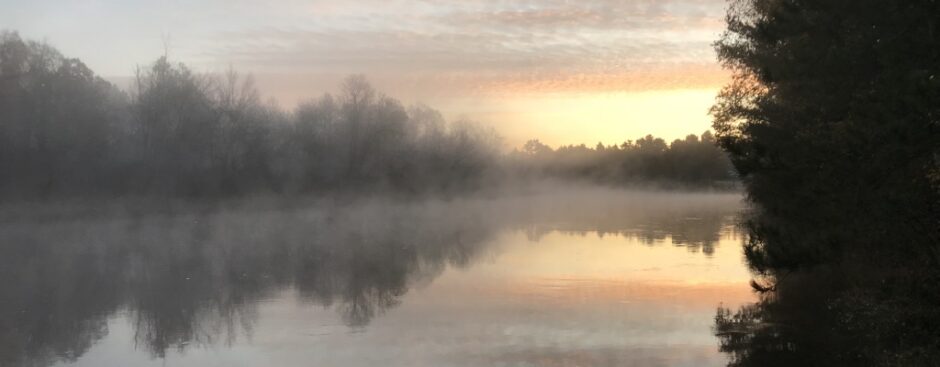
Despite the weight of all things, it was a gorgeous day on the river.

Peace.

Mark

When the Woman is Right… (Posted March 3, 2011)

A long drive. That’s what it is from Duluth, Minnesota to White Sulphur Springs, Montana. By any calculation: miles, kilometers, hours, minutes; it’s a long freakin’ way by car from here to there.

We’re on our semi-annual family ski vacation. Usually, we drive from Duluth to Bozeman and ski Bridger Bowl, Moonlight Basin, and sometimes (if the wallet is still full), Big Sky. This trip, I’m driving with my wife, Rene’, my son Jack, and my nephew Alex to Montana but we’re not going directly to Bozeman, where we’ll meet up with other Duluthians. No, because I have a new novel ready to be born, a novel set in the Smith River valley, a novel set in the Big and Little Belt Mountains that surround White Sulphur Springs, Montana we’re gonna stop in White Sulphur and ski Showdown before moseying on down to Bozeman.The visit will be, as my sons like to say, “an experience”.

You see, all four of my boys have had “experiences” with their old man on any number of jaunts and journeys; from train trips to Montreal; to hockey weekends in Mora. Some good. Some bad. But all definitely, “experiences” of one kind or another. What I really want, what I really need from this diversion into central Montana, is to obtain a sense of place for my book, Laman’s River (see above dashboard under “Work in Progress” for a sample chapter). The Minnesota scenes I was able to write with ease. Duluth. The Gunflint Trail. Grand Marais. Recall for those settings was automatic. But scenes set in Montana’s Smith River valley, a place I’d never visited? Taking a peek in that “neck of the woods” can’t hurt the veracity of my effort. Am I right?

“Hi,” I tell the lady behind the desk. “Mark Munger. From Duluth.”

“One night, right?” the woman says, looking at her handwritten reservation log.

“Right.”

I’ve pulled my Pacifica and its rooftop ski rack, the cargo bay filled with ski gear, two teenagers, my wife, and our luggage in front of a lodging venue that, to be accurate, looked a hell of lot better in the photos displayed on the place’s website. Still, the manager is pleasant. The office seems clean. I hand the lady my credit card and we do business.

“You’re all set. Your cabin is just around the corner. Pull your car in and you can unload.”

“Thanks.”

I move the van a few feet. It’s a tight squeeze between the office and the one-room cabin that will be our home for the night. I’m hungry, tired from driving, and anxious to “set up camp” and then wander off to find a good steak or a burger in this tiny town.

“This is it?” my wife asks softly, incredulity clear in her voice as she stares up at a cement block wall painted white, the cabin’s windows facing the office building (the office is a mere fifteen feet away from the cabin) crudely boarded over with chip board that has been painted white in an equally inept fashion.

“Sure. So long as it’s warm and clean. It’s only for one night.”

I open the back of the Pacifica and lug my suitcase towards the front door of the place. I slide the key into the lock, turn the knob, and enter the very cold interior of the cement “cabin”.

My wife walks in ruefully behind me. The boys follow.

“How much are you paying for this….?”

Rene’ doesn’t finish her sentence. I know she is already mustering an argument against spending the night. The inside of the place is as crude as the exterior. Again, the photos I viewed online do not bear any resemblance to the room we’re standing in. Beyond the aesthetics, which, I silently have to agree with my wife, aren’t very appealing, the place is as cold as ice. I look at the wall heater.

I doubt that will warm this room.

“It’s only for one night,” I say loudly, my patience worn thin. An argument ensues. Some bad words follow. My wife recoils at my barrage, a linguistic attack that is really, as I look back on the situation, wholly unjustified.

“I…am…not…sleeping…in…dog…hair…” my wife says slowly, fighting back tears, pulling the quilt off one of the two beds in the room, revealing an accumulation of petrified black dog hair.

She takes my credit card and receipt from my hand. I say nothing. She leaves.

In my mind, I turn the scene over and over, searching for a reason I’m so damn insensitive and vehement.

Pride. Grandpa Duane was very, very skeptical when I told him where we were staying. He’s been coming here for years. In his subtle way, he tried to warn me. I didn’t listen. I knew better. The website said…

“There’s a room available at the hotel down the street,” Rene’ says quietly when she steps back into the icebox of a cabin. While she was gone, I’d turned on the heater to no affect. The dog hair hasn’t vanished in the interim. “She made the reservation and refunded your money.”

Not much more is said as I lug my suitcase back to the car and slam the tailgate. We drive a few hundred feet to the hotel, the same place my mom and Duane stayed the day before. The lobby is bright, cheery, and spotless. The owner greets me with a smile and when he finds out Duane is my stepdad, he gives me the “Duluth discount” plus discounted lift tickets to ski Showdown the next day.

My pride takes a beating. We save twenty bucks on the room, nearly forty on the lift tickets, and I redeem myself in some small measure with the wife.

We eat big burgers at an old fashioned supper club next door to the hotel and, after turning down the lights, I fall asleep wondering how the hell I’m gonna explain this all to Grandpa Duane.

Peace.

Mark
Posted in Blog Archive | Comments Off on Gravity an Other “G” Words

Thomas Lake

(Posted February 10, 2011)

County Highway 44 is dark this evening; one of those Minnesota winter nights of close, damp claustrophobia. No stars. No moon. Just dark, dank atmosphere pressing in on the world. My wife is driving her Toyota Matrix somewhere behind me. I’m piloting my faithful old Chrysler Pacifica. We’re in separate cars because on Sunday, when Rene’ will head home to see her mom in the hospital, I will be driving to Palo to sell books to Finns during the sliding festival.

“Recalculating…”

Theresa, the name my son Jack has coined for my new Garmin GPS, a gizmo I affixed to the dash of the car just before leaving home (a gift from my wife for Christmas) isn’t happy.

“…turn left 100 yards ahead. Make a u-turn. Follow Peakwin Lake Road south…”

Theresa, in a synthetically computerized voice akin to those you hear in primitive animated videos on YouTube, you know, the ones entitled “So You Want to Be a Novelist” or “So You Want to Be an IRS Agent”, is telling me to turn back, that I missed the turn to Two Harbors.

Thing is, I’m not going to Two Harbors. I inputted Two Harbors as our destination because the place Rene’ and I are headed to, the Larson cabin on Thomas Lake, is close to Two Harbors, which, when you’re dealing with a human navigator, means something. Unfortunately, approximation apparently means nothing to a silicone chip.

No, the chip is all ones and zeroes; all accuracy and exactness. No “close enoughs” inhabit Theresa’s thin little brain. So when I miss what she thinks is the logical turn from the  Pewuaywan Lake Road towards Lake Superior, Theresa has an electronic meltdown. Ignoring her, of course, isn’t a solution.

“Recalculating. Drive one-half mile north on Peakwin Lake Road. Take a left. Drive south on the Peakwin Lake Road…”

And on it goes.

At one point early on in our dark journey, I had stopped the Pacifica along the side of the road and waited for Rene’ to catch up. I thought stopping once for my beautiful bride was a sign of my love, affection, and care for her welfare. Apparently, she disagrees.

My cell phone rings. I answer it.

“Hello?”

“Mark, where in the hell are you?” she asks as I drive towards Brimson.

“A few miles ahead of you. I’m gonna stop at Hugo’s and wait for you.”

“Where are we? I’ve never been on this road.”

Of course you have.

But I’ve been married over thirty years: I know better than to chastise my wife’s memory.

“You’re only a few miles behind me,” I say in as consoling a voice as I can muster. “You can’t miss Hugo’s. Bright lights. Big parking lot. I’ll wait in the lot.”

My cell phone goes silent.

That’s odd. Plenty of bars…

I drive a few more miles, see the bright lights of the famed tavern and pull into Hugo’s. I step out of the warm car into the cool night. I stand jacket-less in inky darkness and wait. The night air isn’t bone chilling. Tomorrow, when we’re slated to cross country ski with the Larsons and the Michelsons, should be a fine day. Headlights crest a distant hill to the south. The Matrix pulls into view.

“Why didn’t you wait for me?”

I thought I did…

Again, I maintain decorum.

“Larsons’ is only 6 miles down the road. Follow me.”

Rene’ rolls up her window. I climb back into the idling Pacifica and head east on the Brimson Road.

“Recalculating…”

I input the cabin’s address into the Garmin. According to Theresa, the distance from Hugo’s  to cold Guiness, hot food, and lively converstation with old friends is actually 6.6 miles.

But who’s counting?

Peace.

Mark

Posted in Blog Archive | Comments Off on Thomas Lake

The Book Club

(Posted February 4, 2011)

We met at a local craft show. She was selling jewelry; jewelry she’d made. I was selling books; books I’d written (of course). A very young, striking, diminutive woman, she approached me during a lull in the customer traffic (there was a bit too much of that) and asked me about my books. We chatted. It turned out she lives in my old neighborhood, in Piedmont, in one of the original farmhouses built on land that some ill-advised immigrant thought could turn a profit truck farming the rocky soil above Lake Superior. We talked. I convinced her to buy a copy of Esther’s Race. I told her that, if she was in a book club and the women in the club read the book, I’d come to one of their events and chat about the story, writing, and whatever writerly topics might be of interest. We exchanged cards. We later exchanged emails. A date for the book club was set.

Last night. The northern Minnesota sky is inky black. Stars pinprick the backdrop but there is no moon. I drop Jack off at the Mall for his guitar lessons. Rene’ will be picking him up on her way home from work. It was only a few miles from the Mall to Jenny’s house, where the book club was to meet.

I wonder if there’ll be any food?

I’d forgotten to eat dinner. The Club was set to meet at 6:00pm, which, in my meager experience over the past ten years I’ve been going to book clubs generally means some sort of food will be served. But still, as my stomach turns, I lament my lack of preparation.

At least some chips or crackers and cheese, I think. I’ll need something before I have a glass of wine.

While I’m unsure of the food, I am certain that there will be wine. I haven’t done a book club in a residence where wine hasn’t been part of the fabric of the event. Given the nerves that accompany talking about one’s art, wine is not a bad thing. Too much wine, of course, would be, though I’ve reached the age where moderation isn’t an issue. I pull my Pacifica into the narrow driveway of the Cross home, squeezing the vehicle in amongst an assortment of other SUVs; standard fare for our neck of the woods. I lug a plastic bin filled with copies of my books past a gaggle of women talking quietly in the drive, and on to the covered porch. Children’s toys are scattered across the green painted deck of the white house’s overhang. I shift the heavy burden in my arms and knock on the storm door.

Jenny answers with a wine glass in one hand and a welcoming smile. She leads me into the bright cheer of her home. The other women join us. There is food: Good food that satisfies. A minor setback occurs when the group (including me) can’t figure out how to use a new-fangled cork puller that Jenny’s husband apparently is proficient with. Even a call by the mistress of the house to her hubby (who is at McDonald’s with their two children) fails to figure out the puzzle. The half-demolished cork remains in the bottle. It’s not a catastrophe: There are other bottles of wine. The kids and their father wander in as we finish dinner. The Club and the author migrate from the kitchen to the living room.

“Sit here,” Jenny says, pointing to a faux leather recliner.

Having been domesticated for over thirty years, I comply. The questions begin. The kids race around the room; a tow headed boy of three or so and a little peanut of a girl, her blond hair tied in a thin top knot,  both gravitating to Mom and a rocking horse standing in the far corner of the room. Intermittently, Dad tries to reign the kids in and let the women ask their questions, provide their insights, and converse with me. It’s a bit of chaos, a bit of laughter, a bit of intelligent discussion (by the women, not so much by me) about writing and how I came to the story of Esther DuMont. As always, I ask questions of my readers as well: I view these discussions as a valuable learning experience for an author. Not that I’d change what I’ve written because I’ve struck a raw nerve or ruffled some feathers. That’s not me. But if there’s a plot twist, a character, or a scene in one of my books that comes off as false, I want to know that. Or if the whole darn thing just doesn’t work, I need to know that too. Hopefully, by the time folks like the nice women in Jenny Cross’ book club are reading my stuff, most of the major kinks have been discovered by my pre-readers and eliminated. But you never know. Any way, wine is sipped, desert is gobbled, Catholicism is discussed. I read a passage from Esther’s Race; a selection about Biwabik from my work-in-progress (Sukalaiset; it’s appropriate since the host of the gathering is from that little Range town); and an excerpt from Laman’s River, my recently completed novel, and then, it’s time for the author to head out.

The whole event takes place a block from my Dad’s house, just a stone’s throw from the banks of bucolic Miller Creek where I grew up.

The warmth of the gas fireplace. The kind words of readers. The glow from the red wine. A full stomach. The joy of exuberant little kids. The cork pulling expertise of Jenny’s husband (yes, he was finally able to extract the thing from the bottle with a little elbow grease). Literary conversation with five attractive, smart women. These are things I’ll remember.

It’s was a good night.

Peace.

Mark

Posted in Blog Archive | Comments Off on The Book Club

Tyrone, Bill, and My Friend Roni

(Posted January 31, 2011)

Friday night. The weather folks say we’re in for a bit of a snow squall. Instead, as I drive south on I-35 in my wife’s Matrix, my wife in the co-pilot’s seat, my sons Jack and Chris safely belted in the rear seats, our weekend luggage piled high in the cargo space of the little Toyota, we hit freezing drizzle; the sort of slop that, combined with the black night, makes driving treacherous. The little car’s all-wheel-drive acquits itself well and we don’t slip and slide; we avoid jetting off into the snowy ditch like the one car we see near the Black Bear Casino that wound up facing north in the southbound median. But no matter how much heat I force onto the windshield, no matter how fast the wipers thrash, a thin layer of ice keeps reappearing on the glass, distorting my view of the road, making life difficult. My hands clench the steering wheel. My wife’s right had grasps the entry assist loop embedded in the car’s ceiling. Chris has his eyes shut, headphones adjusted, music playing. Jack’s attention is riveted on a video game when he’s not offering criticism.

“I wish Mom would drive.”

“Mom doesn’t want to drive.”

“You’re unlucky. Every time you drive, we get hit by someone.”

Chris pulls his headphones off his ears.

“Every time, Jack? Every time Dad drives, you get in an accident?”

Rene’ pipes up.

“The accidents weren’t your dad’s fault. He got hit by a drunk driver who blew a stop light and a nun who lost her way and was in the wrong lane. How is that your father’s fault?”

“He’s unlucky. I’d rather have you drive.”

And so it goes until we pull out of the rainy slime and onto dry pavement somewhere south of Hinckley.

In the Cities, we drop Chris off at his girlfriend’s apartment and leave Jack with cousins in Lakeville. The weekend is ours; Rene’s and mine. We’re going to stay one night in a nice hotel, The Depot on Washington, and meet a group of old friends from Duluth Denfeld High School for dinner and a play, “A Winter’s Tale”, at the Guthrie. It’s a trip inspired by our friend Roni, who usually comes up with great group activities, including a succession of cruises that various members of this same group, couples that have been doing an annual dinner in Duluth for nearly thirty years, have undertaken in the past. This year, instead of another dinner in Duluth, it’s a weekend getaway to Minneapolis to see some Shakespeare.

“I thought you said the walk from the hotel to the Guthrie was two blocks,” someone chides as our little band treks over freshly shoveled sidewalks to the Guthrie.

“It’s just like one of Munger’s canoe trips,” my buddy Dave quips.”I’ve been in this story before.”

“Ya,” I add. “The portage is only ten rods long.”

We take a prearranged tour of the back stage areas of the new theater. We sit down for a nice dinner at the Level Five Restaurant at the Guthrie. A surprise awaits us.

“Where you all from?” our little blond headed, college aged waitress asks as she waits on our group of twenty-one AARP-eligible folks.

“Duluth” someone says.

“That’s funny. Me too,” she reveals.

“Where did you grow up?” I ask as she brings me a glass of Merlot.

“Piedmont Heights.”

“No way! What street?”

“Plymouth.”

“What’s your last name?”

“Gustafson.”

I smile as I raise my glass to toast her.

“Well, that’s about three blocks from where I grew up. These two tables,” I say, pointing my baby finger as I hold the stem of the wineglass, “are nearly all Denfeld graduates.”

The information doesn’t seem to impress her as much as her revelation impressed me. Still, I can’t shake the conclusion that, despite the number of people now walking around our planet, Earth is indeed a very small place.

I find myself having problems understanding Shakespearean English for the first twenty minutes of the play. But then, as if a light goes off in my dialect-challenged-mind, the meanings of words I haven’t heard since high school English become clear. The group settles in to watch a great performance, taking our leave during intermission to stroll about the lobby of the theater to talk, hit the head, and retell old stories. Even the non-theater types in our group are impressed and enjoy themselves. When the final curtain draws, the walk back to the hotel (where one of the women has a homemade cheesecake waiting for our consumption) is filled with talk of the new theater, the play, and life in general. Over drinks in the hotel bar, we fork thick cream cheese filling  and crust into our eager mouths, sip beer, wine or cocktails, and revert back to the easy language of high school friends. Uncharacteristically for folks of advanced age, we close the bar.

Peace.

Mark

Posted in Blog Archive | Comments Off on Tyrone, Bill, and My Friend Roni