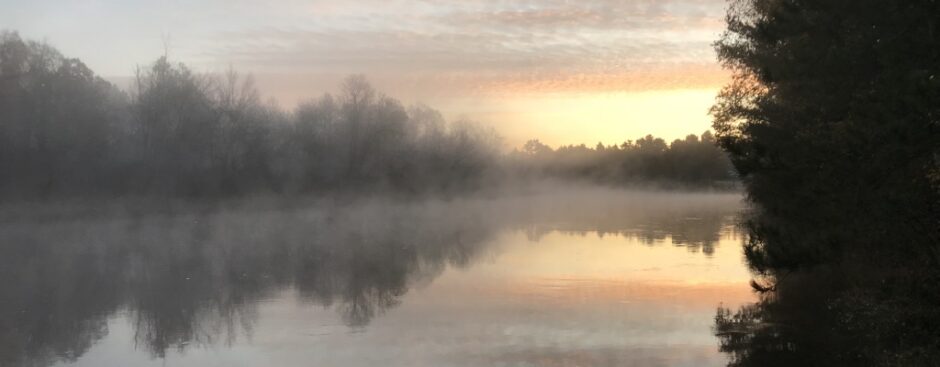
White Iron Lake

(Posted July 26, 2010)
Staying with friends. Didn’t start doing it at the beginning of my sojourn into self-publishing but, as the bottom line loomed more important, as it became clear Steve Spielberg wasn’t going to call, pick up a movie option on The Legacy, and save me from economic ruin, it became not only smart to save money by lodging with the willing. It was necessary.
I’ve imposed myself on any number of friends and acquaintances, new and old, over the ten plus years I’ve been on the road. From places as far distant as Turku, Finland and Cleveland, Ohio, to hamlets such as Ely, this past weekend, right in my own “backyard”.Friday morning. I’m rumbling north in the Pacifica again, the vehicle’s cargo space jammed with my EZ Up, tables, boxes and plastic bins full of books, headed for the Blueberry Arts Festival in Ely. It’s a blessedly cool morning when I arrive at the gateway to the Boundary Waters. I set up my tent, tables, and display, and, by 10:00am, two hours before official opening, my tent is ready for customers and I’ve shed my sweat pitted T-shirt for a Hawaiian party shirt; you know, one with a pattern that screams “umbrella me” to a cocktail. I pull out the book I’ve been reading, The Rocky Mountain Saints, by apostate Mormon, T.H. Stenhouse (see “Mark’s Reviews” tab on the dashboard for a review) and wait.

Business is brisk. By evening, I’m at Dennis and Roxanne Korman’s house on White Iron Lake to the east of Ely, standing on the dock admiring the scenery. The couple and their daughter, Katrina (a cute kid who’s smarter than all of us put together) are across a narrow bay fishing on their pontoon boat. They see me, wave, and pull up anchor to pick me up with the boat.

Not bad. Sold some books and now I get taxi service.

Saturday is traditionally the best day of any three-day arts and crafts event. But with rain threatening (though it never comes), my sales on Saturday are less than Friday’s. After a long day of smiling and talking to strangers, the first Moose Drool goes down fast. I pop a second as the Kormans and Roxanne’s mom, Marge, and I fish for elusive walleye on Garden Lake. We catch oodles of little sunfish which Denny saves in the boat’s live well to transplant into White Iron Lake.

“Kids can catch them under the dock,” he says as we head across the bucolic waters of the Canadian Shield.

Sunday is filled with the sounds of Pat Surface and the Boundary Waters Boys performing on the Blueberry festival stage. Rene’ and our friends, the Salvesons, drive up, meet me at my tent, and the four of us wander over to the Lion’s Club pavilion for blueberry pancakes; one of only three blueberry items you can actually buy at the festival (the others being blueberry soda and blueberry pie.) My guests leave. I return to studying Mormonism. Few folks stop by my booth. Fewer still buy books. It’s likely the worst Blueberry Festival I’ve ever done.

Tear down time. I begin consolidating my booth at 3:30. By 4:00, I am ready to start loading the Pacifica. I pull the van into a parking space a few hundred yards from my booth. I leave plenty of space, so the vendor ahead of me can load her panel truck, and behind me, so I can access my own vehicle.

When I wander back to the Pacifica with a folding table under each arm, I discover some idiot has pulled his or her pickup truck up in tight to the Pacifica. I’m not kidding: the Wisconsin license plate on the truck is actually squashed into the plastic of the Pacifica’s rear bumper. I have no room to load my stuff. I put the tables down and stare at the truck in exasperation. A woman approaches me and smiles.

“Is there a problem?”

“I left plenty of space ahead of me for the other vendor to load and would have expected whoever owns this truck to do the same.”

She looks at me with disdain.

“Well, it’s all the space there was.”

I realize it’s her truck I’m scrutinizing.

“I think you need to back your truck up.”

The woman doesn’t flinch.

“There’s no problem. All you have to do is pull ahead.”

I wince. I’m hot, tired, and disappointed.

I don’t need this shit.

“No,” I say firmly, “I think you need to back up. You caused the problem.”

“All you have to do is move ahead,” she repeats. “There’s no reason to get snippy.”

I take a deep breath. I open the hatch to my van, reach over the bumper of the offending truck, and load the tables.

“You don’t need to be difficult.”

I turn and walk away.

When I come back, the lady, rather than admit she caused the whole chain reaction, has convinced everyone parked ahead of me to move ahead. I load two additional tables and hold my tongue.

“You know, it wouldn’t kill you to move your car forward,” the woman observes as she’s loading boxes into the rear of her truck.

I ignore her and retreat for another load. When I return, I have a change of heart.

No need to get into a rumble with a Cheesehead. Move the car.

I pull my van forward.

‘See, it’s easy to get along with people when you try,” the woman exclaims in triumph.

I keep my powder dry. I cast no pithy retort towards my adversary as I retrieve the last of my stuff.

Peace.

Mark

Posted in Blog Archive | Comments Off on White Iron Lake

Semi-Famous in Grand Rapids

(Posted July 18, 2010)

My kids long ago coined the phrase. We were in Winnipeg, Manitoba, where I was to read from my debut novel, The Legacy at the Grant Park McNally-Robinson bookstore. My second son Dylan (who was in high school at the time) came up with the label. The A-Channel, a Winnipeg television station, was at the bookstore to capture the reading on tape. The station actually aired a spot on the ten o’clock news which included a snippet interview with the author.
“Dad, you’re semi-famous in Winnipeg,” my son said as the piece ended.Dylan’s acerbic observation is a phrase that’s haunted me ever since.Why, you ask? Despite great support from readers, my writing has never won acclaim, never been awarded so much as an honorable mention in the Northeast Minnesota Book Awards or the Minnesota Book Awards, two contests I regularly enter my books in for consideration. But reader after reader, with one or two (and I mean that literally: there have been less than a handful) exceptions, keep coming back to buy another book from me. So I trudge along in semi-fame, wondering if I’ve deluded myself into thinking I can actually spin a good yarn. To keep the bottom line afloat above the red ink, some positive reinforcement from the gods of writing, those folks who decide who wins, who loses, would be much appreciated. But it hasn’t happened yet. So I put one word ahead of another and move forward, onto my next project, all the while keeping a small slender flame of hope alive against the critics of the world.

Saturday. My eyes scan the morning skies as I sit in my portable camp chair in my EZ Up on a soon-to-be sweltering blacktopped parking lot. The forecast for the MacRostie Art Center Festival isn’t good. Rain. Temperatures in the high eighties. Thunder storms. High winds. Hail. That’s the prediction, though, up until noon, the clouds hang in the distance and don’t seem interested in moving towards Grand Rapids.

My eldest son Matt, and his wife, Lisa, join me. They’re both geeked out to the max; checking dueling cell phones with big screens and wireless Internet to chart the storm’s progress. I ask Lisa to check my favorite weather site, Weather Underground. She pulls it up on the tiny digital screen. We both study the display. Radar depicts storms to the north and south of Grand Rapids, with a small breach (approximately where my tent is set up) between thunderheads. The kids buy me lunch, check out the festival, and wander back to their house in Hibbing. Overweight droplets of rain spatter the canopy of my tent as they leave but the storm never materializes.

“I just wanted to tell you,” a smallish woman of middle age says as she ducks away from slow drops and stands in my tent, a copy of Mr. Environment:The Willard Munger Story held aloft in small hands, “that this is a wonderful book. You cover more than just Willard. You’ve captured the entire history of Liberal politics in Minnesota. What a treasure!”

Her husband follows her into the tent and nods.

“She loaned our copy to someone when I was only halfway through it. I need to get it back so I can finish it. It’s a great book.”

The couple doesn’t buy another copy of Mr. Environment, or any of my other books. The woman simply places the biography back on its stack and follows her husband out of the tent.

A smile forms on my face.

She didn’t need to buy anything to make my day. She gave me the one thing I need to keep me writing.

Semi-fame isn’t all bad.

Peace.

Mark

Posted in Blog Archive | Comments Off on Semi-Famous in Grand Rapids

Ground Fog

(Posted July 15, 2010)
It’s been humid all day. When I got off work and drove home, even though the temperature on my car’s thermometer read in the high seventies, it felt warmer because the air was so damn heavy. Weighty, would be the word. The atmosphere of NE Minnesota was weighty; pregnant with rain. Another adjective one could use to describe the atmosphere would be a word that calls to mind the Indian subcontinent: muggy.As I sit on the covered front porch of our house along the Cloquet River, it begins. I hear the distant descent of water from the sky as a subtle echo. I watch storm breach the treeline at the far edge of our pasture where the hay is beginning to yellow. The pitter-patter increases in cadence as the weather moves towards me. I sit beneath the protective overhang of our front porch on a swing, book in hand, studying the storm. Then the sky opens up.

But the rain doesn’t lessen the mugginess. Doesn’t reduce the thick, clammy grip of the portending storm. Thunder crashes. I see no lightening. Birds flee the onslaught, flitting towards the sanctuary of the woods. I return to my book, a non-fiction study of the Forest Brothers, Partisan Estonians who fought the U.S.S.R. for the better part of a decade following WWII. The book is well written. The writer, capable. But the words don’t hold my attention. The ponderous weather has me thinking about another book I’m reading. City of Joy. Maybe you saw the movie when it came out a few decades ago. The story is set in the impoverished slums of Calcutta and chronicles a Christian missionary’s journey into abject poverty. I’m only a few chapters into the book but the imagery, the writing, the characters, well, they’ve latched onto me in such a fashion that the mere presence of humidity carries me away to that slum; a place of decay and indescribable hardship I’ve only visited through words.

I watch the storm push east. Last drops fall into the calm waters of my wife’s garden pond. Thick ground fog ascends from sodden earth and cloaks the surrounding woods in gray. I look across the open field, surveying all that I’ve been blessed with and I know that I’m a lucky man.

Peace.

Mark

Posted in Blog Archive | Comments Off on Ground Fog

Roots

(Posted July 12, 2010)
Pockerbrush. The name coined by Minnesota novelist, and Friberg Township native, Herbert Krause (Wind Without Rain) to describe the hardscrabble environment of rural Otter Tail County, Minnesota. I pull into the Phelps Mill County Park parking lot and unload my Pacifica on Friday night, the hustle and bustle of hundreds of other arts and crafts vendors a backdrop to my labor as I set up my EZ Up tent for the weekend.Shit.

EZ Ups are notorious for leaking during the lightest of summer rains. I always secure a blue tarp over the canopy as added protection against weather. I realize, in trying to stretch the two tarps I have with me, that neither one is right for the job; that both fall short. I improvise. I overlap the tarps. The result is an ugly patchwork of blue and silver. I don’t care. Rain is predicted and the last thing I need is for my inventory to get soaked. Books and water don’t mix, a lesson I’ve learned doing hundreds of festivals over the past ten years.

I finish my work and head for the AmericaInn in Fergus Falls. As I drive through the rolling hills, marshes, and beauteous lakes of Otter Tail County, I think about my dad and his family, both the Munger and the Zuehlsdorf sides. The patriarchs of my roots came to this river valley, this place, for cheap farm land. One grandfather, Lyman Munger, a dreamer, socialist, and wood stump philosopher, was a poor excuse for a farmer. The other, Albert Zuehlsdorf, was a dedicated dairy man; a farmer whose legacy, at his death, included four farms in the valley of the Otter Tail River. My dad and his folks left here for Duluth in 1942 in the midst of war. But we’ve been back many, many times over the years. I pay my respects to the past as I slow for the city limits of Fergus Falls.

Saturday, the traffic at the festival is steady during the morning but tails off after lunch. I converse with folks, some of whom who’ve read my work, some of whom buy books from me for the first time. The day is hot, over eighty-five, but the predicted rain, constrained as humidity, holds off. At the end of the day, I’m dog tired. I make my way to a little Mexican restaurant in downtown Fergus and eat in solitude. My stomach full, I drive to the hotel, remove my sweat-stained clothes, take a shower, and wander down to the pool. I have the hot tub to myself as kids leap with joy into the big pool to cool off. Rumors of thunderstorms and tornadoes persist. I wake up to the crash of thunder and the flash of lightening at three in the morning.

Hope the stakes hold.

There isn’t much I can do other than pray that the storm doesn’t trash my tent. My books are secure in plastic bins. The EZ Up is tied down. The storm passes. When I arrive at the park in the morning, the day is cool. Light clouds drift beneath a robin’s egg blue sky. The day is ever so fine.

Sunday’s are usually less busy. Most folks come to festivals on Saturday. In the shadow of great oaks, alongside the broiling waters of the Otter Tail River, the old grist mill for which the park is named stands as a lonely stone sentinel over an ancient, noisy dam. A steady crowd flows in and out of my tent, buying books, talking writing, asking questions.

“He once warned me for fishing without a license,” an elderly gentleman says, his spine bent with age, his eyes clouded by cataracts, pointing to a poster advertising my biography of my uncle, Rep. Willard Munger, a native of Otter Tail County.

“I think you mean his father, my grandfather,” I correct the man. “Harry Munger is the guy you are thinking of.”

My grandfather, Harry Munger, Sr. was the district game warden in these parts during the 1930s. The old man smiles as he remembers.

“Yes, that’s right. Harry Munger. Well, he caught me fishing, two poles, no license. He said, ‘Mattson, you put those away and go on home now, you hear?’ Didn’t give me a ticket. Just sent me home.”

I smile. I realize this is one of the only folks left who recalls my grandfather for his conservation work during the Great Depression. The man pads off slowly, his misdemeanor concealed by memory.

The festival ends. Vendors line up in cars and trucks on the hillside overlooking the park. I make an executive decision. Rather than wait in line for an hour to drive into the parking lot to load, I decide to hike the hill with my belongings. I tear down the EZ Up, pack my stuff away, and make six arduous treks up and down the steep hill with my heavily laden two wheel cart. It takes the better part of an hour for me to pack everything away and drive east, towards home.

Peace.

Mark

Posted in Blog Archive | Comments Off on Roots

Pulling the Plug Ain’t Nice

(Posted June 28, 2010)

Rochester Minnesota. The Think Green Festival. I drop my third son Chris and Jimi, my wife’s wiener dog, off at Chris’ girlfriend’s house in Minneapolis before resuming my drive from Duluth to the home of the Mayo Clinic. It’s hot and muggy. I’m late, arriving fifteen minutes before the event, a one-day, indoor environmental exposition, is to start. I find my table in one of the barns at the Olmstead County Fairgrounds and begin unloading my books and paraphernalia. I’m set up before 10:00am, just in time. The day grows hotter and more humid as I walk to a portable toilet to change shirts.

I sure seem to spend a lot of time visiting these porta-potties, I muse, thinking of all the festivals, where such toilets are iconic necessities, I’ve sold books at over the past decade.

The Charlie Sheen-style polo I remove in the sweltering privacy of the john (think “Two and 1/2 Men”) is drenched. I pull on one of my festival standards, a blue Hawaiian shirt with a crazy floral print, don my Cloquet River Press baseball cap (branding is everything, or so I’ve heard) and wander back to my booth, perspiration streaming down my face.

I work the crowd for the better part of the day. I meet some nice and some not so nice folks. An older woman (older meaning beyond my fifty-six years) stops by and chats with me. I can tell from her body language (and doing this selling thingy for ten years) that she’s not about to buy a book, that she’s stopping by because she has an agenda.

“I worked for a legislator who knew Willard Munger,” she says. ” He was a conservative.”

“Oh,” I respond. “Willard was anything but, though he got along with many Republicans better than some of his Democratic colleagues.”

“How are you related to him?”

“He was my uncle.”

“And what do you do when you’re not writing books?”

“I’m a judge up in Duluth,” I say. “But I’m just like my uncle. I’m a crazy Liberal,” I say glibly.

The woman stares at me with what I perceive to be scorn.

“You can’t be a very good judge if you’re a Liberal.”

You get the idea. I’ll spare you the rest of the dialogue. Needless to say, I wasn’t about to convince her that, regardless of philosophy, the judges in the Duluth courthouse pretty much decide cases based upon the law and not political ideaology.

The day grows long. I sell a few books, not enough to improve my bottom line but enough to give me hope that, by 9:00pm when the event is over and I drive off to my little Kamping Kabin at the local KOA, I won’t have lost my shirt. When I show up in the 4H building to talk about Mr. Environment, the guy who had the time slot ahead of mine is still at it. He doesn’t yield the stage so I go back to selling books.

A missed opportunity.

I sell three books in quick succession once back behind my table. Then one of the volunteers from the festival stops by.

“We’ve decided to close down at six,” she says, never blinking an eye.

I look at the time on my cell phone. It’s quarter to six. My ears redden. I just smile.

I wouldn’t have paid the money to stay at the KOA if I knew you were going to close down three hours early, I think. I could have driven home. It’s my wife’s birthday tomorrow. I could have been there to make her breakfast in bed.

I’ve never had this happen, not even at an outdoor festival in a thunder storm. I’m speechless. I don’t really know what to say. When six o’clock arrives, I simply pack up my stuff and shuffle off to the KOA. At the campground, I strip down and put on my swimming suit. My piled clothes are etched with salt from sweat. I walk to the swimming pool; a towel thrown carelessly across my shoulders. I drop my sandals on the concrete apron and dive in. The pool is clean. The water is cold.

There’s always tomorrow.

Peace.

Mark

Posted in Blog Archive | Comments Off on Pulling the Plug Ain’t Nice

Free Fallin’

(Posted June 22, 2010)
Morning. I stumble down the stairs into our kitchen, open the pantry doors and a cabinet drawer and grope for the coffee canister, filters, and a large spoon. Water splashes from faucet into pot. The coffee maker gurgles. I retire to my writing room to await the essential first cup of morning coffee. I open emails and read the latest issue of NOWW (Northwestern Ontario Writers Workshop) Magazine. Fog sits low across the pasture outside my window.
I venture outside the house after downing two cups of scalding coffee. Black, like the Norwegians and Finns like it. Standing on our covered front porch, humidity heavy across my face, birds flitting nervously across pasture grass, I notice something’s amiss.The flag. I better pick up the flag.

Wind has dislodged our American flag, depositing it in a bush next to the front stairs. I lean over the railing intent on clutching the flag and retrieving it. Instead, I hear a solid “crack” as the entire railing gives way. There’s nothing I can do. It’s one of those moments, like being trapped in a doomed plane, or standing beneath a cliff giving way, when you’re paralyzed. Not by fear but by inevitability. This ain’t a movie. And I am not going to stop myself before I land on the hard gravel below.

“Shit, that hurt,” I mumble, as I stand up in shrubbery. I rub my right low back and hip, thankful for the extra twenty I’ve put on over the past ten years. Instead of hip bone striking ground, my descent was cushioned by fat. “Damn, that is sore,” I continue, picking up pieces of the fractured railing.

I whine; just loud enough to wake Rene’, who should be getting ready for work. There’s no response. All is quiet inside the house as I climb the stairs with my arms full of railing.

Peace.

Mark

Land Without Loons (Posted June 21, 2010)
The sky wasn’t exactly clear and sunny when I popped out of bed on Saturday and headed to the Land of the Loon Festival in Virginia to set up my EZ-Up tent and sell books. It was gray and cold and drizzly on the banks of the Cloquet River where I live. My Pacifica was already loaded with books, my tent, and gear when I stumbled my way into the dankness of my garage, a travel mug of hot coffee in my right hand, and hit the remote door opener. Sheets of nearly invisible rain were revealed as the mechanical door creaked open.Shit. I don’t need this.I pulled into the festival at seven-thirty greeted by an effervescent, highly energetic team of post-menopausal gals whose cheerfulness was downright annoying. I accepted my registration packet, nodded subdued “thanks” and pulled the car into the festival grounds.

The rain came and went in short spurts; sometimes descending hard enough to send folks scurrying for cover; most often, simply sprinkling the crowd with vague suggestions of moisture. My books sold poorly. Time slid across the day like a dew worm across a wet sidewalk. Folks braving the weather stopped by to chat. A few bought books. Not many; just enough to force me to keep my tent flaps open and my optimism elevated.

Sunday. I woke up refreshed after a good night’s sleep. Rene’ and I celebrated our friend Ron’s sixty-fifth birthday last night. At fifty-five (my age), moderation in celebration is the key to a decent morning after. The sun was out. The sky was clear. A perfect day to sell books.

Back at the festival, I sold a few more books but total sales for the event were disheartening. Trying to juggle a full-time job and marketing my work to the world is exhausting. Book stores sell some books for me but with discounts and printing costs, hand sales at events like Land of the Loon are where I can actually improve my bottom line. Not this time.The bottom line doesn’t budge towards profitability after the meager sales I register sitting in my little white tent.

As I was loading my car, I heard the distant, forlorn call of Minnesota’s state bird, the namesake of the festival. But it, like success, was an illusion. The sound wasn’t that of a real loon calling from the weed choked waters of nearby Silver Lake: It was just a loon whistle, a trinket being sold by another vendor at the show.

“How did you do?” a lady in the next booth selling magnetic jewelry asked as I put the last of my stuff away and closed the Pacifica’s rear hatch.

“Lousy,” I replied, immediately regretting the bitterness behind my revelation. “About half of what I did here last here.”

“That’s too bad,” the woman said consolingly. “But folks really seem to like your writing. I kept hearing them tell you how much they enjoyed this book or that book. That should make you proud.”

She’s right, I thought. She absolutely right. Not a single person stopped by to complain about plot, rag on me about a typo, or debate a scene or character. To a man and woman, the folks who stopped by were not just positive; they were downright giddy with praise.

That’s enough to convince me to show up in Rochester, Minnesota next Saturday at the Olmstead County Fairgrounds for the Think Green Festival.

See you there!

Peace.

Mark

Posted in Blog Archive | Comments Off on Free Fallin’

Loss


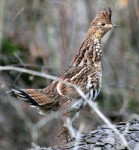
(Posted June 19, 2010) Driving in this morning, one car ahead of me on the Emerson Road, a blacktopped rural two-lane, she sat in the oncoming lane: a hen partridge (ruffed grouse) her head bobbing nervously, her dark birdy eyes blinking incomprehensibly. The car in front of me flew past the hen without hesitation, the breeze from its exit ruffling the tail feathers of the bird. She did not back off. She did not move from her station. She stared blankly at a small tuft of brown, white, and black feathers smashed into the pavement behind the departing car and immediately in front of my Pacifica. It was if the bird was on sentry duty, her attention riveted, her demeanor stern and protective (if an avian brain is capable of such complex thought.)

What the hell, I thought, slowing the car. I have to spend all day in divorce court. Might as well stop and find out what’s going on.

The Pacifica rolled to a stop just short of the blob of feathers that was once a partridge chick. The hen bobbed and pecked the air. Her eyes never deviated from the body of her dead offspring. Meager morning wind brushed the soft down of the dead bird as a new sun rose behind a line of second growth. I opened my window.

“What’s the matter, Mrs. Grouse?” I asked, the name rolling off my tongue like a murder suspect from Clue. “Did you lose one of your little ones?”

The bird studied me but did not advance. Whether finally cognizant that her chick wasn’t coming back to her, or in recognition of me as danger, the bird ducked her head and darted through the kinnikinnick of the ditch, disrupting the detritus as she ran.

I hope her other little ones are safe, I think as feathers merge with landscape.

Peace.

Mark

Posted in Blog Archive | Comments Off on Loss

Sunday


(Posted June 14, 2010) Yesterday, after all the hub-bub of a busy Saturday, it was time to mow the lawn. Now, to those of you who grew up on a farm, that statement likely seems trite. If you spent your youth taking care of dairy cows, milking them twice a day, every day, day in, day out; or feeding hogs; or cleaning a barn, spending four hours on a John Deere riding lawn mower on a cool, overcast Sunday morning sounds inconsequential. Add to the equation the fact I was listening to Brenda Weiler, Warren Zevon, Bob Dylan, Wilco, and assorted other musicians on my Sansa (bargain iPod), and it’s unlikely I’ll draw much sympathy from anyone who ever worked the business end of a Case or an International.

Still, it’s a big job, this keeping nature at bay. Jack helped out by push mowing the front lawn. Two years ago, I bought a rechargeable (battery powered) push mower; my acknowledgment that global warming is indeed real. Jack’s intervention saved me a good half-hour: A half hour I spent (after completing my circuit on the rider) cutting grass along the edges of gardens and trees with a gas powered trimmer and old fashioned hand clippers. Throughout the day, migrant raindrops splatted my bare arms and legs but the clouds never fully opened up.

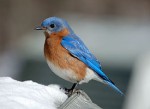
While mowing around our vegetable garden, where corn and green beans have finally sprouted through the wet loam in neat rows, I came upon a scene that caused sadness and reflection. I stopped the rider, stood in the cool air, and lifted a delicate body in my right hand. The plumage of the small bird, rust chested and blue winged, one of the male bluebirds living with its mate in the wooden houses I’ve erected on graying cedar fence posts around our yard, appeared shockingly ordinary in death. Gone was the vibrant, flitting indigo one sees when a male bluebird flies.

Birds die by the thousands along the Cloquet River every summer. I don’t witness their deaths. Why does the death of one bluebird seem so significant?

I showed Rene’ the carcass before depositing it in the woods. The bird’s body was intact. I formed no hypothesis as to why the bird died.

Standing by the side of my lawn tractor, intent upon finishing my work, I watched a pair of bluebirds patrol the space around their nest.

Lord protect them, I prayed before firing up the lawn tractor.

Sunday evening, I sat on a porch swing on our covered front porch reading the Sunday paper. My work was done. My body was sore. Daisey, our black lab mix, an old dog, a tired dog, lay sprawled on wood decking near my feet. The dog’s contented snores added a bass line to the high pitched trilling of tree frogs in the waning light.

“What kind of bird is that?” Jack asked as he stepped from house onto porch, pointing at a small, red chested, white bellied bird sitting at the very tip of a spruce planted alongside my wife’s flower garden.

“I’m not sure,” I replied.

“Looks like a female bluebird.”

“I think you’re right. Get the book.”

Jack retrieved our bird book. He was right. The bird was a female bluebird, a fact verified when it landed close to the porch and flared its blue tail feathers.

Rene’ joined us on the porch.

“Maybe she’s looking for her lost mate,” Rene’ said plaintively.

I watched the little bird flit away, hoping that my wife was wrong.

Peace.

Mark

Posted in Blog Archive | Comments Off on Sunday

Low Water

The Mungers

(Posted June 2, 2010)

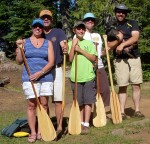
The week before Memorial Day weekend. The final push. For a couple of weeks, I’ve worked my tail off, getting new tires on the Pacifica (tired of having to put air in them every few days; at 50,000 miles, it was time for them to go), picking up camping supplies, a new tent for Jack, creating a menu for five, checking the BWCA website to make sure my reservation for the trip is still valid. Two days before we leave, I spend four hours making last minute purchases, buying the food for our weekend, making it home at 10:30 from Super One to collapse into bed. I make it in to work on Thursday and check to make sure no one has filed against me in the upcoming judicial election (jubilation, no one did!). That night, Matt, our eldest son, and his wife, Lisa, arrive at the house with their four dogs. Only Johnny Cash, a black dachshund of questionable intellect but loving disposition, is going with us for our four days in the wilderness. The other dogs are going to a local kennel to chill. We pack food, personal items, cookware, tents, lanterns, the single burner LP stove, and by 10:00pm, it’s lights out. Tomorrow is the big day. Tomorrow we drive to Isabella, take a right on a forest road, and head to Hog Creek.

Friday afternoon. The Pacifica and Matt’s red Nissan truck, both sporting “canoe hats”, slide into the primitive parking lot overlooking Hog Creek. Our destination is a three hour paddle downstream; Perent Lake. Not to be confused with “Parent Lake”, another BWCA lake which is “paddle only” (no motors allowed), Perent is a nice destination if you’re not into portaging a whole hell of a lot. I don’t mind humping packs over rocky ground. My boys, Matt included, on the other hand, prefer getting into a lake and fishing rather than trying to recreate the era of the Voyageurs. Lisa, our new daughter-in-law, is on her first camping trip to the wilderness. Perent seems like a good choice to test her mettle.

We load the two canoes until every crevice of the boats below the gunwales is stuffed full. Matt and Lisa push off in our green Old Town Discovery. Rene’, Jack and I follow in our red Coleman. Jack is the “odd man out” and sits on the floor of the Coleman, holding onto Johnny who wants to launch himself into the water and pursue the lead canoe. The dog, for as small as he is, is pure muscle. Jack battles him for most of the first hour of the slow meander down the tannin stained creek.

There’s a short portage over rocky debris a few minutes from the parking lot. We heft packs and canoes, cross the isthmus, and put in on sandy ground sloping gently into a wilderness pool of black water. Mallards take wing and quack. The sun is high and bright. There is no threat of rain. We paddle on, marveling that there are no mosquitoes or black flies to bring us misery. It is too dry. The fetid pools and backwash of the land, the places bugs like to propagate, have vanished in drought. There’s enough greenery to forestall a fire ban. We’ll be able to have a campfire at night, in the fire grate supplied by the U.S. Forest Service at whichever campsite we are lucky enough to snag. But that’s the limit of the rain this country has had: just enough to allow us the pleasure of a fire and not enough to hatch bugs.

The scene at the parking lot had been foreboding. The lot was packed with cars and trucks, some with trailers capable of carrying a half dozen canoes. As we float the creek, I am worried about two things: One, whether we’ll find a campsite on the lake, given the number of folks who “beat us to the punch” and put in ahead of us; and two, our return trip upstream. It’s not the current that gives me pause. Hog Creek is a winding, marshy meander, where alder lines the water course for three or four miles through moose country. The flow of the creek, even in a normal spring, is marginal and not a problem when going upstream. But the beaver. My, my those rodents have been busy! As we paddle, we end up sliding over dam after dam in progress. The water is shallow. Our canoes have little clearance over the sticks and twigs bobbing in the current.

Coming back is going to be a bitch.

“I want an island campsite, Dad,” Jack bemoans as we break onto the open water of Perent Lake.

“Maybe. We’ll take whatever we can get,” I tell him in a stern voice, worried about the number of campsites available on the lake and the volume of parked cars back in the Hog Creek lot.

The islands are all taken. We settle on a campsite on the mainland that boasts a rocky overview of the lake, a protected cove for landing canoes, and plenty of space for three tents. In no time, the tents are pitched and their lines are staked, bed pads and sleeping bags are unrolled, and camp is made. Dinner is simple: hot dogs and polish cooked over a roaring campfire, accompanied by Bush’s baked beans (Always thought George W. was full of beans; didn’t know he sold ’em too!), Pringle’s (traditional chips would have been mashed to smithereens during the trip in) and Kool Aid.

The weather cooperates. The sun shines. A light wind blows, bequeathing a “walleye chop” perfect for drifting over reefs and rocks. The fishing is slow but steady, with each of us catching walleye, the occasional snaky northern pike, a few perch, and Jack landing a rock bass to boot. The highlights of fishing are: Jack catching two seven pound pike on Lisa’s pink “lady’s only” rod and reel (he’d already broken the tips on two of my three fishing rods and caught hell for it); and the guide (me) forgetting to tie off the stringer, which allows Sunday dinner (three nice walleye) to escape while Matt and I ponder the universe on rolling water.

We witness a pair of bald eagles do their spring dance, eerie cries echoing over calm morning water. We see mergansers speed low over lapping whitecaps, intent on finding fish to feed their young. We see no moose or bear, but catch a glimpse of a solitary muskrat chugging through water, find the occasional toad and painted turtle intent on sun, and stumble upon one whale of a surprise in the mossy woods just a short walk from our tents.

White cedars tower above our camp, their soft whispers echoing the past. A short distance away, a bed of wildflowers seeks the sun. I find the bed while searching for dead fall to feed the campfire. I am fifty-five years old and I have never seen wild orchids like these. Never. The pink lady slippers were discovered by someone else, someone with a more observant eye than mine. A path has been laid to their niche and the forest canopy opened to allow in the sun. I call the others to see the miracle. It is indeed, the highlight of the trip.

Sunday evening. Our last night. Rain threatens but never materializes. The walleye and pike (Matt, Rene’ and Jack supplied fish to replace those I “set free”) are excellent cooked over a slow wood fire. In the morning, we eat a hearty breakfast of hot oatmeal, the last of our bagels with cream cheese, hot coffee, and Tang, before striking tents and loading canoes. We police the campsite. “Leave no trace” is nearly impossible but we are packing out everything that we brought with. There are no plastic bags, no twist ties, no debris left to spoil the next party’s visit to this marvelous spot.

Hog Creek is indeed a bitch. The slight gaps in the beaver dams we were able to cruise through paddling downstream now impede our progress. No less than a dozen times, Rene’ and I, and Matt and Lisa, are forced to clamber over the gunwales of our canoes and tow them over the beaver dams. The going is slow. But the sun is high. There are no bugs. And Johnny sits contentedly on Jack’s lap, waiting to be reunited with his canine pals.

We clamber out of the canoes at the portage, reload them after hefting packs and tents and gear over rocky ground, and paddle to the landing. On aching, tired legs, the five of us climb from creek to parking lot carrying dusty load after dusty load. We pack gear into our vehicles, hoist canoes onto racks and tie them down, take one last look around, and motor home.

It’s a perfect Memorial Day trip and Lisa, the newest member of the family has proven she has “the right stuff”.


Peace.

Mark

Posted in Blog Archive | Comments Off on Low Water

Hunter Lake

(Posted May 26, 2010)

Last weekend my youngest son, Jack, and I paddled one of our family canoes down the Cloquet River. Our route took us from our house on the river to Hunter Lake, a small oxbow lake off the Cloquet. It was a nice, summery May evening. There were no bugs. The wind was at our backs and the current was mild. That’s important, the current being mild, because we both knew, come Sunday when Jack’s Boy Scout campout was over, we’d be paddling upstream.

We arrived at Hunter Lake to a cacophony (an overused word, I know) of thirty five boys between the ages of eleven and fifteen setting up tents, unloading gear, and engaging in general mayhem. Jack and I landed my Old Town Discovery and muled three heavy packs uphill before pitching our tent, unrolling our sleeping pads and sleeping bags, and making camp. Friday night, I sat around a campfire with the other adults, listening to loons calling on the water, kids shrieking in the woods, and outboard motors gurgling on the darkening lake.

Prior to the campout, the Scouts were charged by patrol (eight to ten boys each) with creating menus for their meals, purchasing the food, and then cooking the food themselves. Saturday morning. Jack’s patrol, the Batz, ends up eating blueberry pancakes with no syrup or butter because they forgot to buy it. The Old Goat Patrol (the parents and scout leaders) are treated to Chef Don’s excellent dutch oven culinary cuisine. Breakfast, the envy of the still-hungry Batz, is an egg souffle baked over the coals and served hot and fluffy. The boys drool as the adults scarf. We do share, but only after every adult has eaten his or her fill. This dissonance in meals continues throughout the two days we’re in camp. I eat well. Jack eats whatever the Batz throw together out of whatever meager supplies they bought.

The boys work on rank advancement with the ever patient Julie and Jim Belden and other scout leaders. Jack completes the requirements for First Class, the last of the beginning ranks. He’s on his way to Eagle if puberty, girls, and fast cars don’t divert him from his goal.

Jack and I fish Hunter Lake and the river. We catch a few northern pike. One ginormous fish, a lunker that stays on the river bottom like a lead weight, breaches and spits the hook. Likely the mother of all Cloquet River northerns, the fish swims free. Jack laments his loss. His only consolation is the image of an enormous tail breaking the placid surface of the water that he’ll never forget.

The biggest fish actually caught, a pike over ten pounds, is reeled in by a ten-year-old girl, the sister of a scout. I take some credit for the catch since she and her dad used my canoe and my net (which was shredded in the process) to land the kraken.

Rain threatens but never arrives. Both mornings, I rise from my slumber, my back in knots, my hair a mess. I stumble down a deer trail to the water’s edge and wash my face and hair and brush my teeth. As I refresh myself, I note that the camp on Hunter Lake is tranquil despite its close proximity to year-round homes and seasonal cabins. There are no jet skis, no big boats disturbing the valley of the Cloquet. Only the mournful wail of the occasional train crossing the river on a trestle downstream, the satisfying squeals of boys having the time of their lives, and the throaty rumble of small outboards plying the lake remind me that this isn’t wilderness, that this place is only a stone’s throw from town.

We pack up on Sunday and paddle home. As Jack and I work against the river’s weight, we encounter pairs of mallards and teal and wood ducks and Canada geese intent on species continuation. A bald eagle soars above us; a cousin to the osprey we watched fish Hunter Lake the day before. A muskrat makes its way through black water and disappears in river bank. We fight through slender chutes defining the rapids just below our pasture. And then we are home.

Peace.

Mark

Posted in Blog Archive | Comments Off on Hunter Lake