What a Long, Strange Trip It Was


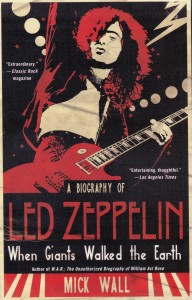
Led Zeppelin: When Giants Walked the Earth by Mick Wall (2008. St. Martin’s. ISBN 978-0-312-59039-0)

I know. The lyric is from the Grateful Dead, not Zep’. But after reading Mick Wall’s comprehensive biography of the quartet, it just seemed to fit. The author (who didn’t come onto the music scene soon enough to personally chronicle the first real power quartet to meld classical, rock, soul, and blues into music that grabbed hold of popular culture; taking work done by other bands like Cream and the Stones and the Beatles to a new and unexpected plain) uses personal interviews, archived materials, news reports, and the like to pull together a very comprehensive and thoroughly enjoyable peek into the lives, demons, and thoughts of the four founding Zeppelin members. It’s, in the end, a well-written book that makes you want to listen to lesser known Zep tracks and simply chill while Jimmy Page’s genius as a guitarist and producer washes over you like the wall of sound that crashed over millions of fans during the band’s zenith.

There is no question after reading Walls’ chronicle of the parade of booze, drugs, groupies, sessions, antics, and concerts that made up the lives of Jimmy Page, John Paul Jones, Robert Plant, and John “Bonzo” Bonham for the better part of a decade, that the lads were lucky that only Bonzo died of an alcohol and drug induced stupor (choking on his own vomit in 1980). Bonzo’s demise spelled the end for Zep, though, as Walls sketches the story, the band had already passed its creative prime and was headed towards a collective crash landing at the time of the drummer’s death. Bonzo’s death (a man revered by many as the greatest rock drummer of all time) simply solidified what was already in process: the end of Zeppelin. The odd three man reunions that took place thereafter (with Bonzo’s son Jason filling in on drums) never rekindled the magic of the band’s six studio albums or the live performances of the mid-1970s and, in many ways, were like the return of an aging athlete to his beloved sport when he’s past his prime. Walls does a very fine job of following the careers (or, in the case of Jimmy Page, non-career) of the surviving band members, making it very clear that Robert Plant, the voice of Zep, was already on the way out when Bonzo died and, with his solo career well launched (including a fist full of Grammys for his work with roots star, Alison Krauss), has never had regrets that Led Zeppelin finally, like the famed Hindenburg, crashed and burned. John Paul Jones, the most inventive and adept musician of the bunch, has found satisfaction in producing the work of others and appearing as a session player on many, many albums since the demise of the band. It is only the sad lament of lead guitarist and band leader, Jimmy Page, who has, since Bonham’s passing, floundered. Walls paints the picture of Page as an old man desperate to recreate what he once had and lost, pleading, begging, for Plant to come back to the fold to recreate the impossible.

Taken by promoter Tats Nagashima to what he boasted was “the most elegant restaurant in Tokyo”, Bonzo grew fed-up with being served sake’ in tiny cups and demanded “a beer mug or some buckets”. Later that night, they paid a visit to Tokyo’s famous Byblos disco where Bonzo showed his disapproval of the music by urinating from a balcony on the DJ. Bundling the drunken drummer into a cab, Cole finally gave up and left him to collapse on the street just feet from the entrance to the Tokyo Hilton where they were staying. The next day, Bonzo and Cole bought Samurai swords, and drunk again that night, began enacting a sword fight at the hotel, slashing and cutting at anything they could: chairs, curtain, mirrors, paintings. For an encore, they snuck into John Paul Jones’ room and carried his still sleeping body out into the hall where he spent the rest of the night…At the end of the night, the Hilton banned Led Zeppelin for life…

This passage reflects the sort of “all hands on deck” writing style Walls employs (to much success) through most of the book. The only criticism I have of the biography is Walls’ use of fictionalized “first person” vignettes interspersed throughout the book: These passages detract from the thorough journalism Walls employs and, are in a word, quite silly. But for this ill-advised device being employed, the book would be a five star read.

In the end, if you want to understand where all that fantastic music came from, this book is a good place to start. Fifty pages into the story, you’ll want to buy the six Zep albums and surround yourself with their collective genius.

4 and 1/2 stars out of 5.

Posted in Books | Comments Off on What a Long, Strange Trip It Was

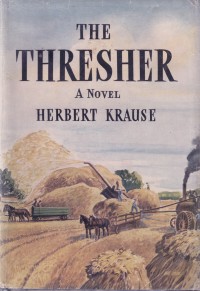
More on Herbert Krause

Dr. Paul G. Theobold the Dean, School of Education, Woods Beal Endowed Chair, and chair, Department of Social and Psychological Foundations of Education, Buffalo State College, had his assistant, Ms. Cynthina Anthony, ask whether I would be willing to allow a link from their site, Rural Lit RALLY (Reinvigorating American Life and Learning through the Literature of Yesteryear) to my essay, “Reading Herbert Krause” (see above under the “Other Writings” tab). The Rural Lit folks are apparently trying to catalog and, through the use of their new website (http://rurallitrally.org/) begin an online dialogue about the importance of rural writing, notably the “forgotten” writers of the dust bowl days and before, including my personal favorite, Minnesota native, Herbert Krause. Dr. Theobald and the Rural Lit RALLY folks sum up their mission this way:

There is a saying:  “You don’t  know what you’ve got til it’s gone.”

Out of print for decades, and long-since discarded from all but research university libraries, wonderful works of rurally based literature are disappearing every day.  Variously called “farm novels,” “regional novels,” or “local color fiction,” these works portray farm life perceptively and in great depth.  To lose them is to lose a piece of our collective history; a piece of who we are, as a people and as a nation.

This Rural Literature Initiative seeks strategies for building demand for rural literature in rural and urban schools such that academic/university presses can put this literature back into print or, short of this, that digitized collections might be created.

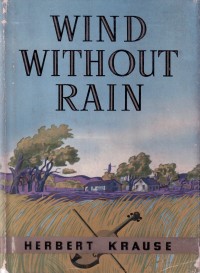
As a lover of Krause and the not-as-yet-forgotten Cather and Rolvaag, I welcome Dr. Theobald’s interest in my essay. I hope to participate in the online discussion that takes place regarding Krause’s importance as a regional writer in January on the RALLY site. I’d also urge all my blog readers who enjoy finely wrought prose to give Krause and the other authors featured on the Rural Lit RALLY website a try. Most of the books are out of print but you can find these gems online (at the usual suspects) or in the dusty corners of you local used bookstores. You won’t be sorry for trying these forgotten authors. Old is not to be confused with outdated: the themes in these stories are as relevant and timely today as they were when they were written. Who knows, if you look hard enough, you might even find an autographed copy for a reasonable price! Holding literary history signed by the author is a treasure to be relished and read. And, if after reading Wind Without Rain or some other long forgotten classic, you feel like joining in the online conversation, I’m sure your input would be appreciated by the folks behind RALLY.

Peace.

Mark


Posted in Blog Archive | Comments Off on More on Herbert Krause

Per Is Peerless


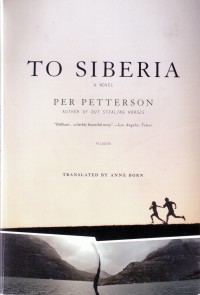
To Siberia by Per Petterson (1996. 1998 Translation. Picador. ISBN 978-0-312-42899-0)

On the way home from school I walk right behind Lone and mimic the way she moves. She minces along. I go on doing that as long as it is fun, and Lone never once looks back. She lives in a big house…almost at Frydenstrand. I don’t go as far as that, but in the same direction. We never walk together. Lone is upper class and must not be seen in my company. The feeling is mutual. But as I am about to turn up Asylgate, she does turn around. She stares at me with eyes full of hate, takes hold of her scarf and wrenches it around so the knot is at her nape and hitches it up until it’s really tight, sticks out her tongue, and squints at me. At once I start to run, hit her with my shoulder, and knock her backward into a snow drift. I give her a thorough ducking. She may be the headmaster’s daughter, but no one makes game of me. No one.

In this brief, almost novella-sized poetic novel, Petterson, whose  Out Stealing Horses (see my review in the Review Archives) became an international best seller, paints a picture of pre and post WWII Denmark and Norway that is the literary equivalent to an Edvard Munch painting: Sparse, dark, bitter, yet compelling. To Siberia is really a collection of interlocked vignettes rather than a fully realized novel: The storyline skips and meanders and moseys around, following the young female protagonist and her brother through a series of scenes and encounters. But this lack of continuity and structure is not a deficit. Indeed, the wayward path of story in this book is one of its distinct charms. The Scandinavian lilt and lyric of the author’s prose reminds one of an old Norse saga or of some long forgotten folk song. Sea spray and snow and gray skies and bone chilling cold are omnipresent throughout this story of  two siblings growing up in chaotic times. There are hints of holocaust, war, death, sabotage, sex, forbidden love, and incest sewn within the fabric of Petterson’s poetry, all of which enable the fully realized characters of the tale to grapple with the emotional upheaval of small countries dragged into a world wide conflagration. A simple yet powerful piece of writing.

4 and 1/2 stars out of 5.


Posted in Books | Comments Off on Per Is Peerless

An Amazingly Creative 55 Years


Steve Jobs by Walter Isaacson (2011. Simon and Schuster, ISBN 978-1-4516-4853-9)

I want to live alone in the desert
I want to be like Georgia O’Keefe
I want to live on the Upper East Side
And never go down in the street
Splendid Isolation
I don’t need no one
Splendid Isolation
Michael Jackson in Disneyland
Don’t have to share it with nobody else
Lock the gates, Goofy, take my hand
And lead me through the World of Self
Splendid Isolation
I don’t need no one
Splendid Isolation

((C) 1998 Warren Zevon)

I’m listening to Warren’s song from his live album, Learning to Flinch as I type this review on my iMac wireless keyboard in my writing studio overlooking a river that, though he wasn’t an outdoorsman, Steve Jobs would appreciate. There’s a high gray and aqua sky above the stark, empty early winter landscape. The sun is hidden somewhere between twelve o’clock and nine: it’s completely concealed by clouds. Somehow, the austerity of the day, the melancholy of the “in betweeness” of this time of year is a suitable, nay perfect, backdrop to talk about the life and legend that was Steve Jobs.

Enigmatic. Irritable. Demanding. Narcissistic. Habitually deficient in honesty if deception served a “greater” purpose. Emotionally absent as a father and partner.

These are a few of the negative character traits that ring true from Isaacson’s multiple interviews with Jobs (over 100) and the men and women who knew him as boss, father, husband, lover, friend, and business competitor.

But, as with every great man (and make no mistake about it, in terms of late 20th century and early 21st century product design and intellectual capacity, Steve Jobs possessed the greatness of a Henry Ford or a Thomas Edison), there is also the positive. For if a man like Jobs did not have his positive side, well then, what the world would be left with is another sociopathic tyrant, another Hitler, another Stalin.

Loyal. Honest in most things (perhaps too brutally so). Generous. Self-reflective. As demanding of himself as he was of others. Spiritual. Artistic. Gifted. Genius. A leader.

Those are the positive aspects of Jobs’s complex personality that shine through in this impressive book.

I am new to the Apple fold. Since 1984, when Rene’ and I bought our first Tandy 8088 machine from a Radio Shack store in the Burnsville Mall, through a series of other DOS or Microsoft based machines ( a Sony, an HP, a Micron, a TI, a Gateway, and several others), I had adhered to the notion that Apples were for graphic designers, architects, and no one else. There was, as I considered each new computer purchase along the way (necessitated by the built-in obsolescence of the DOS-Windows machines or by their inability to last for more than a year or two without a major melt down) always the sense that those folks who owned a Mac were snooty: That because they bought an Apple they were condescending and chauvinistic about their choice in technology. But when my eldest son (and webmaster) Matt finally had enough of my phone calls, enough of my emails asking “How do you add this widget to Windows again?” and pushed hard last year for me to make the switch, I went with him to Best Buy to pick out a new iMac. Now I know what I’ve been missing for  27 years. Finally, as Steve Jobs intended, I have a machine that is built for humans to interact with and understand: I am no longer the pawn of a series of programmers and engineers. I am no longer the mere operator of a machine: I am its master.

The biography is, for someone like me (who didn’t really appreciate the Steve Jobs story as it was being played out in Silicon Valley) an eye opener. Walter Isaacson was tabbed personally by Jobs to write this book and, given that the story’s subject matter selected the author, this biography could have been a whitewash, a fluff piece extolling Jobs’s brilliance as an engineer. But Jobs wasn’t a genius in the sense of Bill Gates or Jobs’s own original partner, Steve Wozniak. Steve Jobs’s genius is best described (according to Isaacson) as an affinity for standing at a particular intersection to direct traffic:

“I always thought of myself as a humanities person as a kid, but I liked electronics…Then I read something that one of my heroes, Edwin Land of Polaroid, said about the importance of people who could stand at the intersection of humanities and science, and I decided that’s what I wanted to do.” It was if he was suggesting themes for his biography…The creativity that can occur in one strong personality was the topic that interested me in my biographies of Franklin and Einstein, and I believe that it will be key to creating innovative economies in the twenty-first century.

There is no clearer example of Jobs standing at the above-stated intersection than his involvement with the iPod and his ability to convince recording studios and musical artists (including U2, Bob Dylan, and the Beatles) of the need to make their music available to the common man and woman through Apple’s iTunes Store at a time when Napster and other on-line sites were decimating the bottom line for artists and studios.

After a lot of negotiating with the record companies, he said, “they were willing to do something with us to change the world.” The iTunes Store would start with 200,000 tracks and would grow each day. By using the store, he said, you can own your own songs, burn them on CDs, be assured of the download quality, get a preview of a song before you download it, and use it with your iMovies and iDVD to “make the soundtrack of your life.” The price? Just 99 cents, he said, less than a third of what a Starbucks latte cost. Why was it worth it? Because to get the right song from Kazaa (an on-line service) took about fifteen minutes rather than a minute. By spending an hour of your time to save about four dollars, he calculated, “you’re working for under the minimum wage!” And one more thing: “With iTunes, it’s not stealing anymore. It’s good karma…” Eddy Cue, who was in charge of the store, predicted that Apple would sell six million songs in six months. Instead, the iTunes Store sold a million songs in six days

Jobs’s insistence on the vertical integration of Apple products, from iMac, to iPod, to iPhone, to iPad has been challenged by tech savvy geeks as being overly paternalistic and limiting. But for the vast majority of computer and device users who have no interest in hacking or innovation on a household level, Jobs clearly got it right: Build beautiful, easy-to-use, durable machines that don’t witness their usefulness expire once they’re pulled from the box. Isaacson explains this philosophy, the history behind it and the man who preached it to his disciples in a concise and compelling fashion that anyone interested in computers, business organization, or creative genius will gobble up like free space on a hard drive.

5 stars out of 5. Highly recommended as a holiday gift!

Posted in Books | Comments Off on An Amazingly Creative 55 Years

One Thanksgiving

Thanksgiving on the Cloquet River


This week was one of mild disappointment. There, I said it. I released the anxiety and the minor upset and the bitter taste that sits in your mouth after you’ve tried for something and, through no fault of your own, you’ve failed. The details are wholly irrelevant and unimportant. What is important is that, despite my OCD nature, I am ready to put that failure, that upset, behind me and move on. Part of why this is so is because of last night.

You see, every year, many (not all) of the churches in Hermantown, MN; the little city that has been the center of our family’s life for the past 27 years (mostly because that’s where our sons have all gone to school) gather together for an ecumenical Thanksgiving worship service. It’s one of the only times when the Roman Catholics, Episcopalians, ELCA Lutherans, Presbyterians, and even (on at least one occasion) the Latter-day Saints worship together. I won’t pretend I’ve attended every one of these ecumenical celebrations. But whenever I have gone, I have carried away with me a sense of hope and promise that, despite the petty grievances and debates over ritual between denominations, is sustaining and real. Last night was no different. Thank God. It’s been a tough year and I needed the boost.

I am now at that age when my parents’ close friends, folks that were like extended uncles and aunts to me through nearly six decades of life (writing that phrase is daunting!) are passing away, one after another, leaving my parents behind. Now, don’t get me wrong: It is a real blessing to have Mom and Dad around. They’re both in their eighties, living independently and in good health. That, alone, is more than enough to be thankful for on this Thanksgiving Day. But the recent deaths of some of their closest friends, folks who had a huge influence on who I am as a person, have taken some of the wind out of my sails, so to speak. Then there was, as I’ve written in detail, the loss of Mercedes, my mother-in-law, a woman who raised six children on a railroadman’s salary and did her very best to see that they all became good Christians and good citizens. That was a tough one because, even though she was 86, her passing was very unexpected. But the blessing in it is that, for over 35 years, I got to love her as my second mom and she (hopefully) got to love me.

My daughter-in-law Lisa has had it rough this year, rougher than me by a long shot. She lost her father, a guy not much older than me, to a sudden heart attack, and also her maternal grandfather, all in the span of four or five months. Though I didn’t know either man well, their passings touched me because of the pain I could see, and still can see, in Lisa’s eyes when we talk about the men who made a difference, who held her up, in her young life.

All of this loss, this passing (even though, outside of my mother-in-law’s death, I haven’t been touched by gut-wrenching, knock-you-on-your-ass sadness) is sort of like being bit by mosquitoes: The bites don’t have the sting of a hornet’s barb but they begin to bother you over time. Still, even with all that’s happened over the past year, I am a thankful man, though it took last night to reinforce that notion.

Cheryl and I have known each other since we were four years old. We’ve been church friends, work friends, and friends at large for most of our lives. She has had her ups and her downs over the years but, in the end, she’s turned out to be a hell of human being. She’s a wife, a mother, a grandmother, a civil servant, an Episcopal Priest, and an artisan. She was one of the guiding lights in the little Episcopal church that Rene’ and I and the boys attended for many years. Her preaching is powerful yet compassionate. Her singing voice is steady and true. Her ministering is fair and even-handed. So, when she and I talked in my judicial chambers about my decision to leave the Episcopal Church and attend an ELCA Lutheran church closer to home, there were tears and hugs and quite a bit of sadness. I was, and am, despite the transition that needed to be made for our family, so grateful, so thankful to have sung by her side and listened to her wisdom for all these years.

So last night. I wandered over to our new church, Grace Lutheran, for the ecumenical Thanksgiving service because, well, because I had to. The minor disappointment of the week, sitting as it was, on top of the larger losses of the past year, compelled me to seek solace in faith. I know, from year’s of casting petitions to the great beyond, that not every wish or desire or whim I send up to God in a prayer comes to fruition. But I also know that sitting in community with others, listening to sacred music, hearing the words of the Savior, never hurts. And so I went. I am so glad that I did.

It wasn’t a huge crowd, maybe eighty or so Christians from all faith traditions worshiping together. But the vibe was so calming and grace-filled, the size of the congregation really didn’t matter. The sermon was rock-solid, like Peter roaring at the crowd on his best day. Each pastor or priest played a part, no matter how large or how small, in the service, giving the ceremony legitimacy in ways that an ordinary service, conducted by a singular man or woman of God, cannot. But the best was yet to come.

Cheryl and the musical director of Grace stood shoulder to shoulder by the keyboard and sang a duet, so spiritual and soothing, so thanksgiving laden, that tears came to my eyes. The music moved me to understanding, to releasing my burdens and bowing my head in a gentle, calm, and sincere prayer:

“Thank you, God, for I am truly blessed.”

The faces of all those who have departed (and those still with us), the dozens if not hundreds of friends, family, teachers, religious leaders, co-workers, Boy Scout leaders, coaches, and all the others who have carried me this far in my life came into focus during my silent contemplation. And with that prayer came the reinforcement of spirit that I so desperately needed and this realization:

I know I am a blessed man; the father of four beautiful sons, the husband of a wonderful wife, and the son of two caring and loving parents.

Nothing life throws at me can change that truth.

Peace.

Mark


Posted in Blog Archive | 2 Comments

Steve and Me and the Women of the Trees

Rene' and Mark Munger at FOT 2011


I’ve done the Festival of Trees (FOT), an event sponsored by the Junior League of Duluth, ever since I became a published author. My first novel, The Legacy was published by Savage Press of Superior, WI in October of 2000. That November, I sat in the Savage Press booth during the FOT and sold books alongside the owner of the press, Mike Savage. I did so well that, the next year, I had my own booth space. Over the ten years CRP has been a presence at the craft show, it has done well. I’ve sold hundreds of books to folks (mostly women). This year’s event, sad to say, was not very productive.

Now, I’ll readily admit, that part of the problem is that I haven’t had a new book released since Mr. Environment: The Willard Munger Story came out in March of 2009. So It’s been over two years since a new “Munger” product has been released. And book buyers, whether they are purchasing for themselves or others, want a new book, something unique and never-before-seen, to either read themselves or give as a gift. I get that. But, with stock of four book titles on hand (out of eight), one might assume that there would be something for everyone interested in buying a book even without a new title. But it’s more than that, dear readers. It’s also, as someone during a debate once said, “It’s the economy, stupid.” To be fair to the estrogen-driven female shoppers at this year’s FOT, I’d say my poor sales this year are a combination of not having “new” on hand to entice shoppers and the hard economic times we find ourselves in. I can remedy the first problem by releasing a new book (though, right now, I can’t afford to print it). But, like President Obama and Congress, I am clueless as to how to turn our dismal economy around.


Rene's Benches FOT 2011 CRP Booth


Thinking  about this weekend (two days of not many sales), maybe there’s more to this story than just product fatigue and global economic malaise. I come to this conclusion because, as the title to this piece says, I spent much of the weekend in my booth with Steve Jobs. No, I didn’t become delusional as I sat alone, waiting for customers, asking the perennial question I always ask: “Did John Grishom start this way?” (Actually, he did. A Time to Kill, his first effort, was self-published and languished in boxes in his basement until The Firm went ballistic.) I was reading, as I always do during down time at festivals, and my book of choice was the new biography of Apple icon and founder, Steve Jobs. I’ll save the review of the book for another blog but, suffice it to say, with all Jobs’s peculiarities, there’s one thing that has impressed me about the man’s story so far: He was always concerned with the aesthetics and the utility of his products. Keeping them beautiful and simple, while retaining functionality, was and is the hallmark of Apple’s product line. Reading the book got me to thinking (always dangerous, as my wife will attest): What if Cloquet River Press adopted the same business philosophy? What if, instead of perennially hitting my head against the wall, trying to break into a mainstream publisher through force of will, churning out manuscripts, sending out queries to agents and small presses, I simply took a step back, gathered my breath, and changed how Cloquet River Press does business? Interesting. What if, instead of trying to do things that big publishers are very, very good at (though their profit margins suck these days due to the onset of e-readers), like getting books into bookstores for strangers to read, I concentrate on my loyal fans, as small a base as that may be, and simply give them the best product I can produce? What if, when the next Munger book is released, it is done not with an eye towards pushing Mark Munger to a new level, but is released on a limited print basis (with e-book versions on all the major platforms) so that, in the end, I am not running hither and tither trying to sell books in the rain beneath my beloved EZ-Up? Craft shows were once the mainstay of what I did to sell books. Over the past three years, that avenue to sales has, even with a new book on the table (Mr Environment) dried up. Maybe the message that is being sent is: “Munger, it’s time to re-think, to re-vision what it is you’re trying to do.”

Over the next year, I will ponder more and travel less in an attempt to figure out what model makes the most sense for CRP. I’m tired of swinging for the fence only to hit pop flies: Better to wait for the right pitch and take a single. Steve Jobs likely wouldn’t be happy with that analogy: He’d urge me to swing for the fence. But in this changing world of print media, with a down economy and all the uncertainty of what tomorrow will bring, maybe taking a deep breath and actually thinking about where I want to be with my writing and my stories is the right thing to do.

Peace.

Mark


Posted in Blog Archive | Comments Off on Steve and Me and the Women of the Trees

Moll Doesn’t Satisfy…


Moll Flanders by Daniel Defoe (2005. Barnes and Noble Classics. ISBN 978-1-59308-216-1)

One of the classics or it wouldn’t be included in B&N’s trade paperback library, right? Well, Moll Flanders appears to have been included in the bookstore giant’s series of “great” novels because, as the editor of the B&N edition of the novel writes:

If we define the novel in the way we are used to thinking about fiction-as a prose narrative of substantial length that makes a pretense of reporting life in a form human beings might well have imagined to have lived it-Defoe surely stakes a claim as the first English novelist…

(p.xiii, ibid, Michael Seidel)

Purported to be, as the subtitle states, The Fortunes and Misfortunes of the Famous Moll Flanders (a fictional biography of a woman born to poverty in Newgate Prison, whose only chance, as a child, of a safe and honorable upbringing disappears like morning vapor on a Welsh moor) this book attempts (to recreate in fiction) depictions of English poverty and class disadvantage painted far more honestly and credibly by Charles Dickens in Oliver Twist and Bleak House. Now, some might argue the book’s failings arise from the language Defoe wrote in: late 17th and early 18th century English, a form of English that is so archaic, so outmoded that four hundred years later  the language itself is the main issue with the novel. I would disagree. Think of more recent works of fiction, such as Their Eyes Were Watching God by Zora Hurston. That novel is embedded with a twisted distortion of English derived from the Deep South that many might find difficult, if not impossible, to negotiate. And yet, to this day, Their Eyes retains its vigor and its passion as a great read. Certainly, the distance of time makes works of fiction less relevant. And certainly, in comparison to Moll Flanders, Their Eyes is a relative newborn. But in the end, I have to disagree that it is the language of Defoe’s novel that makes the book less than satisfactory.

A great novel, whether contemporary, literary, science fiction, or romance lives or dies upon the shoulders, broad or narrow, of its plot and characters. And that’s just it: In my view, the shoulders that this story rests upon are too narrow to carry the weight of the book’s narrative. There are far too many coincidences, too many pat plot devices, too many escapes from the noose experienced by Moll Flanders along the way to make the story ring true. Would, at a time when children were executed for stealing, a matronly thief (with a long history of deception, prostitution, lies, thievery, and other law-breaking) really escape the noose as Moll does towards the end of story? (This isn’t a spoiler alert: Since the book is written in first person, we know from page 1 that Moll will survive her travails.) Doubtful. This is but one of many, many purported “ah ah” moments in the plot that seem contrived. Then there is the character of Moll herself: One moment seemingly honest and hard-working and ready to redeem herself, and the next, ready to steal from the house down the street. Complex characters are great: No villain is totally evil and no hero is totally good. But if a character is to possess such multiple layers, these nuances need to be explained in context and revealed in depth. Such revelations do not occur (with respect to Moll’s character) in the book.

Overall, this novel amounts to a chronicle of an incident-driven fictional life with little, if any, genuine exposition of character.

3 stars out of 5.


Posted in Books | Comments Off on Moll Doesn’t Satisfy…

Why we hit the Road


Blue Guitar Highway by Paul Metsa (2011. University of Minnesota Press. ISBN 978-0-8166-7642-2)

Bob Dylan. Mark Knopfler. Nils Logfren. Bruce Springsteen. Tom Waits.

You’re asking: “Munger, what the hell do those guys have to do with you writing a review about Minnesota’s hardest working, less-than-a-household-name, guitar slinging Iron Range boy, Paul Metsa?” Fair question, dear reader. Fair question. Well, immediately after finishing Metsa’s memoir of the road, Blue Guitar Highway, having read numerous passages depicting Metsa’s home in North Minneapolis as a virtual library of pressed vinyl, I was so moved by the book, I began pulling out my old LPs: records I haven’t played in at least a decade and started listening to music the way it should be listened to: Pillow under my head, flat on my back, a nice Merlot in hand, the volume way up, and no one else home. Oh, the journey Metsa paints with words isn’t always as pretty or succinct (a couple of scenes were repeated, leaving me with the sense that a bit more editing would have made the book even better), and, as someone else has written, Paul tends to be a name dropper (by repeatedly telling us whom, amongst the gods of rock, folk, blues, and jazz he’s shared a stage with). But in the end, for a first time author of a piece of substantial length, Metsa mostly hits the right notes. In fact, there are portions of the prose that fairly sing, that are as good as it gets in rendering a contemporary life on the page. Consider this passage, towards the end of the book:

Backstage were the musicians-the performers and listeners-who were there to enjoy the evening along with the crowd that was now arriving from all directions. Wherever lifer musicians gather the bonds are felt-those who know the decades of blasts of glory, music itself a life-lasting love. Followed by rejection, broken-down cars, the times in sickness and in health, other band members, friends at first, only in it for the money (like there ever was any) who will jump ship for a few dollars more. The slow suicide of drugs and booze that lurks in the guise of midnight angels and  whiskey queens, sirens who call from corners with the dove-like eyes of your first true love, but the intent of prostitutes who follow the feet of their victims in the quicksand of slow and meaningless death. Bar owners, booking agents, and record labels that could give a good goddamn. Audiences more interested in pinball or pool tables or television screens, the band on the stage nothing but a bother. Death and destruction, love many times lost, and the occasional one-night stand hotter than the skillet of a New Orleans short-order cook…Or real love with a human touch made to last with lovers sometimes drawn from opposite magnetic poles that proved marriage was possible and strong like David’s slingshot against the Goliath that was the music business, sweeter than honey…Building families that stand the test of time and kids that are now musicians themselves. Or the kids who never knew Daddy’s name, and some only remembering it as long as child support was paid on time, the waiting for that to come around, as music is nothing if not the discipline of hope. And all the rest-the poison gigs and the majestic ones that vanish as quickly as they came, all the things you could only wish would happen but would never bet on-that reminded us why were here in the first place, like black-robed priests who take an oath of poverty…whose faces we never saw but whose presence we always felt…

(p. 251, Blue Guitar Highway)

See what I mean? Metsa uses his talents as a songwriter and lyricist to full advantage. His prose sets us to laughing, crying, and remembering often within the same sentence. Honesty (regarding Metsa’s success as a musician and in his personal life) drips onto the pages of this hard-wrought memorial like sweat from The Boss on a great night on the stage. Sure, as some critics have complained, there’s some gratuitous name dropping here and there in the story. Teaching Bruce Springsteen the three chords of a Woody Guthrie song before playing en masse in a Rock and Roll Hall of Fame tribute to Woody. Is that incident significant enough to record for posterity? Sure it is if, as is likely, this is your one opportunity to tell your story. The fact that Springsteen asked and Metsa answered, yeah, I’d say that’s worthy of reportage, in an honest, off-hand sort of way. Which is exactly the way it comes off in the passage. Those who have criticized the occasional name dropping (or, in the case of one insensitive jerk ( Michael Adams) in his Amazon.com “review”, Metsa’s creds as a musician) are missing the point of this journey: Paul Metsa is not Bob Dylan. Hate to confuse you folks, but Metsa doesn’t claim he wrote anything as world changing as “Blowing in the Wind” or altered the face of music by his work on the stage. What he’s chronicling (to steal the title to Dylan’s own memoir) is something that this writer is very familiar with: The day to day grind of trying to make a name for yourself in the ever-confusing, cut-throat world of popular culture and art. Just like Metsa, I’ve logged tens of thousands, nay, likely hundreds of thousands of miles, hawking my books in the U.S., Canada, and Finland. And I’ve only been at it ten years. Metsa has been walking the Blue Guitar Highway for over forty years. And he’s done it despite rejection, personal loss, money woes, dependency demons, and all the other gremlins that leap up to smack an artist down. There is tremendous value in this story of sweat and blood and tears: It lets the rest of the world know, those folks that think you simply pen a song or a novel and toss it towards an agent and become instantly famous and wealthy, that such stories are fantasy and don’t bear any resemblance to the grit and toil of the real world of a musician, artist, or writer.

In a nutshell: This memoir belongs on any music fan’s bookshelf. It’s sitting on mine, as I finish this review, next to Dylan’s Chronicles, David Crosby’s Long Time Gone, Neil Young’s Shakey, and Guthrie’s Bound for Glory. Metsa has captured a life not yet completed: Let’s hope he tells us more.

4 and 1/2 stars out of 5.

(Note: Buy this book and, if you like what you read, log on to: http://www.amazon.com/Blue-Guitar-Highway-Paul-Metsa/dp/0816676429/ref=sr_1_fkmr0_1?ie=UTF8&qid=1321106475&sr=8-1-fkmr0 and add your review. I’m serious: Michael Adams, whoever the hell he is, trashed Metsa for no apparent reason. There’s no substance, no actual critique of the book contained in Adams’s review, and yet, Adams felt sufficiently mean-spirited to give the book one star. Peruse my book reviews on this site: The only book I’ve ever given one star was The Book of Mormon! Not for its content but for its readability. Give an honest assessment of Blue Guitar Highway on Amazon because, in my view,  a one star rating wrongfully diminishes the beauty and value of the book.)


Posted in Books | Comments Off on Why we hit the Road

11/11/11

In Flanders fields the poppies blow
Between the crosses, row on row,
That mark our place: and in the sky
The larks still bravely singing fly
Scarce heard amid the guns below.

We are the dead: Short days ago,
We lived, felt dawn, saw sunset glow,
Loved and were loved: and now we lie
In Flanders fields!

Take up our quarrel with the foe
To you, from failing hands, we throw
The torch: be yours to hold it high
If ye break faith with us who die,
We shall not sleep, though poppies grow
In Flanders fields

(Composed at the battlefront on May 3, 1915  during the second battle of Ypres, Belgium by Lt. Col. John McCrae, British Expeditionary Force)

Graves of the Lost


The guns fell silent 93 years ago today. On the eleventh hour of the eleventh day of the eleventh month of 1918, the fifth year of the devastation and destruction that defined the so-called Great War, the fighting stopped, men and boys at arms stood down, and WWI was over. Though political intrigue and fighting would continue in places like Finland, Estonia, Russia, and the Middle East as world leaders tried to redraw and redefine the global map, with the Armistice, the war was declared “over” and American soldiers, sailors, and Marines (who, in the last year of the war had been deployed to shore up the French, British, Italian, Canadian and other allied forces against the Germans and Austrians) began to dream of returning home.

Home.

I sit this Armistice Day (renamed “Veteran’s Day” to honor all of the men and women who have fallen defending America across time) in the comfort of my little writing studio along the banks of the Cloquet River in northeastern Minnesota, never having fired a shot at another human being; never having clawed my way through mud on my belly in the face of combat; never having experienced the utter terror and degradation of war on a personal level. Oh, I served ever-so-briefly. My career as an Army Reservist was undistinguished and of short duration. It did not involve watching my friends and my enemies die. It involved typing at a unit typewriter (you remember typewriters, I’m sure) at a cozy desk in a warm office in Fort Snelling. But, despite my innocence, my naivete with respect to the horrors of combat, I think I understand. But of course, as interview after interview with the vanishing heroes of another war (members of, as Tom Brokaw proclaimed, “The Greatest Generation”) have revealed I know nothing about war. So I will not pretend, as I sit contentedly in my bathrobe sipping hot coffee and listening to classical music as I type this piece, to understand what our young men and women in uniform posted in Iraq and Afghanistan are experiencing. I cannot relate to their reality any more than I can relate to the experiences of Frank Buckles and the other young men who stood the trenches on the eleventh hour of the eleventh day of the eleventh month so many years ago.

Frank Buckles, last WWI Veteran


And now, they are all gone. Buckles was the last: The last American veteran of WWI. He died this year. He died, in some ways, unhappy: He had lobbied, to the end of his days, for a memorial to be erected to honor those who fought and died (improvident as the war might have been) as Americans under arms in the Great War. Perhaps it is too distant a time, too far a journey back, for the public to care enough (or at all) about their service. But Buckles cared: He knew the terror, the blood, the horrors of trench warfare and its impact on those who survived and how, for nearly five years, political forces on both sides of the conflict moved young men around strategically, like pieces manuevered by chess masters, with little regard for their dignity or their lives. They called it the Great War: Those who served and saw would tell you that there was nothing magnificent or heroic about it at all, that in the end, twenty million human beings (more than six million of that number were civilians) died because of a madman’s political insult. And though, in some ways, WWI was the end, for empires and old alliances, it was also the beginning: Science and technology impacted the way men would kill each other in that, for the very first time, masses of humanity could be dispatched from a distance by the use of modern weaponry. Despite the distance of time, on this eleventh day, of the eleventh month, of the eleventh year of a new century, how much, dear readers, has really changed? How much have we humans really learned?

Today, take a moment away from your coffee cups, from your cozy enclaves, from the safety and security of your existence here at home and say a prayer, or recite a poem, or simply remain silent in honor of those boys who stood (and still stand) the trenches, and for the women who minister to the wounded, guard our positions, and transport our troops. Whether you believe we need to be in Iraq and Afghanistan isn’t the issue. When you remember the eleventh hour of the eleventh day of the eleventh month remember this as well: We asked and they said “yes”.

American men and women who serve in uniform should be honored (for doing what the rest of us cannot or will not do) regardless of our personal politics.


Peace.

Mark

Posted in Blog Archive | 2 Comments

Hunting without Grandpa…

The Judge lugging back a rooster pheasant somewhere north of Ashley.

When you’re nearly 84 and your doctor tells you, “Sorry, Harry, but you’re not going to be able to go” a few days before a scheduled hunting trip with your son, two of your grandsons, and your lifelong buddy, well, that doesn’t light up your day. That’s what happened to my old man about a week ago. He and I went down to the Eleanor Mondale Memorial Service in the Twin Cities so he could pay his last respects to the daughter of one of his oldest fishing pals, former Vice President Fritz Mondale. Somewhere along the way, grandpa caught a nasty bug that turned into pneumonia serious enough that it landed him in St. Luke’s Hospital for a week and ended his hopes of joining me, my sons Chris and Matt, and Bruce out in Ashley, ND for our annual pheasant hunt. It was a bummer but, when your doctor, a guy who’s saved your life a few times, tells you, “No”, you have to listen.

The Munger boys aren’t the best shots. We aren’t the smartest or the hardest working hunters. But, over the past five years that we’ve joined my old man out on the Dakota prairie, we’ve always managed to find a few rooster pheasants, the odd sharptail grouse or two and even hit them on occasion. We’ve watched innumerable sunrises and sunsets over soybeans, corn, and sunflowers. We’ve tromped through ditches and hedgerows and swales until our boots were caked in mud and our wool socks were soaked. We’ve tried to sneak up on ever-elusive and diminutive Hungarian partridge, blue-gray birds not much larger than pigeons that favor open fields devoid of crops. We’ve watched wave after wave of sandhill cranes circle high above us, geese soar in gigantic ballet-style formations, and flocks of fast flying mallards and teal race with the wind to the next prairie pothole. This year didn’t prove to be any different even without Dad: Our aim hadn’t improved and, despite a sense of bitter-sweetness to the trip without grandpa, we had a whale of a good time.

Matt, my eldest son, was our chef. He and his wife Lisa (newly expecting my first grandchild: I call her Emily but I doubt that’s gonna stick) did all the grocery shopping for us. Chris was assigned the job of cleaning any birds we managed to shoot. I was the dishwasher. And Bruce? Absent his perennial hunting partner, Bruce continued on in his role as philosopher and guide, pouring over the public lands maps depicting places near Ashley available to hunt. After a day of seeing virtually no birds, we used Bruce’s expertise to find other spots to hunt: We found success, even in a year of poor rooster production (the result of two bad winters and a very wet spring), at least, success in the Munger sense of the word. We shot enough roosters to keep Chris plucking every night when we returned bone tired to the little frame house we rented in the center of town. We ate well, had a couple of cold Leinnies, swapped stories, hit the rack early, and, in the morning, got up to go at it again.

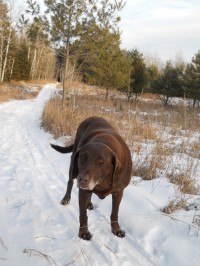
Chris brought his pal’s Springer spaniel, Windsor, along for the hunt. Matt brought his beloved Lexie, a spoiled, but well-mannered bronze colored Labrador retriever. Hunting over dogs in a stiff autumnal breeze beneath the open skies of the North Dakota was a pleasure. There’s nothing like watching a good dog like Windsor lock up tight on a rooster sitting in a patch of sedge grass no bigger than a loaf of bread. The human eye can’t see the bird: But you learn to trust the dog’s nose. Windsor was unrelenting, a bundle of nervous energy, bounding over high grass, cattails, and weeds on the trail of birds. Lexie was methodical but equally effective: In one day, she found, locked on, and retrieved all three roosters we hit. Not that Windsor wasn’t working: Lexie just happened to be the dog of the moment.

Of course, with modern technology, Grandpa Harry kept in touch, calling us every night for a post-hunt update. You could sense the lament, the longing in his voice when he’d call. Though he loves his friend and care-taker Pauline dearly and enjoys her company immensely, he’d waited all summer for our annual trip. Not to be with us was, in a word, heartbreaking. Being that we’re guys, that word was never spoken: You just knew that was the case from the tone of the old man’s voice.

Our last day, we came upon a small covey of Hungarian partridge. We don’t see a lot of Huns where we hunt, though every couple years, we run into them. Usually, the birds are far off, out in the middle of sown crop, nibbling left over soybeans or corn, far out of range. I think we’ve had one or two shots at Huns over the years but never hit one. They are, to use my son Chris’s analogy, my Holy Grail. So when I saw Huns pecking away on remnant beans half a football field away, I wanted them bad. But the birds saw us long before we could get in range. And so, we tromped the edge of a big mown field alongside a huge lake, hoping to coax a rooster out of cover. A mile later, all we had for our effort was the sight of one skittish hen pheasant (off limits to hunters) flying low over weeds.

“I’ll bet those damn Huns are back by Bruce, eating again,” I said aloud, though my two sons were trudging over the wasteland left by the bean harvester too far from me to hear. “And Bruce is likely snoozing in his car.”

Damn if I wasn’t right. Neither of my sons saw them but I did: My little beauties were, as predicted, clucking and picking and eating to their hearts’ content just fifty yards away from Bruce’s Toyota Highlander. Bruce, never one to waste energy, was sitting behind the steering wheel, reading a map, totally oblivious to the Holy Grail just outside his car.

“Huns,” I whispered loudly, gesturing emphatically towards the blue-gray specks ahead of us.

My sons understood. The dogs, though they were working into the wind, hadn’t picked up the scent of the covey. Windsor was by my side though he kept trying to stray. I held him in close by command so as not to spook the Huns. All three of us walked slowly, our shotguns at the ready, making ourselves as small as possible in a completely naked field that rolled to the south for better than a mile. I kept my eyes glued on the birds. The Hun closest to me became skittish, opening and closing its wings as if making ready to fly.

Now or never.

I eased the bead of my 12 gauge over-under on the nearest bird, clicked off the safety, and raised the barrel.

Boom.

Boom. Boom. Boom.

The Huns flew away unscathed.

“My fault,” I said apologetically as I joined my sons. “I shot too soon.”

“Damn straight, Pops,” Chris said. “What were you thinking?”

“I wasn’t,” I admitted.

There was little reason to continue the discussion. I’d messed up. Not the first time, won’t be the last. But through all the noise and commotion, Bruce hadn’t moved: His eyes were riveted on the map in his hands. He had no idea the Holy Grail had been just outside his windshield.

Later that evening, I had the chance for redemption. We were driving back to the house on a dirt road near dusk when a big rooster pheasant rose from the ditch and settled in a patch of saw grass next to standing corn.

“That’s your bird, Dad,” Chris said. “He didn’t make the corn.”

I exited Matt’s truck, let Windsor out of his kennel and a flock of pheasants ran across the road behind the Nissan headed for open country.

“More birds. You take Lexie after them. I’ll take Windsor after the rooster.”

We split up. Windsor bounded over thick ditch grass and worked the edge of the corn. The dead stalks swayed and cracked in a slow wind. The sun was setting above the horizon in the west, its gold and orange glow casting magic over the land. Windsor stopped dead, his wet nose pushed into cattails. A cackle split the cooling air. A rooster pheasant rose from thick cover next to an open pond. It’s wings glinted in the dying sun. Then another bird, a hen, rose to my left. Another rooster cackled and burst into the declining sky to my right. I kept my eye on the first bird, the bird that we’d been tracking.

Boom.

The rooster tumbled and hit water. Windsor dove into the rushes. A few minutes later, he reappeared with the colorful bird in his mouth.

As I type this story on my iMac in my writing room overlooking the Cloquet River, far removed from pheasant country and the hunt, day is again breaking. Down river, I hear the bark of shotguns. Geese fly above the house, followed by flights of local mallards smart enough at this stage of the season to get the hell out of dodge. The sun is rising in the east and a clear blue sky is replacing night’s veil. I am hopeful, as I end this story, that there’s at least one more good hunt in my old man. Next year, Jack, my fourteen year old son, will come with us to Ashley. It would be great if he could hunt with his grandpa.

Peace.

Mark

Posted in Blog Archive | Comments Off on Hunting without Grandpa…