Brigham Young – Review


Brigham Young by M.R. Werner (1925;  Hyperion, ISBN0-88355-254-x)

The quintessential biography of Mormonism’s second president, self-proclaimed Moses, and most ardent polygamist, Brigham Young is written in somewhat antiquated language but is a well-researched, even-handed depiction of both the beginning of the Mormon faith before Young’s involvement, and Young’s own long life. Though an older work, having been written just at the outer edge of  the era during which “unofficial polygamy” was practiced by the church hierarchy (after President Wilford Woodruff’s revelation in 1890 banned polygamy and allowed Utah to become a state) and not cited by John Krakauer in his expose’ of Mormonism reviewed below, Werner’s use of original speeches, revelations, discourses, and sermons of early Mormon prophets, leaders, and seers, is impressive. A bit of a wandering tome at times, but all in all, a fair rendition of a man and the beginning of a truly American religion. 4 stars out of 5.

Posted in Books | Comments Off on Brigham Young – Review

True Compass: a memoir – Review


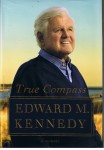
True Compass: a memoir by Edward M. Kennedy (2009; Twelve, ISBN 978-0-446-53925-8)

OK. True confession time again. As a life-long Democrat, I grew up with a picture of President John F. Kennedy hanging in the den of my family’s little two bedroom suburban rambler in the Piedmont Heights neighborhood of Duluth. I was eight years old when I attended President Kennedy’s last speech in Minnesota at the University of Minnesota-Duluth Gymnasium in September of 1963, a little over a month before he was assassinated. I don’t remember much of the event other than I was bored to tears; we (my mom and I) were on a bench seat way up near the rafters of the gym while my dad, a local DFL leader, was down by the stage with the other dignitaries; and that I fell asleep somewhere during the message. I wasn’t an R.F.K fan; I was, of course, a Humphrey man in 1968, just like my dad. And the events on Chappaquiddick Island in 1969, even though I was only 13, turned me off to Teddy’s political ambitions. But, as this wonderfully paced family saga turned memoir reveals, I was wrong to judge the youngest Kennedy so harshly.

True Compass shares iconic faith with Tim Russert’s memoir reviewed below and does so in a similar vein: tying the principles and beliefs of the largest Christian denomination to the actions of the individuals occupying the memoir. Above all, through the tragedies endured by Senator Kennedy individually and as the titular head of the Kennedy clan, this is indeed a story of great faith centered around a rock of Catholic belief named Rose.

Beyond being a story of an American political dynasty, True Compass is also a fascinating study of the United States Senate and how it used to work (in a bipartisan fashion) before the advent of gross partisanship which began with Watergate, was exacerbated by successive Republican administrations, and which culminated in the weird and senseless attempted impeachment of Bill Clinton over a lie and a few drops of semen on a dress. Kennedy’s book is a historical record, a love story of a boy for his family, and a gift to all of us. In the end, Senator Kennedy should be forgiven for his indiscretions and praised for his service to our country. 5 stars out of 5.

Posted in Books | Comments Off on True Compass: a memoir – Review

The Blue Hour: A Life of jean Rhys – Review

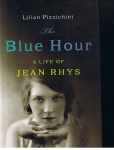
The Blue Hour: A Life of jean Rhys by Lillian Pizzichini (2009; Norton, ISBN 978-0-393-05803-1)

Sometimes, a good biography can read like a great novel. That’s the case with The Blue Hour. I would use the adjective “great” to modify “biography” but to me, a “great” biography (one that dots all the i’s and crosses all the t’s) is the result of painstaking research which reveals a compelling story. But it’s difficult for a “great” biography to replicate the storytelling of a “great” novel simply because biography generally avoids narrative nonchalance in favor of concrete truth. This book proves that a good biography, one that relies more upon storytelling and less upon abject fact, when enlivened by curt dialogue and the melodrama of everyday life, can triumph.

Ella Gwendoline Rees Williams, the impoverished-mysterious- troubled- alcoholic- depraved writer we know as Jean Rhys walks off the pages of this fine book into your living room, parlor, or wherever it is that you happen to be entrenched while reading this can’t-put-it-down work. You won’t like Jean much despite her feline attractiveness and initial charm. In fact, much of the time, you will be yelling: “Why are you so damned self-absorbed? Why don’t you care for those who profess to love you? Why can’t you be a mother to your children?” Mental illness as a defense, you say? Sustained. Alcoholic abuse as an excuse, you plead? Surely true. An unfeeling mother and a clueless father? Again, the evidence is with you. But that is only the beginning of this psychological peeling away of the layers to Jean Rhys, a 20th century writer who, in many ways, is the female equivalent of Hemingway: A man she met once, briefly, but remembered as the gentleman who helped her put on her coat.

If you’re a non-writer, read this book to understand what it’s like to be tormented by the unwritten stories in your head. If you’re a writer, read this book and say: “Thank God, that isn’t me.” 5 stars out of 5.

Posted in Books | Comments Off on The Blue Hour: A Life of jean Rhys – Review

Banned in Britain – Beating the Liberal Elite

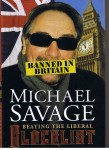
Banned in Britain: Beating the Liberal Elite by Michael Savage (2009; Savage Productions, Inc., ISBN 978-4276-3401-6)

Even an unabashed Liberal shouldn’t be afraid to learn something new. That’s why, when a Republican colleague of mine on the bench in Duluth gave me a copy of conservative talk show host Mike Savage’s Banned in Britain for Christmas as a gag gift (signed copy, no less!), I put it in my stack of “to do’s” and eventually got around to reading it.

Ostensibly, the book is a chronicle of Savage’s battle to redeem his “good name” in Great Britain after being placed on the “undesirables” list by the Home Secretary of Great Britain, Jacqui Smith. This distinction means that Savage is unwelcome in jolly old England. The reasons given for Savage’s dishonor include his penchant for politically dangerous diatribe and fostering violence amongst his listeners in the United States against various groups, including followers of Islam. While there is no doubt that; 1.  Savage is a smart man (he has a Phd); 2. He shouldn’t be banned from traveling to Great Britain simply because his ideas might be unpopular with Liberals; and; 3. He has never been charged (at least he asserts that he hasn’t) with any crime in the United States; those points are made in the first few chapters of this overblown letter to the editor. This poorly written rant should have been submitted as an op-ed piece to the New York Times or the Washington Post, where, despite Savage’s paranoia about “mainstream media” it would have generated significant sympathy amongst true Liberals. Sadly, Savage chose to self-publish this poorly edited and poorly written volume instead.

Beyond repeating his mantra, that conservatives need to protect America’s borders, culture, and language (that line must appear at least twenty times in the book), Savage’s prose is more or less a political scream against Barack Hussein Obama (yes, he always uses President Obama’s Islamic middle name to drive home his distaste for the man); an expression of disdain for the Republicants; and a mixed bag of Xenophobia, disguised prejudice, and poorly written sentences and paragraphs.  There is precious little here for anyone trying to really understand Savage’s anger and rage against all things Liberal beyond, “We are the true Americans and they are not.”

Dr. Savage urges his loyal listeners and readers to buy his books to support his fight against his being banned in Britain. I think the ban should be upheld, though on humanitarian grounds: No one in England, Wales, Scotland, or Northern Ireland should have access to this over-extended, badly executed (entire paragraphs and sections are repeated, as if Savage’s audience isn’t smart enough to figure out a cut and paste job when they see it) vitriolic sermon.

I’ll concede that the main premise of the book (and some of Savage’s observations about both major political parties) are spot on. The other fifty thousand words, however, are a complete waste of time. 1 star out of 5.

Posted in Books | Comments Off on Banned in Britain – Beating the Liberal Elite

The Shack: Where Tragedy Confronts Eternity – Review

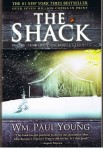
The Shack: Where Tragedy Confronts Eternity by Wm. Paul Young (Windblown Media; 2007, ISBN 978-0-9647292-3-0)

Whew! My wife handed me The Shack two days ago. I stuck up my nose at it because I knew the book by its reputation: it’s a cultural phenomenon and I , as a contrarian, rarely stoop to the level of reading anything remotely successful as a pop cultural phenomenon. Well, I started reading the thing and, like a voyeur drawn to the slight parting of a curtain in an attractive co-ed’s dorm, I couldn’t stop leering; couldn’t let go of Mackenzie’s pain, his loss, his search for truth, and, in the end, his quest for his own soul. There is much to be admired about the terse, compact writing prevalent in this novel. There is more still to be admired in the courage displayed by author Young as he enters the personal hell of his protagonist, and in so doing, drags the reader beneath turbulent water like a loving, but mischievous big brother pulling his sibling into the deepest reaches of a desolate, forbidding, mountain lake.

There are a few flat philosophical bobs and weaves to the story. A bit of over reliance by Young upon mystique and mystery; the sort of literary slight of hand that I’m not normally fond of (being the concrete, black and white writer that I am). But the Trinity composed of a Queen Latifah look alike; a flighty Asian spiritress; and a benevolent Jerry Seinfeld turned carpenter; is experienced, more than read.  These three characters, by themselves, without the added attraction of great pacing, snappy dialogue, and emotive writing, are worth your tithe of time.

The easiest way to describe the brand of Christianity announced by Queen Latifah-as–God in The Shack is to consider the point made near the end of the book (no spoiler alert here!): Whereas, we too often live our lives as human beings dependent upon fulfilling expectations (ours and those of others); we should devote our lives to looking forward with expectancy.

This book is not ratable because my self-created system only goes up to five stars: A must read for anyone of faith; anyone of little faith; anyone searching for faith; anyone of no faith; just anyone.

Posted in Books | Comments Off on The Shack: Where Tragedy Confronts Eternity – Review

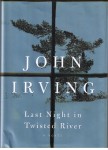
Last Night at Twisted River – Review

Last Night at Twisted River by John Irving (Random House; 2009, ISBN 978-1-4000-6384-0)

Cruising in the Caribbean is made for reading. Reading fiction. So, when my wife and I boarded the MS Noordam recently out of Ft. Lauderdale and headed for a much-needed vacation in the sun, I took a stack of books with me to read. One of them was John Irving’s latest novel, Last Night in Twisted River. I was about 2/3 of the way through the book before the Noordam left its moorings. I finished the book a day or so into the voyage. Here’s what I think.

Irving, like other male authors of a certain age (my age or older) has fallen into the trap of reliving his sexual awakening over and over and over again in his fiction. I’m no prude. My first novel, The Legacy, and some of my other writing, includes very explicit scenes of love making. But Irving, along with older male novelists like Jim Harrison, seems to possess, as he ages, a great inner need to recount what its like to experience that first erection, that first touch of a breast. Not once. Not twice. But over and over again. This driving urge, which was the main premise behind Irving’s disaster of a novel, Until I Find You, is omnipresent in his latest work once again.

I’m a great fan of Catcher in the Rye, the quintessential coming-of-age story. I wouldn’t mind it so much if Twisted River recounted the protagonist’s (Danny Angel’s) first, second or even third encounter with love making as an adjunct to a plausible criminal chase story. But the book falls flat not only because of Irving’s infatuating need to continue the sexual retrospections beyond mere repetition; the main gist of the story, that Danny and his father are being pursued by a crazed cop bent on revenge, simply falls flat on its face as a plot device.

Much optimism emerged as I read the first quarter of the book. Irving is a master story teller when he works within a historical context as he does in painting life in a New England logging town in the book’s opening scenes. My optimism dissipated to tedium as the accidental murder-escape scenario emerged to overtake the beginning chapters of this novel. Not as bad as Until I Find You (which I threw away before finishing) this book simply doesn’t measure up to Owen Meany. 2 and 1/2 stars out of 5.

Posted in Books | Comments Off on Last Night at Twisted River – Review

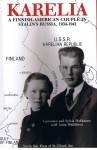
Karelia; A Finnish-American Couple in Stalin’s Russia

Karelia; A Finnish-American Couple in Stalin’s Russia, 1934-1941 by Lawrence and Sylvia Hokkanen with Anita Middleton (North Star Press; 1991, ISBN0-87839-065-0)

As an informal student of Finnish history, I have enjoyed writing about the Finn’s immigration to the United States during the early 1900’s in a fictional context. My novel, Suomalaiset: People of the Marsh is one of my best selling books and remains popular with Finnish-American and Finnish-Canadian readers. I chanced upon this nice little memoir in researching “Karelian Fever”, a term used to denote the Depression-era emigration of Finns from the U.S. and Canada back to Finnish Karelia, which, at the time, was a region within the U.S.S.R. This book, rather than attempt to explain the myriad of reasons over 10,000 people of Finnish descent returned to a place none of them had left (virtually all of the folks who left North America for Karelia had come not from Karelia, but from Finland itself) simply chronicles one married couple’s reasons for taking a chance on Stalin’s empire. Well-written and informative, this book is a quick and easy read and is an essential bit of history told by folks who lived it.  Maps and some additional historical pictures, charts, and diagrams supplied by the authors or the publisher would have made this book even better. 3 and 1/2 stars out of 5.

Posted in Books | Comments Off on Karelia; A Finnish-American Couple in Stalin’s Russia

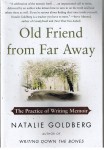
Old Friend from Far Away – Review


Old Friend from Far Away by Natalie Goldberg (Free Press; 2007, ISBN 978-1-4165-3503-4)

I picked up this “how to” manual regarding the writing of memoir at a recent fund raiser for the Lake Superior Writers, of which I once served on the board of directors. It was in the silent auction as part of a basket of “essentials” needed for writing a memoir. The book is really a text, to be used either in a classroom setting, a workshop, or by the reader individually to work on the structure and fiber of his or her life story. I read the thing on a cruise ship in the middle of the Caribbean and wasn’t really in the mood for homework. However, that disclosure having been made (and with the added declaration that I didn’t do any of the exercises set out by the author in the book), there is enough here for even the casual reader to enjoy in terms of getting the juices flowing in anticipation of working on one’s life story.

I especially enjoyed Goldberg’s sense of humor, her use of anecdotes from her life and the lives of other writers, to add color and dimension to what is, in essence, a workshop manual of how to write your life. 3 stars out of 5.

Posted in Books | Comments Off on Old Friend from Far Away – Review

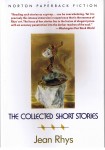
The Collected Short Stories – Review


The Collected Short Stories by Jean Rhys (Norton; 1987, ISBN978-0-393-30625-5)

I discovered Jean Rhys’ writing thanks to Poets and Writers magazine. Someone wrote an article about reading her work. I had never heard of her and became interested in her writing because of her engaging biography (in the larger sense; see below for a review of a biography about her life, The Blue Hour). The article compelled me to read all of her novels, including her masterpiece, Wide Sargasso Sea, all of which I found intriguing and well-conceived.

This collection of thirty-six stories, from postcard tales of a page in length, to longer works, shows Rhys’ progress as a writer and explores, in written terms, the factual elements of her life as embedded in her fiction. There are, as in any complete compendium of an author’s shorter prose, some real gems and some real stinkers in the group. But even the less appealing stories serve a purpose: they chronicle Jean’s struggles with alcoholism, mental illness, and gender bias in post-Victorian England.

For me, the closer Rhys drifts to her early days on the Caribbean island of Dominica, the truer the writing. All in all, this grouping adds to our appreciation and knowledge of Rhys’ strange and bewitching ability as a fiction writer. 4 stars out of 5.

Posted in Books | Comments Off on The Collected Short Stories – Review

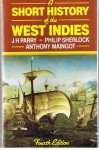
A Short History of the West Indies – Review

A Short History of the West Indies by J.H. Perry, Philip Sherlock and Anthony Maingot (MacMillan; 1987 (4th Edition), ISBN 978-0-333-40954-1)

When I’m out and about, whether it’s inside the U.S. or outside my native country, I like to buy books that reflect the culture and history of wherever it is that I am traveling. Thus, on my recent vacation to the Caribbean, I picked up a copy of A Short History to familiarize myself with the history of islands I was visiting on this trip (St. Thomas, Martinique, St. Martin, St. Lucia, the Bahamas, and Barbados) as well as learn about islands I’ve been on before (Aruba, Curacao, St. Croix, Puerto Rico and others). Because the Caribbean islands were initially settled (in terms of European displacement of the indigenous Caribs, Tainos, and Arawak peoples who actually owned the place) by English, French, Spanish, Dutch, and Danish interlopers, the history of the area is far more complex, than say, the history of Minnesota.

There have been comings and goings of various European stakeholders in the Caribbean for over five hundred years. Add to this, the forced migration of millions of African slaves to the islands to work the sugar plantations, as well as a smaller, but equally important influx of East Indian indentured servants to some of the islands (Trinidad, for one), and you have an historic cauldron of ethnicity, language, and culture that is unique and complex. The authors seek to nobly guide the interested spectator and visitor to the region through the web of immigration, conquest, intrigue, politics, and economics which has led to the formation of independent nation states no larger than the size of a postage stamp (Barbados), or the inclusion of distant and far away exotics (Martinique) in the daily fabric of foreign government (France).

The book is a bit too ambitious in scope and inexplicably leaves out any reference to the history of the Bahamas, one of the closest island nations geographically to the U.S., which is puzzling, to say the least. Still, the book is a good solid base from which a reader can dive in and explore the history of this region in more detail. 3 and 1/2 stars out of 5.

Posted in Books | Comments Off on A Short History of the West Indies – Review