Secret Ceremonies: A Mormon Woman’s Intimate Diary of Marriage and Beyond – Review

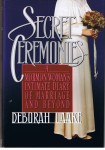
Secret Ceremonies: A Mormon Woman’s Intimate Diary of Marriage and Beyond by Deborah Laake (Morrow; 1993, ISBN 978-0-688-09304-4)

In my research regarding Mormon fundamentalism, I came across this memoir written by a mainstream Mormon woman who was wed at a young age to another mainstream Mormon in a temple ceremony. The “sealing” service is, despite the fact that Ms. Laake was sworn to keep the service secret, revealed by Ms. Laake to be a knock off of well-known Masonic initiation rituals. No great surprise since; at exactly the time Joseph Smith was creating the temple ceremonies for his new religion, he was partaking of Masonic rituals as a member of the Nauvoo, Illinois Masonic lodge. Smith and the other Mormons were soon booted out of the Masons, and remain unwelcome to this day, because of Smith’s appropriation of Masonic ritual for his new church.

Mostly a personal diary of the trials and tribulations of being a young woman growing up Mormon at the height of the feminist movement of the 60s and 70s, Secret Ceremonies sheds some light on the place of women in contemporary Mormonism. Very readable (no doubt because the author is a print journalist) but not deep in terms of content or meaning. 2 stars out of 5.

Posted in Books | Comments Off on Secret Ceremonies: A Mormon Woman’s Intimate Diary of Marriage and Beyond – Review

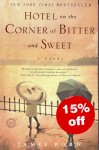
Hotel on the Corner of Bitter and Sweet by Jamie Ford – Review

Hotel on the Corner of Bitter and Sweet by Jamie Ford (2009. Ballantine. ISBN 978-0-343-50534-7)

Hmm…The book I am about to review is this year’s “One Book, One Community” selection by the Duluth Public Library. It is  (as most such novels selected for community “reads” are) a New York Times bestseller. I don’t know if it’s an Oprah pick but it’s a good guess the novel made Ms. Winfrey’s list as well. And on Thursday, March 24 at 7:00pm, I’ll be talking about the themes raised in the novel in conjunction with my own book on discrimination and the Finns, Suomalaiset: People of the Marsh at the library. So, with all that said, what do I think of the book itself?

Henry Lee, a Chinese American of advanced age, a man who had been a ten year old boy during the Japanese internment during World War II, is the protagonist of this story. His father is vehemently anti-Japanese because of atrocities inflicted upon his family in China by invading Imperial Japanese forces. The story weaves back and forth between the recent (1986) and the distant (WWII and before) past, depicting Henry’s relationship with a young Japanese girl who, along with Henry, is the only other Asian American student at a local elementary school in Seattle. The young girl, Keiko OKabe, and Henry fall into love before she is shuffled off to internment with her family. But Henry, who loves jazz music as much as he loves Keiko, is a very resourceful ten year old. He and an older African American jazz musician travel from Seattle to one of the camps housing Keiko and her family where Henry continues their relationship. And then, predictably, the bond between the boy and the girl, between two warring cultures, is severed and Henry marries another woman, a young Chinese girl who knows of his secret love.

Slow moving, descriptive, well written, Hotel seems to this author to be an odd choice for a community read. Yes, it does portray the bitterness and unfairness of the internment of our own citizens during a war. Perhaps the hope of the selection committee was to foster conversation about how we, as Americans, view a disparate culture, perhaps Muslim culture, in this time of global jihad. Are we on the brink of another round of prison camps, where anyone looking like an Arab, American citizen or not, is interned for the “greater good”? Maybe. But I don’t find that broad a theme in this book. There’s an intimacy, a smallness to the story that simply doesn’t seem to compel such generalized reflection. And while the story of how America treated Chinese Americans (who were not interned) and Japanese Americans (who were) during WWII does break some modest new literary ground, frankly, the story of Japanese internment has been told before with far more art and beauty. David Guttormson’s Snow Falling on Cedars depicts the angst and unfairness of the internment in ways that are broader, deeper, and more believable (Henry’s dialogue is of the same intellect and level regardless of his age in Hotel) than Jamie Ford’s attempt to do so on a smaller canvas.

A reasonably well-written novel and a quick read but no classic. 3 and 1/2 stars out of 5.

Posted in Books | Comments Off on Hotel on the Corner of Bitter and Sweet by Jamie Ford – Review

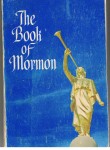
The Book of Mormon – Review

The Book of Mormon translated by Joseph Smith, Jun. (The Church of Jesus Christ of Latter-day Saints; 1961).

Well. I had to read the thing because I was writing a story of Mormons hell bent for leather to “bleach” Lamanites into “white and delightsome” beings as The Book of Mormon foretells. Yes, I understand that this is a purported book of scripture, “another testament of Jesus Christ” as is now proclaimed on the cover of newer editions of the book. So I will not, in this brief post, try to argue against the authenticity or veracity or plausibility of the story behind Joseph Smith’s purported translation of ancient plates left in New York by Jews who inhabited North American before the coming of Christ. For a scholarly discussion of the shortcomings of the book as theology or history, there are hundreds of websites and books you can read to come to your own conclusions as to whether or not the book is a novel or a revelation from God.

But I will review The Book of Mormon as a book, as a readable, or in this case, virtually unreadable attempt at communication. It has been said that the phrase, “and it came to pass” occurs in the book no less than 2,000 times.  I believe whoever wrote that but I didn’t independently verify the number. The repetition of that singular phrase says volumes about the quality of the dialogue, narrative, and plot of The Book of Mormon. It is insipid. It is violent without point or purpose. It lacks any details of setting or place which might make the journeys of its characters the least bit inspiring or interesting. The Bible, while having its own shortcomings, is, overall, a wondrously written book. The Song of Solomon is exquisite. The Gospel of Mark is divinely written, even if one doubts the divinity of Christ. The Gospel of John sings. There is no such literary quality to The Book of Mormon. The book’s failure in this respect is likely due to the fact that one man, Joseph Smith, a man of very limited vocabulary and learning, “translated” the entirety of the book. In a very real sense, the book points out his limitations as a writer, theologian, and historian. The most tortured read of my life. 1 star out of 5.

Posted in Books | Comments Off on The Book of Mormon – Review

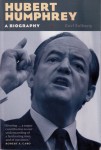
Hubert Humphrey – Review

Hubert Humphrey: A Biography by Carl Solberg (1984; Borealis Books. ISBN 0-87351-473-4)

Not once in the 572 pages of this exhaustive but thoroughly documented and well written book did the author, Mr. Solberg, reference the label that I recall being applied by the press and public to Vice President Humphrey: “The Happy Warrior”. The title, a bow to Humphrey’s seemingly unfailing optimism and bounding joy, whatever the situation, originally appeared as a title to a poem about a battle weary WWI solider by Herbert Read. Having read the poem, I understand why Solberg avoids the reference: It simply doesn’t apply to the buoyantly affable Minnesota politician. Solberg does a fine job of giving us insight into who Humphrey was and the origins of his, as the author calls it, “Plains Progressivism” but I found one glaring failing in the story: Muriel Humphrey is given very short shrift and, from all appearances, her role, in supporting HHH’s numerous quixotic quests for the White House (at least three), and more importantly, her role in forming him as a young man and father, is a part of the story that deserved more ink.

The best (and most disheartening) section of the biography is the depiction of Humphrey’s near teat-suckling relationship with the president he served, Lyndon Johnson. As brought to life by Solberg’s typewriter, LBJ comes off as the quintessential bully: A man who, after befriending the open and honest Humphrey, does everything in his power to belittle and diminish the man. Why? Solberg never really answers that crucial question, nor does he probe this, or any other issue, with then-alive witnesses to Humphrey’s rise as a political whirlwind. This deficiency is, in my estimation, one of the largest holes in the organizational structure of the book: There are no interviews with Mondale, Freeman, Heaney, Fraser, Spannus, or any of a host of other old DFL (Democratic-Farmer-Labor; the party HHH helped create) icons.

In addition, while Solberg chronicles the details of Humphrey’s agonizing role as loyal supporter of the Vietnam War and other unpopular policies of the Johnson presidency, the author never really answers the question that haunts this crucial section of the book: Why did a man of Humphrey’s immense integrity cow-tow to Johnson: scraping, bowing, and “yes-sirring” his way to political defeat in his own race for the White House in 1968? Solberg reiterates HHH’s own version of the “why”: The Vice President followed the company line out of loyalty; it was Johnson who pulled him from obscurity and placed him in the second highest office of the land and HHH felt duty bound to honor the man who gave his political aspirations second wind. But this explanation, coupled with Solberg’s assertion that “there was just something in Humprhey’s nature” that led a principled man to vacate his principles in a quest for power seems trite and inadequate in answering the most important question of HHH’s career.

There’s also no afterword dealing with Muriel’s ascending the throne (she accepted appointment to HHH’s U.S. Senate seat upon his death) or an in-depth discussion of how Humphrey managed the news that the urinary difficulties he’d battled for years suddenly became terminal. While the facts are there, the human equation (What sort of man of faith was Humphrey? How did he handle the issue of sudden mortality?) really aren’t fleshed out.

Still, this book is an invaluable read for anyone interested in Minnesota political history. When read in conjunction with Mr. Environment: The Willard Munger Story (my own attempt at biography which chronicles the rise of Minnesota’s best loved state legislator and the Farmer-Labor Party of Minnesota), this well paced biography will give the casual historian a nearly-complete view of Liberal, Progressive politics in Minnesota.

3 and 1/2 stars of 5.

Posted in Books | Comments Off on Hubert Humphrey – Review

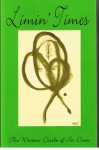
Limin’ Times – Review

Limin’ Times by the Writers’ Circle of St. Croix (U.S.V.A.) (Author House: 2009. ISBN 978-1-4389-7493-4)

Limin’ Verb.

Caribbean term: “To relieve from attention or effort: relax.”

“Limin’ ” is just hanging out, to buss a lime with friends, dat means to take advantage of life, yeah, mon. De ony ting you waste is time, cause dat’s the only ting in life comes free.” (Source: National Geographic article, “Limin’ Times” by Chalres Kulander.

So for those of us from colder latitudes, “limin'” s the equivalent of “chillin'”, but said with an island lilt. I picked up this little collection of essays, poems, and short fiction when I was on a cruise in the Caribbean this past spring. I love to read local writing when I travel:oo It let’s me feel the pulse of the place and learn a bit of local culture. I got those things from this rather sparse (though not cheap) collection. Some of the writing was topnotch. A collection of Sherlock Holmes stories, though set in London, was pretty darn good. A long novella about the Maroons (“the Hiawatha Project”) occupies too much of the book and is a tad disappointing. The tale rambled on without any real plot, point, or intrigue. I would have much rather read the author’s poem about the Maroons in one pass than have the verse interspersed throughout the novella.

This collection also has the misfortune of having been printed by AuthorHouse, one of many POD (Print On Demand) outfits out there. Not having a professional editor outside AuthorHouse go over the manuscript before printing causes irritations like the lack of consistent indentation over 1/3 of the book. Still the product is better than my first two efforts at self-publishing in terms of overall quality, but, when a writers’ group is behind the effort, you’d expect more. Not as local in flavor or as literary as I expected. 2 and 1/2 stars out of 5.

Posted in Books | Comments Off on Limin’ Times – Review

The Winter of Our Discontent – Review


The Winter of Our Discontent by John Steinbeck (1961; Viking. ISBN (unknown)

Sometimes a writer just makes you sigh and ask yourself Why do I even bother to try? Most readers know Steinbeck from the books that made him famous at the peak of his prowess, Grapes of Wrath, Cannery Row, East of Eden, of Mice and Men. But few casual readers ever read his so-called “lesser works” , including Steinbeck’s last novel, The Winter of Our Discontent. That’s really too bad. Because even though critics who reviewed the book at its release (1961) were less than awe-struck by Steinbeck’s last gift to fiction readers, Winter is one whale of a good book (there’s a pun in there and those of you who’ve read the book will understand!).

Ethan Hawley, the story’s protagonist, is a broken man. His paternal family name is one of former importance, wealth, and affluence in the New England town of New Baytown but Ethan, due to the investment ineptitude of his father, has been reduced to the status of a grocery store clerk in a store his family once owned, on a block of the town that his ancestors built. His wife Mary knows his conflict, feels his pain, but wants the good life. Ethan’s two children, his troubled son and defiant daughter, seem to require more of their father than his weariness can give. Surrounded by small town shenanigans and graft, Ethan hatches a plan to right his listing life. But there is a cost, a terrible cost, to be reckoned in regaining what has been lost. I’ll leave it to you to learn what that cost is.

A remarkable book in many ways, most especially for the style of writing Steinbeck uses to convey character and plot. The book begins in third person, with the omniscient narrator in charge, but by the third chapter, Ethan emerges as the person telling the tale in the first person. But more than this literary slight of hand, the language and the pace of the book are so removed from the style that is readily identified as classic Steinbeck; Winter really lives and breathes on the page as a stage or screen play, as if, by borrowing the Bard’s words for the title of the book, Steinbeck felt obligated to create a thespian masterpiece in honor of  Sir Bill. A solid masterpiece. 5 stars out of 5. What else would you expect from an author who won both the Pulitzer Prize (for Grapes of Wrath) and the Nobel Prize for Literature ( in 1962, for his “keen social perception”)?

Writing About Your Life by William Zinsser (2004; Da Capo Books. ISBN 978-1-56924-379-4)

Someday, the world will be forced to come to grips with my “real” story. Yes, friends, there will come a time when Judge Munger unleashes his memoir on the world. When that day comes, I hope I can recreate in words a world as compelling and real as Zinsser does in his latest book on memoir. Hailed as a writing teacher of genius for his seminal work, On Writing Well, Zinsser is a master of explaining what a life story should and should not be. A good place to start, when considering great memoir writing, is Zinsser’s critique of Frank McCourt’s masterpiece of Irish lament, Angela’s Ashes:

The marvel of Frank McCourt’s childhood is that he survived it…The second marvel is that he is able to triumph over it in Angelas’ Ashes, beating back the past with grace and humor and the power of language. Those same qualities are at the heart of all good memoirs…

This is but one of Zinsser’s succinct and deliberate examples of great expository writing. Throughout the book, the master uses examples from his own past (and those of other writers) as springboards to discourse about life, writing about life, and the avoidance of ordinariness that plagues so many attempted memoirs. A great little book even if you’re not thinking about telling the world who you are. 4 1/2 stars out of 5.

Cooler Near the Lake by Jim Heffernnan (2008; X-Comm ISBN188731734-1)

Jim Heffernan was a reporter and editor at the Duluth Herald and Duluth News Tribune for 42 years. For 34 years, he wrote a “slice of life” column that chronicled a variety of experiences, real and imagined, Jim and his family (again, real and imagined) endured. This collection of 52 (one for each week of the year, clever that) stories, a sort of “best of” compendium of Jim’s work will bring tears to your eyes (“Paul Wellstone Leaves Big Shoes to Fill”) and a smile to your face (“Calvin Griffith: Calvin at the Plate”). Short (mainly because his column had a word limit of approximately 600 words) and to the point, these stories are the perfect thing to read around a campfire on a canoe trip, before bed, or when, shall we say, “retiring to the facilities”. There’s much more to Heff than these stories but at least the best of what he had to say is preserved for us to enjoy. 4 stars out of 5.

Posted in Books | Comments Off on The Winter of Our Discontent – Review

The Oxcart Trail – Review

The Oxcart Trail by Herbert Krause (1954; Brevet Press (Originally, Bobbs-Merrill Co.) ISBN 088-4-980-472)

Most of you have no idea that little Friberg Township in Otter Tail County, Minnesota produced two great men in the first decade of the 20th century. The first, born in 1908, was novelist and long-time Augustana College (Sioux Falls, S.D.) faculty member, Herbert Krause. The second was State Rep. Willard Munger (my uncle and Minnesota’s foremost environmentalist) born in 1911.  You can read about Willard in my biography, Mr. Environment: The Willard Munger Story. To learn about and understand Herbert Krause, you need to read his novels.

Krause and Munger were both raised in Friberg Township in German Missouri Synod Lutheran families. Both came from farming stock; strong and stout hearted men ruled their families and tilled the often difficult soil of the place Krause called “Pockerbrush”. In the 1930s and 1940s, Krause, then teaching at Augustana, wrote two nationally acclaimed novels depicting the harsh life of his upbringing; Wind Without Rain and The Thresher. Both books are highly recommended as fine pieces of literature and compelling stories. Krause’s last novel, The Oxcart Trail, which was originally released by his publisher, Bobbs-Merrill in 1954 (the year I was born), unfortunately does not measure up to the author’s previous work.

Much different in setting and tone, The Oxcart Trail is, in some ways, a prequel to Krause’s more successful fiction. Set in the early 1850s in St. Paul, the tale chronicles the journey of Shawnie Dark, a young twenty-something from the East on the run from his past. Dark seeks refuge with an uncle in the burgeoning frontier town that will, with some spit, polish, and money, become Minnesota’s state capital city. But while the book’s narrative accurately portrays the life and times of the setting, that’s where the similarities between Oxcart and Krause’s seminal works of fiction diverge. The plot, Dark’s journey from St. Paul to Otter Tail County, while clear and precise in the little details of life on the oxcart trail, lacks any real urgency, feeling, or angst. The love story between Black and a young school teacher-missionary, seems celluloid. Indeed, the entirety of the book seems caught between dime novel and 1930s cinema depictions of settling the Old West.

A fine book to read if you want to know everything possible about St. Paul, Minnesota in the 1850s or if you are from Pockerbrush, since many landscape icons (lakes, trails, rivers) present in the story remain today. But beyond that, as compared to Krause’s earlier work, The Oxcart Trail is a real disappointment.In fairness to Krause, he was pushed hard by Bobbs-Merrill to make his last book (last by his own choice since he lived a long life after its publication but did not write another novel) less dark and onerous than Wind or The Thresher. That’s too bad because, in the hands of the man who gave us those wonderful bits of Minnesota prose, The Oxcart Trail could have rivaled their literary flair and story.

2 1/2 stars out of 5

Posted in Books | Comments Off on The Oxcart Trail – Review

Dan Brown – Review

The Lost Symbol by Dan Brown (audio version) (2009; Random House. ISBN 978-0-7393-0956-8)

I read Dan Brown for the first time when I was sitting at the Green Man Festival at Spirit Mountain in Duluth one summer, not so far past. Here’s a tip for you would-be paperback writers: Don’t try to sell novels at a folk music festival. Though the crowd is generally interested in reading, they’re not interested in buying books to lug around a music venue. Just a heads up. Anyway, with few customers, I read the entirety of The Da Vinci Code over the three days of the event. It was indeed, to steal an overused phrase, a “page turner”. Though I’m not much of  genre fiction guy, the book held my interest with its premise and pace.

I haven’t read Angels and Demons, another book in which Brown details further exploits of his protagonist, Robert Langdon, but I did see the movie: very disappointing in comparison with both the book and movie versions of Da Vinci. But when someone bought me the audio version of Brown’s latest, The Lost Symbol, and I knew I had a good five hour drive ahead of me this past weekend to sell books in Rochester, Minnesota (see posts for results of that fiasco!), I thought, This is as good a time as any to listen to the new Dan Brown book in the car.

Well, turns out, it wasn’t such a hot idea after all. Now, I get genre fiction. I generally enjoy Grisham’s take on legal issues of the day wrought in fiction. Some of his and Scott Turow’s work approaches literature in language, nuance, and character. And I can enjoy a Kent Kruger Minnesota-based mystery, or a John Hassler book on occasion. But when confronted with an author lecturing me (telling and not showing) for the entire final hour of a novel on CD, well, that’s just too damn much to take!

Ostensibly  the story of a crazed lunatic who seeks a key to unlock ancient mysteries held by the Masons (that’s right, the guys who gave us the Shrine Circus apparently hold a secret within their ritual so dark and devastating as to cause an orge to go on a murdering rampage to secure it), the book starts with a bang. Action abounds from the first page on, until, inexplicably, somewhere about hour five of the six hour audio experience, the chase is over, the bad guy (spoiler alert) is dead, the girl is saved, and Robert Langdon is the subject of a lengthy lecture by a very smart but very ponderous author.

Save your money and buy Turow’s latest which I haven’t even read but which I know will be far better than this misconceived bundle of gibberish. The only saving grace is that you learn a lot about Washington D.C.’s architecture. But you could get that from a tour guide. 2 stars out of 5.

Posted in Books | Comments Off on Dan Brown – Review

Purge – Review


Purge by Sofi Oksanen (2008; Black Cat. ISBN 978-0-8021-7077-4)

I ran into this novel in Poets and Writers Magazine where it was being discussed as an “international best seller”. That’s not what drew me to the book. It was the revelation that the story takes place in Estonia, one of the few European countries I’ve actually visited. Couple my personal knowledge of Tallinn, the capital city my wife and I spent a wondrous day in about five years ago, with the fact that I actually know an emigre from Estonia (and may well someday use his story as the basis for my own Estonian novel) well, you can figure out what I did. I bought Purge from the friendly booksellers at Northern Lights here in Duluth.

Aliide and Zara. An old woman living out the end of her life in a lonely farm house in rural Estonia and a young woman, really no more than a girl, whose life should be just beginning, but, due to her own bad choices, may well end too soon. Aliide is the old woman. Zara is the young Russian-Estonian prostitute on the run. Their lives are drawn together, seemingly by fate, but in reality, by design. Fast paced and breathless. Foul and disheartening. Redemptive and aggravating in its final pages, Purge is a literary thriller that takes from the reader about as much as it gives. That’s not a bad thing; it’s just a fact. You’ll find yourself, in the way of The Reader and Stones in the River, diving headlong into the abyss; the dark, dirty world of ordinary humanness.  The question is: Does Ms. Oksanen let you, the reader, up for air? Read the book to find out. 4 and 1/2 stars out of 5.

Posted in Books | Comments Off on Purge – Review

Elmer Gantry – Review


Elmer Gantry by Sinclair Lewis (1927 (4th Ed.): Harcourt, Brace and Co. ISBN: Unknown)

Elmer Gantry was drunk. He was eloquently drunk, lovingly and pugnaciously drunk. He leaned against the bar of the Old Home Sample Room, the most gilded and urbane saloon in Cato, Missouri, and requested the bartender to join him in “The Good Old Summer Time…”

So begins the story of evangelical preacher, once Baptist, eventually Methodist, Dr. Elmer Gantry, a novel written by Minnesota literary giant, Sinclair Lewis.  Winner of both the Pulitzer Prize (for Arrowsmith, which he refused) and the Nobel Prize for Literature (for Babbitt), Lewis’ credentials as a writer cannot be quarreled with, at least, not by this puny talent.

After the brilliant expose’ of Gantry’s sinful nature in the opening lines of the book, one has the sense that the preacher’s story is going to be one of great prose and pacing, the masterpiece of a master. Sad to say, Elmer Gantry doesn’t quite make it to the literary mountain top.

The why is quite simple: Lewis ends up doing what Gantry does: He preaches. The first third of the novel, Gantry’s schooling in college and a Baptist Seminary, fairly flies along, revealing all of Elmer’s flaws and foibles. We see Elmer as a selfish, boozing, womanizing, no account lout (to use a term of the day) struggling to reconcile his desire to chase skirts with his desire to serve God. But the fatal flaw is that Gantry’s faith is so thin, so airy, that it comes off as pretext;  a device which, in the long run of the story’s arc, cannot be sustained over time. Simply put, Lewis never really gives us any reason to hope; Gantry is so foul, so irredeemable, that by the second half of the book, we are tired of Gantry, tired of his excuses, and simply want him to go away. This thinness of character, combined with the author’s need to preach against organized religion of all stripes, both through narrative and through the various characters, takes the early steam of Lewis’ creative engine and dissipates it into the atmosphere, rendering the last third of the book as powerless as a locomotive without coal.

Through the climactic scene on the board walk, where Elmer’s hope of a life-long relationship dies with his beloved fellow evangelist, Sharon, this is one magnificent piece of writing. But Lewis falls prey over time, I’m afraid, to the rumors of his genius, which makes the latter portion of the read not nearly as engaging or forceful. 3 stars out of 5.

Posted in Books | Comments Off on Elmer Gantry – Review