The Rocky Mountain Saints – Review

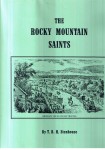
The Rocky Mountain Saints by T.B.H. Stenhouse (1873 (photomechanical reproduction); Utah Lighthouse Ministry)

Mr. Stenhouse’s historic depiction of the rise of the Church of Jesus Christ of the Latter-day Saints ( the Mormons) was originally published in 1872. He and his wife were once ardent followers of the faith, to include T.B.H. taking a plural wife over Fanny’s somewhat tepid objection to sharing her husband with another woman.

However, a series of misfortunes befell T.B.H’s career in the newspaper industry. He wrote for The Mormon in New York City and, after migrating to Utah, founded the Telegraph. On Brigham Young’s command (and as apparently ordained by God)  Stenhouse moved his fledgling newspaper from Ogden to Salt Lake City, where it promptly failed.

Seeing little evidence of the divine revealed by the misunderstanding between God and Mr. Young, T.B.H. divorced his plural wife and asked to be excommunicated. He’d lost faith in the infallibility of the Mormon priesthood and seriously doubted that the origins of the religion, as related by Joseph Smith, were divinely inspired. Soon thereafter,Fanny followed her husband into apostasy.

This background (none of which is included in the book) could serve to render The Rocky Mountain Saints a heated, unfair diatribe against Mormonism. But it’s a credit to Stenhouse’s journalist ethic that he refrained from invoking vindictive prose to attack his former spiritual leader: Throughout the book’s 762 pages, Stenhouse maintains proper authorial distance from his subject matter.

Initially, reading The Rocky Mountain Saints requires adjusting to the archaic language of the times. But after a few chapters, Stenhouse’s writing style overcomes this initial difficulty.

In the end, the volume is an invaluable study into the beginnings of the Mormon church through the eyes of folks who lived and breathed the fire and brimstone of President Brigham Young’s sermons.

Despite Fanny’s own apostasy (her book, A Lady’s Life Among the Mormons created its own scandal in the late 1800s) and T.B.H’s decision to disavow his faith, this book is embedded with the sort of journalistic fairness rarely found in today’s print or electronic media. 4 stars out of 5.

Posted in Books | 2 Comments

The Ghost Writer – Review

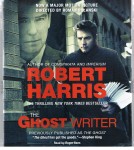
The Ghost Writer by Robert Harris (Abridged Audio version, 2007: Encore. ISBN: 978-0-7435-8304-6)

On my way to FinnGrand Fest in Sault Ste. Marie, Ontario, I stopped in at Book World in Ashland, Wisconsin to pick up an audio book to co-pilot me from Minnesota to the wilds of Canada. I looked at Grishom’s collection of literary short stories, Ford County but the store wanted like sixty gazillion dollars (OK, only 39.95-still too much for my wallet). I studied a couple of Michael J. Fox memoirs with the idea that, since I was going to the land of the Maple Leaf flag, I should learn about one of the Queen’s own. Then the synopsis of The Ghost Writer caught my attention.

The goal of a ghostwriter is to make his client look good, not to uncover the truth…

What could be better for a writer to listen to than a novel about another writer? Wasn’t that much of what makes Heminway so compelling’ the connection of writer in the story to the writer behind the page? And at $14.95 (the same price as the abbreviated version of Michael J. Fox’s life story) well, I just had to go with the thriller.

Adam Lang, the former prime minister of Britain during 911 (Tony Blair here with very little camouflage) had a guy writing his memoirs mysteriously take a header from a ferry on its way to Martha’s Vineyard. Enter the protagonist, a writer who’s made himself a reputation by cleaning up the messy lives of the rich and famous for the general masses. He “assists” his clients in writing their stories. In actuality, he writes the books and then fades into the background, paid handsomely for the effort as a silent partner, a ghost.

But there’s something slightly amiss with PM Lang’s version of history: Someone is bound and determined to correct the legacy Lang seeks to leave behind, even if it means spilling a bit more blood. And all that stands between the killer(s) and more dead bodies is one man and his…keyboard.

A whopping good yarn from across the pond, this one. Save some money and time: This is a more concise and better listen than Dan Brown’s monolithic drudge, The Lost Symbol (see review below). Fast paced and contemporary without any allusions to literary greatness, this is a crisp read (or listen); perfect for the beach (print) or when driving (audio) across Wisconsin and UP Michigan to talk to Finns. 3 and 1/2 stars of 5.

Posted in Books | Comments Off on The Ghost Writer – Review

War in the Woods – Review

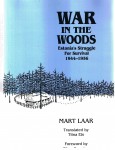
War in the Woods: Estonia’s Struggle for Survival by Mart Laar (1992; Compass. ISBN:0-929590-09-0)

Laar has the credentials to write a thorough and insightful history of Estonia’s struggle for freedom from 1918 through the “Singing Revolution” in 1991, when, without bloodshed or violence, this tiny Baltic nation of barely more than one million souls freed itself from years of Stalinist dominion. Laar was there, as a recently-graduated historian and political activist, for the ultimate showdown between the Bear and the clever mouse. As we all know, the mouse won and Laar, in no small measure, had something to do with that success. If you are looking for a book that chronicles the partisan bravery of the Forest Brothers (Estonian guerrilla fighters who lived in bunkers from 1945 until 1978, when the last known survivor was killed in a Soviet ambush) and also weaves a solid, vibrant, hard-hitting and well-written narrative throughout the facts, this isn’t the book for you.

While Laar does an admirable job of giving you a sense of the scale of the Forest Brothers resistance and the measures the partisans used to bring notice to their cause (hoping the West would confront Stalin reagarding his human rights abuses and, if need be, go to war over those abuses) this work is rather dry. There are moments, like the scene where a young Finn sails a homemade boat across the Gulf of Finland to rescue his Estonian lover under cover of darkness that show how vibrant and alive this book could have been in the hands of a writer capable of merging history and language. I doubt that the translator is to blame here. The problem is more that a scholar and academic, who may possess a fine ability to write technically, has cobbled together a well documented segment of history with clean precision but little passion.

While there are glimpses of such intuitive depth throughout the book, only in the final chapter, “The Resistance Lived On”, does Laar (who twice served as Estonia’s Prime Minister) rescue the story from  dull, fact-driven narrative for more than a page or two. A valid exercise of historical research but not a book for the casual reader. 2 and 1/2 stars out of 5.

Posted in Books | Comments Off on War in the Woods – Review

Against the Wall – Review

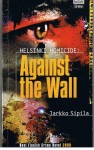
Against the Wall by Jarkko Sipila (2009; Ice Cold Crime. ISBN 978-0-982449-0-0)

Investigator Suhonen, aka Suikkanen, goes undercover as a small-time thug to catch a murderer in present-day Helsinki. There’s a dirty Finnish customs agent, the obligatory blonde with the low cut dress, and a host of supporting characters in this fast paced crime novel originally written by Helsinki television reporter, Jarkko Sipila in his native tongue and recently translated into English. The writing is taut; the pace, quick, though if a bit abbreviated in style. Aside from one or two improbabilities (searching for a gun in a Finnish lake underwater at night?), the plot is believable.

All in all, Sipila has cast a narrow net with his aspirations in creating this line of crime novels set in the seedier, less than tourist friendly climes of Helsinki. The author isn’t trying to impress; he’s trying to entertain. And the book does that in spades, though in the end, the plot is a bit shopworn and the climactic curtain close, a tad too cliche’. All in all, a quick, easy diversion. The perfect airplane or beach chair read. 3 and 1/2 stars out of 5.

Posted in Books | Comments Off on Against the Wall – Review

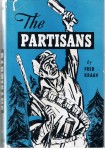
The Partisans – Review


The Partisans by Fred Kraav (1952; Vantage Press. ISBN unknown)

When I ordered this used copy of Fred Kraav’s 1952 novel set in the forests of Estonia, I was hoping for the Baltic version of A Farewell to Arms. In point of fact, the book doesn’t measure up to Hemingway’s classic war novel. In fact, it doesn’t measure up to my own first foray into historical war fiction, The Legacy. That’s not a boast; just an observation. Part of the problem may be in that the book appears to have been written in English, a language that was not Kraav’s native tongue, which presents the writer with limited vocabulary choices. Never a good situation when trying to recreate life, war, and love.

Then too the plotting and writing is formulaic. The Soviets are all evil, vodka swilling bastards. The Estonian Forest Brothers (partisans) are all noble, proud, loyal, men of good cheer and strong will. The women throughout the book are essentially props; objects to fall in love with their heroes or be raped by the villainous Reds.

Another problem surfaces in the dust jacket blurb. For whatever reason, Kraav (for Vanatage is the original vanity publisher so this is entirely Kraav’s project from cover to cover) chose to reveal on the inside dust cover that everyone, including the book’s protagonist, Jaan, dies in a hail of Soviet fire. Not a very good way to build suspense, that.

Still, once Kraav has disposed (spoiler alert) of the winsome Helga and sent the partisans scurrying for the safety of Sweden, the plotting improves and, despite the revelations contained in the dust jacket, there is actually a sense of suspense created by the feverish pace of the book’s conclusion.

One other point. Having read Mart Laar’s description of the small scale of the Forest Brothers’ operations throughout Estonia, I have some doubts as to the historical accuracy of the story ultimately being told in this book; that of a platoon (or larger) sized resistance force coming to blows with a full regiment of Soviet and Estonian Security Forces on a beachhead. Laar’s historical accounting (see below) doesn’t seem to reveal such larger scale conflicts as being part of the Forest Brothers’ legacy. Perhaps such a battle did take place but if so, Laar never mentioned it.

A bit disappointing but because of the ending, a worthwhile foray into Estonian fiction. 2 and 1/2 stars out of 5.

Posted in Books | Comments Off on The Partisans – Review

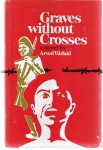
Graves without Crosses – Review

Graves without Crosses by Arved Virrland (1972; Clarke, Irwin & Co. ISBN 0-7720-0525-7)

To my people. This simple dedication by Estonian literary giant, Arved Virrlaid, says it all. Graves is the novel to read before reading the recently released Purge, a contemporary novel covering much of the same geography (Tallinn and the surrounding Estonian countryside) while detailing a different political reality.

The author of nine novels and several collections of poetry, Viirlaid emigrated to Canada after fighting the Soviets in Finland and returning to his war-torn homeland. The book jacket tells us he lived some of the exploits used as background and setting for the novel. There’s no doubt, given the realism of the scenes Virrlaid brings to his depictions of the Estonian countryside, that this indeed is the case.

Graves takes place during the height of the Forest Brothers conflict after the second invasion of Estonia by Stalin in 1945 on the heels of the retreating Germans. The book centers upon Forest Brother Taavi Raudoja, the protagonist, and tells the tale of a tiny country caught between the competing interests of world powers. This powerfully written drama displays, in succinct prose, the abject despair that defeated Estonia and led to fifty years of Soviet domination.

Slow going at the outset, the book gains momentum as Taavi seeks to find his wife, newborn daughter, and eight year old son, who’ve been taken by the Soviet security apparatus and held in hopes of flushing Taavi from the forest. There is near constant sorrow, fear, and frustration to be had in this wonderfully written book. Chock full of memorable characters, action, heroes, and villains, Graves establishes Viirlaid as a master of Estonian culture and literature.5 stars out of 5.

Posted in Books | Comments Off on Graves without Crosses – Review

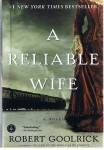
A Reliable Wife – Review

A Reliable Wife by Robert Goolrick (2009; Algonquin. ISBN 978-1-56512-977-1)

I picked up this slender novel at Reagan National in D.C. on my way home from a recent conference. Given that the topic of the conference was domestic violence, and this book is dripping with cruelty and violence wrought by family members against each other, I’d say it was either an odd or a fortuitous choice. But readers, including readers who write (like me) often do indeed judge a book by its cover. The cover of Reliable caught my eye. The blurbs on the back cover cemented the deal. I wasn’t disappointed.

Think Rebecca (one of my favorite suspense novels) set in the cold, desolate Wisconsin countryside of the early 20th century. Add a desperately lonely widower of means (Ralph Truitt); a vengeful, horribly abused bastard (I use the term literally); and the bastard’s sexually powerful lover (Catherine Land) to the eternal darkness of the farmlands outside Madison, and you have one creepy, compelling, driven story of love, sex, violence, and redemption.

A page turner with literary sensibilities and Victorian noir; the story, plot, setting, and characters flow together to form a beauteous evil. You reach for the rose. You are pricked by a thorn. And yet, you can’t help but reach for the rose again. 4 and 1/2 stars out of 5.

Posted in Books | Comments Off on A Reliable Wife – Review

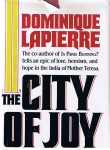
City of Joy – Review


City of Joy by Dominque Lapierre (1985; Doubleday. ISBN 0-385-18952-4)

Every once and awhile, a non-fiction book blows this novelist away. City of Joy is that kind of read: A compelling story; characters you care about; broad-shouldered issues; prose that connects. Some of you are old enough to remember that the late Patrick Swazye played American Max Lowe in the movie version of this sweeping look at the City of Joy; the most disease ridden, inhospitable, ugly slum in all of slummy Calcutta. The movie (confession: I haven’t seen in it since it came out in 1992 so I’m relying on Internet sources to refresh my memory) focused on the character of Max Loeb; who, in the book, is the physician son of a wealthy Miami Jew who also happens to be a physician. Loeb (Lowe in the movie) journeys to the slums of India’s most decadent city to find answers; answers to questions that many folks never ask: Why does God not see? Why does God not hear? Why does not God care? Why does God let children suffer? You know, the sort of questions raised by Elie Wiesel’s seminal book, Night.

Looking at the cast of characters from the movie script, one glaring deficiency looms obvious: The main character in Lapierre’s story, a Polish Roman Catholic Priest named Father Stephan Kovalski, who comes to the slums, stays for an extended period of time to live and work with the poor in their squalor, and who “shows Max Loeb the ropes” isn’t even mentioned in the movie script. That’s a huge hole and, even though the movie (as I recall) was entertaining and somewhat enlightening as to the reality of India’s poverty, despair, and inhumanity, without Father Kovalski’s story, the book would be about thirty pages in length (instead of 464.)  For this non-Catholic, the grit, determination, resolve, and piety shown by the good Father is the story. Without his light, light cast by his comrades in the slums and reflected in the priest’s actions and faith, the tale loses its bearings like a galleon at sea with no compass. My advice? Read the book. Relish the words. Praise Father Kovalski and all the others like him. And then, if you feel the need, rent the movie. But you’ll likely be disappointed; not by Swazye’s acting or the script, or the supporting cast, but because it’s not the story the author wrote. 5 stars out of 5. A must read if you’re at all interested in world affairs.

Posted in Books | Comments Off on City of Joy – Review

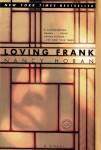
Loving Frank by Nancy Horan – Review

Loving Frank by Nancy Horan (2008; Ballatine Books. ISBN 978-0-345-49500-6)

So my mom, who is the person most responsible for me being a writer and a reader (I remember her reading Pinocchio to me as a child) hands me this book in the social hall of our church on Sunday and says, “Read this, you’ll love it.” So of course, being the kind of son who always does what his mother says, I read Loving Frank. Here’s what I think.

The story of Mamah Borthwick, an early 20th century college educated woman and mother, married to dull but faithful Edwin, is captivating.But the story of her love affair with Frank Lloyd Wright becomes, in some ways, a lazy, self-indulgent expose of Mamah’s imagined life , and, before the climatic conclusion, seems to become  stalled in angst and indecision. Well-written to be sure, the book seems bent on regaining the slow and deliberate pace of the era lived by its characters. That’s not a bad thing but I wanted, at various points in the novel, to push Mamah and Frank towards finality with respect to their obviously ill-fated affair. I grew tired of their bickering and whining over money, their respective spouses, and their lack of control over their own lives.

No doubt a favorite of women’s book clubs everywhere, this is a good read and explains, in a fictional sense, the tortured life of an American icon. 4 stars out of 5.

Posted in Books | Comments Off on Loving Frank by Nancy Horan – Review

Conversations with Jon Hassler – Review

Conversations with Jon Hassler by Joseph Plut (2010: Nodin Press. ISBN 978-1-93472-97-4)

I have “bumped into” the owners of Nodin Press a couple of dozen times over the years at various book venues. Nice people, Norton and his wife. This summer, at the Northwoods Arts and Crafts Festival in Hackensack, Minnesota, I renewed that acquaintanceship and also bought a copy of Nodin’s latest book, Conversations with Jon Hassler. I got a signed copy from the author, Joseph Plut, who taught with Mr. Hassler for a number of years at the Brainerd Community College before Hassler went on to literary fame and a stint as the author in residence at St. John’s University in Collegeville.

As a writer and sometime Hassler reader (my wife is much more the devoted fan than I am),the intimate tone of the interviews between Plut and Hassler, each of which centers on one of Hassler’s novels in great and succinct detail, was amazing. I’m not sure if non-writers or non-Hassler readers would see the immense value of preserving one of Minnesota’s most beloved authors in this fashion. The book is very much “an inside job”  in that it reveals much of the thinking process Hassler engaged in during his writing of nine of his most important works. Still, like a biography of a renowned artist of any stripe, this book is important to understanding the creative process.

Well written and very tightly edited, I found this expose of Jon Hassler’s mind a fine addition to my library. 4 stars out of 5.

Posted in Books | Comments Off on Conversations with Jon Hassler – Review