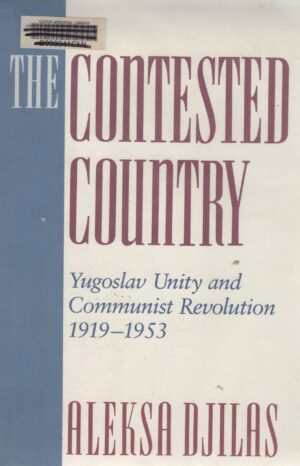
The Contested Country by Aleksa Djilas (1991. Harvard. ISBN 0-674-16698-1)
Diljas answers many of my questions about why and how the relatively new nation of Yugoslavia emerged from the aftermath of WW II. And while he doesn’t enlarge the topic to include why and how that same nation disintegrated a decade after Marshall Tito (the titular head of the country from 1945 until his death in 1980) ended his long reign, the seeds of understanding the nation’s demise are indeed reflected in the political history chronicled by the author.
I ordered a used copy of this scholarly work not for my reading pleasure or on some whim of trying to understand my own Balkan heritage (I’m one-quarter Slovenian) but because the writing bug has me pointed in the direction of my first novel, The Legacy. In that story, I somewhat innocently beatified Tito and his prowess in forging an army and a nation. I did not, for example, delve into the reasons behind Croatian and Serbian atrocities against each other during WW II nor explore the massacres, murders, and heavy-handedness of Tito towards the vanquished once his Partisans (Communist guerrillas) emerged as the clear power during their war against the Germans, Italians, Croat Ustashi (Fascists aligned with the Axis Powers), and Serbian Chetnik forces. That history, I think, is a fine setting for, if not a sequel, than at least a sequential novel, which I’ve just begun to work on. Research, as Mitchener has taught those of us seeking to write fictional truth, forms the bones of a historical novel. And so, this book became a “must” read.
The Contested Country is a scholarly read. By that I mean Diljas offers a plethora of footnoting to support his essential argument: that both Croatia and Serbia, the larges components in terms of the population of what became Yugoslavia, harbored nearly magical thinking when it came to interpreting the importance of their history. The medieval kingdoms of Serbia and Croatia were never world or regional political powers when they did exist as independent nation states. Ultimately, both were absorbed by larger empires; the Croats into Austro-Hungry and the Serbs into the Ottoman body politic. Serbia managed, before WW I, to wrest itself free from Turkish control and, at the end of the war, as a member of the victorious alliance, carved out the Kingdom of the Serbs, Croats, and Slovenes (the South Slavs), leading to the imposition of Serbian monarchs, who, on the cusp of the 1930s, turned the constitutional monarchy into a dictatorship. Imposition of Serbian rule against the Croatian national will, coupled with traditional Croatian animosity towards the Serbs (not based upon language, culture, or even religion but ethnicity) led to an explosion of intraSlav terrorism and slaughter, the extent of which, given the mists of history, remains largely difficult to document even today.
Anyone who is seeking to understand the Balkans as they exist in the 21st century should start here. The book is not a pleasurable read but it is succinct, well drawn, and sets the stage for what took place once Tito died.
4 stars out of 5.
Peace
Mark
Posted inUncategorized|Comments Off on Understanding Yugoslavia
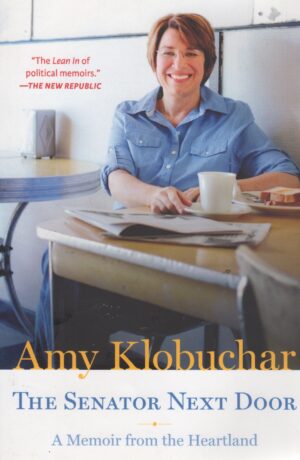
The Senator Next Door by Amy Klobuchar (2016. University of Minnesota. ISBN 978-1-5179-0227-8)
Confession time. I supported Senator Klobuchar when she was a candidate for the presidency in 2020. I cast my primary vote in support of her by mail only to have her announce her withdrawal ahead of the primary. So it goes. Any way, my daughter-in-law gave me this book a Christmas ago and it’s been sitting in my “to read” pile for over a year. I finally got to it. Here goes.
The first half of the book, chronicling Amy’s childhood, schooling, family woes, law school education, courtship, marriage, birthing of her only child, and her private legal career is very well written. Often, the senator lets her hair down and even cusses a bit, which, given her father’s Iron Range roots and lengthy career in the newspaper business, makes abundant sense. I was especially taken by her description of working at Dorsey, a law firm I spent two years at (working full-time days as a litigation legal assistant while attending night law school), and her appreciation for our mutual mentors (and later, Dorsey lawyers) Fritz Mondale and Warren Spannus (former MN AG). Both men are exemplars of what was once the pride and joy of public service: dedication to the people who voted you into office, their concerns, and the greater good. There’s a lot of those two men in the way the author ran for, won, and managed the Hennepin County Attorney’s position: her springboard into politics.
Klobuchar’s discussions regarding the justice system, as seen by the chief prosecutor of the largest Minnesota county (in population), the cases that came before her, the decisions she made, including the decision to prosecute Minnesota Court of Appeals Judge Roland Amundson (who taught ethics, of all things, to my Baby Judge class in 1999) and seek prison time for the judge’s financial thievery (from a disabled person he was supposed to be protecting) was riveting. Those passages displayed her ability to lead her prosecutorial team “without favor” (her words). Her run for the senate, the parades, the decisions about campaigning, and the fervor of seeking one of the most powerful offices in the land, is also enlightening and educational without being dull or preachy.
The only failing in the book is that it came out four years too early. What do I mean? The later portion of the book, where the senator details the bipartisan bills she worked on and passed with the assistance of her Republican mentor, John McCain, while recognizing DC gridlock and a trend to making law only when pushed to do by crisis, still rings with optimism, a “we’re all in this together” cheeriness that, sadly, disappeared with the 2016 presidential election. I wish she’d waited a bit longer to discuss and digest what the Orange Prankster means to our nation and its future. She couldn’t have known and yet, reading her optimistic end chapters, her belief that there will be many, future opportunities for the two sides of the aisle to come together and do great things had the opposite effect on me as I closed the book. She intended positivity concerning our collective future; a commodity I believe impossible in a political world that includes Faux News, the Orange Imposter, Little Kevie, and the Turtle Man. Yes, there are some good people in politics on a national level. Senator Klobuchar is one of them. But other than a handful of old-style, moderate Republicans (Romney and Collins come to mind), the other side of the aisle is full of lunatics and crazies and those who seek power, not answers to national problems. Not her fault. But the ending to her story has yet to be written.
Peace
4 stars out of 5
Mark
Posted inUncategorized|Comments Off on A True Minnesota Original
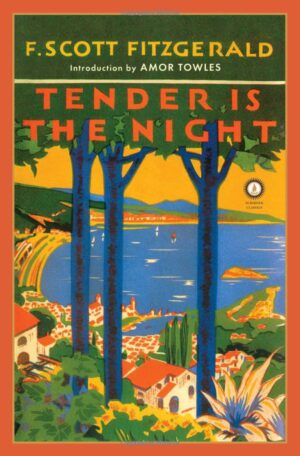
Tender is the Night by F. Scott Fitzgerald (2014. Audible. ISBN 978-1909305175)
Minnesotan. Iconic member of the Paris scene from the days of Hemingway, Stein, and a host of other ex-pats. Husband to Zelda, whom some claim was the real, if tortured, genius in the family. I’ve listened to this classic novel through Audible now at least three times and despite the familiarity such usage brings, even the third trip through Europe at the head of F. Scott’s pen was worth the time.
Love triangles tend to be, in real life and in literature, messy affairs (pun intended). In this, one of Fitzgerald’s most autobiographical works, Dick Diver, M.D., an up-and-coming psychiatrist from the States who survived WW I’s horrific trenches, becomes infatuated with Nicole, another American ex-pat who is being treated at the Swiss Clinic where Diver works. Originally, the scheme of the author’s storytelling included much back and forth, past and present, which, to the critics, made the storyline confusing and didn’t help sales of the book when it debuted in 1934. A later revision of the novel (the one I was listening to) was completed in the 1940s by a friend of the author’s using Fitzgerald’s notes to create a more linear piece of fiction. This later version of the tale is listed as one of the great novels of the 20th century.
The tortured romance between Diver and Nicole, whom the doctor eventually “cures” and marries, profiles Diver’s plunge into alcohol abuse and Nicole’s re-emergent psychosis (either schizophrenia or manic-depressive disorder), as well as the doctor’s brief yet destructive affair with young American actress, Rosemary. Though Dick is the mature one in the tryst, it is Rosemary’s strength of character, and Nicole’s eventual recovery and affair with soldier-of-fortune Tommy Barban that convinces the disintegrating doctor that his marriage, and his time with Rosemary are over. The writing is crisp and moves with rapidity, mirroring the “Jazz Age” vintage of the work. One comes away from the tale’s ending wishing that, someway, somehow, Fitzgerald’s friends could have saved he and Zelda from disaster, a disaster foreshadowed in this novel. But such was not to be …
5 stars out of 5. A classic tale of hubris, lust, longing, and downfall.
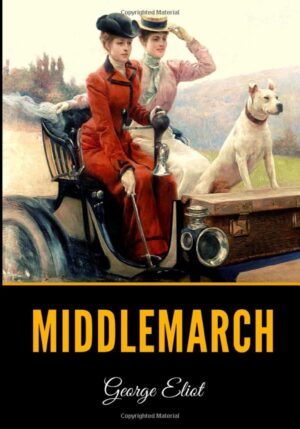
Middlemarch by George Eliot (2009. Audbile. ISBN979-8478127350)
I’ve not read Mary Evans (pen name, George Eliot) before so I thought I’d give a listen. This is a very long audiobook: coming in at over thirty hours, perfect for listening to when walking the track at the local YMCA. Eliot weaves a comprehensive tale of life in the fictional English village of Middlemarch during the early-19th century (circa 1820s-30s), a time when, despite having lost the United States as a colonial territory, the Brits rule the waves and most of the world. In this lengthy, sprawling, domestic novel, Eliot centers her prose on a fairly remarkable young woman, nineteen-year-0ld Doreathea Brooke, who marries a man of means, Rev. Edward Casaubon, a codger nearly thirty years her senior. Casaubon is the most unloveable of the myriad characters Eliots sets upon her stage: an old fuddy-duddy who, given his youthful bride’s beauty, is convinced Doreathea is in love with a vagabond traveler, Will Ladislaw, a distant cousin of her husband’s. Though those suspicions are not, at that point, based on fact, Casaubon’s vitriol forces him to include provisions for disinheriting his wife should she remarry Ladislaw upon the old man’s demise.
There are many other subplots and minor and major characters woven into the privileged, gentrified life of the plot’s principles. In its setting and characters, a reader might consider this to be the gentrified equivalent of Dickens. Each personage in the tale has his or her own story to tell and Eliot does a masterful job of merging varied storylines into a coherent, conclusive plot. While the language is, given the time period, somewhat foreign to today’s ear, and the setting of the tale in an English village is somewhat limiting in terms of the social and economic backgrounds of the characters, I found the book, as a whole, very satisfying, and well worth time spent walking the Y’s track to find out what happens to Doreathea and her companions.
4 stars out of 5
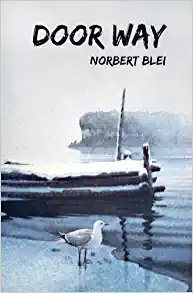
Door Way by Norbert Blei (2013. Ellis Press. ISBN 978-0-944-24-59-9)
Finally, to prove I still actually read the written word, there’s this collection of essays written in the late 1970s and early 1980s by former newspaper and Door County (Wisconsin) resident Norbert Blei, to consider.
Last fall, as the leaves on the maples, oaks, aspen, and birch turned to glory, my wife René and I towed our travel trailer to a destination we both had never explored: the tourist mecca of northern Wisconsin, Door County. We camped at the KOA just south of Sturgeon Bay, the largest municipality on the peninsula, and by bicycle and car, explored the apple orchards, vineyards, fishing villages, and eateries of the storied county. At the infamous Al Johnson’s Swedish Restaurant in Sister Bay, I picked up this book while perusing the restaurant’s gift shop while waiting for a table. I was not disappointed by the food nor Blei’s prose.
Each chapter in th book is a vignette of someone whom Blei became acquainted with when he moved from Chicago to the county in the late 1960s. Some, like painter Charles “Chick” Peterson, a watercolorist, are internationally known. Others, like neighbor Charley Root, are simply, in the truest and kindest sense of the word, characters who the author became close to before his death in 2010. Many of the pieces were published as newspaper articles or profiles during the author’s lifetime but only later were compiled into a comprehensive volume with the assistance of editor and publisher David Pichaske. I always love buying quality local fiction or creative non-fiction when I travel. It allows for a more in-depth inquiry into the places that René and I visit. In that respect, this collection is well worth reading by anyone traveling to or staying in Door County.
Throughout Blei’s essays, the theme of inexorable progress, the gentrifying of a water-contained thumb of land thrust into Lake Michigan, surrounded on three sides by Green Bay and the vastness of the lake, is a constant refrain. But it’s not only the landscape that is changing, day by day, acre by acre, as more restaurants and condos and shops squeeze out fishermen, dairy farmers, orchards, and ordinary working folk living in the place:
The specifics of melancholia Chicago set in. How do I look these days? Strange, strange. That’s one of the last changes to take effect, though Door worked on the dress of the former Chicagoan from the very beginning. Back-t0-earth can play havoc with a man’s manner of dress-a whole wardrobe goes to seed. I hardly recognize myself these days …
If you are at all interested in the changing of rural America into something folks who passed on just a generation ago might not recognize; if you have any interest in visiting Door County; or if you’ve been to this still somewhat (despite the progress lamented by Blei) removed and rural piece of Wisconsin to fall in love with the God-painted leaves, flights of noisy Sandhill cranes flying overhead and landing on neighboring fields by the thousands, or platoons of grim, serious fishermen and fisherwomen lining the lazy rivers of the county in hopes of latching on to gigantic Chinook salmon during their fall spawn, well then, these stories are for you.
5 stars out of 5.
Peace
Mark
Posted inUncategorized|Comments Off on A Trio of Great Writing …
Necropolis by Boris Pahor (1995. Dalkey. ISBN 978-1-56478-611-1)
As the newest member of the Greater Mesabi Men’s Book Club (GMMBC), I was charged with providing the book, treats, and beverages for this month’s meeting at Dr. Rich Dinter’s home outside of Hibbing, MN. Given I’m of Slovenian ancestry (one-quarter) and given my first novel, The Legacy, was about Tito and Yugoslavian Partisan resistance to Fascists during WW II, and given I’m attempting to work on another historical novel set in post-WW II Slovenia, I scoured the Internet for a novel that might be of interest to my fellow book club members. Necropolis is the book I settled on.
I’ll admit to making a slight mistake in selecting the book. GMMBC reads exclusively novels, which, on many websites, Necropolis is considered to be. However. In reading the book and checking other sources, it turns out the book is more correctly denoted as “autobiographical fiction”, i.e., memoir. So right out of the gate, I violated the intentions of the club I’d just joined. Ugh.
Anyway, the members were kind and, to a reader, appreciated Pahor’s effort to illuminate an aspect of the Holocaust that gets little attention: the plight of non-Jews who opposed Fascism and found themselves in various Nazi-run concentration camps in Europe. Pahor, who was Slovenian but born and raised in Trieste, which became part of Italy after WW I (remember, Italy spent that war on the side of the Allies; territory including Trieste was Italy’s reward for opposing Austria), was drafted into the Italian army in 1940 and served in Africa. After the Allies cleared the Axis from north Africa, Pahor returned to Trieste and joined the Slovenian Partisans, a group opposing not only the Italians and Germans but Tito’s communist Partisans as well. That stand, one voiced in his writings, got the man into hot water and ended with him being sent to Natzweiler Concentration Camp in France. Given his language skills, Pahor ended up working as a camp medic and that’s where his journey to hell begins.
Pahor’s prose is lyrical and, as one of my book club members pointed out, reminiscent of Ulysses in it’s non-chaptered, stream of consciousness style. In describing the heroism of a young athlete who attempted escape by improvisational pole vaulting over an electric fence, only to be recaptured and executed, the author writes:
A quarter of a century had passed between that “damn you” and the moment when the young Russian spat at an SS commandment here, but the essential qualities of the players had not changed. Slavic pride, Germanic ruthlessness. Indeed, except for love, which indisputably holds first place, high-minded resistance to injustice is the most we can contribute to the salvation of human dignity.
The Russian did not escape Germanic ruthlessness but the image Pahor paints with words is timeless. My only criticism of the book is that, in attempting to ramble through the horrors of Nazi evil in a very personal re-telling of his experiences, coupling history to revisiting the camp (wherein he describes present-day tourists viewing sites he lived through in pain, agony, and dismay), the author leads the reader on a somewhat confusing journey. The retelling is very non-linear and takes some getting used to.
That said, in the end, this is a classic story of the Holocaust, retold by one who survived.
4 and 1/2 stars. The book prompted much in-depth examination by members of my book club.
Peace
Mark
Posted inUncategorized|Comments Off on A Slender Truth
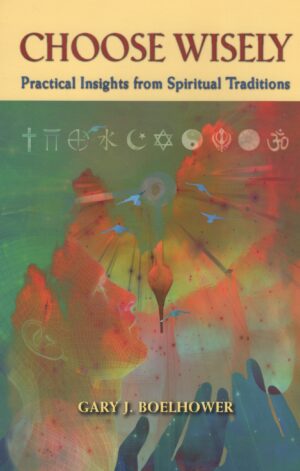
Choose Wisely by Gary J. Boelhower (2013. Pauist Press. ISBN 978-0-8091-4814-1)
I picked up this book at a local arts and crafts fair here in Duluth. I’ve met and chatted with the author, a professor at a local college, on a number of occasions and, having enjoyed his poetry (insert the author’s name in the search bar on this site to see other reviews) so I thought I’d give his prose a try.
Boelhower uses the faith traditions of the world’s major religions (Hinduism, Buddhism, Judaism, Christianity, Confucianism, and Hinduism) to craft a model for both joint (institutional) and individual decision making in a modern world. To do so, he culls five key wisdom principles common to our major faiths to create operating principles and judgmental criteria to assist readers in coming to wise and clearly-thought decisions. The five tenets cited (and used) by the author in crafting his model include:
Respect for all persons;
Appreciation of the wholeness of being human;
Recognizing the interconnectedness of all reality;
Valuing inner wisdom and personal experience;
Attending to preservation and transformation.
The book often times seems directed more to institutional and corporate collaborative thinking than individual problem solving, which is my main criticism of the work. However, Boelhower’s organization and elucidation of his salient points does transfer from group institutional decision making to family, personal, and smaller group transformation through careful discussion, planning, and implementation.
All in all, I came away with, I think, a more thoughtful and kind approach to working with others, both in my family and in my greater world.
4 stars out of 5
Peace
Mark
Posted inUncategorized|Comments Off on A Fine Tutorial
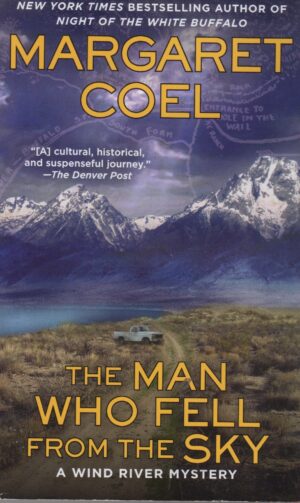
The Man Who Fell from the Sky by Margaret Coel (2015. Penquin. ISBN 978-0-425-28031-7)
I rarely read genre fiction but when assigned this book after my very recent acceptance into a local men’s bookclub, I plunged in eyes wide open. I was hoping, given that Ms. Coel chooses to write Arapaho-inspired crime fiction due to an encounter with the late, great master of Native American detective/police stories, Tony Hillerman, I might learn a bit and also be entertained as I had been by Hillerman’s Joe Leaphorn books. I wasn’t. Here’s why.
As described by the book club member giving us a mini-tutorial on Coel’s life and writing career, the author is a historian by trade who, after listening to Hillerman at a gathering of writers, turned her love of the Arapaho people in Colorado into a series of novels. That background was interesting but what struck me most is that Coel considers herself dedicated to character rather than plot, a departure for most genre specific authors. Generally, writers of mystery tales, detective stories, or police procedurals are driven by a crime and the resulting plot and only briefly touch upon character. So I was surprised to hear that this writer views herself more interested in studying and illuminating the folks who populate her stories. That may be her ambition, her intent, but that’s not how this book played out.
There are two stories here. The first, a present-day murder that takes place on the reservation, leads to speculation by the protagonists, lawyer Vicky Holden and Catholic priest Father John O’Malley that Robert Walking Bear’s death wasn’t an accidental drowning but a murder related to the second story: the legend of a fortune buried in the Colorado hills where infamous hoodlum Butch Cassidy buried loot back near the turn of the 19th century. It’s the historical fiction contained in the Cassidy sections that’s tightly drawn, spurred my interest, and kept me engaged in the book. One of the main issues with the story is that Vicky, a local attorney, is a poor choice to be the foil for the obligatory evil surrounding Walking Bear’s death. She is not a DA, not a criminal defense lawyer, not someone who would naturally be tossed into the mysterious death of a local. She’s a civil attorney and seemingly, as the plot plods along, really doesn’t do all that much in terms of solving the crime other than placing herself smack dab in the killer’s clutches. I disagree with the author: she is not a writer of complex, deep, interesting characters, at least not here. Here, she is the creator of a formulaic genre crime story populated by paper dolls.
Unlike Hillerman, who delved deeply into the culture of the Navaho to explain and detail his plots and characters, Coel doesn’t do a great job of giving the reader insight into Arapahoe culture as it relates to her fictional story. In the end, I agree with a couple of my other book club buddies: this is a beach read, though even in that context, I’ve read better.
Too coincidental and ordinary to compel me to read others in the series and that’s too bad because I do so love Hillerman. Not horribly written but not something that makes a reader go “wow.”
2 and 1/2 stars out of 5
Peace
Mark
Posted inUncategorized|Comments Off on Not Hillerman
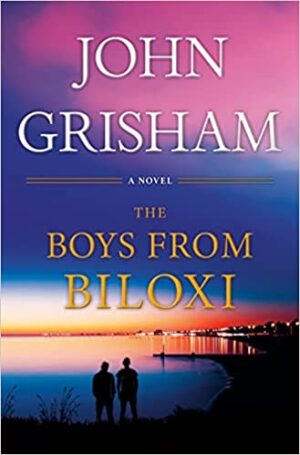
The Boys from Biloxi by John Grisham (2022. Random House Audio)
Here’s the thing. I’m not going to quibble too much about the author, a trained trial lawyer like me, setting up a death penalty case in Mississippi circa mid-1970s without an alternate (or two) on the jury. Maybe he inserted that detail and I missed it while listening to this novel via Audible while walking the track and working out at the local “Y”. Maybe not. There were a couple other instances (like the fact that the District Attorney’s second-in-command, a witness to a fatal bombing, sitting as co-counsel at the bomber’s murder trial) that didn’t ring true. But it’s fiction, right? So I’ll give the dean of trial thrillers a pass.
But what I won’t give the author a pass for is the lack of any real suspense, surprise, or tension within this long saga of the Delta underworld. Oh, I was interested in Jesse, the protagonist DA’s battle to bring sanity, values, and peace to his birthplace by taking on the Dixie Mafia. I also was intrigued to an extent and by some of the antagonists and other supporting characters. But after spending much time setting up the characters for the anticipated twists and turns inherent in Grisham’s best work (e.g., The Firm) once good and evil squared off, other than one unfortunate death (no spoiler here!), this tome plods to a very dull, unsatisfactory conclusion.
The narration is typical for this author and is acceptable genre prose. The dialogue, read by the narrator, is fine. But what this story lacks is heart: a deep-seated, emotional bond created between the book’s fictional characters and the reader. Readable (or listenable) for certain but nowhere near the best of this author’s legal thrillers or those of others in this category. I recently re-watched the movie version of TheVerdict, a faithful rendition of Barry Reed’s classic courtroom drama. That story and The Firm, both on the page and on film, are what we who write legal fiction should strive for. Sadly, this effort falls short of reaching such a such lofty perch on the library shelf.
3 stars out of 5. Not sure if book clubs want to tackle this one or not.
Peace
Mark
Posted inUncategorized|Comments Off on What Happened to Suspense?
From this month’s Finnish American Reporter: writer Mark Munger interviews Finnish-Canadian filmmaker Kelly Saxberg.
MM: I’m assuming, given all the work you’ve done to preserve Finnish Canadian history in your documentaries, that you’re of Finnish descent.
KS: My Finnish heritage is on my father’s side. My great-grandfather, Kustaa Saxberg, immigrated at the end of the 19th century to Fort William. He first started working at Silver Mountain as a miner. Then he met his wife Ida, who was from Himanka and they lived out at the mine site and she was a midwife. When they moved into Fort William (now Thunder Bay) my great-grandmother would host Finnish women from rural communities and helped birth hundreds of children. She was the main midwife for the east end of Fort William, which was home to many immigrants in those days. My great-grandfather, because of his mining experience, helped build the water tunnels from Mount Mackay to Fort William. My grandfather was the youngest child of eight. I made a film about his oldest brother, Alfred Saxberg, who was a veteran of the first World War.
MM: Can you fill the readers about you, about Thunder Bay, and what it means to be a person of Finnish heritage in Thunder Bay in the 21st century?
KS: I was born in Cornwall, Ontario, but my parents moved back to Thunder Bay when I was just a baby so my mother could finish her nursing degree. Then we moved to Brandon and later to Winnipeg, but my family never missed a summer out at Lake Shebandowan, where my grandfather Jack Allen built a log cabin in 1928. When I started in the film industry, my first company was Shebandowan Films now shortened to Shebafilms. Somehow fate brought us back to Thunder Bay in 1996 when my husband Ron Harpelle got a job at Lakehead University teaching history. I had been working in the film industry but since there were no jobs for me in Thunder Bay, I decided to try making my own films. Not long after our success with a few, Ron joined the filmmaking and later, when our children grew up, they too joined the family business. One of the first films I made was “Letters from Karelia” about Finns from North America who were recruited to build a socialist utopia in Stalin’s Karelia. I then made the film “Under The Red Star,” which tells kind of a prequel and is the story of the Finnish Labour Temple.
MM: As a non-Finn, I loved the neighborhood surrounding Hoito and the old Finnish Labour Temple. Tell a bit about the building’s history and the effect of its loss.
KS: My husband and I started Friends of the Finnish Labour Temple as a charity when we were both on the board of the Finlandia Association of Thunder Bay. As the treasurer, I knew how fragile the state of finances were; however, by careful sales of some parking lots, the Kivela Bakery, fundraising, and, new management of the Hoito and its renovation we were able to get everything back in the black. Sadly, a group of people with other agendas were voted in and they had other plans. Within a few years, almost every organization that had helped raise funds for the hall were no longer welcome. Bad management finally led to bankruptcy and the building sold to an outsider who gutted the hall to build condos. A fire started accidentally that winter and it destroyed 110 years of Finnish and labor history in a few hours. Miraculously, the owner was able to demolish the entire building two months later and get every permission to build condos in a building five times the size of the original historic landmark. They claim that they will rebuild the façade, but it just won’t be the same. The owner was the same person who gutted the inside and sent hundreds of historic artifacts to the landfill.
On a positive note Friends of the Finnish Labour Temple is more active than ever. We continue to collaborate with the Finnish community. We have organized two Finn Festivals Canada events and three virtual Juhannus festivals.
MM: One thing I loved about sitting in Hoito was listening to the Finnish voices around me. Do you speak and/or write Finnish?
KS: the first thing I did when I moved to Thunder Bay was to sign up for Finnish language course at the University of Lakehead. I did really well, and now that I have been back-and-forth to Finland and working on several films in Finnish, I have a pretty good ear for the language, but I will never be fluent. I do feel however, a strong connection to my roots and I’m very proud of the countless hours of footage captured of events that I documented over more than a dozen years at the Finnish Labour Temple. My hope is that I will create a virtual website that will rebuild a virtual Finnish Labour Temple.
MM: I recently watched your short film, The Hoito Project. Give the readers some insight into the film.
KS: It was the composer for my film Letters From Karelia, Ari Lahdekorpi, who got me involved in the Finnish Labour Temple. He is an amazing jazz musician, and he was very active in the Finnish community, and had just been elected to the Finlandia Association, when we proposed our very first film festival to be held in 2005 in Finnish Labour Temple. … I have been involved in literally hundreds of fundraising efforts for the Finnish Labour Temple. I don’t regret any of it and we were able to bring Finnish musicians, filmmakers, artists to Thunder Bay to experience the Hoito and the magic of the Big Finn hall and all its legacy.
MM: Describe your background, training, and desire to make films. Where did that passion originate?
KS: I became a filmmaker because of my dad who was a local DJ here in Thunder Bay in the 1950s and early ‘60s. He was the on-air sports Director at CKX in Brandon then got his teaching degree and got a job teaching broadcasting at Tech Voc high school in Winnipeg. As a 12-year-old I was able to go and play with all of the equipment and make videos. I had a babysitting job when I was 14 which allowed me to buy a film camera and projector. When I was 18, I got a job at the local television station doing studio camera for the nightly news and TV show. Later I did sound for the newsroom and learned how to edit. My boss there, then connected me with Lara Mazur at the National Film Board who hired me as an editor trainee. Eventually I started editing NFB films and when I moved to Thunder Bay I decided I wanted to be a director and cinematographer as well. Because we live in a small, isolated community far from Toronto, I also had to become a producer, grant writer and promoter. We helped build a filmmaking community here with our not-for-profit organization, Flash Frame Film and Video Network.
MM: Talk a bit about Under the Red Star and your work with Ron as a collaborator on your films.
KS: “Under The Red Star” was really Ron’s idea and Michel Beaulieu’s research. We wrote up a proposal quickly to the Ontario Arts Council and a new organization that funded films to build an industry in Northern Ontario gave us a grant that enabled us to shoot on 16 mm film and create an amazing historical docudrama that was supported by almost the entire community. The film is also about politics so the people who are on the right-wing spectrum obviously never supported the film, or went to set foot in the “The Big Finn Hall,” which was built by socialists.
The same divisions between red and white are still alive and well in Thunder Bay. Part of the reason for this is because, the most recent Finnish immigrants were obliged by the Canadian government during the Cold War to pledge that they never had been nor ever would become communist. The halls during the war were closed down, because in fact, Canada was at war with Finland, which was a co-belligerent with Germany, and had invaded our ally, the Soviet union. Amazingly all these politics still tend to play out.
Ron was the producer, production manager, actor and helped write the narration for the film. It was a huge project and meant that we had to gain the trust from the local Finnish community. The working title for the film was “Big Finn Hall.” When we showed the film in Finland people were absolutely amazed by the number of Finnish speaking local actors we were able to feature and hire.
MM: Another of your Finnish-themed documentaries is Letters from Karelia. What prompted your interest in the reverse migration of Finns from Canada back to Karelia?
KS: When I first moved to Thunder Bay, I started researching my Finnish heritage and found the story of Rosvall and Voutilainen, and found a book by Varpu Lindstrom called “Defiant Sisters.” I phoned her up and told her I was interested in telling that story and I would like to meet Taimi Davis, who she had been interviewing and documenting for years. I went to Toronto and Varpu gave me all of her research and was keen to help me make films about Finnish immigrants in Canada. It became a labor of love because we didn’t get any positive response for any of our project ideas so we decided we would just make a film about Taimi. Then the letters arrived from her brother, who had gone to Karelia in the 1930s. We learned his fate and in investigating it, we found out the fate of so many others. The project was not really about making a film. It was about telling the stories of people who had been disappeared and murdered.MM: Most readers will likely be familiar with the somewhat pejorative terms, “church Finns” and “hall Finns.” In Under the Red Star, you explore the more radical elements of Finnish political thought.
KS: Varpu Lindstrom‘s work in Defiant Sisters told the story of radical women, Finnish immigrants like Taimi, her mother and Sanna Kannasto. Their stories and struggles were so incredible to me. I felt I needed to shed light on them, and the contribution they made to our country.
My Finnish family were in fact, quite conservative and leaders in the church; however, my great-grandfather and my grandfather were union men and they knew how to fight for workers’ rights. You don’t inherit your politics, and I would say I was drawn to these stories as a historian, and also as a feminist. Looking over my entire career as a filmmaker, I have to say that the majority of my work focuses on strong women and stories that are seldom heard and rarely celebrated.
MM: How do you select a topic for a film? What goes into writing, filming, editing, and distributing documentary films in Canada?
KS: I have a master’s degree in history and my thesis was “Women in Power Structures in Cuba and Nicaragua.” My husband is a Latin Americanist and we have spent a lot of time travelling and living in Latin America. We are both historians and we are both fascinated with labor history and social history. Most of the films we have made stem from the kind of research that we are doing. We are getting old now, and someday might even retire however, we have trained up a dozen or so young filmmakers and artists in Thunder Bay, who will be able to carry on the tradition that we have started.
MM: I recently interviewed your friend Ava Karvonen. She’s working on a feature film and then, likely, looking towards retirement. What are your future plans in terms of projects and life after filmmaking?
KS: I would love to show any of my films at Finn Fest 2023. I am the current chair for the Finnish Canadian Cultural Federation which organizes Canadian Grand Finn festivals. We have had to go virtual for the past three years, so we are really looking forward to participating in a live Finn Festival once again! Right now, Ron and I are on sabbatical in France where we are trying to complete three films which were delayed due to the pandemic, but are nearly complete. We have funding for three more films which are now starting in production. Another huge project connected with Friends of the Finnish Labour Temple has been the digitization of our local 16mm nightly news footage from 1956 to 1979. We created Reel Memories of the Lakehead on Facebook and streaming on www.ResearchTV.ca and are now working on another series called the View From Up Here.
MM: Kiitos!
Posted inUncategorized|Comments Off on Filming the Finns
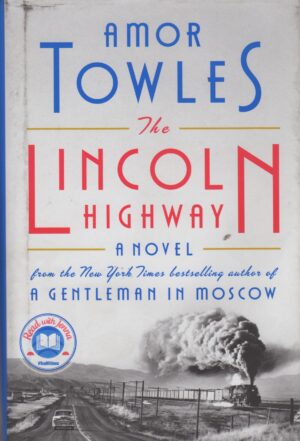
The Lincoln Highway by Amor Towles (2021. Viking. ISBN 978-0-7352-2235-9)
Love it or sort of like it. No one I’ve talked to who’s read this very long, winding epistle from the road, actually hates it. Readers appear to fall into two distinct camps: those who adore the book and those who can take it or leave it. After spending inordinate time slogging through this lengthy tome, I find myself in the later camp.
Towles begins his story in southern Nebraska, not far from the Kansas state line, in the little farming community of Morgan. In the first chapter, we’re introduced to Emmett Watson, eighteen years old, traveling in the back of a car driven by the warden of the reformatory where Emmett did time for manslaughter. At the Watson farm, we meet Emmett’s eight year old brother, Billy, a precociously strange child who is, in a word, a savant genius and wise beyond his years. Shortly after the warden deposits Emmett on the family farmstead, we learn two other inmates from the reformatory; the troublemaking yet lovable Duchess and his affable and nondescript (at least to me) sidekick, Woolly; have hidden themselves in the warden’s car trunk to escape their youthful prison. The patriarch of the Watson family is dead, having failed miserably as a farmer, and so the two boys decide to set out in search of their mother who left the dusty plains for San Francisco years before.
What transpires is a convoluted, unexciting, mundane, slow-moving trip, not west, to California, but east to New York City. I quickly became uninterested in the boys’ journey (the two escapees being part of the drive east on the book’s namesake highway), finding little to pique my interest beyond the insertion of Sally, a local gal who may or may not be Emmitt’s love interest, and the mysterious Preacher, a Black tramp the Watson boys befriend after hoping a train (their car having been “borrowed” by Duchess). It’s not that Towles can’t write. He clearly can. But as a storyteller, the principle job of an author dabbling in fiction, I found the boys’ journey, both literary and descriptive, to be unduly tedious. It took three hundred pages into this long, long saga of nuance for me to say, “OK, there’s enough here for me to see it through.” Not what I’d call a sterling endorsement.
After that, I found myself digging in and enjoying the storyline as all four boys scurried around New York City trying to figure out their collective or separate destinies. But then, in supremely disappointing fashion, as if the writer of this long, meandering road journey ran out of gas, I came to an ending that left me thinking, “What was the fucking point?” Sorry to swear but that’s what I actually said when I closed the cover on this one, folks.
Love it or tolerate it. I didn’t end up hating this book (despite my rant) but the invocation of an eight-year-old genius protagonist began this tale’s long, slow descent into disbelief. From the book’s onset, I couldn’t buy into the character of Billy, one of the four main actors on Towels’s stage. He seems, as I think about the book, a weak attempt by the writer to avoid writing in the guise of a child by cloaking Billy with wisdom, intellect, and insight that, as a dad of four sons, doesn’t ring true no matter how smart the kid is. That strained depiction of character started my questioning of this story, questioning that briefly abated but then became full-blown skepticism when I reached the novel’s uninspired conclusion.
Maybe you will see things differently. Maybe not.
Peace
2 and 1/2 stars out of 5. Book clubs seem to love this novel and I can’t figure out why.
Mark
Posted inUncategorized|Comments Off on Not Quite a Classic
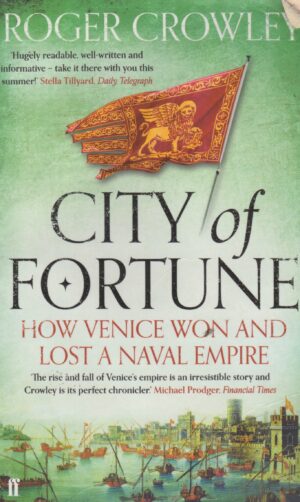
City of Fortune: How Venice Won and Lost a Naval Empire by Roger Crowley (2011. Faber and Faber. ISBN 978-0-571-24595-6)
Having traveled to Venice with friends (at the end of a 12 day Mediterranean cruise) and spent three days taking it all in, I wish I’d read this book before making the trip. While Crowley’s primary emphasis is chronicling-sometimes in agonizingly lush detail that slows the narrative, the military history of an enigmatic republic-he weaves within that storyline enough politics, culture, art, and science to flesh out Venice’s rise and fall as an Adriatic naval power to keep things well-rounded.
Written in a largely crisp and sequential style, the author carefully reconstructs the history of Italy’s most magical and independent city-state from the Crusades to the fall of Constantinople and beyond. Along the way, we are treated to character studies of scoundrels, leaders, admirals, artisans, traitors, and thieves that enrich the overall story arc and strengthen the narrative.
A fine piece of historical writing.
4 stars out of 5
Posted inUncategorized|Comments Off on A Watery Look at the World