
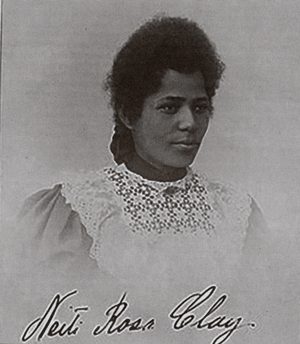
A Forgotten Star
By Mark Munger
Special thanks to friend and dedicated Finnish American Steve Leppälä for handing me The Rosa Lemberg Story by Eva Erickson after sauna at Steve’s place with Steve and Dr. Arne Vainio. Steve’s admonition was, “You need to read this and write about Rosa Lemberg.” Indeed.
First, some perspective.
Despite recent immigration, Finland remains a fairly homogeneous nation. As of 2025, twelve percent of Finland’s population is composed of recent arrivals from Estonia, Russia, Ukraine, Iraq, China, the Philippines, India, Iran, and Somalia. Eleven percent of the current population has a first language other than Finnish, Swedish, or Sámi. Prior to this recent trend, the primary minorities living in Finland were Finn-Swedes, Sámi, and Roma (Kale). But that has changed: the net migration (emigration from Finland versus immigration to Finland) in 2025 was a gain of 31,233 immigrants. This number includes, as indicated, folks who don’t necessarily “look” Finnish and may well be devoted to faiths other than Lutheranism. Why do I bring this up?
Well, to comprehend the unusual story of Rosa Clay Lemberg (also known variously as Rosalina, Rose, and Rocy), one needs to understand the uniqueness of her ethnicity and her heritage. Thankfully, Ms. Eva Erickson, in compiling The Rosa Lemberg Story, spent considerable time evaluating, critiquing, and researching the life of this remarkable woman. Erickson’s study of Rosa includes a detailed reading and analysis of the only memoir of Rosa (Rosalina by Arvo Lindewall: written with Rosa’s assistance and cooperation in Finnish in 1942 and translated into English in 1988.) Building upon that original work, Ms. Erickson allows the unique tale of a young girl born in Africa but raised and educated in Finland to unfold.
In the late 19th century, British colonial official Charles Clay (stationed in Windhoek, Southwest Africa now the capital of Namibia) became romantically involved with a young woman in her late teens. Ferona Sabina Hazara’s mother was a Muslim Arab. Her father was Bantu (indigenous African). Due to Ferona’s skin color she was considered Black or mulatto by the rules of the day. Ferona was also extremely attractive; no doubt the reason Clay fell for her despite whatever taboos were in place prohibiting such a relationship. Predictably, on August 31, 1875, a strikingly beautiful baby girl was born to the couple. That infant was Rosa.
Rosa remained in her unmarried mother’s care for only a brief time. Due to Ferona’s erratic behavior, Clay transferred custody of the child to an English couple. For three years, Rosa was in their care until Clay again transferred his daughter into the care of the Weikkolins; a Finnish missionary couple living in West Africa. When the Weikkonlins returned to Finland, Clay gave them permission to take Rosa, forever severing Rosa’s ties with her birth mother and father.
At the tender age of eight years old, a very dark complected young African girl sailed thousands of miles from her birthplace to (it must be said regarding her perspective) a strange and foreign land. Remember: this was young African/Arab/English girl raised amidst the heat and humidity, the smells and foods and customs, and the unique culture of Southwest Africa who suddenly, and without warning, was thrust into a very white and homogeneous place and people located on the cusp of the Arctic Circle!
The saving grace for the young immigrant was that she was innately smart, clever, and yes, talented. While (according to Lindewall and Erickson) the child had difficulty learning Finnish; she excelled at Swedish and her other studies, accepted Christianity (she was confirmed in the Lutheran church), and eventually entering a teaching seminary in Sortavala. Her time at Sortavala saw her talent for singing gain much attention; so much so, she was called upon to perform solos. Ultimately, she attained her teaching certificate. If that alone was Rosa Clay’s (as she was known then) singular accomplishment as a young, Black immigrant to Finland; if that alone was the ending coda to her saga; it would be miraculous enough. But that was only the beginning of Rosa’s remarkable journey.
Rosa Clay accepted an elementary school teaching position in Mustinlahti but as reported by both authors in their chronicles of her early years in Finland, as a Black living amongst white-skinned Finns, Rosa experienced near-constant discrimination in the form of insults, catcalls, and rejection. The prejudice Rosa faced caused her to become a recluse, to avoid being out in public. Her situation became so awful, she considered returning to Africa. But by then, both her parents were dead. Instead of leaving Finland, she accepted a new teaching position in Tampere and took up additional work as a governess for a local Finnish family. She ultimately became involved with a Russian doctor and was engaged to be married. But shortly before the wedding date, her beau, who was afflicted with mental illness, shot himself. Adrift and alone in a place she was a stranger, Rosa Clay decided to immigrate to America.
Arriving in New York amongst a cavalcade of other folks who, like Rosa, were darkly complected, Rosa discovered Socialism and the city’s Finnish enclave. After her outstanding vocal abilities were “discovered” by the Socialist Association’s choir director, Rosa was cast as the soloist in “The Orphan’s Tears”; a role that caught the attention of young Lauri Lemberg. Lemberg joined the choir and began dating Rosa and the two were married in 1908. Lauri was then hired as the drama director of a small Finn Hall in Ironwood, Michigan. As was typical for the day, Lauri went west first, followed by the now-pregnant Rosa four months later.
What followed was an unhappy, truncated marriage that produced two children. Irja, the daughter, was born in Ironwood in 1908. Shortly after Irja’s birth, Laurie, who was dissatisfied with his life, career, and marriage, accepted another theater job with the Finns of Astoria, Oregon. As Rosa awaited funds to allow her to travel by rail to join her erstwhile husband, she boarded with a Finnish couple on their farm. Eventually, the money arrived and Rosa and her daughter joined Laurie in Oregon. There, Rosa reentered the world she loved best: music and the theater, acting, singing, and performing in many plays her husband directed. Rosa became pregnant again and gave birth to a son, Kalervo “Orvo” in 1910 while her husband was in California searching for his illusive happiness. Laurie returned to Oregon after Orvo’s birth but the couple could not get along, separated, and eventually divorced.
The breakup of Rosa’s marriage marked a new era of freedom for the now famous (at least in Finnish American circles) actress, singer, play and choir director. Laurie didn’t contribute to the health, welfare, or day-to-day raising of the two Lemburg children. Much of the remainder of her story in theater and music, primarily as it involved Socialist Finn Halls in Oregon, Washington, Montana, and Illinois (her final stop on her epic journey of acclaimed vocal and theater work being Chicago) is detailed, in narrative and through copies of playbills, in Ms. Erickson’s book. Throughout her long involvement with Finn Halls no matter the locale, Rosa remained active in the Socialist cause. She also returned, from time to time, to her first love: teaching children. Unlike her experiences in Finland, Rosa’s dark skin didn’t affect the respect and admiration shown her by her Finnish American students. Once Mrs. Lemberg’s students heard her flawless Finnish (and interacted with her as a teacher) the children and their parents readily appreciated the genius behind the woman.
For his part, Laurie Lemberg drifted across Finnish America directing Socialist-inspired plays and musicals. To make ends meet, he also took up a trade. After his divorce from Rosa was finalized and he remarried, Laurie Lemberg became a typesetter for various newspapers (Butte, Seatle, and Portland are mentioned in Rosa). But he never gave up his love for theater and music. At the time of his death (Duluth, Minnesota in 1965) Lemberg was still involved in the arts, having started a “play rental service” in Duluth that was active at the time his passing. Though not regularly involved with his children and having provided little financial support to Rosa after their divorce, Laurie did maintain some contact with his daughter and his son. Orvo recalls living with his father and his step-mother in Montana, Oregon, and Washington at various times during his youth. No similar statement is recorded regarding Irja, who followed her mother’s lead and became active in Finnish American theater.
The real story behind Rosa Clay Lemberg is, to use a word I too often associate with folks of Finnish lineage or heritage (here, by adoption!), her sisu. Her resilience.
Think about the journey a young mixed-race girl of African features found herself on from an early age. As a child, she was taken from her mother (reportedly only seeing her once thereafter) and sent by her father from equatorial Africa to an unfamiliar place of cold and darkness, and yes, reindeer and snow! Despite losing her mother and her father, Rosa excelled in her new home and learned a very complex and difficult language to become an educator. Propelled by discrimination and leers and untoward comments, the young teacher left her adopted home for another strange, foreign, far-off place: America. Using her native talents, keen intellect, and resourcefulness, Rosa prevailed in Finnish America to become a household name despite being cast adrift with two little children by a husband infected with wanderlust.
Near the end of her life, Rosa was brought by her children and her friends to a rest home in Covington, Michigan. In 1959, Rosa Clay Lembrg, who never remarried, died in her sleep not far from the place where she fell in love.
Through Eva Erickson’s and Arvo Lindewall’s excellent reportage (and Steve Leppälä’s urging) I’m so glad I became acquainted with this unique woman. I hope you agree she’s someone worth knowing and remembering.
(This essay first appeared in the September 2026 issue of the Finnish American Reporter. (c) 2026 Mark Munger.)